

How to Detect and Reduce Bias in Machine Learning Models
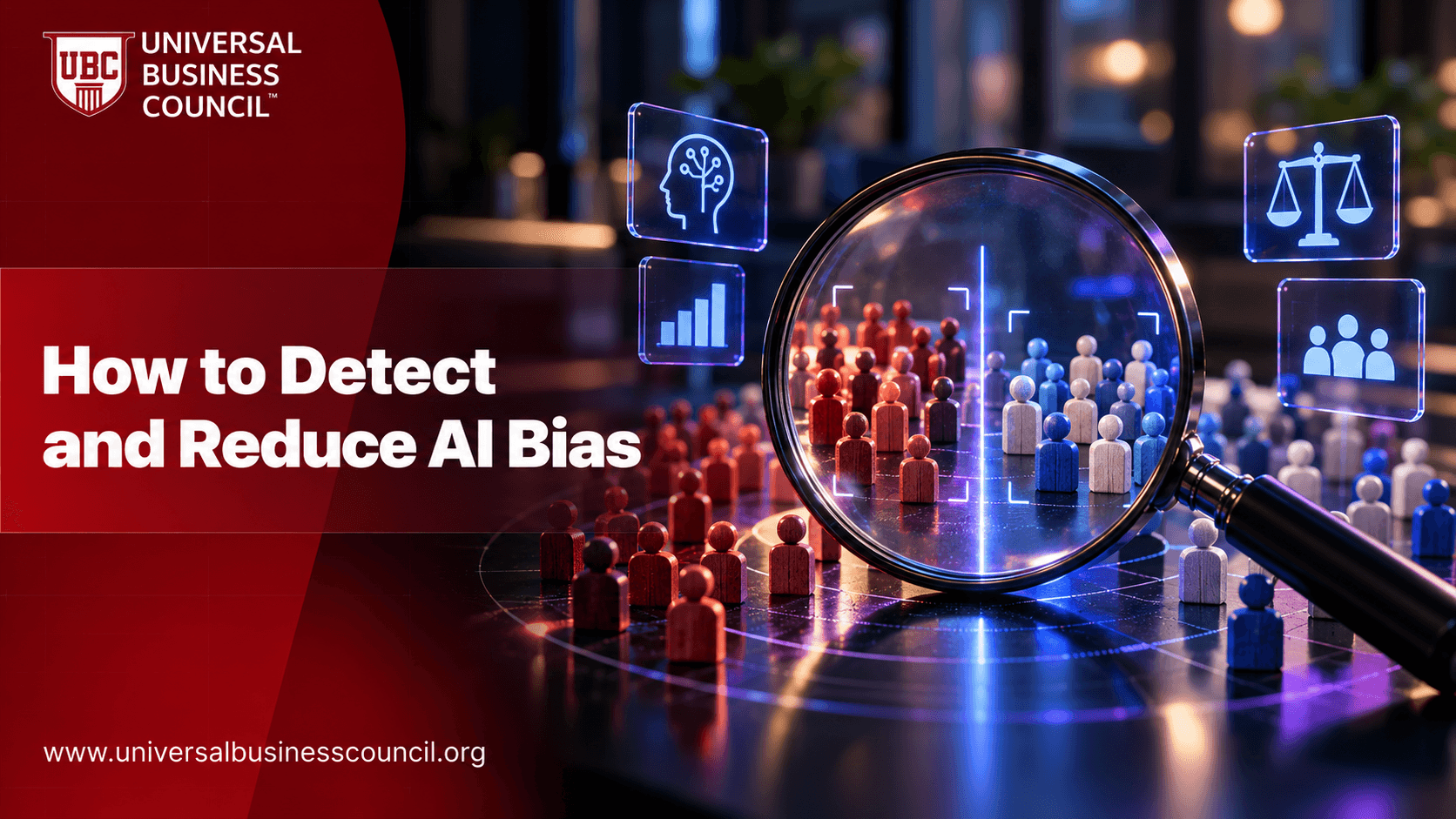
Bias in machine learning models rarely shows up in accuracy scores. A model can reach 95 percent accuracy overall and still fail badly for a smaller group, because the average hides the gaps. Finding and fixing those gaps takes specific tests, specific tools and a clear process.
This guide explains how to detect and reduce bias in machine learning models, from data checks and fairness metrics to mitigation techniques and monitoring. If you're building skills in this area, the Certified Responsible AI Expert certification from Universal Business Council is a structured option to consider. The sections below follow the machine learning lifecycle step by step.

What does bias in a machine learning model look like?
Bias in a model means it produces systematically different or unfair outcomes for different groups of people. It may appear as different error rates, different approval rates or different score distributions. For example, a loan model might reject qualified applicants from one group more often, or a screening model might miss disease more often in one patient population.
Bias can enter at any stage: in the data that is collected, in how labels are defined, in feature selection, in the training objective, in the decision threshold and in how people use the output. That's why detection and reduction need to cover the whole lifecycle, not just the final model.
Step 1: Define the context and the groups
Start by clarifying what decision the model supports, who is affected and which groups matter. Groups might include gender, race, age, disability status, language or region, depending on the use case and the law. Also consider intersections, such as older women or younger people with disabilities, because bias can hide there even when each group looks fine alone.
If you don't hold sensitive attributes, you may need privacy-protective ways to estimate group differences or to run tests on a separate evaluation set. Consult legal and privacy colleagues, since rules about collecting and using such data vary.
Step 2: Detect bias in the data
Check representation: how many examples exist for each group, and do they match the population the model will serve?
Look at label quality: were labels created by human judgments that may reflect bias?
Examine historical outcomes: does past decision-making show unequal patterns the model could learn?
Search for proxies: which features correlate strongly with sensitive attributes?
Check missing data: are values missing more often for some groups?
Step 3: Detect bias in model performance
Slice your evaluation
Report metrics for each group, not just overall. Look at accuracy, false positive rate, false negative rate, precision and recall by group. Beware small samples, which can make differences look larger or smaller than they are, and report uncertainty where you can.
Use fairness metrics
Different metrics capture different ideas of fairness:
Selection rate or demographic parity compares the share of each group receiving a positive outcome
Disparate impact ratio compares those rates, and the four-fifths rule used in U.S. employment guidance treats a ratio below 0.8 as a warning sign
Equal opportunity compares true positive rates across groups
Equalized odds compares both true positive and false positive rates
Calibration checks whether predicted probabilities mean the same thing for each group
Not all metrics can be satisfied at once, so choose based on the harm you most want to avoid and document the choice.
Explain the model's behavior
Explainability tools such as SHAP and LIME show which features drive predictions. If a proxy feature carries heavy weight, that is a signal to investigate. Tools like Fairlearn, AI Fairness 360 and the What-If Tool help run these checks, and short tech certifications in programming and data science can make them easier to use.
Step 4: Reduce bias with mitigation techniques
Mitigation methods are usually grouped by when they act.
Pre-processing methods
These adjust the data before training. Examples include collecting more representative data, rebalancing or reweighting examples, removing or transforming problematic features and fixing label problems at the source. Data work is often the most effective and least risky fix.
In-processing methods
These change the training process. Fairness constraints, regularization terms and adversarial approaches push the model to perform more evenly across groups while still learning the task. They can involve a trade-off with overall accuracy, which should be measured and discussed openly.
Post-processing methods
These adjust predictions after training, for example by setting group-specific thresholds or adding a reject option that sends borderline cases to human review. Check legal advice first, because group-specific treatment may be restricted in some settings, such as certain employment and lending decisions.
Process and people fixes
Add human review for high-stakes decisions
Use diverse review teams and consult affected communities
Offer appeals and clear explanations
Document data, choices and limits in model cards and data sheets
Step 5: Monitor after deployment
Bias can change over time. Data drift, new user groups and feedback loops can reintroduce problems after launch. Track group-level metrics in production, set alert thresholds, review incidents and re-test after major updates. Assign a named owner so monitoring doesn't fall through the cracks.
Governance depends on people with the right skills. Organizations often check credentials and work history before adding auditors, data scientists or compliance staff to sensitive AI work, and services like HireValid can help with that verification. Clear communication about testing also matters, and a Digital Marketing Course can help teams describe their fairness work accurately without overclaiming. For wider technology context, Deep Tech Certifications cover AI and related fields.
A quick checklist
Define the decision, groups and harms.
Audit data for representation, labels and proxies.
Evaluate performance and fairness metrics by group.
Explain feature influence and review proxies.
Apply pre-, in- or post-processing mitigation, and test again.
Add oversight, documentation and appeals.
Monitor in production and re-audit regularly.
Conclusion
To detect and reduce bias in machine learning models, look beyond overall accuracy. Examine data, slice performance by group, use fairness metrics that fit the harm you want to avoid, apply mitigation at the data, training or output stage and keep monitoring after launch. No technique removes bias entirely, but a documented and repeatable process makes it far easier to find problems early.
Start with one high-impact model, run group-level tests and share the findings with your team. The FAQs below answer common questions.
Frequently asked questions
How do you detect bias in a machine learning model?
Compare performance and outcomes across groups using fairness metrics and sliced evaluation.
What are common fairness metrics?
Demographic parity, equal opportunity, equalized odds, disparate impact and calibration.
What is the four-fifths rule?
A U.S. guideline that flags a selection rate for one group below 80 percent of the highest group's rate.
What is demographic parity?
Equal rates of positive outcomes across groups.
What is equalized odds?
Equal true positive and false positive rates across groups.
Can all fairness metrics be met at once?
Usually not, so choose based on context and document trade-offs.
What is a proxy variable?
A feature that indirectly encodes a sensitive attribute.
Does removing sensitive features fix bias?
Not on its own, since proxies can carry the same information.
What is pre-processing mitigation?
Fixing bias in the data before training, such as rebalancing or reweighting.
What is in-processing mitigation?
Changing the training objective or constraints to encourage fairer outcomes.
What is post-processing mitigation?
Adjusting predictions or thresholds after training.
Does bias mitigation reduce accuracy?
Sometimes slightly, but often it improves real-world reliability.
Which tools help with fairness testing?
Fairlearn, AI Fairness 360, the What-If Tool, SHAP and LIME.
What is intersectional bias?
Bias affecting people in combined groups, like older women, that may not appear in single-group tests.
How much data do I need per group?
Enough to measure reliably. Small samples need caution and uncertainty estimates.
Is it legal to use sensitive attributes in testing?
It depends on jurisdiction and use, so consult legal and privacy teams.
What is a model card?
A document summarizing a model's purpose, data, performance and limits.
How often should I re-test for bias?
Regularly in production and after any major change to data, model or context.
Can human review reduce bias?
It can help in high-stakes cases, but reviewers need training to avoid automation bias.
Where should teams start?
Pick one high-impact model, define groups and harms and run group-level evaluation.
Related Articles
View AllArtificial Intelligence
Jev vs Machine Learning Models
Compare Jev with traditional machine learning models and explore how typed decisions, calibrated probabilities, structured outputs, and automation-focused workflows set Jev apart.
Artificial Intelligence
AI Models for Machine Decision Making
Explore AI models for machine decision making, including how they evaluate data, generate predictions, assign scores, and support automated actions across software systems.
Artificial Intelligence
What Is Algorithmic Bias? Causes, Examples and Prevention Strategies
Learn what algorithmic bias is, explore its common causes, and discover real-world examples of biased AI systems. Understand how data quality, model design, and decision-making can contribute to bias, along with practical strategies for identifying, reducing, and preventing algorithmic bias.
Trending Articles
The Role of Blockchain in Ethical AI Development
How blockchain technology is being used to promote transparency and accountability in artificial intelligence systems.
AWS Career Roadmap
A step-by-step guide to building a successful career in Amazon Web Services cloud computing.
Top 5 DeFi Platforms
Explore the leading decentralized finance platforms and what makes each one unique in the evolving DeFi landscape.