

What Is TimesFM 3.0? Meet Google's AI Forecasting Model
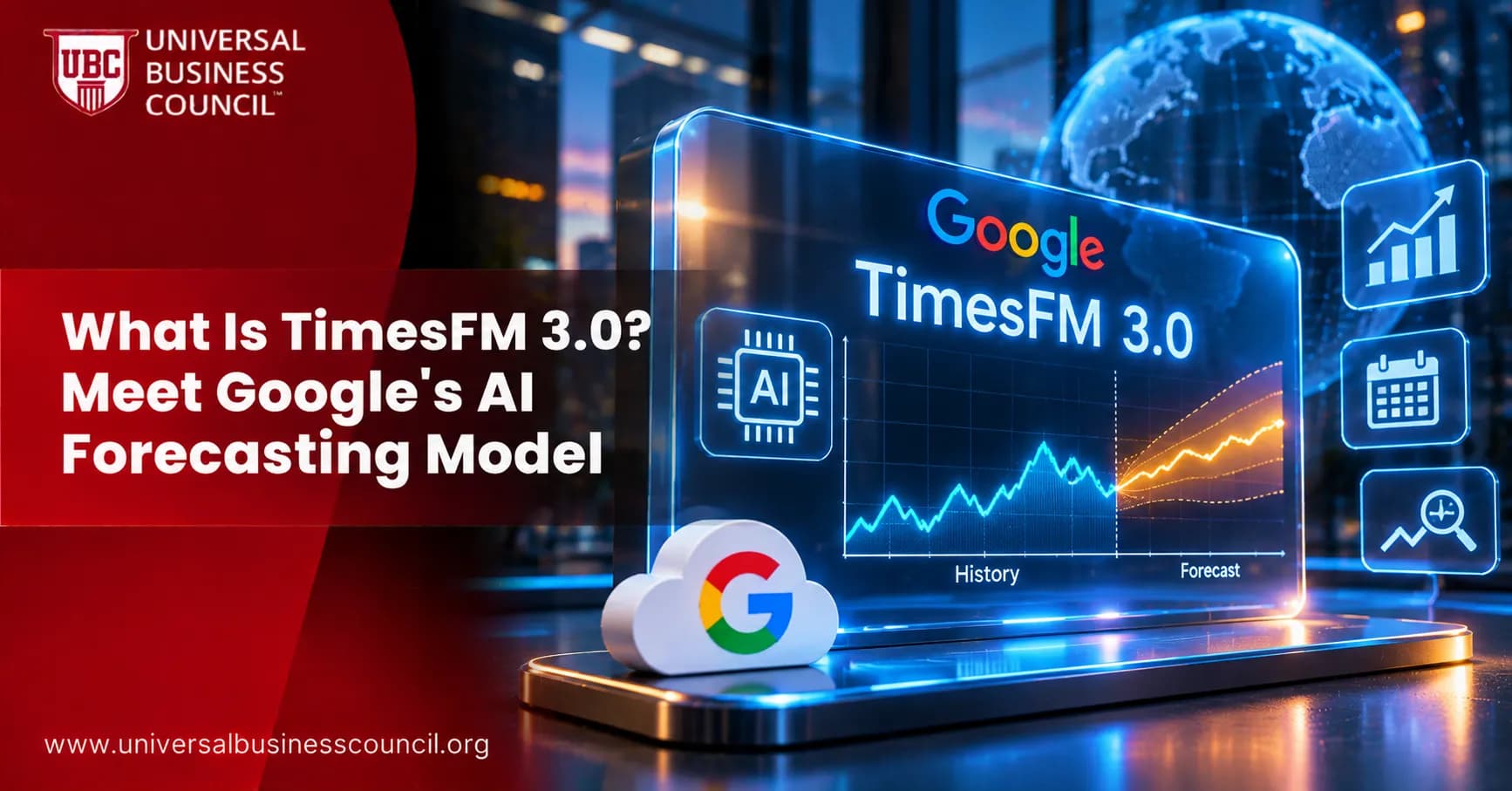
TimesFM 3.0 is a forecasting model from Google Research that predicts future numbers, such as sales, traffic, or energy use, without being trained on your data first. It was announced in August 2026 and is the first TimesFM generation built from the start to read several related data series at once.
Forecasts shape almost every business choice. A store decides how much stock to order, a utility plans for tomorrow’s power demand, and a growth team estimates next month’s leads. Until recently, getting reliable predictions meant building a custom model for each problem. This guide explains what the model is, how it works, how it compares with its predecessor, and how you can try it. It is written for beginners, yet it keeps enough detail for analysts and engineers. Even marketers can benefit, since better demand forecasts improve campaign timing, and a Marketing Certification can help professionals link data insights to growth strategy.

What Is TimesFM 3.0?
TimesFM stands for Time Series Foundation Model. A time series is a list of values recorded in order over time, such as daily sales or hourly temperatures. A foundation model is a large pretrained model that can be reused for many jobs rather than built for one.
The latest version has 330 million parameters, the internal numbers a neural network adjusts while it learns. Google Research pretrained it on real and synthetic data that adds up to more than 1 trillion time points. The Hugging Face model card says the training mix includes the GiftEvalPretrain collection, Wikipedia page views, Google Trends queries, and synthetic data.
Because the model has already seen so many patterns, it can forecast a new series “zero-shot.” That means you give it your history and it returns predictions without any extra training.
The biggest change is native multivariate forecasting. Versions up to TimesFM 2.5, released in September 2025, looked at only one series at a time. The new model can read several related series together and can also use outside clues such as weather forecasts, holidays, and planned promotions.
Quick Facts
Developer: Google Research
Announced: August 2026
Size: 330 million parameters
Training data: More than 1 trillion time points
Design: Decoder-only transformer
Core skill: Zero-shot univariate and multivariate forecasting
Access: BigQuery, GitHub, and Hugging Face
Why Older Forecasting Methods Fell Short
To see why this release matters, look at how forecasting used to work. Classic statistical tools such as ARIMA needed an expert to choose settings for each dataset. Machine learning approaches often needed long histories, hand-made features, and retraining whenever the world changed.
At scale, that workload becomes heavy. A retailer with thousands of products in hundreds of stores would need thousands of tuned models. Many small teams skip proper forecasting and fall back on simple averages.
Foundation models offer a different path. Large language models learned many writing skills by reading huge amounts of text. TimesFM applies that same idea to numbers. It studies a vast library of series from many fields, then carries general knowledge into your problem. People who want to work with such systems can explore a range of Artificial Intelligence Certifications to build skills in machine learning, model deployment, and responsible AI.
Real Problems Have Many Moving Parts
Real forecasting is rarely about one line of numbers. Google Research illustrates this with an ice cream example. Past sales alone do not tell the full story. A strong forecast also draws on sales of related items like cones and syrups, foot traffic, weather, promotions, and holidays. The new model was designed for exactly this kind of situation.
How Does TimesFM 3.0 Work?
Inside, the model uses a decoder-only transformer, the same broad design family behind many modern language models. Based on the Google Research announcement, the process can be explained in four steps.
Step 1: Cut the Data into Patches
The model does not read one number at a time. It groups neighboring values into patches of 32 time steps. You can think of each patch as a word in a sentence. This speeds up processing and helps the model notice short shapes, such as a weekly rhythm.
It also normalizes each series. One series may count millions of dollars while another counts a handful of units. Normalizing puts them on a similar scale so the model compares patterns rather than raw size.
Step 2: Add Extra Signals
A covariate is any additional series that helps explain what you want to predict. The model supports three kinds of input:
Multiple targets: Several related series are forecast together, such as different ice cream brands.
Past covariates: Signals known only for history, such as earlier foot traffic.
Past-future covariates: Signals known ahead of time, such as holidays, weather forecasts, or planned promotions.
For future-known signals, the model uses a lookahead design. Each token joins the current patch with upcoming patches, so the model can see scheduled events before they happen.
Step 3: Alternate Two Kinds of Attention
The patches then pass through a stack of transformer layers arranged like a grid. Two kinds of attention take turns:
Causal temporal attention: Each token looks back through time inside its own series. It cannot look forward, which prevents data leakage.
Full variate attention: At each moment, tokens look across all series. This helps the model learn how one series affects another, such as a promotion on one product shifting sales of a neighbor.
The Hugging Face model card lists 20 transformer layers, a model dimension of 1280, and 16 attention heads.
Step 4: Predict the Whole Future at Once
Earlier versions produced forecasts one patch at a time and fed each result back in as input. That loop adds delay and lets small errors snowball. The newest model uses Contiguous Patch Masking to generate the full forecast horizon in a single forward pass.
It adds blank placeholder tokens for the future beside the known history. Targets and past-only covariates stay hidden in the future because their values are unknown. Future-known covariates stay visible. The attention layers then fill every future patch at the same time.
The output is more than one line. The model predicts nine quantiles, from the 10th to the 90th percentile, for each target at every step. A quantile marks a point below which a given share of outcomes is expected to fall, so you receive a range of likely results instead of one fragile guess.
Tools like this sit on top of a broad mix of skills in data, cloud computing, and software. Learners who want to build that wider foundation can consider a general Tech Certification to strengthen their technical profile.
Standout Features
Zero-shot forecasting. Send in your history and get predictions without training anything. This lowers the barrier for teams that lack machine learning specialists.
Built for multivariate data. The model was pretrained for multivariate tasks from the start rather than patched later.
Uncertainty included. Nine quantiles show the range of possible outcomes, which helps with stock levels, staffing, and budgets.
Quick predictions. Producing the entire horizon in one pass cuts delay and avoids compounding errors.
Small footprint. At 330 million parameters, it is far lighter than a large language model, so memory and storage needs stay modest.
TimesFM 3.0 vs TimesFM 2.5
Feature | TimesFM 2.5 | TimesFM 3.0 |
|---|---|---|
Forecasting scope | Univariate only | Univariate and multivariate |
Target columns | One | One or several |
Past-only covariates | Not supported | Supported |
Past and future covariates | Not supported | Supported |
Decoding style | Patch by patch | Full horizon in one pass |
Parameters | About 200 million | 330 million |
Google Cloud states that existing BigQuery workflows can gain the higher accuracy by simply choosing the new model name, so no rewrite is needed.
How Well Does It Perform?
Google Research tested the model on three public benchmarks: GIFT-Eval, FEV-Bench, and TIME. On all three, it ranks first among pretrained foundation models for both point forecasts and probabilistic forecasts. The comparison included recent models such as Chronos-2 and the Toto 2.0 family, plus TimesFM 2.5.
One detail stands out. Google shows two results for the new model. In univariate mode, where it ignores covariates and other series, it already matches or beats rivals. In full multivariate mode, it improves further. This suggests the gain comes from both stronger base forecasting and the new ability to use extra information.
Keep one caution in mind. Benchmark rankings rely on public datasets and Google’s own reporting. Your data may behave differently, so test the model against your own history and against a simple baseline before you trust it.
Real-World Uses
Because it works on any numeric sequence, the model fits many fields.
Retail demand planning: Forecast sales while accounting for promotions and holidays. In Google’s example, a promotion schedule lets the model anticipate a lift of roughly 20% on promotion days, which a single-series forecast misses.
Transportation: The BigQuery announcement forecasts commuter and casual bike rides together using New York Citi Bike data, capturing shared weather effects and different weekend habits.
Energy: Predict electricity load using temperature forecasts and calendar effects.
Finance and operations: Plan cash flow, call center volume, or support tickets.
Anomaly detection: Compare real values against predicted ranges to flag unusual behavior. BigQuery also offers anomaly detection with this model.
Capacity planning: Estimate traffic for websites and apps ahead of launches.
How to Try TimesFM 3.0
There are two main routes, depending on your goal.
Route 1: Use It Inside BigQuery
The simplest path is Google Cloud BigQuery. Google announced a preview of the model there on October 12, 2026. You call it with the AI.FORECAST function and set the model to ‘TimesFM 3.0’. No hosting or training is required.
For multivariate work, three inputs matter:
TARGET_COLS: The series you want to predict
PAST_COVARIATE_COLS: Signals known only for the past
FUTURE_COVARIATE_COLS: Signals known for the future as well
Everything goes into a single table. Historical rows are fully filled in. Future rows contain only the known future signals, while target and past-only columns stay NULL. The output returns a forecast value with lower and upper prediction bounds for each target. You can also ask for forecasts in plain English through BigQuery Conversational Analytics, which writes the query for you.
Route 2: Run the Open Checkpoint
Developers can download google/timesfm-3.0-pytorch from Hugging Face and follow the code in the official GitHub repository. The repository includes a forecaster interface that supports univariate or multivariate input with past-only and past-future covariates. This route suits research and learning. Read the licensing section first.
What Does the License Allow?
Licensing deserves attention. The official GitHub repository says the TimesFM 3.0 pretrained weights come under a separate non-commercial license, limited to non-commercial and non-production use. The same page states that commercial and production use is fully permitted through authorized Google Cloud services, including BigQuery ML, under the Google Cloud Terms of Service.
In plain words, students and researchers can experiment with downloaded weights. Companies that need production forecasts should use the managed Google Cloud route. Always read the current license before building a product, since terms can change.
Limits to Keep in Mind
No forecasting model is perfect, and careful planning means knowing the weak spots.
The future can surprise you. Sudden events that no history reflects can break any forecast. The prediction ranges are a reminder that uncertainty is normal.
Inputs must be trustworthy. If a weather forecast or promotion plan is wrong, the prediction will carry that error.
Zero-shot is a starting point. Unusual or specialized data may still call for cleaning, domain knowledge, and comparison with simpler methods.
Preview status matters. The BigQuery feature is in preview, so check the documentation before building critical systems on it.
Local testing is essential. Strong public rankings do not guarantee the best result on every private dataset.
Where Time Series Foundation Models Go Next
This release shows the direction of the field. Forecasting is moving from many small custom models toward one general model that handles many tasks well. Adding native multivariate input also brings the technology closer to how businesses think, where many factors act at the same time.
For learners, this is a good moment to build skills in AI, data, and cloud platforms. Practice with public datasets, read official documentation, and compare results against simple baselines to build real judgment.
Conclusion
TimesFM 3.0 is Google Research’s multivariate time series foundation model. It has 330 million parameters, learned from more than a trillion time points, and forecasts new data without retraining. Patching, alternating attention, and single-pass decoding let it read several series and outside signals together and return a full range of likely outcomes. It leads three major public benchmarks, and you can try it in BigQuery or through the open checkpoint for non-commercial work.
Start small, test it on your own data, and measure it against a simple baseline. For professionals who want to explore the wider world of emerging technology beyond forecasting, a Deep Tech Certification can be a useful next step.
Official Sources
TimesFM-3: A zero-shot foundation model for multivariate forecasting (Google Research)
Introducing TimesFM 3.0 with multivariate time-series forecasting in BigQuery (Google Cloud Blog)
FAQs
1. What is TimesFM 3.0?
TimesFM 3.0 is a time-series foundation model developed by Google Research. It uses artificial intelligence to analyse historical data, recognise patterns, and predict future values. The model supports forecasting applications across industries such as finance, retail, healthcare, energy, and manufacturing.
2. Who developed Google TimesFM 3.0?
TimesFM 3.0 was developed by Google Research as part of its work on foundation models for time-series forecasting. It builds on Google's research into pretrained AI systems that can understand temporal patterns and generate predictions across different datasets.
3. What does TimesFM stand for?
TimesFM stands for Time Series Foundation Model. It refers to an AI model designed to understand data collected over time and use previously learned patterns to forecast future outcomes.
4. How does TimesFM 3.0 work?
TimesFM 3.0 uses a Transformer-based architecture to process time-series information. It analyses historical observations, identifies temporal patterns, and generates predictions. It can also incorporate related variables, such as seasonal trends, promotions, and other external factors.
5. What makes TimesFM 3.0 different from traditional forecasting models?
Traditional forecasting models often require separate training and configuration for individual tasks. TimesFM 3.0 uses pretrained knowledge to support zero-shot forecasting and multivariate predictions, allowing users to apply it to different datasets with less task-specific development.
6. How many parameters does TimesFM 3.0 contain?
TimesFM 3.0 contains approximately 330 million parameters. Google Research reports that it was pretrained using more than one trillion time points from real-world and synthetic datasets, helping it learn patterns across diverse forecasting problems.
7. What is zero-shot forecasting in TimesFM 3.0?
Zero-shot forecasting allows TimesFM 3.0 to generate predictions for new datasets without requiring task-specific training or fine-tuning. This makes it easier to apply pretrained forecasting capabilities to different business and research applications.
8. What is multivariate forecasting in TimesFM 3.0?
Multivariate forecasting involves predicting multiple related time series simultaneously. For example, a retailer can forecast sales across several product categories while considering shared influences such as customer demand, promotions, and seasonal changes.
9. What are covariates in TimesFM 3.0?
Covariates are additional variables that provide useful information for forecasting. TimesFM 3.0 supports historical and future covariates, including weather records, promotional schedules, holidays, and other factors that may influence future outcomes.
10. What role does Transformer architecture play in TimesFM 3.0?
The Transformer architecture helps TimesFM 3.0 identify relationships and patterns within historical data. Its attention mechanisms allow the model to process temporal information and understand connections between different variables when generating forecasts.
11. Can TimesFM 3.0 predict future business sales?
Yes. Businesses can use TimesFM 3.0 to analyse historical sales, customer activity, seasonal demand, and promotional data. These insights can support inventory planning, purchasing decisions, and demand forecasting.
12. Can TimesFM 3.0 be used for financial forecasting?
Yes. TimesFM 3.0 can support forecasting tasks involving financial indicators, revenue, expenses, and other time-dependent financial data. However, predictions should be evaluated carefully because financial markets are influenced by unpredictable events and changing economic conditions.
13. How does Google BigQuery integrate TimesFM 3.0?
Google BigQuery provides forecasting capabilities through the AI.FORECAST SQL function. Users can generate predictions directly from their datasets without building and maintaining a separate machine learning pipeline.
14. Can beginners use TimesFM 3.0?
Users with basic SQL knowledge can access its forecasting capabilities through BigQuery. Conversational analytics features can also make forecasting more accessible through natural-language instructions. However, understanding data preparation and prediction results remains important.
15. What are probabilistic forecasts in TimesFM 3.0?
Probabilistic forecasts provide a range of possible future outcomes instead of presenting only one predicted value. TimesFM 3.0 supports quantile predictions, helping organisations understand uncertainty and evaluate different scenarios.
16. Which industries can benefit from TimesFM 3.0?
TimesFM 3.0 can support forecasting applications across several industries:
Retail: Predicting product demand and inventory requirements.
Finance: Analysing financial indicators and business performance.
Healthcare: Supporting operational and resource planning.
Manufacturing: Forecasting production requirements.
Energy: Estimating electricity demand.
Logistics: Planning transportation and supply chains.
17. How accurate is Google's TimesFM 3.0?
Google Research reports strong results across major forecasting benchmarks, including GIFT-Eval, FEV-Bench, and TIME. However, actual forecasting accuracy depends on data quality, prediction horizons, industry requirements, and the specific task.
18. Is TimesFM 3.0 open source?
Google has made TimesFM 3.0's source code and pretrained model weights publicly available through repositories such as GitHub and Hugging Face. However, its pretrained weights are distributed under a non-commercial licence. Businesses should review the applicable licensing terms before using the model commercially.
19. What are the limitations of TimesFM 3.0?
TimesFM 3.0 cannot guarantee accurate predictions in every situation. Unexpected events, incomplete datasets, changing market conditions, and unreliable input variables can affect forecasting results. Organisations should validate predictions against actual outcomes before making important decisions.
20. What is the future of AI forecasting with TimesFM 3.0?
TimesFM 3.0 represents an important development in AI-powered predictive analytics. Its multivariate forecasting capabilities and cloud integration could help businesses improve planning, identify trends, and make data-driven decisions. Continued improvements in foundation models may make advanced forecasting more accessible across industries.
Related Articles
View All
Artificial Intelligence
AI Model Cards Explained: Documentation for Responsible AI Systems
Learn what AI model cards are and how they support responsible AI development through clear and structured documentation. Explore the key information they contain, including model purpose, performance, limitations, intended use, risks, and evaluation results, and how they improve transparency and accountability.
Artificial Intelligence
Responsible AI Maturity Model: How to Assess Your Organization's Readiness
Explore the Responsible AI Maturity Model and how organizations can assess their progress toward ethical, transparent, and accountable AI adoption. Learn about key maturity levels, assessment criteria, governance practices, and the steps needed to strengthen responsible AI capabilities.

Artificial Intelligence
Differential Privacy in AI: A Practical Guide for Organizations
Learn how differential privacy helps organizations protect sensitive information while developing and using AI systems. Explore how it works, key techniques, privacy budgets, practical applications, implementation challenges, and how businesses can use it to strengthen data protection and responsible AI practices.
Trending Articles
The Role of Blockchain in Ethical AI Development
How blockchain technology is being used to promote transparency and accountability in artificial intelligence systems.
AWS Career Roadmap
A step-by-step guide to building a successful career in Amazon Web Services cloud computing.
Top 5 DeFi Platforms
Explore the leading decentralized finance platforms and what makes each one unique in the evolving DeFi landscape.