

Differential Privacy in AI: A Practical Guide for Organizations
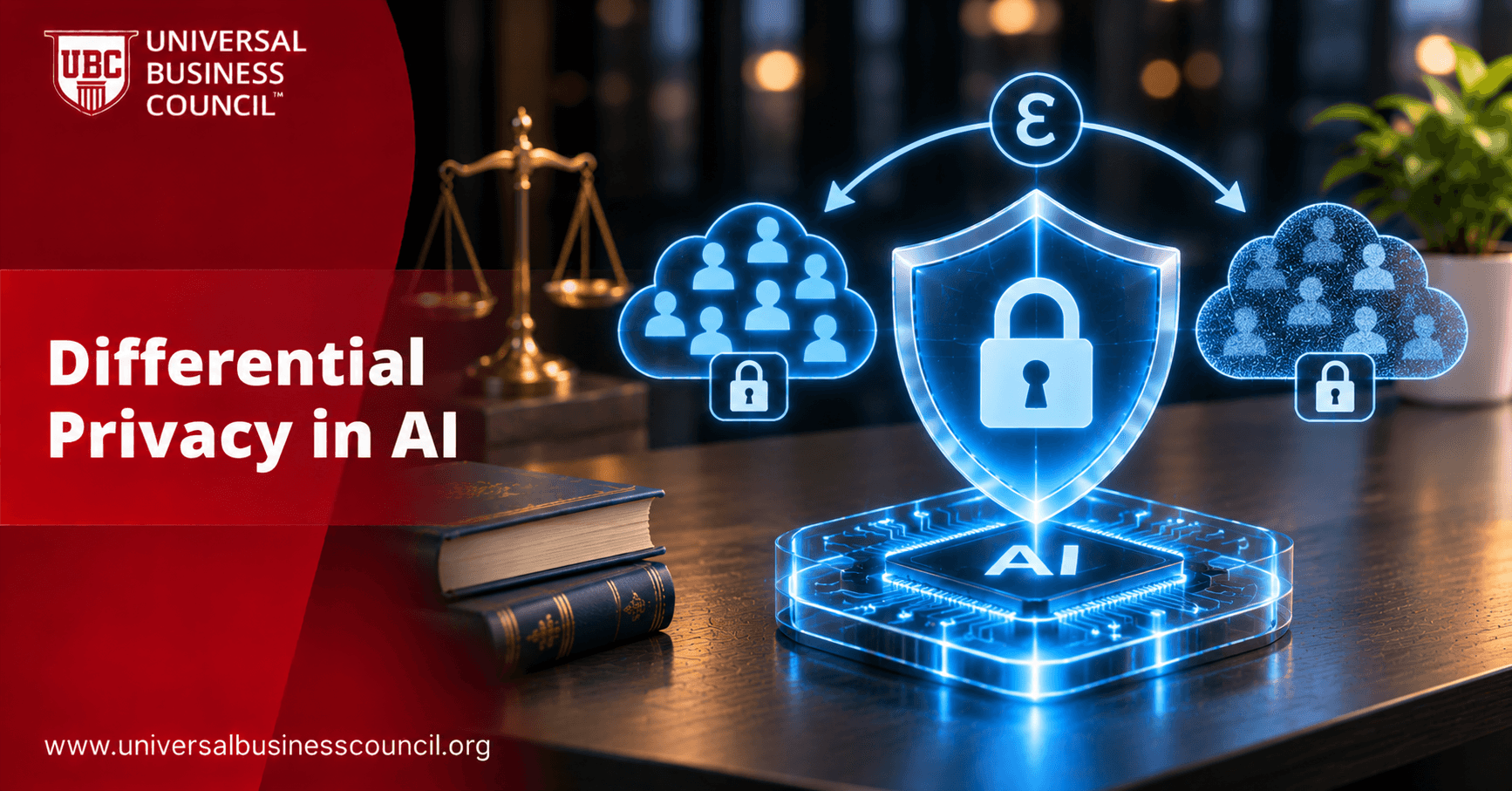
Removing names from a dataset does not make it anonymous, and publishing averages does not make it safe. Differential privacy offers something stronger: a mathematical limit on what anyone can learn about a single person from the results of an analysis or a trained model. For organizations handling sensitive data, it is one of the most rigorous privacy tools available.
This practical guide explains what differential privacy is, how it works, where it is used in AI, how to implement it and what to watch for. Readers who want a wider grounding in responsible AI may also explore the Certified Responsible AI Expert certification from Universal Business Council.

What Is Differential Privacy?
Differential privacy (DP) is a framework for sharing information about a dataset while limiting what can be inferred about any individual in it. A computation is differentially private if its output looks almost the same whether or not any one person's data is included. That means an observer cannot confidently tell whether a particular person took part, which protects against many attacks, including membership inference and attempts to link records with outside information.
The idea was formalized by Cynthia Dwork and colleagues in 2006. It has since been adopted by organizations such as national statistical agencies and large technology companies for publishing statistics and collecting usage data.
How It Works
Noise and the Privacy Budget
DP works by adding carefully calibrated random noise. The amount depends on how much one person's data could change the result, called sensitivity, and on a privacy parameter, usually written epsilon. A smaller epsilon means stronger privacy and more noise, while a larger epsilon means weaker privacy and more accurate results. A second parameter, delta, allows a tiny probability of failure in some variants.
Each query or training run spends part of an overall privacy budget. Because repeated releases leak more information, organizations must track cumulative spending and stop when the budget is used up.
Central and Local Models
Central DP: a trusted curator holds raw data and adds noise to outputs, giving better accuracy for a given level of privacy
Local DP: each user adds noise before sending data, so no one has to trust the collector, at a cost in accuracy that needs larger datasets
Differential Privacy in AI and Machine Learning
Private Model Training
The best known method is differentially private stochastic gradient descent (DP-SGD). During training, the algorithm clips each example's gradient to limit any one record's influence and then adds noise before updating the model. Libraries such as Opacus for PyTorch and TensorFlow Privacy implement this approach, and privacy accounting tools estimate the resulting epsilon.
Other Applications
Analytics and statistics: publishing counts, averages and histograms with noise
Synthetic data: generating data with differential privacy guarantees
Federated learning: adding noise to updates to protect participants
Telemetry: collecting usage statistics from devices with local DP
Fine-tuning large models: applying DP methods to reduce memorization of sensitive data
Benefits and Trade-Offs
The main benefit is a provable guarantee that does not depend on what an attacker knows. DP also helps organizations show regulators and customers that they applied strong safeguards, and it can reduce the memorization that causes leakage in models.
The trade-offs are real. Noise reduces accuracy, and the effect is larger for small datasets and rare groups. Training is slower and more memory-intensive. Choosing epsilon is as much a policy decision as a technical one, and there is no universal safe value. DP can also affect fairness, because noise and clipping tend to harm underrepresented groups more, so subgroup testing is essential.
How to Implement Differential Privacy: A Practical Path
Identify the use case and risk: decide what you are protecting, from whom and why DP is the right tool
Define the unit of privacy: protect each record, each person or each user across many records
Select the model: choose central or local DP, and pick established libraries rather than writing your own
Set the privacy budget: agree on epsilon and delta with privacy, legal and business stakeholders and document the rationale
Measure the cost: compare accuracy and fairness with a non-private baseline
Test empirically: run membership inference and extraction tests as a sanity check
Track and govern: maintain budget accounting, record settings in model cards and review periodically
Implementation needs people who understand statistics, machine learning and privacy engineering. Teams often verify qualifications and experience when hiring for these specialized roles, and HireValid can support that screening. Practitioners and governance staff also benefit from solid coding and data foundations, and short tech certifications can help build them.
Differential Privacy and Regulation
DP does not automatically make data anonymous under every law, and regulators may judge each case on its facts. Still, it is widely seen as a strong technical measure that supports privacy by design, data minimization and security obligations under laws such as the GDPR. It also fits with frameworks like the NIST AI Risk Management Framework, which encourages privacy-enhanced AI. Confirm treatment with legal counsel for your jurisdiction and use case.
Common Mistakes to Avoid
Choosing epsilon without governance or documentation
Ignoring cumulative budget across repeated releases
Writing custom implementations instead of using vetted libraries
Skipping subgroup accuracy and fairness checks
Claiming perfect privacy in public messaging
Careful messaging matters when privacy is part of a product promise. A Digital Marketing Course can help communications teams describe privacy features accurately. Cryptographic and decentralized technologies often complement DP in privacy programs, and Deep Tech Certifications offer useful background on those fields.
Conclusion
Differential privacy gives organizations a rigorous, measurable way to protect individuals in data analysis and AI. Success depends on choosing the right model, setting and documenting the privacy budget, using proven tools, testing for accuracy and fairness and governing the whole process. The FAQs below answer common questions.
Frequently Asked Questions
What is differential privacy?
A framework that limits what can be learned about any individual from a data analysis.
Who created differential privacy?
It was formalized by Cynthia Dwork and colleagues in 2006.
What is epsilon?
A parameter controlling the privacy and accuracy trade-off, where smaller means stronger privacy.
What is a privacy budget?
The total privacy loss allowed across all releases from a dataset.
What is sensitivity?
How much one person's data can change a result.
What is central differential privacy?
A trusted curator adds noise to results computed on raw data.
What is local differential privacy?
Users add noise to their data before sharing it.
What is DP-SGD?
A training method that clips gradients and adds noise to protect individual records.
Which libraries support DP?
Examples include Opacus for PyTorch and TensorFlow Privacy.
Does DP reduce accuracy?
Usually somewhat, especially for small datasets and strong privacy settings.
Can DP affect fairness?
Yes, it can disproportionately harm underrepresented groups, so test subgroups.
What is a good epsilon value?
There is no universal value. It is a policy choice based on risk and context.
Does DP protect against membership inference?
Yes, it is designed to limit such attacks.
Is DP the same as anonymization?
No, it is a mathematical guarantee on outputs, while anonymization removes identifiers.
Does DP satisfy GDPR?
It supports compliance but does not automatically settle legal questions.
Can DP be used with federated learning?
Yes, adding noise to updates strengthens protection.
Can I build my own DP system?
It is safer to use established, reviewed libraries.
Who uses differential privacy?
Statistical agencies, technology companies and research institutions.
How do you test DP in models?
With accuracy comparisons, privacy accounting and attack simulations.
Where should an organization start?
With a defined risk, an expert team and a small pilot on a non-critical dataset.
Related Articles
View All
Artificial Intelligence
AI Transparency and Accountability: A Practical Guide for Organizations
Learn how organizations can improve AI transparency and accountability through practical governance strategies and responsible AI practices. Explore explainability, documentation, human oversight, risk assessment, and monitoring to build trustworthy AI systems and ensure responsible decision-making.

Artificial Intelligence
NIST AI Risk Management Framework: A Practical Implementation Guide
Explore the NIST AI Risk Management Framework and learn how to implement it across the AI lifecycle. Understand its four core functions, Govern, Map, Measure, and Manage, along with practical steps for identifying AI risks, improving accountability, and building trustworthy AI systems.

Artificial Intelligence
Data Privacy in Artificial Intelligence: Risks, Controls and Best Practices
Explore the key data privacy risks associated with artificial intelligence and how organizations can address them. Learn about sensitive data exposure, unauthorized access, consent, data protection controls, and best practices for safeguarding personal information throughout the AI lifecycle.
Trending Articles
The Role of Blockchain in Ethical AI Development
How blockchain technology is being used to promote transparency and accountability in artificial intelligence systems.
AWS Career Roadmap
A step-by-step guide to building a successful career in Amazon Web Services cloud computing.
Top 5 DeFi Platforms
Explore the leading decentralized finance platforms and what makes each one unique in the evolving DeFi landscape.