

Privacy-Preserving Machine Learning: Techniques and Use Cases
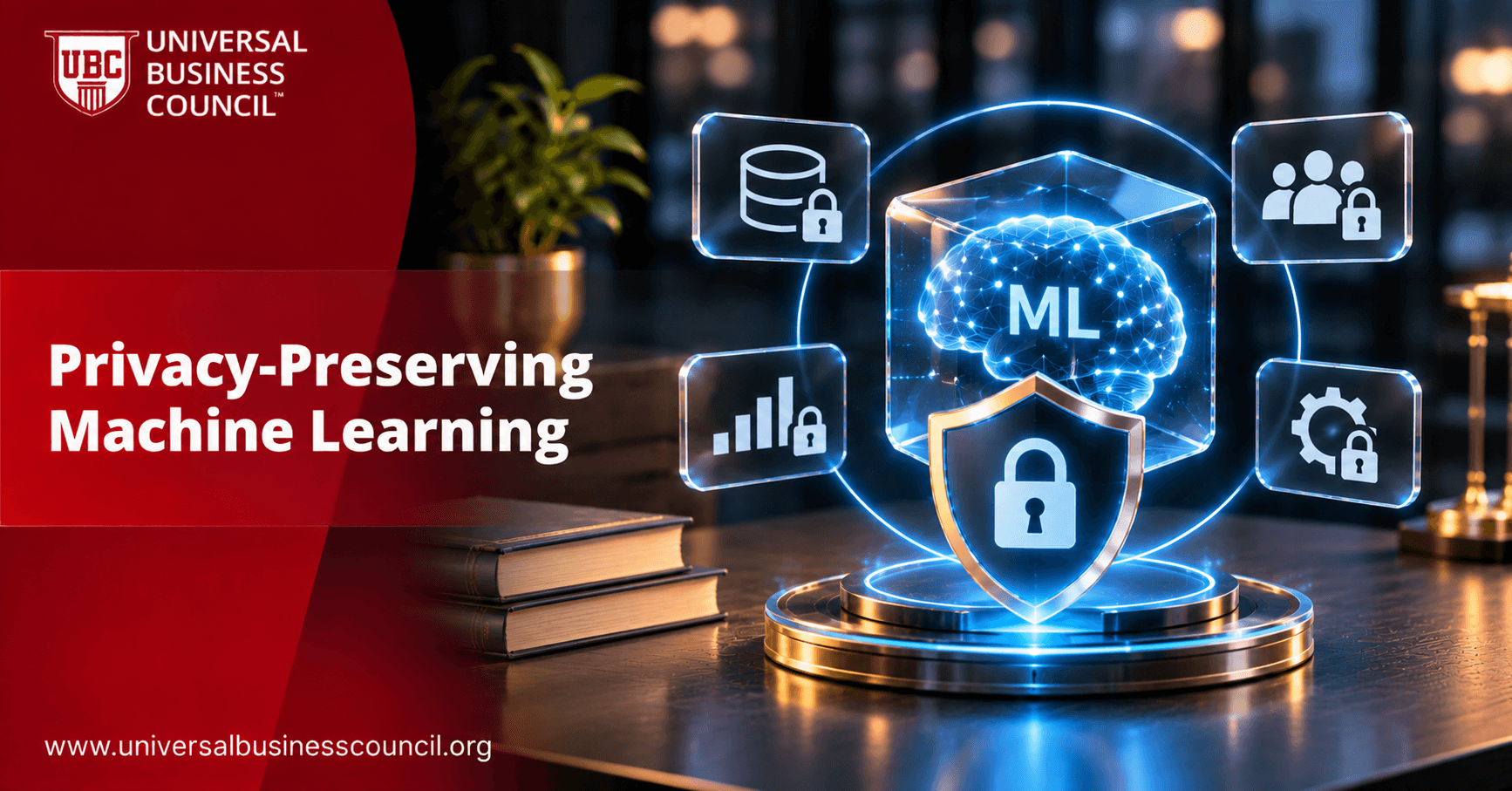
Sharing data makes models better, but sharing data also creates risk. Privacy-preserving machine learning (PPML) is a group of techniques that lets organizations learn from sensitive data without exposing the individuals behind it. It is quickly moving from research papers into banking, healthcare and consumer technology.
This guide explains the main PPML techniques, where each fits, their trade-offs and how to choose among them. Professionals who want broader responsible AI training can also look at the Certified Responsible AI Expert certification from Universal Business Council.

What Is Privacy-Preserving Machine Learning?
Privacy-preserving machine learning refers to methods that protect sensitive data during model training, evaluation and inference. The aim is to extract useful patterns while limiting what can be learned about any one person, record or organization.
It matters because standard machine learning can leak information. Models can memorize training records, attackers can run membership inference to check whether someone's data was used and gradient or output information can sometimes be used to reconstruct inputs. Privacy law, including the GDPR and similar regulations, pushes organizations to adopt data minimization and appropriate technical safeguards, and PPML is a practical way to do so.
Core Techniques
Differential Privacy
Differential privacy adds carefully calibrated statistical noise to data, queries or training so that the result barely changes whether or not any single person's data is included. It provides a mathematical privacy guarantee, usually expressed through a privacy budget (often called epsilon). Lower budgets mean stronger privacy but often lower accuracy. It is widely used in analytics and has been applied to model training through methods such as DP-SGD.
Federated Learning
In federated learning, the model travels to the data instead of the data traveling to the model. Devices or organizations train locally and share only model updates, which are combined centrally. This reduces raw data movement, though updates can still leak information, so it is often combined with differential privacy and secure aggregation.
Homomorphic Encryption
Homomorphic encryption allows computation on encrypted data without decrypting it. A model owner can run inference on a client's encrypted input and return an encrypted result that only the client can read. It offers strong protection but remains computationally heavy, which limits it to specific, high-value use cases.
Secure Multi-Party Computation
Secure multi-party computation (SMPC) lets several parties jointly compute a result while keeping their individual inputs secret. It suits cases where competitors or institutions want to collaborate, such as joint fraud analysis, without revealing their data to each other.
Trusted Execution Environments
Trusted execution environments, also called confidential computing, use hardware-isolated enclaves to process data so that even the cloud operator cannot see it. They offer better performance than purely cryptographic methods but depend on trust in the hardware and require careful configuration.
Synthetic Data and Anonymization
Synthetic data mimics the statistical features of real data without containing real records, and anonymization or pseudonymization removes or replaces identifiers. Both help, but neither is automatically safe. Poorly generated synthetic data can still leak information, and anonymized data can sometimes be re-identified when combined with other sources, so testing is necessary.
Comparing the Techniques
Differential privacy: strong formal guarantee, accuracy trade-off, flexible
Federated learning: keeps raw data local, needs coordination and extra protection
Homomorphic encryption: compute on encrypted data, high computational cost
SMPC: collaboration without sharing inputs, communication overhead
Trusted execution environments: efficient, hardware trust assumptions
Synthetic data: easy to share, needs privacy and quality testing
In practice, organizations layer techniques instead of relying on one. For example, a federated system might add differential privacy and secure aggregation to strengthen protection.
Real-World Use Cases
Healthcare
Hospitals can train diagnostic models together without moving patient records out of each institution, using federated learning and differential privacy. Research groups can analyze sensitive genomic or imaging data under strict privacy constraints.
Finance
Banks can collaborate on fraud detection and anti-money-laundering analysis using SMPC or federated approaches, sharing signals instead of customer data. Encrypted computation can also support privacy-sensitive credit analysis.
Consumer Technology
Phone keyboards and recommendation features can learn from usage on-device while limiting what leaves the device. Aggregate statistics about product usage can be collected with differential privacy.
Public Sector and Research
Statistical agencies use differential privacy to publish data without exposing individuals, and researchers use secure computation to analyze data across organizations.
How to Choose and Implement PPML
Define the threat model: who might attack, what could they learn and what are you protecting?
Clarify requirements: consider legal duties, accuracy needs, latency and budget
Select techniques: match them to data location, parties involved and sensitivity
Prototype and measure: compare accuracy and performance against a non-private baseline
Test privacy: run attacks such as membership inference to verify protection
Document and govern: record choices, parameters and residual risk in model documentation
Monitor: review as data, models and threats evolve
Implementation takes specialized skills in machine learning, cryptography and privacy engineering. Organizations often verify the qualifications and experience of such specialists during hiring, and HireValid can help with that. Teams building these capabilities also benefit from solid programming and data foundations, and short tech certifications can support that learning.
Limitations and Governance
PPML is not a magic shield. Techniques can reduce accuracy, raise costs and add complexity, and they do not replace legal compliance, consent or good data governance. Misconfigured parameters, such as an overly generous privacy budget, can give a false sense of safety. Treat PPML as one layer in a broader program that includes data minimization, access control, vendor management and incident response.
When describing privacy protections to customers, avoid overstatement. A Digital Marketing Course can help communications teams explain these safeguards accurately. Because several PPML methods draw on cryptography, resources such as Deep Tech Certifications are also useful for building general background in that area.
Conclusion
Privacy-preserving machine learning lets organizations benefit from sensitive data while limiting exposure. Differential privacy, federated learning, encryption-based methods, trusted hardware and synthetic data each have a place, and the best results often come from combining them. Start with a clear threat model, test your protections and govern the program. The FAQs below answer common questions.
Frequently Asked Questions
What is privacy-preserving machine learning?
Techniques that let models learn from sensitive data while limiting exposure of individuals.
Why is PPML needed?
Models can leak training data, and privacy laws require appropriate safeguards.
What is differential privacy?
A method that adds noise so that any one person's data has little effect on results.
What is a privacy budget?
A parameter, often epsilon, that controls the privacy and accuracy trade-off.
What is federated learning?
Training models across devices or organizations without centralizing raw data.
Is federated learning fully private?
No, model updates can leak information, so extra protections are often added.
What is homomorphic encryption?
Encryption that allows computation on data without decrypting it.
What is secure multi-party computation?
A method for several parties to compute jointly without revealing their inputs.
What are trusted execution environments?
Hardware-isolated enclaves that process data securely, even from the host.
Is synthetic data always private?
No, it needs testing for leakage and quality.
Is anonymized data risk-free?
No, it can sometimes be re-identified when combined with other data.
Which technique is best?
It depends on the threat model, data location, accuracy needs and cost.
Can techniques be combined?
Yes, layering them, such as federated learning with differential privacy, is common.
Does PPML reduce accuracy?
Often somewhat, especially with strong privacy settings.
What is membership inference?
An attack that checks whether a record was in the training data.
Which industries use PPML?
Healthcare, finance, consumer technology, the public sector and research.
Does PPML ensure legal compliance?
No, it supports compliance but does not replace consent or governance.
How do you verify privacy protections?
By running privacy attacks and reviewing parameters and documentation.
What skills are needed?
Machine learning, privacy engineering, cryptography and security knowledge.
Where should I start?
Define a threat model, then prototype and test simple options.
Related Articles
View All
Artificial Intelligence
AI Governance vs AI Ethics: Differences, Use Cases and Implementation
Understand the differences between AI governance and AI ethics, including their principles, frameworks, use cases, and implementation approaches. Learn how organizations combine ethical guidelines with governance policies to manage AI risks, ensure accountability, promote transparency, and support responsible AI adoption.
Artificial Intelligence
How to Detect and Reduce Bias in Machine Learning Models
Learn how to detect and reduce bias in machine learning models using practical techniques and evaluation methods. Explore data analysis, fairness metrics, bias testing, model auditing, and mitigation strategies to build more accurate, fair, and reliable AI systems.

Artificial Intelligence
GPT-6.1 Terra: Features, Capabilities, and Use Cases
Explore GPT-6.1 Terra, OpenAI’s new mid-tier model. Learn its key features, how it performs on tests, and practical ways to use it in marketing, operations, support and development.
Trending Articles
The Role of Blockchain in Ethical AI Development
How blockchain technology is being used to promote transparency and accountability in artificial intelligence systems.
AWS Career Roadmap
A step-by-step guide to building a successful career in Amazon Web Services cloud computing.
Top 5 DeFi Platforms
Explore the leading decentralized finance platforms and what makes each one unique in the evolving DeFi landscape.