

AI Governance for Startups: A Practical Framework on a Budget

A small budget does not shrink legal duties. Startups building or using AI face the same privacy, consumer protection, discrimination and security rules as larger firms, and they often face them with no legal team, no risk function and a product that changes every week. The good news is that AI governance for startups does not need heavy bureaucracy. A lean framework, built around a few decisions and habits, can protect customers, satisfy investors and enterprise buyers and avoid costly rework later. This guide lays out a practical, low-cost approach. For professional grounding in the field, see the certified responsible AI expert certification. This is general information, not legal advice.
What is AI governance for a startup?
AI governance for a startup is the minimum set of policies, roles, checks and records that keeps your AI use lawful, safe and defensible as you grow. It is proportionate: a two-person team shipping a low-risk feature needs far less than a company deploying a hiring or lending model, but both need to know what they are doing and why.

Done early, governance is cheap. Retrofitted after a customer complaint, a security questionnaire or a funding diligence request, it is expensive and stressful.
Why startups should care early
Enterprise customers increasingly ask about AI practices in security and procurement reviews
Investors look for regulatory and reputational risk during diligence
Early design choices on data and architecture are hard to reverse
One incident can damage a young brand far more than an established one
Good habits scale better than heroic cleanup
A lean framework in six steps
Each step can start small and grow with the company.
Step 1: Name an owner
Assign one person, such as a founder or the head of product or engineering, as accountable for AI governance. Give them the time and authority to say no. If no one owns it, nothing happens.
Step 2: List what you use
Create a simple register, even a spreadsheet, of every AI model, API, tool and dataset you use or build. Record purpose, data involved, vendor, owner and risk level. Include tools staff use informally, such as public chatbots.
Step 3: Sort by risk
Use three tiers. High risk covers decisions about people's jobs, credit, health, safety or legal rights, and uses of sensitive data. Medium covers customer-facing features. Low covers internal convenience tools. Spend your limited effort in proportion.
Know what you should not build yet
Some uses carry heavy legal duties. If you are not ready to meet them, delay or choose a lower-risk design until you are.
Step 4: Write a one-page policy
Cover acceptable use of AI tools by staff, rules on what data may be entered into them, approval for new AI features, disclosure to users and how to report problems. Short policies get read.
Step 5: Do light checks before launch
For each new AI feature, answer a short checklist: purpose, data and permission, who is affected, what could go wrong, how it was tested including for bias and harmful output, how humans can intervene and how users are informed. Keep the answers as a record. Engineers who run these tests benefit from strong technical grounding, which many build through tech certifications.
Step 6: Monitor and respond
Track basic quality, complaints and incidents, and agree in advance who does what if something goes wrong. A short incident plan on one page beats none.
Keeping costs down
Several practical choices stretch a small budget.
Use free and existing resources
Public frameworks, templates and open-source testing tools provide structure at no cost. Adapt them instead of writing from scratch. Use the security and privacy practices you already follow as the base.
Choose vendors carefully
Pick AI providers with clear data terms, security documentation and no training on your data by default. Ask a short set of questions before signing, and keep the answers. Avoid building what you can responsibly buy, but do not buy what you cannot assess.
Get targeted advice
Spend legal budget on a few high-value reviews, such as terms of service, privacy notices and any high-risk use, instead of general retainers. A few hours with a qualified adviser early can save much more later.
Automate where possible
Build simple checks into your development workflow, such as required fields in a pull request template or a deployment checklist, so that governance happens as part of normal work.
People, proof and trust
Trust is a startup's most valuable asset.
Hire and contract carefully
Early hires and contractors often have wide access to data and systems. Verify credentials and backgrounds within legal limits, using services such as HireValid, and give people the minimum access they need.
Keep simple records
Store the register, checklists, test notes and decisions in a shared, version-controlled place. Records you can show a customer or investor on short notice carry weight. Integrity techniques for records appear in deep tech certifications for those who want to go further.
Market honestly
Startups feel pressure to oversell AI. Avoid claims about accuracy, safety or fairness that you cannot support, because false claims draw regulatory attention. A digital marketing course can help teams promote products persuasively and truthfully.
Plan to grow
Review the framework at each growth stage, such as a new market, a larger customer or a new kind of data, and add controls as risk grows.
Conclusion
AI governance for startups can be lean without being empty. Name an owner, keep a simple register, sort uses by risk, write a one-page policy, run light pre-launch checks and monitor and respond. Use free resources, choose vendors with care, buy targeted advice and automate checks. Verify key people, keep simple records and describe your AI honestly. A small, working framework builds trust with customers and investors and makes growth easier.
Frequently asked questions
These are the questions founders ask most about AI governance.
1. Do startups need AI governance?
Yes, scaled to their risk and size.
2. When should we start?
From the first AI feature, while it is cheap to do.
3. Who should own it?
A founder or senior product or engineering lead.
4. What is the minimum we need?
An owner, a register, risk tiers, a one-page policy and pre-launch checks.
5. How do we classify risk simply?
Use high, medium and low tiers based on impact on people and data sensitivity.
6. Which uses are high risk?
Decisions on jobs, credit, health, safety or legal rights, and sensitive data uses.
7. What should the policy cover?
Tool use, data rules, approvals, disclosure and incident reporting.
8. Can staff use public AI tools?
With clear limits on what data they may enter.
9. What do enterprise buyers ask?
About data use, security, testing, oversight and incident handling.
10. How do we test on a budget?
Use realistic samples, open-source tools and structured manual review.
11. What should we ask AI vendors?
About data use, training, security, retention and change notice.
12. Do we need a lawyer?
For targeted reviews, especially for high-risk uses and customer contracts.
13. How do we disclose AI use to users?
Plainly, where they interact with AI or where it affects them.
14. What records matter most?
The register, checklists, test notes and key decisions.
15. How do we handle incidents?
Follow a one-page plan with owners, steps and notifications.
16. What if we use only third-party AI?
You still need governance because you are accountable for outcomes.
17. Can governance slow us down?
Not if it is lightweight and built into existing workflows.
18. How do investors view this?
As a sign of maturity and lower regulatory risk.
19. When should we upgrade the framework?
When risk, customers, data or regulation grow.
20. What is the biggest mistake?
Treating AI as unregulated because the company is small.
Related Articles
View All
Artificial Intelligence
NIST AI Risk Management Framework: A Practical Implementation Guide
Explore the NIST AI Risk Management Framework and learn how to implement it across the AI lifecycle. Understand its four core functions, Govern, Map, Measure, and Manage, along with practical steps for identifying AI risks, improving accountability, and building trustworthy AI systems.
Artificial Intelligence
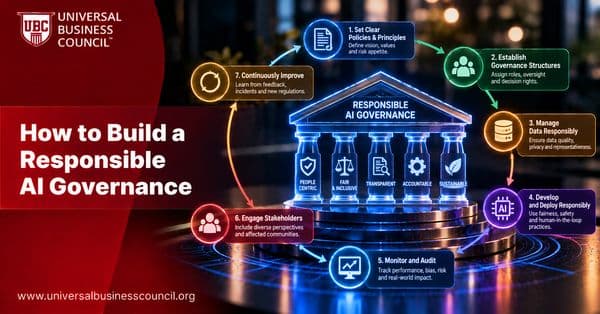
How to Build a Responsible AI Governance Framework
Learn how to build a responsible AI governance framework that supports ethical AI development and deployment. Explore key steps, including defining governance policies, assigning responsibilities, assessing risks, ensuring regulatory compliance, and establishing continuous monitoring and accountability.

Artificial Intelligence
Chief AI Officer Responsibilities: Governance, Risk and Strategy
Explore the responsibilities of a Chief AI Officer (CAIO) and how the role supports AI adoption across an organization. Learn how CAIOs lead AI strategy, establish governance frameworks, manage risks, oversee compliance, and align AI initiatives with business goals.
Trending Articles
The Role of Blockchain in Ethical AI Development
How blockchain technology is being used to promote transparency and accountability in artificial intelligence systems.
AWS Career Roadmap
A step-by-step guide to building a successful career in Amazon Web Services cloud computing.
Top 5 DeFi Platforms
Explore the leading decentralized finance platforms and what makes each one unique in the evolving DeFi landscape.