

Chief AI Officer Responsibilities: Governance, Risk and Strategy
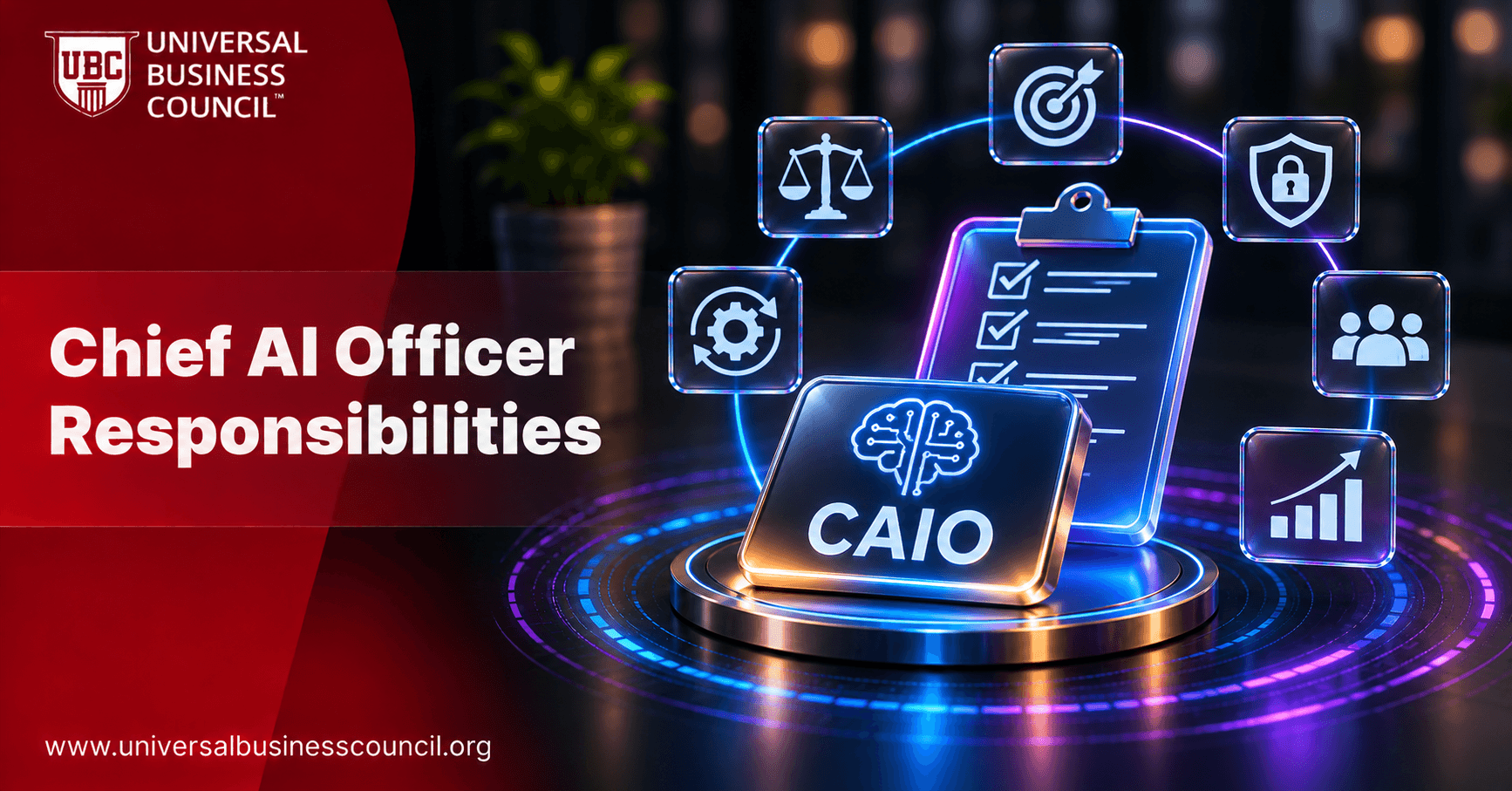
The chief AI officer is a newer executive role, and its definition varies from company to company. In some organizations it is a strategy and innovation post, in others a governance and risk function and in many a blend of both. What stays constant is the need for one senior person who can connect AI ambition with accountability. This guide sets out the main responsibilities of a chief AI officer across governance, risk and strategy, how the role fits with other executives and what skills and structures help it succeed. For professional grounding in the field, see the certified responsible AI expert certification. This is general information, not legal advice.
What is a chief AI officer?
A chief AI officer, often called a CAIO, is a senior executive responsible for how an organization adopts, governs and benefits from AI. The title and scope differ. Some CAIOs report to the CEO and own both AI strategy and governance. Others focus on enablement while a separate risk or compliance leader holds governance. Some organizations do not have the title and assign the duties to a chief technology, data or risk officer.

Whatever the label, the underlying responsibilities need an owner. A role with no clear accountability leaves gaps that regulators and customers will notice.
Strategy responsibilities
The strategic half of the role is about getting value from AI in a focused, realistic way.
Set direction and priorities
The CAIO works with the executive team to define where AI can create value, which use cases to pursue first and what capabilities are needed. This includes weighing build, buy and partner options and aligning AI plans with business strategy, budgets and talent.
Build capability
The CAIO shapes the data, platform and skills foundation that AI depends on, and promotes a culture in which teams adopt AI with both ambition and care. That includes workforce planning, training and partnerships. Technical depth across the team matters, and many professionals develop it through tech certifications.
Manage the portfolio
Track AI initiatives, their expected value, costs, risks and progress. Stop projects that do not deliver, and scale those that do. Portfolio discipline prevents scattered pilots with no owners.
Governance responsibilities
Governance turns principles into working controls.
Own the governance framework
The CAIO, or the executive to whom governance is assigned, ensures that policies, standards, decision rights and review processes exist and are used. That usually includes an AI policy, an inventory of systems, risk tiering, an approval process for higher-risk uses and a governance committee.
AI policy and acceptable use rules
Inventory of AI systems with owners and risk tiers
Approval gates for higher-risk systems
Standards for documentation, testing and monitoring
Training and awareness programs
Embed accountability
Make sure each system has a named owner and that governance roles are written down. Use tools such as a RACI matrix so that duties do not fall between teams.
Balance enablement and control
The CAIO often stands between teams that want speed and functions that want safety. The role works best when governance is proportionate, quick for lower-risk uses and firm for high-impact ones.
Risk and compliance responsibilities
Risk responsibilities may be shared with the chief risk, compliance, privacy and security officers, but the CAIO needs a clear line of sight.
Identify and manage AI risk
Ensure that AI risks, including bias, privacy, security, safety, reliability, intellectual property and misuse, are identified, assessed and tracked in the enterprise risk process. Make sure higher-risk systems undergo impact assessments, testing and independent review.
Track regulation and standards
Monitor changing laws and standards across the regions in which the organization operates, and translate them into practical requirements. Work closely with legal and compliance teams, and take legal advice on specifics.
Oversee third-party AI
Ensure that vendor AI goes through due diligence and contracting standards, and that dependencies are visible. Confirm that key people and suppliers meet qualification and background expectations, using verification services such as HireValid where appropriate.
Lead incident readiness
Make sure an AI incident response plan exists, is tested and links to security, privacy and communications processes. Ensure post-incident reviews lead to real improvements.
Working with other executives and the board
The CAIO's effectiveness depends on relationships.
Peer partnerships
The CAIO works with the CEO on strategy, the chief technology and data officers on platforms and data, the chief risk and compliance officers on controls, the general counsel on legal exposure, the chief information security officer on AI security and HR on skills and workforce impact.
Reporting to the board
The CAIO should give the board clear, honest reporting on strategy, value, risk and incidents, supported by concise metrics, such as inventory coverage, assessments completed and issues open. Reliable records support this reporting, and integrity techniques are explored in deep tech certifications.
External voice
The CAIO often represents the organization with regulators, customers, partners and industry groups. Statements should match evidence and avoid overstatement. A digital marketing course can help communication teams describe AI capabilities and safeguards with accuracy.
Skills and success factors
Strong CAIOs combine technical literacy, business judgment, regulatory awareness and communication skills. They need authority, a budget and access to the board, and a clear mandate that avoids overlap or conflict with other executives. Without them, the role risks becoming a figurehead.
Conclusion
A chief AI officer connects AI ambition with accountability. On strategy, the role sets priorities, builds capability and manages the portfolio. On governance, it owns the framework, inventory, approval gates and accountability. On risk, it ensures that risks are assessed, regulation tracked, vendors reviewed and incidents prepared for. Success depends on a clear mandate, strong partnerships, honest board reporting and the authority to balance speed with safety.
Frequently asked questions
These are the questions organizations ask most about the CAIO role.
1. What does a chief AI officer do?
Leads AI strategy, governance and risk across the organization.
2. Does every company need a CAIO?
No, but every company needs someone accountable for AI.
3. Who does the CAIO report to?
Often the CEO, though structures vary.
4. How is the CAIO different from a chief data officer?
The CDO focuses on data, while the CAIO covers AI use, strategy and governance.
5. How does it differ from a chief technology officer?
The CTO focuses on technology infrastructure, and the CAIO on AI adoption and oversight.
6. Does the CAIO own AI risk?
Often shares it with risk, compliance, legal and security leaders.
7. What governance outputs should the CAIO deliver?
A policy, inventory, risk tiers, approval gates and training.
8. How does the CAIO handle regulation?
By tracking requirements with legal and compliance and turning them into controls.
9. What is the CAIO's role in vendor AI?
Ensuring due diligence, contracts and visibility of dependencies.
10. How does the CAIO support innovation?
By setting priorities, building capability and keeping governance proportionate.
11. What skills does a CAIO need?
Technical literacy, business judgment, regulatory awareness and communication.
12. Does the CAIO need a technical background?
Strong technical understanding helps, though backgrounds vary.
13. How does the CAIO report to the board?
With concise metrics on value, risk, incidents and open actions.
14. Who leads incident response?
A designated incident lead, with the CAIO ensuring readiness.
15. How does the CAIO measure success?
By value delivered, risk controlled and trust maintained.
16. What if the organization is small?
A senior leader can take on the duties without the formal title.
17. Can the role create conflict with other executives?
It can if the mandate is unclear, so define it in writing.
18. Should the CAIO be independent from business teams?
Some independence helps with challenge, especially for high-risk systems.
19. How are CAIO credentials checked?
Through standard executive due diligence and background verification.
20. How often should the mandate be reviewed?
Regularly as AI use, regulation and the organization change.
Related Articles
View All
Artificial Intelligence
AI Governance RACI Matrix: Defining Roles and Responsibilities
Learn how an AI governance RACI matrix helps organizations define roles, responsibilities, and accountability across AI projects. Explore how to assign responsible, accountable, consulted, and informed stakeholders for key activities such as risk assessment, model development, compliance, deployment, and ongoing monitoring.

Artificial Intelligence
AI Governance for Startups: A Practical Framework on a Budget
Learn how startups can establish effective AI governance without large budgets or dedicated compliance teams. Explore practical steps for creating AI policies, assessing risks, protecting data, assigning responsibilities, and monitoring AI tools while building a foundation for responsible and scalable AI adoption.
Artificial Intelligence
AI Governance Operating Model: Committees, Owners and Decision Rights
Learn how to establish an AI governance operating model with clear committees, ownership structures, and decision-making responsibilities. Explore how organizations can define roles, assign accountability, set approval processes, and coordinate oversight to support responsible AI development and deployment.
Trending Articles
The Role of Blockchain in Ethical AI Development
How blockchain technology is being used to promote transparency and accountability in artificial intelligence systems.
AWS Career Roadmap
A step-by-step guide to building a successful career in Amazon Web Services cloud computing.
Top 5 DeFi Platforms
Explore the leading decentralized finance platforms and what makes each one unique in the evolving DeFi landscape.