

AI vs Machine Learning vs Deep Learning Explained
 Smita
Smita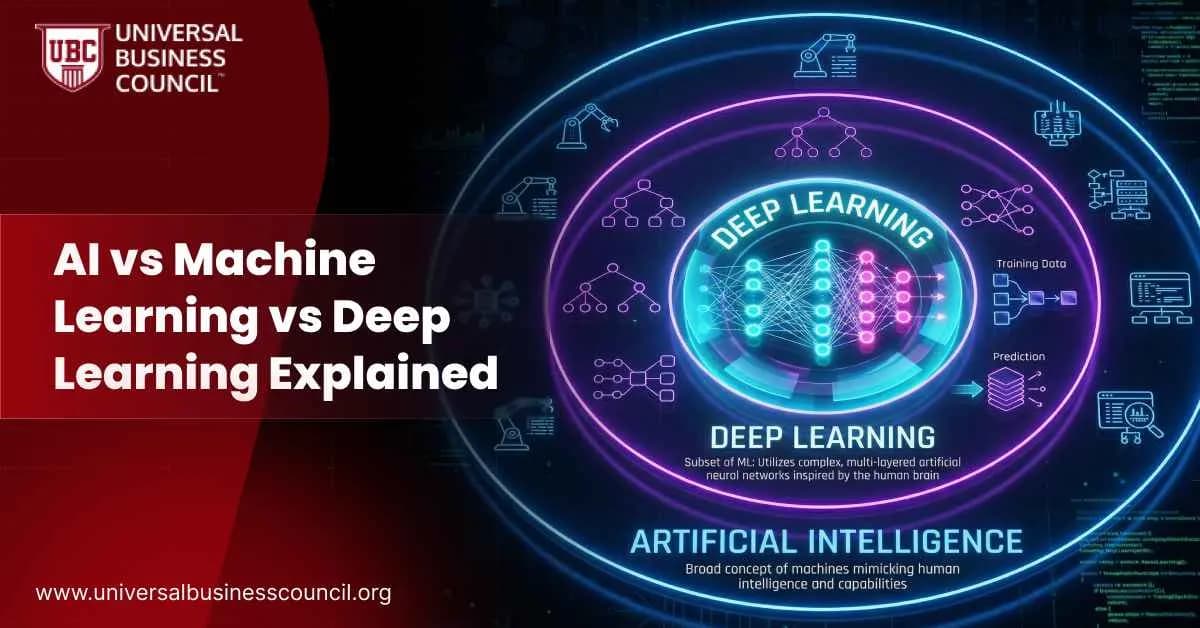
Artificial intelligence, machine learning, and deep learning are often treated like interchangeable terms, but they do not mean the same thing. They belong to the same technology family, yet each one has a different role, a different level of complexity, and different business applications. For students, professionals, business leaders, and aspiring tech specialists, understanding the distinction is essential. Artificial intelligence is the broadest concept. It refers to systems that can perform tasks that usually require human intelligence, such as reasoning, problem-solving, recognizing patterns, understanding language, or making decisions. Machine learning is a branch of artificial intelligence that enables systems to learn from data instead of relying only on manually coded rules. Deep learning is a specialized part of machine learning that uses layered neural networks to process complex information such as images, audio, and language. Knowing how these three fields relate to one another helps professionals make smarter learning choices and better business decisions. It also makes it easier to understand why some AI tools are simple automation systems while others can generate content, recognize speech, or analyze medical scans with remarkable accuracy. This article explains AI vs machine learning vs deep learning in a clear, practical, and SEO-friendly way.
Why These Terms Are Often Misunderstood
One of the main reasons people confuse artificial intelligence, machine learning, and deep learning is that the technology industry often uses these labels loosely. Businesses frequently call any smart automation AI, even when it is based on simple logic. Others describe a system as deep learning because it sounds advanced, even when the underlying model is much more basic. The relationship between these technologies is actually straightforward. Artificial intelligence is the overall field. Machine learning is one method within AI. Deep learning is one method within machine learning. In other words, deep learning is part of machine learning, and machine learning is part of artificial intelligence. This layered relationship matters because not all AI systems learn from data, and not all machine learning systems use deep neural networks. The differences affect cost, performance, implementation time, and the type of problems each method can solve.

Artificial Intelligence: The Umbrella Category
Artificial intelligence is the broad field focused on building machines or software that can imitate aspects of human intelligence. These systems may analyze information, make decisions, respond to language, automate workflows, or solve structured problems. Some AI systems are based on rules rather than data-driven learning. For example, a chatbot may answer basic customer questions using prewritten scripts and decision trees. A scheduling engine may assign appointments according to fixed conditions. A business workflow tool may automate approvals based on defined logic. These systems can still be considered AI because they simulate decision-making processes. That is why artificial intelligence is the widest category. It includes rule-based systems, expert systems, robotic automation, search algorithms, recommendation engines, and data-driven predictive models. It is not limited to robots or futuristic assistants. AI already exists in industries such as healthcare, retail, finance, education, logistics, manufacturing, and customer support.
Machine Learning: The Data-Driven Core of Modern AI
Machine learning is a branch of artificial intelligence that allows systems to learn from data. Instead of telling a machine exactly how to respond in every situation, developers train it using examples. The system identifies patterns in the data and uses those patterns to make predictions or decisions on new inputs. This method transformed software development because it reduced the need for endless rule-writing. In traditional programming, humans explicitly define instructions. In machine learning, humans provide data, a training method, and evaluation criteria, and the model discovers useful patterns by itself. A simple example is email spam detection. Instead of manually coding every possible spam rule, developers train a model on thousands or millions of emails labeled as spam or safe. The model learns which combinations of words, sender behavior, formatting, or other signals are associated with unwanted messages. Once trained, it can classify new emails far more efficiently than a rigid rule-based system. Machine learning is used in recommendation engines, fraud detection, demand forecasting, customer segmentation, credit scoring, predictive maintenance, lead scoring, and personalized marketing. It is especially useful when the patterns in the data are too complex for manual rule creation. This is why machine learning sits at the center of modern AI adoption. It helps businesses move beyond simple automation and toward systems that improve with experience and data.
Machine learning roles often require knowledge of algorithms, data preparation, model evaluation, and statistical reasoning. Hiring teams can benefit from assessing these job-specific competencies rather than relying exclusively on qualifications. HireValid's technical assessment solutions are worth exploring for organisations recruiting machine learning talent.
Deep Learning: Advanced Pattern Recognition at Scale
Deep learning is a specialized area of machine learning that uses artificial neural networks with multiple layers. These layers allow the model to learn highly complex relationships from massive amounts of data, especially when the input is unstructured. Unstructured data includes images, audio, video, and natural language. Traditional machine learning models often require human experts to define useful features in advance. Deep learning reduces that manual effort by learning many of those patterns automatically. For example, in image recognition, a deep learning model can learn to identify shapes, textures, edges, and complete objects directly from pixel data. In speech recognition, it can learn acoustic patterns from raw audio. In language applications, it can model context, grammar, sequence, meaning, and relationships between words at a scale that traditional systems struggle to match. This is why deep learning powers many of the most impressive AI applications today. It is used in large language models, voice assistants, image generation, facial recognition, autonomous systems, advanced translation tools, and medical image analysis. Many of the AI systems people interact with every day rely on deep learning behind the scenes.
A Simple Way to Remember the Difference
The easiest way to understand AI vs machine learning vs deep learning is to picture three nested layers. Artificial intelligence is the outer layer. It includes any system designed to mimic human-like intelligence or automate smart decision-making. Machine learning sits inside artificial intelligence. It is a method of building intelligent systems by learning patterns from data. Deep learning sits inside machine learning. It is a more advanced technique that uses multi-layered neural networks to process highly complex and unstructured information. So every deep learning system is part of machine learning, and every machine learning system belongs to AI. But not every AI system uses machine learning, and not every machine learning system requires deep learning. This distinction is more than academic. It helps companies choose the right technology for the right business problem. It also helps learners avoid the usual buzzword fog that somehow keeps thriving in every tech conversation.
Real-World Examples That Make the Difference Clear
The difference between AI, machine learning, and deep learning becomes much easier to understand when you look at practical examples. Imagine an online retail platform. A rule-based virtual assistant that answers return policy questions using fixed scripts is an AI system, but it may not use machine learning. A recommendation engine that suggests products based on customer browsing and buying behavior is using machine learning because it learns from historical data. A visual search tool that lets users upload a photo to find similar products is likely powered by deep learning because it must process image content automatically. Now consider healthcare. A medical rules engine that flags dangerous drug interactions is a form of AI. A predictive model that estimates hospital readmission risk using patient records is machine learning. A system that analyzes X-rays or MRI scans to detect abnormalities is more likely to be deep learning because it handles image-based pattern recognition. In finance, AI may automate workflows or apply business rules. Machine learning may identify suspicious spending patterns or predict loan default risk. Deep learning may be used for voice authentication, advanced fraud detection, or document understanding. These examples show that the technologies are connected, but they are not interchangeable. Each one is better suited to certain tasks.
How Data and Computing Needs Vary
Another major difference between artificial intelligence, machine learning, and deep learning is the amount of data and computing power they usually require. Traditional AI systems that rely on rules can work with relatively small datasets or even no learning data at all. They are often easier to explain and quicker to implement, which makes them useful for structured processes and narrow automation tasks. Machine learning models usually require structured or semi-structured data. They need enough examples to learn meaningful patterns, but they often remain more efficient than deep learning for many business use cases. Problems such as churn prediction, sales forecasting, and credit risk scoring can often be solved effectively with standard machine learning techniques. Deep learning typically requires very large datasets and significant computing resources. Training deep neural networks can take longer and cost more, especially when working with image, video, or language data. However, the payoff can be substantial when the task involves highly complex patterns that other models cannot capture easily. The key lesson is simple. More advanced technology is not always the best choice. Sometimes a rule-based system is enough. Sometimes machine learning offers the best balance of performance and efficiency. Deep learning becomes worthwhile when the complexity of the data and the task justifies the cost.
Business Uses Across Major Industries
Artificial intelligence, machine learning, and deep learning are now deeply integrated into many industries. In retail, businesses use them for recommendation engines, pricing optimization, customer support, and inventory forecasting. In healthcare, they support diagnostics, patient monitoring, medical imaging, and administrative efficiency. In finance, they improve fraud detection, risk analysis, compliance review, and customer engagement. In manufacturing, they support predictive maintenance, quality control, robotics, and process optimization. In education, they power adaptive learning systems, automated assessment, and personalized learning experiences. Marketing is another major area where these technologies create measurable value. AI helps automate repetitive tasks. Machine learning improves audience targeting, campaign optimization, and customer segmentation. Deep learning supports advanced personalization, image analysis, voice interaction, and content generation. Because of this growing relationship between business growth and intelligent automation, many professionals pursue an AI Powered marketing certification to understand how AI tools can improve campaign strategy, customer engagement, and commercial performance.
How Agentic Systems Are Expanding the AI Landscape
Artificial intelligence is now evolving beyond one-step predictions or single-response systems. More organizations are adopting agentic systems that can plan, decide, act, and continue working across multiple steps with minimal human guidance. These systems can use tools, retrieve information, perform tasks across software environments, and refine outcomes based on new input. That makes them useful in areas such as research automation, operations, workflow orchestration, coding support, and intelligent business assistance. As agentic systems become more common, professionals need to understand not only how they work but also how to deploy them responsibly. This is why an Agentic AI Certification is becoming increasingly relevant for people who want to work with next-generation enterprise AI systems.
Why Deep Technology Skills Matter More Than Ever
AI is no longer developing in isolation. It now overlaps with advanced computing, automation, cloud infrastructure, cybersecurity, blockchain ecosystems, and other deep technology environments. That means technical professionals increasingly need broader knowledge across connected innovation areas. For example, AI solutions may rely on distributed systems, secure digital architecture, or real-time data processing frameworks. Organizations looking to build advanced digital products need professionals who understand not only AI models but also the wider technical ecosystems that support them. This is where broader technical expertise becomes useful. It helps professionals strengthen their understanding of advanced technology domains where AI plays a growing role, especially in future-facing enterprise and innovation settings.
Common Myths About AI, Machine Learning, and Deep Learning
One common myth is that deep learning has made machine learning obsolete. It has not. Deep learning is powerful, but traditional machine learning still solves many business problems more efficiently and with less cost. Another misconception is that AI always means human-level thinking. Most real-world AI systems are narrow and task-specific. They may perform a particular function extremely well, but they do not have general human intelligence. People also assume that bigger datasets automatically create better models. That is not true. Poor data quality, weak labeling, bias, and irrelevant variables can damage model performance no matter how advanced the technique is. There is also a tendency to think AI is relevant only to data scientists or software engineers. In reality, managers, marketers, analysts, product teams, consultants, and business leaders all benefit from understanding how AI systems work and where they create value.
Skills That Matter in AI-Related Careers
For professionals entering the field, understanding terminology is only the first step. Employers increasingly value people who can combine conceptual clarity with practical skill. A strong foundation begins with learning what AI is, how machine learning fits into the bigger picture, and when deep learning is appropriate. From there, useful skills include Python, data analysis, model evaluation, automation design, prompt engineering, workflow integration, and responsible AI practices. For professionals who want to validate their programming skills, a python certification can strengthen technical credibility, while a node.js certification can support backend development and AI application deployment. Structured learning helps transform general interest into applied expertise. Many learners begin with an AI expert certification to build a strong conceptual base, then expand into specializations aligned with their role or industry. For business-oriented learners, an AI Powered marketing certification may be especially useful because it combines commercial strategy with applied AI understanding. For emerging enterprise use cases, an Agentic AI Certification can help professionals build knowledge in multi-step autonomous systems. The professionals who stand out are not just the ones who know the buzzwords. They are the ones who understand which method fits which problem and how to apply it responsibly in real situations.
Which Approach Is Best for Different Problems?
Choosing between a general AI system, a machine learning model, or a deep learning solution depends on the problem you are trying to solve. If the rules are clear and stable, a basic AI system may be enough. This is often true in workflow automation, policy-based decision trees, or simple customer service logic. If you need predictions based on structured data, machine learning is often the best fit. It works well for classification, forecasting, recommendation, and risk scoring. If the task involves highly complex patterns in images, speech, video, or language, deep learning is often the strongest choice. It becomes especially effective when there is large-scale data and enough computational support. The smartest organizations do not blindly choose the most advanced option. They choose the method that best fits the problem, the data, the budget, and the desired outcome.
Final Perspective
Understanding the difference between artificial intelligence, machine learning, and deep learning is essential in today’s technology landscape. Artificial intelligence is the broad field of intelligent systems. Machine learning is the data-driven method that allows systems to learn from examples. Deep learning is the advanced neural network approach that powers many of the most sophisticated AI capabilities in use today. These technologies are related, but they are not identical. Each has its own role, strengths, limitations, and use cases. Businesses that understand the distinction make better strategic decisions. Professionals who understand the distinction build stronger careers. Learners who understand the distinction waste less time being hypnotized by trendy terminology. The best way forward is to master the fundamentals first, then build practical knowledge based on your goals. Whether your interest is business strategy, digital marketing, technical development, or emerging enterprise systems, understanding AI vs machine learning vs deep learning gives you a clearer path. An AI expert certification can help build strong foundational knowledge. An AI Powered marketing certification can connect AI skills to business growth. An Agentic AI Certification can prepare professionals for advanced autonomous systems. A python certification and a node.js certification can strengthen technical expertise for practical implementation.
FAQs
What is the main difference between artificial intelligence, machine learning, and deep learning?Artificial intelligence is the broad field of creating systems that can perform tasks requiring human-like intelligence. Machine learning is a subset of AI that learns from data, while deep learning is a more advanced subset of machine learning that uses neural networks to process complex information.
Is machine learning a part of artificial intelligence?Yes, machine learning is a branch of artificial intelligence. It allows systems to learn from data and improve their performance without being explicitly programmed for every task.
Why is deep learning considered more advanced than machine learning?Deep learning is considered more advanced because it uses multi-layered neural networks to identify complex patterns in large amounts of data. It is especially useful for image recognition, speech processing, and natural language understanding.
Which is better for business applications: AI, machine learning, or deep learning?The best choice depends on the business problem. Rule-based AI works well for simple automation, machine learning is ideal for prediction and pattern recognition, and deep learning is best for highly complex tasks involving images, audio, or large-scale language data.
Where are artificial intelligence, machine learning, and deep learning used in real life?These technologies are used in healthcare, finance, retail, education, marketing, customer support, manufacturing, and logistics. Common examples include chatbots, fraud detection, recommendation engines, medical imaging, and content generation tools.
Do I need programming skills to learn AI, machine learning, and deep learning?Basic programming knowledge is very helpful, especially if you want to work practically with AI systems. Python is one of the most widely used languages in this field, which is why many learners pursue a python certification to strengthen their technical foundation.
Why is Python important in artificial intelligence?Python is important because it is simple to learn and supports many major AI, machine learning, and data science libraries. It is widely used for building models, automating tasks, analyzing data, and developing intelligent applications.
How does Node.js support AI development?Node.js helps developers build backend systems, APIs, and real-time applications that integrate AI tools into websites and software platforms. A node.js certification can be useful for professionals who want to connect AI features to practical applications.
What is Agentic AI, and why is it important?Agentic AI refers to AI systems that can plan, act, and complete multi-step tasks with limited human intervention. It is important because it supports advanced automation, workflow management, and intelligent decision-making across business and technical environments. An Agentic AI Certification can help learners understand this growing field.
Which certification is useful for building a career in AI?The right certification depends on your career path. An AI expert certification is useful for broad AI knowledge, while an AI Powered marketing certification is valuable for professionals focused on business and marketing applications of AI.
Related Articles
View AllArtificial Intelligence
Jev vs Machine Learning Models
Compare Jev with traditional machine learning models and explore how typed decisions, calibrated probabilities, structured outputs, and automation-focused workflows set Jev apart.
Artificial Intelligence
Jev Latency Explained
Learn how Jev achieves low-latency AI decisions through parallel sampling, structured outputs, and a System One architecture designed for real-time software automation.
Artificial Intelligence
Jev Calibrated Decisions Explained
Learn how Jev’s calibrated decisions work, how probabilities and confidence scores represent uncertainty, and how software can use them for more reliable automation.
Trending Articles
The Role of Blockchain in Ethical AI Development
How blockchain technology is being used to promote transparency and accountability in artificial intelligence systems.
AWS Career Roadmap
A step-by-step guide to building a successful career in Amazon Web Services cloud computing.
Top 5 DeFi Platforms
Explore the leading decentralized finance platforms and what makes each one unique in the evolving DeFi landscape.