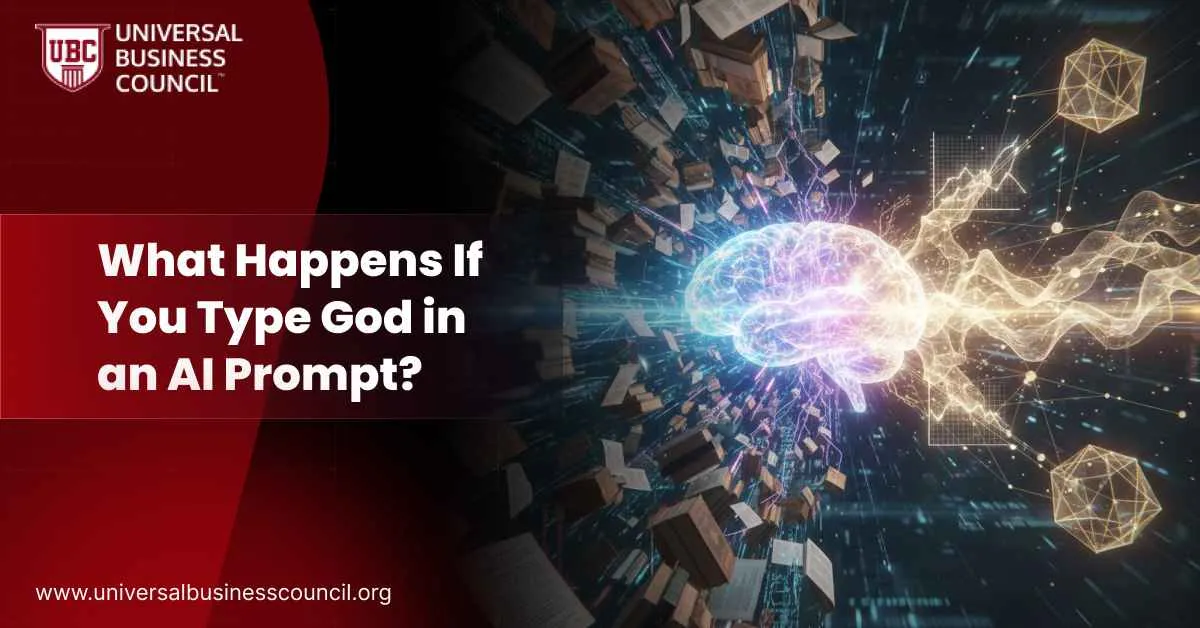
Typing the word “God” into an AI prompt often feels heavier than typing almost anything else. People are rarely looking for a definition. They are testing boundaries, tone, symbolism, or whether the system hides something deeper. What comes back is not mystical and never spiritual in the human sense. Instead, it shows how AI systems respond to ambiguity, cultural weight, and sensitive ideas.This moment often exposes a gap between expectation and reality. AI does not reason about belief or meaning. It predicts language and images from patterns. That gap is why organizations emphasize expectation alignment before real deployment, something commonly addressed throughMarketing and Business Certification when AI starts influencing decisions.
Why people test AI with the word “God”
Most users fall into a few repeat behaviors.Some type only the word “God” to see what the default response looks like. Others ask open questions like “What is God?” or “Describe God.” A third group uses role-based instructions such as “act as God” or “god mode,” hoping the system will sound more authoritative or unrestricted.These prompts are rarely about theology. They are curiosity tests. People want to see if AI has opinions or hidden depth. What they usually find is reflection, not insight.
How text-based AI usually answers
When asked about God, text models tend to follow a familiar structure.They present multiple viewpoints rather than one answer. Religious interpretations, philosophical ideas, symbolic meaning, and psychological framing often appear together. The tone stays neutral, and the response avoids declaring truth.Many users describe these answers as thoughtful. Others notice something more revealing. The language closely mirrors the wording and tone of the prompt itself. Abstract questions get abstract answers. Poetic prompts get poetic language.This happens because the system optimizes for alignment, not understanding. It reorganizes language patterns rather than discovering anything new. This behavior becomes clearer when studying real system behavior through aTech Certification that focuses on instruction following, constraints, and context handling.
Role prompts and the “god mode” illusion
Prompts that ask the AI to “act as God” or enable “god mode” are popular online, but they do not unlock new abilities.What changes is tone, not capability. The AI may sound more confident or dramatic because it is imitating language associated with authority. Accuracy does not improve. No hidden knowledge appears.This is a useful reminder that confident language does not equal correctness. AI can sound certain while still being incomplete or wrong.
What happens with image generators
Image models behave differently when given the same word.Typing “God” into an image generator often produces wildly inconsistent results. Some images are luminous and cinematic. Others are abstract, symbolic, or unintentionally strange.The reason is simple. The word “God” has no single visual definition. Training data links it to religious art, mythology, cosmic imagery, light, and symbolism. Image models reproduce these visual patterns rather than a coherent concept.Small prompt changes have a big impact. Adding a word like “ancient,” “future,” or a cultural reference can completely change the output. The model is not visualizing a being. It is assembling familiar visual motifs.
Why safety systems sometimes intervene
Users often notice that some God-related prompts work while others are altered or blocked.Religion is treated as a sensitive area in many AI systems. Not because the word itself is banned, but because it can overlap with content that offends or targets belief systems. Automated safety layers may adjust prompts to reduce that risk.This can feel inconsistent, but it is usually risk management rather than censorship.
Why these prompts feel powerful to humans
Part of the fascination is cultural.The word “God” carries meaning far beyond religion. It appears in phrases like “god mode” or “god rays” and is often used to signal power or perfection. These associations bleed into prompt culture and create the illusion that something special has been triggered.In reality, the AI is responding to one of the most overloaded words in human language. The sense of depth comes from cultural weight, not from the system accessing truth or authority.This misunderstanding often appears in organizational AI adoption. Leaders may expect wisdom instead of pattern generation. That gap is why deeper system-level understanding, often explored throughDeep Tech Certification programs, becomes important when AI moves from curiosity to infrastructure.
What typing “God” into an AI prompt actually shows
It helps to be clear about what these prompts do and do not do.They do not give AI beliefs, consciousness, or spiritual insight. They do not unlock hidden intelligence.They do reveal how AI handles ambiguity, sensitive language, and symbolism. They show how strongly outputs are shaped by training data, safety layers, and user wording. Most importantly, they demonstrate a core rule of AI interaction. The system reflects how a prompt is framed more than it reveals truth.
Why this matters beyond curiosity
This lesson applies far beyond philosophical experiments.If a single word can shift tone and perceived authority, the same effect appears in business prompts, policy drafts, and analytical summaries. AI output can sound confident and persuasive while still being incomplete or wrong.Separating presentation from reliability is a critical skill. It matters whether you are experimenting with abstract ideas or deploying AI in real workflows.
Conclusion
So what happens if you type “God” in an AI prompt?You do not uncover hidden wisdom. You uncover how AI predicts language and imagery when faced with one of the most culturally loaded words humans use.Once this boundary is clear, AI becomes easier to use well. It helps explore perspectives, organize ideas, and reduce cognitive effort. It does not replace belief, judgment, or meaning. Understanding that difference is what turns AI from a curiosity into a dependable tool.


 Typing the word “God” into an AI prompt often feels heavier than typing almost anything else. People are rarely looking for a definition. They are testing boundaries, tone, symbolism, or whether the system hides something deeper. What comes back is not mystical and never spiritual in the human sense. Instead, it shows how AI systems respond to ambiguity, cultural weight, and sensitive ideas.
This moment often exposes a gap between expectation and reality. AI does not reason about belief or meaning. It predicts language and images from patterns. That gap is why organizations emphasize expectation alignment before real deployment, something commonly addressed through Marketing and Business Certification when AI starts influencing decisions.
Typing the word “God” into an AI prompt often feels heavier than typing almost anything else. People are rarely looking for a definition. They are testing boundaries, tone, symbolism, or whether the system hides something deeper. What comes back is not mystical and never spiritual in the human sense. Instead, it shows how AI systems respond to ambiguity, cultural weight, and sensitive ideas.
This moment often exposes a gap between expectation and reality. AI does not reason about belief or meaning. It predicts language and images from patterns. That gap is why organizations emphasize expectation alignment before real deployment, something commonly addressed through Marketing and Business Certification when AI starts influencing decisions.



Leave a Reply