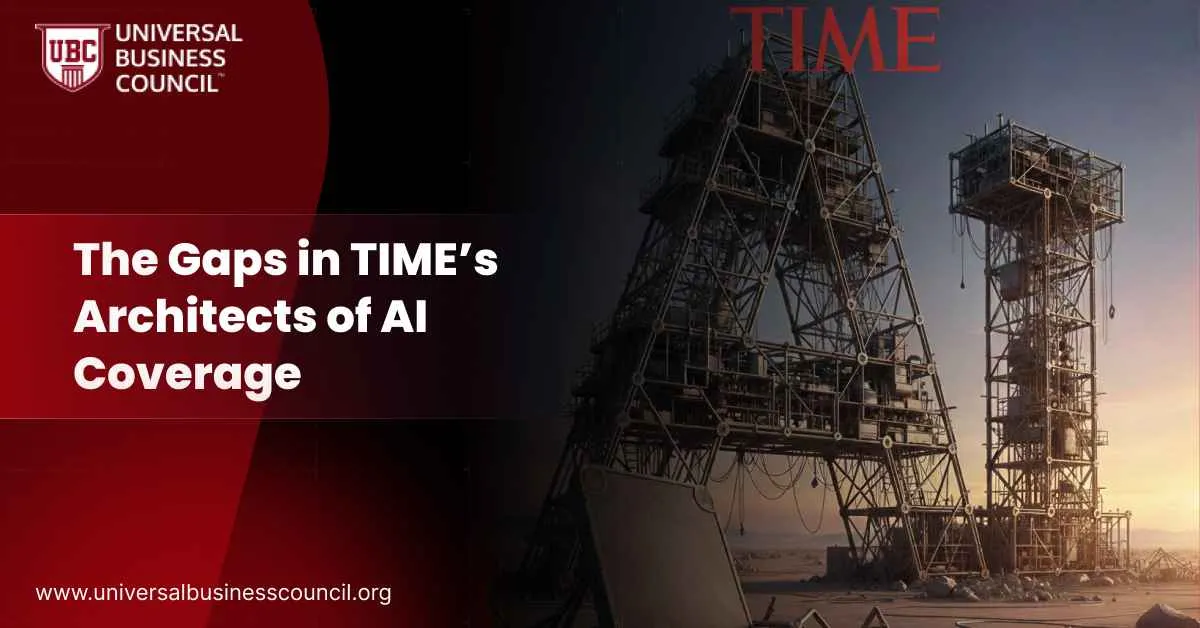
 TIME’s Architects of AI coverage set out to define who is shaping artificial intelligence at a moment when AI has moved far beyond research labs and product demos. The list highlighted model creators, chip executives, and founders whose companies dominate headlines and market capitalizations. That framing created a clean narrative, but it also left critical gaps. These gaps are not academic. They affect how governments regulate AI, how enterprises invest, and how communities experience the consequences of large-scale AI deployment.
The gaps in TIME’s Architects of AI coverage reveal a deeper issue. AI power today is no longer concentrated only in algorithms and compute. It is distributed across infrastructure, capital flows, policy enforcement, enterprise execution, and public consent. Leaving these dimensions out produces a distorted picture of how AI actually operates in the real world.
For business leaders and decision-makers trying to interpret this complexity, the conversation often starts with strategy rather than technology alone. That is why frameworks such as Marketing and Business Certification increasingly sit at the front of AI discussions, helping leaders connect technological capability with organizational reality.
TIME’s Architects of AI coverage set out to define who is shaping artificial intelligence at a moment when AI has moved far beyond research labs and product demos. The list highlighted model creators, chip executives, and founders whose companies dominate headlines and market capitalizations. That framing created a clean narrative, but it also left critical gaps. These gaps are not academic. They affect how governments regulate AI, how enterprises invest, and how communities experience the consequences of large-scale AI deployment.
The gaps in TIME’s Architects of AI coverage reveal a deeper issue. AI power today is no longer concentrated only in algorithms and compute. It is distributed across infrastructure, capital flows, policy enforcement, enterprise execution, and public consent. Leaving these dimensions out produces a distorted picture of how AI actually operates in the real world.
For business leaders and decision-makers trying to interpret this complexity, the conversation often starts with strategy rather than technology alone. That is why frameworks such as Marketing and Business Certification increasingly sit at the front of AI discussions, helping leaders connect technological capability with organizational reality.
A Builder-Centric View of Influence
TIME’s coverage treated AI architects primarily as builders. The emphasis was on people who design models, fabricate chips, or lead AI-first companies. That view assumes power flows from invention outward. In practice, AI influence is negotiated across multiple layers long after a model is trained.
By 2025, AI outcomes are shaped just as much by who controls deployment, funding, and adoption as by who writes the code. The coverage did not sufficiently acknowledge this shift, reinforcing the idea that innovation alone determines impact.
Infrastructure as a Deciding Force
One of the most visible gaps is physical infrastructure. AI systems run in data centers that require land, electricity, water, and regulatory approval. According to Goldman Sachs research published in June 2024, data centers consumed roughly 4 percent of total US electricity demand in 2023
, with projections rising to 8 percent by 2030.
This growth is not abstract. In November 2024, Virginia’s 30th House District election flipped after sustained opposition to large-scale data center expansion. Campaign messaging focused on zoning pressure, water usage, and transmission lines linked directly to AI workloads. These local outcomes shape where AI can operate at scale.
TIME acknowledged infrastructure in passing but did not treat it as a core axis of power. In reality, data centers now influence elections, permitting decisions, and energy planning.
Energy Constraints Were Undervalued
Closely tied to infrastructure is energy. The coverage referenced compute capacity but did not seriously engage with energy availability as a constraint.
Between October 2024 and January 2025, major AI infrastructure announcements exposed this tension. Meta’s Hyperion project in the US Southwest, Oracle-backed AI cloud expansions, and Elon Musk’s Stargate initiative for xAI all faced grid interconnection timelines that stretched beyond seven years in some regions.
AI models evolve in months. Power grids evolve in decades. This mismatch increasingly determines where AI growth is possible. Energy policy has effectively become AI policy, yet this connection was underexplored.
Capital Allocation as Structural Power
Another gap lies in how capital was portrayed. Investors on the list were framed as visionaries rather than as architects shaping outcomes through capital discipline.
SoftBank’s Masayoshi Son illustrates the scale of this influence. After losing approximately $70 billion during the dot-com crash and exiting Nvidia too early, Son pivoted decisively. By mid 2024, SoftBank had committed or earmarked more than $180 billion toward AI-related investments. This capital reshaped hiring markets, compute pricing, and startup survival rates.
Similarly, in October 2024, Thrive Capital launched Thrive Holdings, a vehicle designed to acquire traditional businesses and embed AI directly into operations. This model collapses the distance between AI development and real-world deployment, yet it received little attention in mainstream coverage.
Understanding these capital-driven feedback loops requires systems-level thinking that goes beyond product narratives. Many professionals explore this layer through advanced frameworks such as Deep Tech Certification, which focus on how large-scale technical systems interact with finance, infrastructure, and governance.
Enterprise Execution Was Largely Absent
TIME’s Architects of AI coverage focused heavily on creation and far less on execution. This is a significant omission.
Surveys conducted between September and December 2024 show that over 70 percent of large enterprises had piloted AI tools. Fewer than 30 percent reported measurable return on investment at scale. The most common blockers were data readiness, process redesign, compliance alignment, and employee trust.
These challenges are not solved by better models alone. They are organizational problems. The people translating AI capability into operational workflows were largely invisible in the coverage, despite being essential to whether AI delivers economic value.
China Was Treated as a Monolith
China’s role appeared in TIME’s coverage, but largely as a simplified rival. This missed important nuance.
In late 2024, Chinese AI firm DeepSeek released a model that surprised Western analysts by achieving strong performance with less advanced chips, lower compute budgets, and shorter training cycles. This challenged assumptions inside US policy circles that export controls alone would slow Chinese AI progress.
At the same time, internal Chinese policy debates in November 2024 focused on whether to accept Nvidia H200-class chips if access were restored or to continue prioritizing domestic chip development at the cost of short-term performance. These strategic tradeoffs shape global AI competition more than headline model releases.
Skepticism Still Shapes the Market
Public skepticism was briefly mentioned but understated.
Michael Burry closed his hedge fund in October 2024 after years of shorting AI-related stocks. Despite the closure, his commentary continues to influence narratives around AI capital expenditure risk. In a November 2024 Bloomberg column, Jonathan Levin observed that society remains drawn to contrarian figures who warn of bubbles even as adoption accelerates.
This skepticism affects boardroom decisions, regulatory caution, and investment pacing. AI narratives interact constantly with financial memory and fear.
The Middle East’s Strategic Role Was Overlooked
One of the most consequential gaps is geographic. The Middle East received minimal attention.
By late 2024, entities in the UAE and Saudi Arabia were financing or hosting some of the world’s largest planned AI compute clusters. Firms like G42 positioned themselves as neutral AI infrastructure hubs between the US and China, leveraging sovereign wealth and low-cost energy.
These investments shape where models are trained and who controls access to compute. Excluding this region distorts the global map of AI power.
Cultural Resistance Was Treated Lightly
AI adoption is not only technical. It is cultural.
Hollywood labor disputes in 2023 and 2024 made AI a flashpoint around authorship and compensation. While TIME acknowledged creative concerns, it did not explore hybrid solutions emerging in response. Companies such as Asteria are developing IP-safe video models designed to work within existing creative frameworks rather than replace them.
Treating resistance as a design constraint rather than a public relations issue is critical for long-term adoption.
Local Communities Are Becoming Gatekeepers
Perhaps the most overlooked group in TIME’s coverage is local communities.
Data centers, transmission lines, and water usage have forced AI into zoning hearings and town halls. Organized opposition has delayed or blocked projects across several states. Executive efforts to limit state-level AI regulation have already faced resistance from governors concerned about infrastructure impact.
AI is no longer debated only in national policy circles. It is negotiated locally.
Participation Is the Missing Thread
The deepest gap in TIME’s Architects of AI coverage is participation.
When AI architects are portrayed only as executives and billionaires, AI feels imposed. When enterprises, educators, operators, and communities are acknowledged, AI becomes negotiated. That difference shapes trust, legitimacy, and adoption.
Leaders increasingly recognize that AI strategy cannot be separated from organizational communication and change management. This is where practical grounding through Tech Certification often complements deeper technical expertise.
Conclusion
The gaps in TIME’s Architects of AI coverage do not invalidate the list. They expose its limits.
AI’s future will not be decided by models alone. It will be shaped by grids, capital allocation, enterprise execution, public resistance, and geopolitical positioning. The real architects include those who build, those who finance, those who regulate, and those who live alongside the infrastructure.
Understanding these layers is no longer optional. AI has become infrastructure, and infrastructure shapes everything that follows.