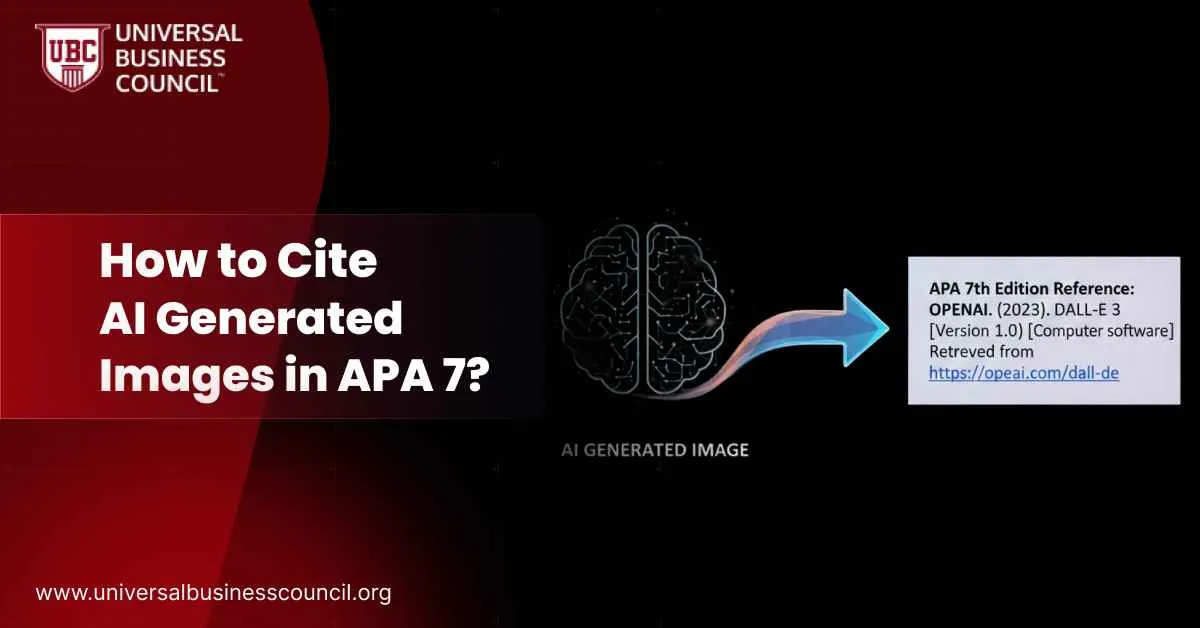
AI-generated images are now part of everyday academic work. Students use them in assignments, researchers include them in papers, and presenters rely on them for slides and visual explanations. The uncertainty usually begins with one question: how do you cite an AI-generated image in APA 7 without risking penalties or confusion?The answer is simpler than it looks. APA 7 already provides the structure. What most people struggle with is understanding where disclosure belongs and when a reference is actually required. Once you understand that logic, the formatting becomes routine rather than stressful.This issue often comes up when AI moves from experimentation into real deliverables, which is why responsible documentation is frequently discussed in execution-focused programs likeMarketing and Business Certification, where transparency and attribution are treated as operational necessities, not optional extras.
How APA 7 approaches images
APA 7 does not treat images as special or separate sources by default. It treats them as figures.Every figure in APA 7 follows the same core structure:
A figure number in bold
A figure title in italics written in Title Case
The image itself
A figure note, when explanation or attribution is needed
AI-generated images fit directly into this framework. You are not creating a new citation category. You are explaining how the figure was created.The key difference with AI images is disclosure. APA cares about whether a reader can understand how the figure came into existence and whether they could retrieve it themselves.
The principle that clears most confusion
APA 7 does not yet have a dedicated page that says “This is exactly how to cite AI-generated images.” Instead, institutions rely on an underlying rule that already exists.If a reader cannot independently retrieve the exact same image, you usually do not place it in the reference list. You explain it in the figure note.That single idea explains why some AI images need references and others do not.
What you should record when generating an AI image
Before thinking about formatting, you should capture a few details at the moment the image is created. These details matter for academic honesty and future clarification.You should always record:
Any share link, image ID, or output reference if one exists
The prompt is especially important. It documents the human input that shaped the image. Without it, reviewers cannot tell whether the image reflects original academic intent or undisclosed automation.
The most common APA 7 method used in coursework
For most assignments, the expected approach is figure-note disclosure only.This method applies when:
You generated the image yourself
The image is not publicly accessible
There is no stable URL others can open
In this situation, the image is treated as an original figure, with disclosure added.Basic formatFigure XShort Descriptive Title in Title Case [Image] Note. Image created using [tool name] on [Month Day, Year] from the prompt: “Exact prompt used.”Illustrative exampleFigure 1AI-Generated Illustration of a Coastal Flood Defense System [Image] Note. Image created using Midjourney on March 3, 2026, from the prompt: “Coastal flood barriers at sunset, realistic style, wide-angle view.”No reference list entry is required here because the reader cannot independently retrieve the same image.
When the AI tool itself must be referenced
Some departments, especially in technical or research-oriented programs, ask students to cite the AI tool as software.In this case, you do two things:
Keep the full figure note with prompt disclosure
Add a reference list entry for the AI tool
A standard APA-style software reference looks like this:Company Name. (Year). Tool name (Version) [Software]. URLThe figure note explains how the image was generated. The reference documents the tool as a piece of software.This approach often reflects system-level thinking emphasized in applied learning paths like aTech Certification, where reproducibility, tooling, and documentation are treated as part of technical competence.
Publicly accessible AI-generated images
The rules change slightly when an AI-generated image can be accessed by others.This applies if:
The image appears on a public website or report
There is a stable share link
The reader can view the same image you used
In this case:
The figure note still discloses that the image was AI-generated and includes the prompt
The reference list includes a citation pointing to the page where the image is hosted
This follows standard APA logic. If a reader can retrieve it, it belongs in the references.
Why prompts matter more than people expect
In traditional image citation, the creative process is rarely visible. With AI images, the prompt is the creative input.Including the prompt:
Shows academic honesty
Clarifies intent
Explains stylistic or conceptual choices
Reduces suspicion about misuse
Many instructors care less about which tool you used and more about whether you disclosed how the output was shaped.
Common mistakes that cause problems
Most issues around AI image citation do not come from using AI. They come from poor disclosure.The most frequent mistakes include:
Clear disclosure almost always prevents academic integrity concerns.
Using APA-style figures in slides and presentations
When APA style is applied to slides:
Place a short figure note directly below the image
Put the full prompt and details in speaker notes or an appendix slide
Keep formatting consistent across the deck
In presentation-heavy disciplines, clarity often matters as much as strict formatting. This balance between compliance and communication is why AI usage is frequently discussed alongside governance and accountability in deeper system-focused programs such asDeep Tech Certification tracks.
Final takeaway
Citing AI-generated images in APA 7 does not require new rules or guesswork.AI images are treated as figures. Disclosure usually belongs in the figure note. References are only required when retrieval is possible. Prompts matter for transparency and integrity.When you are unsure, disclose more rather than less. That habit aligns with APA 7 principles and protects you in almost every academic situation involving AI-generated images.


 AI-generated images are now part of everyday academic work. Students use them in assignments, researchers include them in papers, and presenters rely on them for slides and visual explanations. The uncertainty usually begins with one question: how do you cite an AI-generated image in APA 7 without risking penalties or confusion?
The answer is simpler than it looks. APA 7 already provides the structure. What most people struggle with is understanding where disclosure belongs and when a reference is actually required. Once you understand that logic, the formatting becomes routine rather than stressful.
This issue often comes up when AI moves from experimentation into real deliverables, which is why responsible documentation is frequently discussed in execution-focused programs like Marketing and Business Certification, where transparency and attribution are treated as operational necessities, not optional extras.
AI-generated images are now part of everyday academic work. Students use them in assignments, researchers include them in papers, and presenters rely on them for slides and visual explanations. The uncertainty usually begins with one question: how do you cite an AI-generated image in APA 7 without risking penalties or confusion?
The answer is simpler than it looks. APA 7 already provides the structure. What most people struggle with is understanding where disclosure belongs and when a reference is actually required. Once you understand that logic, the formatting becomes routine rather than stressful.
This issue often comes up when AI moves from experimentation into real deliverables, which is why responsible documentation is frequently discussed in execution-focused programs like Marketing and Business Certification, where transparency and attribution are treated as operational necessities, not optional extras.


Leave a Reply