

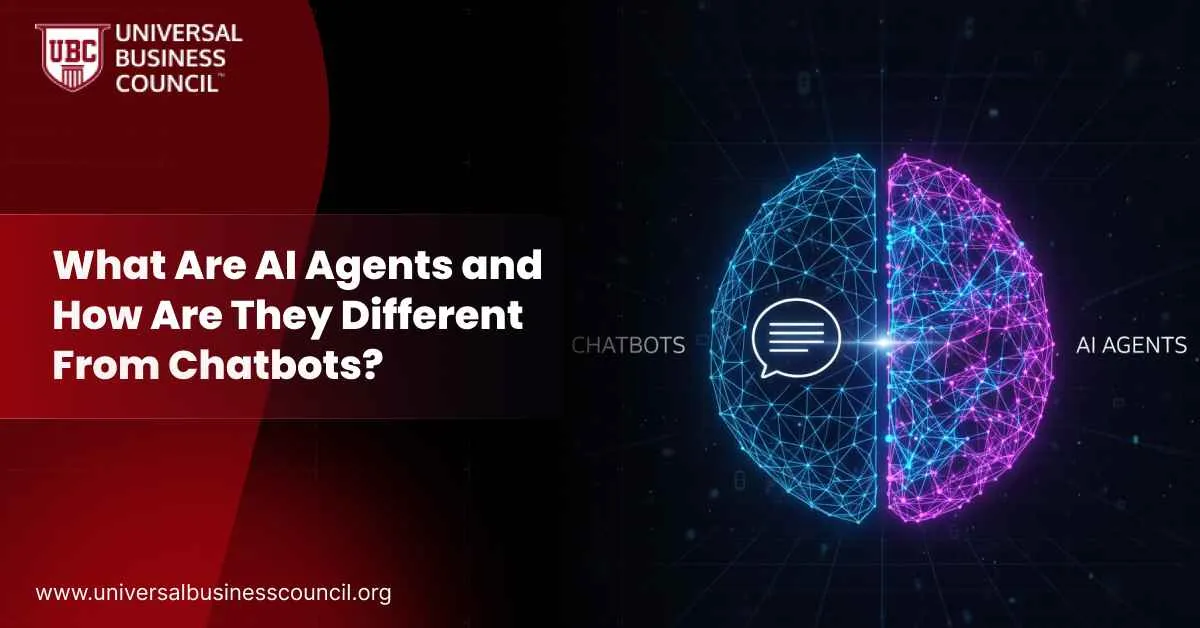
 AI agents and chatbots are often mentioned together, but they are not the same thing. To answer the search intent directly: AI agents go beyond conversation by reasoning, planning, and acting on goals, while chatbots mainly respond to user inputs in a conversational way. This difference is shaping how businesses think about automation and digital interaction. For leaders exploring how these tools tie into long-term growth, a Marketing and Business Certification provides the right perspective to connect customer-facing innovation with business outcomes.
What Are AI Agents?
AI agents are autonomous systems that can make decisions, trigger workflows, and interact with external tools or applications. Instead of just answering a query, they can break down a larger goal into smaller steps, plan actions, and execute them. Frameworks like the Autonomous Cognitive Entity model show how agents combine strategy, control, and task execution to operate without constant prompts. For those who want to explore the technical side of these intelligent systems, an AI certification offers practical training in how AI models are applied across industries.What Are Chatbots?
Chatbots are designed for conversation. They can guide users through structured flows, answer FAQs, or handle simple interactions. Some modern chatbots use language models for more flexible dialogue, but they usually stop at providing responses. They don’t take multi-step actions or manage tasks independently. If you’re interested in gaining a broad understanding of the AI tools behind these systems, exploring AI certs gives a clear path into specialized areas of artificial intelligence.Comparing AI Agents and Chatbots
| Dimension | AI Agents | Chatbots |
| Autonomy | Act on goals, plan, and complete tasks | Respond only when prompted |
| Tool use | Can connect with apps, APIs, and databases | Limited to conversation or preset flows |
| Complexity | Handle multi-step reasoning and workflows | Designed for simpler interactions |
| Adaptability | Adjust to changing inputs and contexts | Rigid and rule-based in most cases |
| Scope | Broad applications across industries | Narrow focus on support or FAQ-style help |
| Transparency | Harder to trace due to decision layers | Easier to understand because logic is simple |
| Risk | Greater risk if misused due to autonomy | Lower risk, as scope is restricted |
| Examples | AutoGPT, Kruti, business process agents | FAQ bots, website assistants, customer support bots |


Leave a Reply