

What Are AI Agents and How Are They Different From Chatbots?

What Are AI Agents?
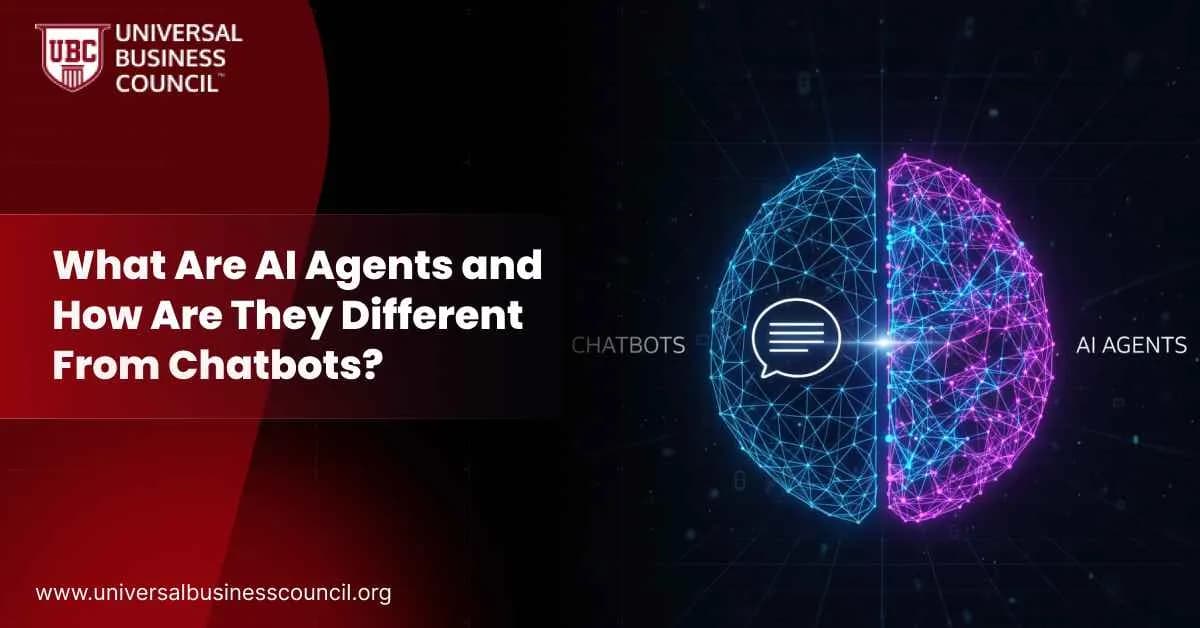
AI agents are autonomous systems that can make decisions, trigger workflows, and interact with external tools or applications. Instead of just answering a query, they can break down a larger goal into smaller steps, plan actions, and execute them. Frameworks like the Autonomous Cognitive Entity model show how agents combine strategy, control, and task execution to operate without constant prompts. For those who want to explore the technical side of these intelligent systems, an AI certification offers practical training in how AI models are applied across industries.What Are Chatbots?
Chatbots are designed for conversation. They can guide users through structured flows, answer FAQs, or handle simple interactions. Some modern chatbots use language models for more flexible dialogue, but they usually stop at providing responses. They don’t take multi-step actions or manage tasks independently. If you’re interested in gaining a broad understanding of the AI tools behind these systems, exploring AI certs gives a clear path into specialized areas of artificial intelligence.Comparing AI Agents and Chatbots
| Dimension | AI Agents | Chatbots |
| Autonomy | Act on goals, plan, and complete tasks | Respond only when prompted |
| Tool use | Can connect with apps, APIs, and databases | Limited to conversation or preset flows |
| Complexity | Handle multi-step reasoning and workflows | Designed for simpler interactions |
| Adaptability | Adjust to changing inputs and contexts | Rigid and rule-based in most cases |
| Scope | Broad applications across industries | Narrow focus on support or FAQ-style help |
| Transparency | Harder to trace due to decision layers | Easier to understand because logic is simple |
| Risk | Greater risk if misused due to autonomy | Lower risk, as scope is restricted |
| Examples | AutoGPT, Kruti, business process agents | FAQ bots, website assistants, customer support bots |
Why AI Agents Are Different
The defining trait of AI agents is autonomy. They don’t wait for commands but instead work toward achieving objectives. This allows them to complete multi-step tasks like booking travel, ordering supplies, or updating databases without ongoing human guidance. Chatbots, in contrast, stay in the realm of conversation. They may feel intelligent, but they don’t act independently. For professionals interested in learning how such autonomous systems are designed, an Agentic AI certification gives a focused view of applied intelligent agents.Practical Examples
AI agents are already being deployed. AutoGPT can split a high-level goal into smaller subtasks and complete them without extra input. Kruti, an agentic AI tool built in India, can book rides, order food, and handle requests in multiple languages. In customer service, AI agents are starting to manage refunds, order changes, and backend system updates, going beyond the scope of simple chatbots. For those who want to learn the technical foundations needed to build such tools, tech certifications provide valuable hands-on knowledge.Challenges and Risks
AI agents are powerful but not without risks. They can make mistakes if they hallucinate or misinterpret tasks. Their decision paths are harder to trace, making explainability a concern. They also raise safety issues, as granting them too much control could lead to unintended actions. Managing permissions and building safeguards is crucial. Developers who want to focus on designing safe and ethical systems should explore deep tech certification, which emphasizes responsible innovation.Why the Distinction Matters
Chatbots are still valuable for quick answers and customer support, but AI agents represent a shift toward systems that act, not just respond. This distinction matters because it changes how companies plan their digital strategies. Chatbots reduce human effort in communication, while AI agents expand what automation can achieve in business operations. For anyone looking to understand the wider role of these technologies, studying technology provides the background needed to navigate this new space.Conclusion
AI agents and chatbots may share conversational roots, but their capabilities are very different. Chatbots keep conversations flowing, while AI agents step into action, reasoning, and planning. Small or large, businesses adopting these tools need to understand both their strengths and risks. As AI becomes more embedded in everyday work, distinguishing between agents and chatbots will guide smarter adoption and better strategies.Related Articles
View AllArtificial Intelligence
System One Models for AI Agents
Explore how System One Models can support AI agents with fast, typed, probabilistic decisions for routing, scoring, verification, branching, and automated workflows.
Artificial Intelligence
Jev vs AI Agents
Compare Jev and AI agents to understand how Jev provides fast, typed, probabilistic decisions while agents coordinate models, tools, actions, and multi-step workflows.
Artificial Intelligence
RSI vs Recursive Self-Training: How Are They Different?
Learn how recursive self-improvement differs from recursive self-training, including what each process changes, how they work, and why the distinction matters in AI development.
Trending Articles
The Role of Blockchain in Ethical AI Development
How blockchain technology is being used to promote transparency and accountability in artificial intelligence systems.
AWS Career Roadmap
A step-by-step guide to building a successful career in Amazon Web Services cloud computing.
Top 5 DeFi Platforms
Explore the leading decentralized finance platforms and what makes each one unique in the evolving DeFi landscape.