

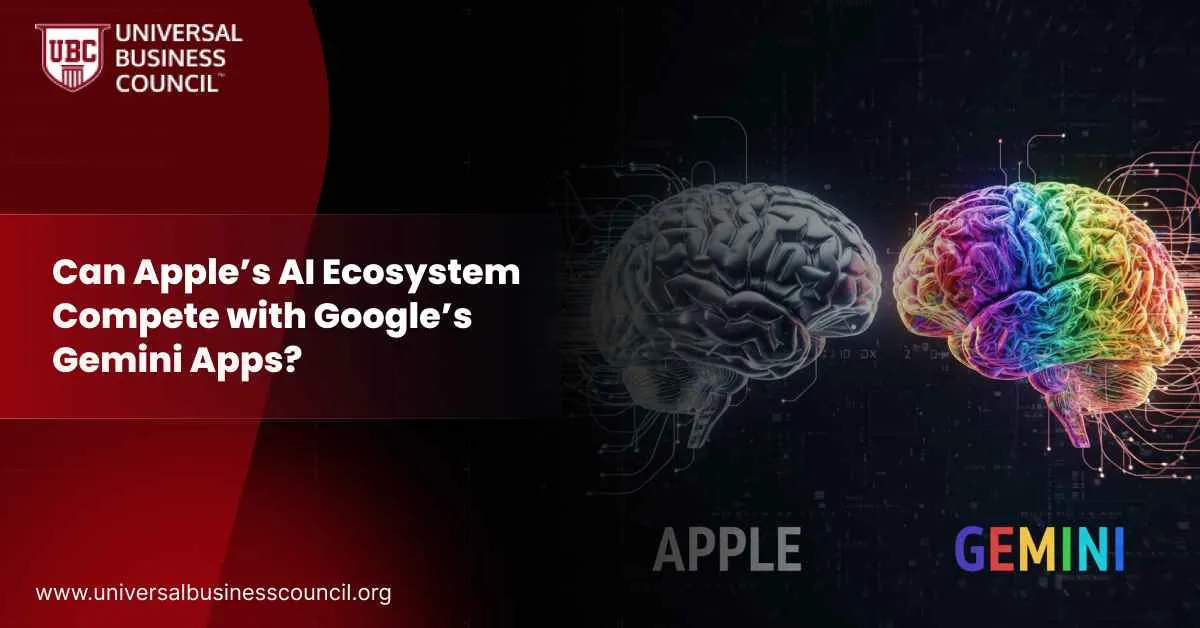
 The biggest question in smartphones today is no longer about cameras or battery life. It’s about AI. Apple has rolled out Apple Intelligence across its devices, while Google has expanded Gemini into apps, subscriptions, and even TVs. Both companies are racing to define how we work, learn, and create with AI. So the real question is simple: can Apple’s ecosystem stand against Google’s fast-moving Gemini apps?
If you want to understand how these shifts connect to professional skills, the Marketing and Business Certification is a strong path for building leadership in AI-driven growth.
The biggest question in smartphones today is no longer about cameras or battery life. It’s about AI. Apple has rolled out Apple Intelligence across its devices, while Google has expanded Gemini into apps, subscriptions, and even TVs. Both companies are racing to define how we work, learn, and create with AI. So the real question is simple: can Apple’s ecosystem stand against Google’s fast-moving Gemini apps?
If you want to understand how these shifts connect to professional skills, the Marketing and Business Certification is a strong path for building leadership in AI-driven growth.
Apple Intelligence: Tight Integration with Limits
Apple’s strategy centers on Apple Intelligence, a system designed to blend on-device models with a privacy layer called Private Cloud Compute. It works across iPhone, iPad, Mac, Watch, and Vision Pro, making the AI feel like part of the system rather than an add-on. Apple offers tools like writing support, Live Translation, smarter Siri, and image cleanup. Developers now get access to the underlying models through a new Foundation Models framework, which allows third-party apps to use Apple’s AI — even offline. The strength of Apple’s approach is its polish and tight ecosystem. The downside is exclusivity. Only newer devices with the latest chips can run Apple Intelligence in full. This limits reach, especially compared to Google’s broader rollout. Privacy is also under scrutiny. Independent research has found that more data may be sent to Apple servers than Apple initially claimed, raising questions about how private “private” really is.Google Gemini: Apps That Go Everywhere
Google is pushing hard with Gemini. The Gemini app is replacing Google Assistant on Android devices, handling phone functions like calls and messages. With Gemini Live, users can talk naturally to the model. Gemini 2.5 Flash has boosted reasoning, formatting, and image understanding, making answers clearer. There’s also Gemini Advanced, now packaged as part of Google AI Pro, which adds long-context reasoning and creative tools. The Gemini ecosystem isn’t limited to phones. It’s moving into TVs, smart displays, and the Home app, where “Ask Home” lets you control your house through conversational commands. Gemini also added Agent Mode with Project Mariner, enabling the AI to perform multi-step tasks on its own. This step toward autonomy shows where Google wants to go: an AI that doesn’t just answer but acts. Gemini’s openness and fast updates make it appealing, but its reliance on subscriptions and cloud processing could frustrate users who want more features without paying. Privacy is also a concern, even though Google now offers options like Temporary Chats that don’t train its models.Apple Intelligence vs Google Gemini
Here’s a simple look at where Apple Intelligence and Gemini stand right now:| Area | Apple Intelligence | Google Gemini |
| Core Features | Writing help, Live Translation, improved Siri, photo cleanup | Gemini Live, app extensions, 2.5 Flash upgrades, reasoning improvements |
| Developer Access | Foundation Models framework for third-party apps | Gemini API, multiple model sizes, Agent Mode for autonomous tasks |
| Ecosystem Reach | iPhone, iPad, Mac, Watch, Vision Pro | Phones, TVs, smart displays, Home app, web |
| Privacy Stance | Strong marketing around Private Cloud Compute but under scrutiny | On-device Nano for some tasks, Temporary Chats for privacy, cloud-heavy |
| Availability | Limited to devices with A17 Pro or newer | Broad rollout across many Android devices, plus Google AI Pro tier |
| Pricing | No direct cost but tied to hardware upgrades | Free basics, premium features via AI Pro subscription |





Leave a Reply