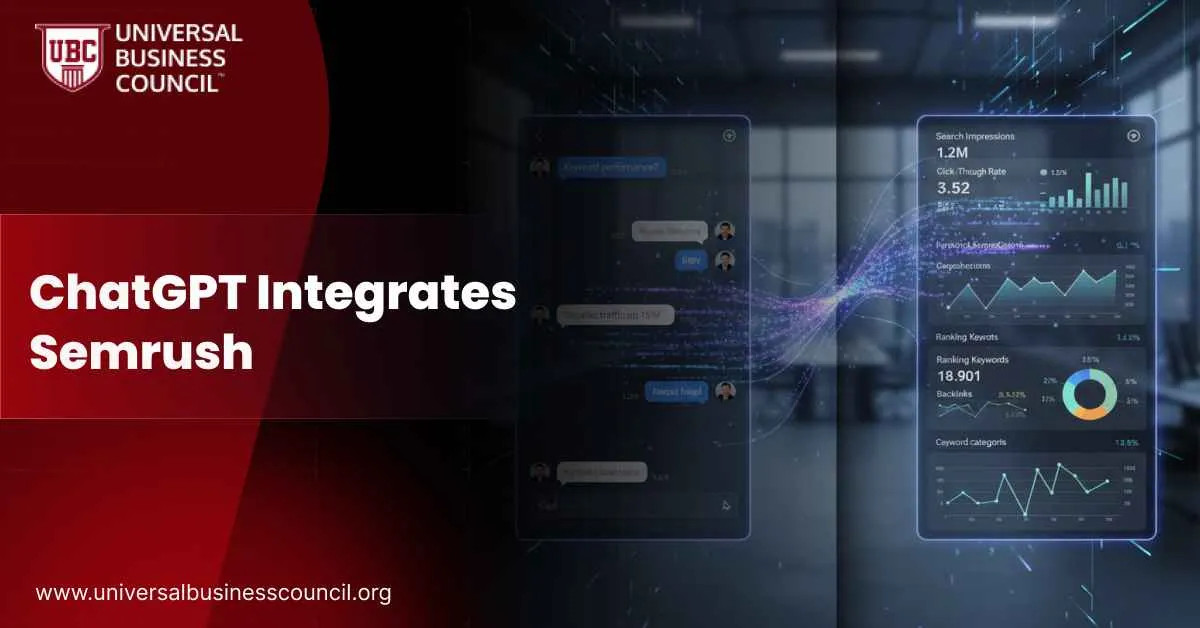
For a long time, AI writing tools and SEO platforms lived in separate worlds. Ideas were generated in ChatGPT, then manually checked, rewritten, or validated inside Semrush. That back and forth created delays and, more importantly, uncertainty. Suggestions sounded confident, but the numbers still had to be verified elsewhere.That separation is now gone. With Semrush integrating directly into ChatGPT, marketers can work inside a single flow where ideas, analysis, and live SEO data sit in the same conversation. This shift matters because modern marketing decisions are no longer driven by intuition alone. They are driven by evidence, which is why many teams anchor their thinking in frameworks commonly discussed in aMarketing and business certification.
What the Integration Actually Changes
The key difference is simple but powerful. ChatGPT can now access real Semrush data instead of guessing. Before this integration, ChatGPT could propose keywords, competitors, or content ideas, but those outputs were based on patterns in training data, not current SEO metrics.With Semrush connected, responses can reference actual traffic trends, keyword difficulty, ranking positions, and visibility metrics. This changes ChatGPT from a brainstorming assistant into a data grounded decision tool.
The Official Semrush App Inside ChatGPT
On 17 December 2025, Semrush launched its official app inside ChatGPT. This app allows authenticated Semrush users to pull Semrush insights directly into a chat without switching tabs.Once connected, ChatGPT can surface live metrics inside responses. For example, instead of suggesting that a competitor might be growing, the assistant can show how organic traffic has actually changed over the last few months.
Who Can Access It
According to Semrush, the app is available to users on Enterprise, EDU, Business, Pro, and Plus plans. Regional availability can vary, which means some users may see it immediately while others may need to enable it through their account settings.The important point is that this is a first party integration tied to your Semrush subscription, not a public demo or third party plugin.
Practical Workflows Enabled
Semrush highlights several workflows that become far easier with the app installed:
Competitive analysis inside a single prompt, including traffic and ranking comparisons
Data backed content briefs that combine keyword difficulty, intent, and SERP features
Automated reporting outputs that can be sent to tools like Google Docs, Notion, Slack, or email through agent based actions
Instead of exporting CSV files and explaining them manually, users can ask questions and receive summaries that already reflect the underlying data.
The Semrush MCP Connector Behind the Scenes
Under the surface, this integration is powered by Semrush’s MCP connector. MCP acts as the secure data layer that allows AI tools to query Semrush APIs in a controlled way.The connector exposes access to Semrush’s Trends API, Analytics API v3, and read only endpoints from Projects API v3. This means ChatGPT can read data but cannot modify projects or settings.Authentication is handled through OAuth by default, with API key support in cases where OAuth is not available. Usage consumes API units from the Semrush subscription, and Semrush notes that there are no additional ChatGPT specific fees beyond your existing plan.This architecture reflects a broader move toward AI systems that interact directly with production data sources, a pattern often explored in depth through aDeep Tech certification where system boundaries, access control, and reliability are core topics.
How This Fits Into ChatGPT’s App Platform
The Semrush integration exists because OpenAI expanded ChatGPT into a platform for installable apps in late 2025. Along with an Apps SDK and an app directory, this shift allows third party tools to appear as native capabilities inside ChatGPT.Semrush is one of the clearest examples of how this model works in practice. Instead of building a separate AI interface, the tool brings its data directly into the conversational environment where users already work.This approach signals where AI tooling is heading. Rather than replacing existing platforms, AI becomes the interface layer that connects them.
What You Can Do Now That You Could Not Before
With the official app or MCP connector enabled, prompts can move beyond speculation and into verification. Examples include:
Pulling organic traffic trends for a domain and summarizing what changed and why
Identifying top organic competitors in a specific market and explaining ranking gaps
Creating content briefs that combine keyword clusters, intent signals, and SERP analysis
Because the assistant can fetch real numbers, the outputs are anchored in current data rather than assumptions.
Third Party Automation Still Has a Role
Tools like Zapier can still connect Semrush and ChatGPT for no code automation. These setups are useful when teams want rigid workflows across multiple applications.However, they are not the same as native data access. The key difference is context. The official integration allows ChatGPT to reason over Semrush data in the middle of a conversation, not just pass information from one system to another.
Things to Check Before You Rely on It
There are a few practical considerations before building workflows around the integration:
Some regions may require enabling developer mode to access MCP connectors
Heavy data pulls will consume Semrush API units
Availability depends on both plan level and regional rollout
These are normal constraints for early platform integrations, but they matter when planning scale.
Why This Matters Long Term
The integration between ChatGPT and Semrush is not just about convenience. It represents a shift in how marketing work is done. Strategy, execution, and validation are starting to happen in the same place.As AI becomes the front end for more business tools, teams that understand both the technical and operational implications will move faster. That broader perspective, often built through programs like aTech certification, helps professionals connect tooling decisions with long term outcomes.
Bottom Line
ChatGPT integrating Semrush turns conversational AI into a data backed marketing workspace. Ideas are no longer separated from validation, and insights no longer require manual translation between tools.For teams focused on SEO, content, and competitive intelligence, this is a meaningful step forward. It shows how AI is evolving from a creative assistant into a decision layer grounded in real world data.


 For a long time, AI writing tools and SEO platforms lived in separate worlds. Ideas were generated in ChatGPT, then manually checked, rewritten, or validated inside Semrush. That back and forth created delays and, more importantly, uncertainty. Suggestions sounded confident, but the numbers still had to be verified elsewhere.
That separation is now gone. With Semrush integrating directly into ChatGPT, marketers can work inside a single flow where ideas, analysis, and live SEO data sit in the same conversation. This shift matters because modern marketing decisions are no longer driven by intuition alone. They are driven by evidence, which is why many teams anchor their thinking in frameworks commonly discussed in a Marketing and business certification.
For a long time, AI writing tools and SEO platforms lived in separate worlds. Ideas were generated in ChatGPT, then manually checked, rewritten, or validated inside Semrush. That back and forth created delays and, more importantly, uncertainty. Suggestions sounded confident, but the numbers still had to be verified elsewhere.
That separation is now gone. With Semrush integrating directly into ChatGPT, marketers can work inside a single flow where ideas, analysis, and live SEO data sit in the same conversation. This shift matters because modern marketing decisions are no longer driven by intuition alone. They are driven by evidence, which is why many teams anchor their thinking in frameworks commonly discussed in a Marketing and business certification.


Leave a Reply