

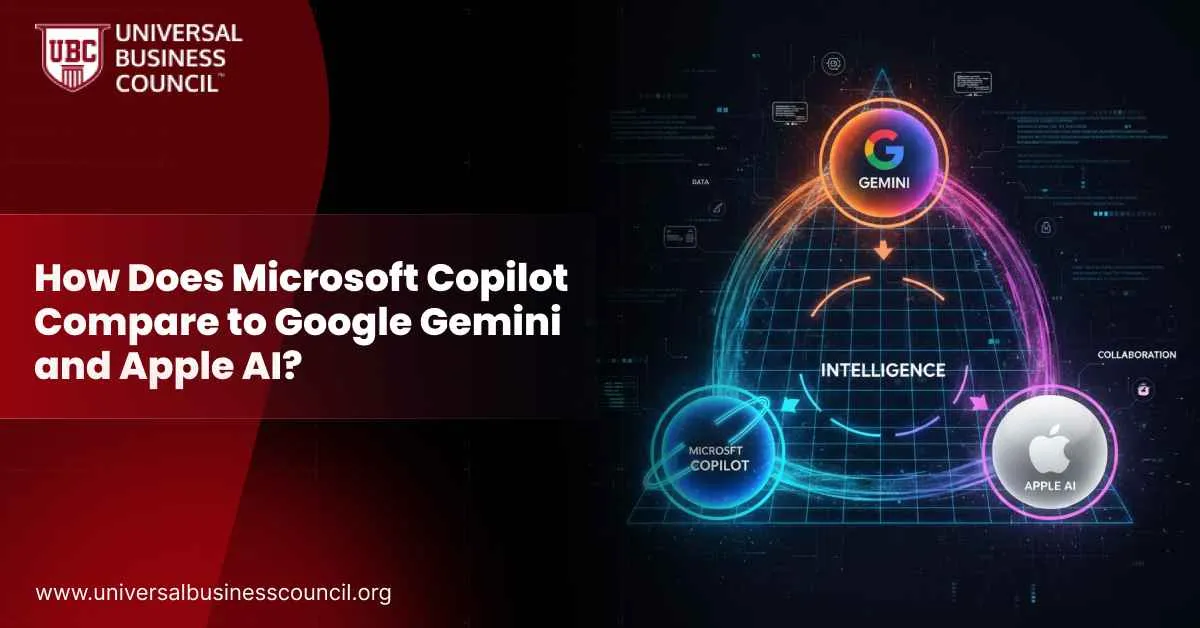
 In 2025, professionals have more choice than ever when it comes to AI ecosystems. Microsoft Copilot, Google Gemini, and Apple Intelligence all promise to boost productivity, but they do so in very different ways. Microsoft embeds AI deep into its Office suite and enterprise tools. Google Gemini focuses on flexibility and multimodal reasoning. Apple emphasizes privacy and seamless device integration. For people who want to understand how these tools can drive organizational growth, the Marketing and Business Certification is an excellent way to get started.
Microsoft Copilot: Productivity with Enterprise Focus
Microsoft Copilot has become the workhorse of the professional AI space. It sits inside Word, Excel, PowerPoint, Outlook, and Teams, handling everything from meeting summaries to variance analysis. In 2025, Microsoft added support for Anthropic’s Claude models, giving users more choice beyond OpenAI’s GPT-4. This makes Copilot a multi-model tool, capable of adapting to different reasoning needs. Copilot Studio is another big step. It allows companies to build custom agents that can interact with apps and even legacy systems that lack APIs. Microsoft also added Copilot Mode in Edge, a unified chat and navigation experience that helps users manage tabs and context in the browser. Still, professionals report that while Copilot boosts speed for routine tasks, it sometimes struggles with deeper reasoning and complex analysis.Google Gemini: Flexible and Multimodal
Google Gemini has leaned into versatility. It’s designed as a multimodal system, handling text, images, audio, and video. Gemini is strong in creative and research-oriented tasks, thanks to its ability to process long context windows and multiple file types. Its cross-app prompts let users move from research to email to scheduling in a single flow, something that appeals to freelancers and teams who need flexibility. In coding, Gemini 2.5 Pro shows up in GitHub Copilot, giving developers a choice between Gemini and Microsoft’s own integrated models. This kind of interoperability sets Google apart. Reviews often note that Gemini is the best for handling diverse formats and very long conversations, though it lacks Microsoft’s enterprise-grade compliance and security guarantees.Apple Intelligence: Privacy and Device Integration
Apple’s approach is built on trust. Apple Intelligence runs most of its features on-device, using Private Cloud Compute only when absolutely necessary, and discards that data immediately after processing. The tools focus on everyday workflows: live translation, writing support, and intelligent automation in Shortcuts. While Apple doesn’t match Microsoft’s enterprise focus or Google’s multimodal breadth, it has a powerful advantage in device synergy. Features move smoothly across iPhones, iPads, and Macs, creating a seamless experience for professionals already committed to Apple hardware. Reports suggest Apple is exploring ways to integrate Google’s Gemini into Siri, which could combine Apple’s privacy-first stance with Google’s generative power.Comparing Copilot, Gemini, and Apple AI in 2025
| Dimension | Microsoft Copilot | Google Gemini | Apple Intelligence |
| Integration | Deep inside Office, Teams, Dynamics, Power Platform | Cross-app prompts across Gmail, Docs, Calendar, Android, iOS | Tied closely to iPhone, iPad, and Mac ecosystems |
| Model flexibility | OpenAI GPT + Anthropic Claude options | Strong multimodal reasoning, flexible use cases | Limited flexibility, but exploring Gemini partnership |
| Enterprise focus | Strong compliance, tenant data protection, Copilot Studio for automation | Less enterprise compliance, more creative and developer strength | Less enterprise focus, strong for personal and professional privacy |
| File and context handling | Works best with structured Office documents | Handles multimodal inputs and long contexts (up to ~1M tokens) | Limited scope, device-first everyday tasks |
| Privacy posture | Data stays in tenant, not used for model training | Data use depends on product and plan settings | On-device processing, Private Cloud Compute discards requests |




Leave a Reply