

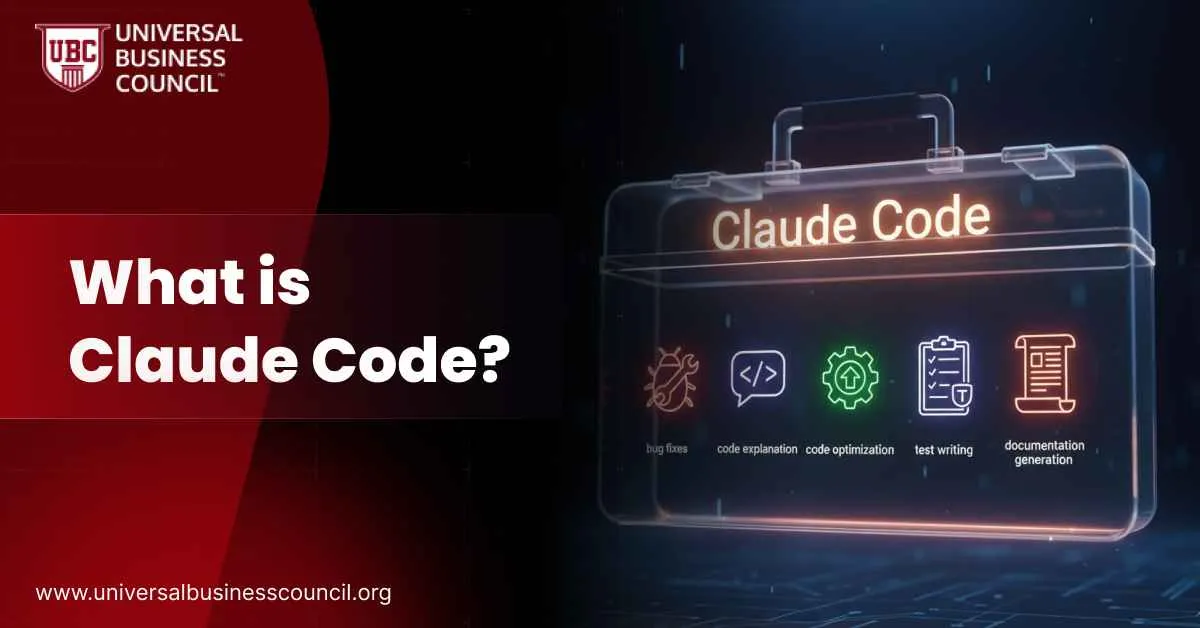
 Claude Code has become one of the most advanced AI driven development systems available today. It is not a code assistant, nor is it a snippet generator. It is a full scale agentic coding environment that can read repositories, diagnose issues, execute commands, run tests, apply multi file changes and prepare production ready patches. Businesses exploring how this shift affects product velocity and engineering operations often start with strategic upskilling through the Marketing and Business Certification because Claude Code is transforming not just coding workflows but the entire structure of how software teams collaborate.
Claude Code Explained in Clear Terms
Claude Code is an agentic development environment built on top of Claude, but designed specifically for real software tasks. Instead of generating code tokens, Claude Code operates like a virtual engineer that can:- Explore full repositories
- Apply refactors across multiple files
- Search directories and interpret project structure
- Run shell commands and test suites
- Generate diffs and commit ready changes
- Validate its own work before presenting output
How Claude Code Works Behind the Scenes
Claude Code pairs a language model with a set of controlled developer tools. These tools allow it to interact with codebases safely and intelligently. The environment includes:- A file system view of the repository
- A directory search utility that enables pattern recognition
- A command execution layer for running tests and scripts
- A structured diff generator
- Tool guardrails that prevent unsafe actions
The Workflow of a Claude Code Task
Claude Code follows a predictable process for every request:1. Understanding the task
It reads the user instruction and evaluates what the intended outcome should be.2. Scanning the repository
Claude Code searches directories and files to locate the relevant modules, functions or patterns.3. Planning a multi step approach
Instead of generating immediate output, Claude Code breaks the task into ordered steps.4. Executing actions
It modifies files, creates new ones, updates dependencies or restructures code.5. Running validation
It executes tests, scripts or type checkers to ensure the changes do not break the build.6. Producing a final diff
Claude Code provides clean, review ready patches that show every change it made.7. Preparing the pull request
It presents everything needed for human review, including explanations and file diffs. This entire cycle happens inside a controlled Claude Code session.Core Capabilities of Claude Code
| Dimension | Claude Code Capability | Why It Matters |
| Repo understanding | Reads full project structure | Enables context aware changes |
| Multi file edits | Applies updates across modules | Suitable for large scale refactoring |
| Tool execution | Runs tests, linters and scripts | Ensures correctness before output |
| Planning | Breaks tasks into steps | Moves beyond simple text completion |
| Validation loop | Fixes errors and reruns tests | Produces production safe results |
| Output format | Clean diffs and PR ready changes | Fits real engineering workflows |
What Makes Claude Code Agentic
Unlike chat based coding tools, Claude Code can manage a development task from start to finish without constant prompting. It performs:- Iterative reasoning
- Self correction
- Environmental interaction
- Multi step planning
- Validation through execution
Practical Use Cases Where Claude Code Excels
Fixing failing tests
Claude Code can trace test errors through the codebase, inspect dependent modules, patch logic and re run tests to confirm the fix.Refactoring legacy code
It can reorganize large components, update imports, convert patterns, and validate functionality through test suites.Adding features
Claude Code can create new functions, modules or endpoints while respecting architecture patterns in the existing codebase.Documentation generation
It can read complex code and produce docstrings, comments or architectural summaries.Dependency and configuration updates
Claude Code can update libraries, fix configuration issues and ensure builds remain stable. These tasks reflect real development work rather than prompt level coding.Why Claude Code Requires Governance
Because Claude Code can modify repositories and execute commands, companies must establish governance before giving it unrestricted access. This includes:- Repository level permissions
- Tool access controls
- Code review requirements
- Testing and CI enforcement
- Policy guidelines for agent behavior
- Audit logs and traceability
The Strategic Impact of Claude Code
Claude Code changes the nature of engineering work. Instead of developers spending time on repetitive tasks, boilerplate changes, refactoring or debugging small issues, they shift toward:- Architectural thinking
- Complex problem solving
- Reviewing agent generated patches
- Designing safe automation layers
- Coordinating multi agent workflows



Leave a Reply