

LLM vs Agent
 Smita
Smita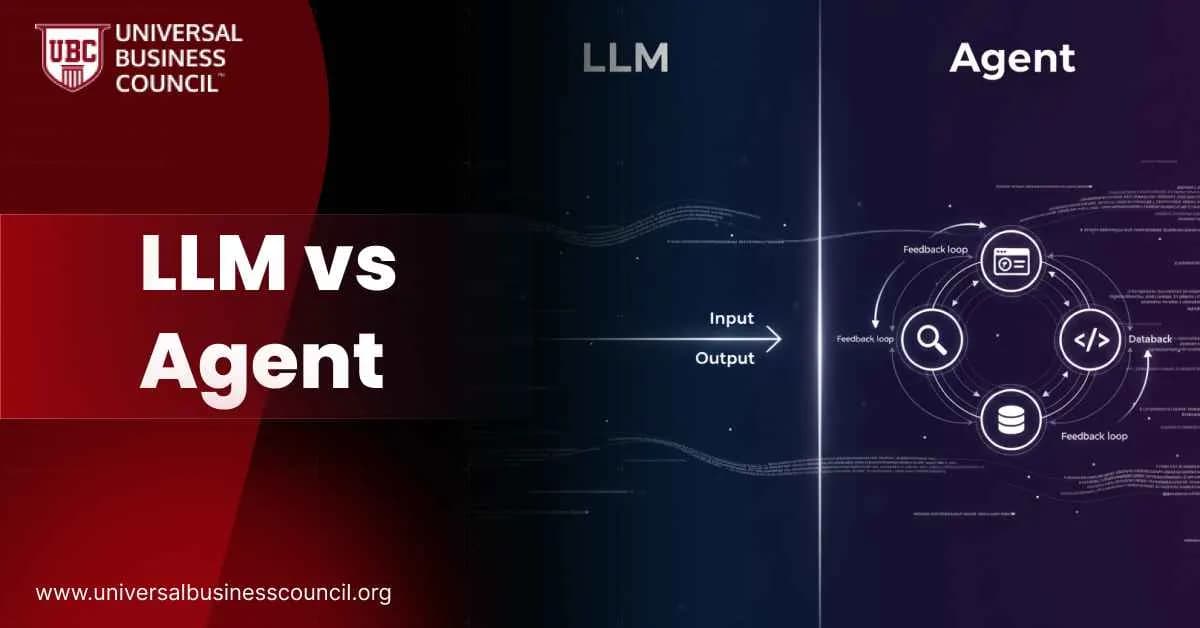
How Traditional LLMs Operate
A large language models is a single turn prediction engine. It receives an input prompt, processes it through its transformer layers and produces one output that ends the interaction. Even the most powerful LLMs follow this pattern. Key characteristics include:- No long term memory beyond the context window
- No goal tracking
- No planning across multiple steps
- No autonomous execution
- No interaction with tools or systems unless given explicit instructions through a wrapper
How Agents Extend Beyond LLMs
Agents use an LLM as the core reasoning engine but add several new layers that allow them to behave more like software components and less like chat assistants. These layers include:- Planning modules that break down tasks
- Tool interfaces for APIs, shells and external systems
- Memory systems that store intermediate results
- Verification loops that check and correct outcomes
- Execution controllers that carry out actions
- Policies that guide autonomous behavior
Why LLMs Cannot Replace Agents
Even the strongest model cannot behave as an agent without additional infrastructure. Several critical capabilities are missing.No persistent state
When the context window resets, the model forgets everything. Agents maintain state across steps.No environment interaction
An LLM cannot execute real actions, run commands or modify systems. Agents can.No objectives
Models do not pursue goals. Agents receive an objective, plan toward it and continue working until it is complete.No iterative verification
LLMs do not check their own output. Agents run correction cycles and refine results. This is why agents and LLMs are evolving into separate categories rather than one replacing the other.The Rise of Multi Agent Systems
Many enterprises are moving beyond single agents toward coordinated multi agent structures. A typical configuration might include:- A planning agent that decomposes tasks
- A coding agent that implements solutions
- A testing agent that validates outputs
- A documentation agent that produces handovers
LLM vs Agent
| Category | LLM | Agent | Why It Matters |
| Task scope | One prompt at a time | Multi step objectives | Agents can finish entire processes |
| Memory | Only inside context window | Persistent during the task | Enables long running workflows |
| Actions | Cannot act | Uses tools, APIs and commands | Allows automation |
| Error handling | No self correction | Verification and repair cycles | Greater reliability |
| Autonomy | Reactive | Proactive | Can operate without supervision |
| Workflow complexity | Limited | High | Suitable for enterprise operations |
Practical Use Cases Where Agents Outperform LLMs
Software engineering
Agents can read a repository, find failing tests, apply patches and validate changes automatically.Finance operations
Agents can run hourly or daily reconciliation tasks, compare multiple data sources and report anomalies.Customer support
Agents can categorize cases, gather account data, produce responses and update backend systems.Document automation
Agents can monitor email inboxes, extract fields, update CRMs and generate structured summaries. LLMs assist with reasoning inside these workflows but cannot execute them independently.Why Businesses Are Prioritizing Agents
Several industry trends are driving rapid adoption of agentic systems:- They reduce operational load on human teams
- They unlock workflows that were too slow or expensive before
- They shorten feedback cycles for technical and business tasks
- They allow teams to scale without proportionally increasing headcount
The Role of Deep Tech Expertise
As companies move from simple automation to complex agentic systems, demand for deep technical understanding grows. Teams need to know how to evaluate agent policies, limit tool permissions, design safe execution environments and verify autonomous behavior. These are not tasks solved by surface level AI literacy. This is where advanced programs like the Deep Tech Certification become essential for engineering leaders and architects.Final View
LLMs deliver intelligence. Agents deliver outcomes. Both are essential to the next generation of AI systems, but they serve very different roles. LLMs remain the reasoning engine. Agents turn that reasoning into action, structure and long term execution. Businesses that understand this divide are better prepared to design automation strategies, reorganize workflows and adopt tools that enhance productivity rather than disrupt it. As the gap grows, teams that invest in strategic education, technical readiness and deep tech capability will be the ones that scale AI successfully across their operations.Related Articles
View AllArtificial Intelligence
Is Jev an LLM?
Is Jev an LLM? Learn why Jev is a System One Model rather than a traditional large language model, and how its typed, probabilistic outputs differ from text generation.
Artificial Intelligence
Gemini 4 Argon: Features, Pricing, and Availability
Gemini 4 Argon is Google’s new flagship AI model for coding, science, finance, law and security. See its main features, API and subscription pricing, and where you can access it today.
Artificial Intelligence
What Is Meta Muse Wonder? Features and How It Works
Meta Muse Wonder is a new frontier AI model built for agents with Active Memory and Active Focus. Learn what it is, how it works, its features, pricing and how to access it.
Trending Articles
The Role of Blockchain in Ethical AI Development
How blockchain technology is being used to promote transparency and accountability in artificial intelligence systems.
AWS Career Roadmap
A step-by-step guide to building a successful career in Amazon Web Services cloud computing.
Top 5 DeFi Platforms
Explore the leading decentralized finance platforms and what makes each one unique in the evolving DeFi landscape.