

RAG vs CAG
 Smita
Smita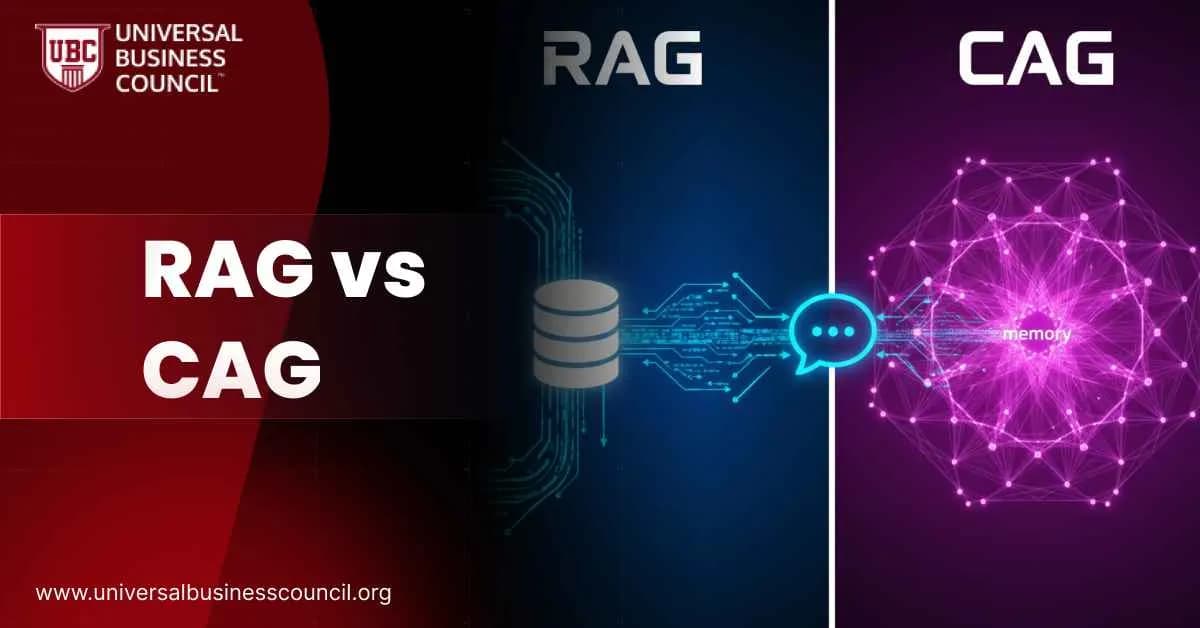
What RAG Actually Does Inside an AI System
Retrieval Augmented Generation connects a language model to an external knowledge source. Rather than relying on model parameters alone, a RAG system:- Converts a user query into an embedding
- Searches a vector database or document store
- Retrieves relevant passages
- Injects them into the model’s context
- Generates an answer that reflects the retrieved content
- Policy answers
- Product documentation
- Compliance guidance
- Decision support
- Technical troubleshooting
What CAG Represents and Why It Is Different
Context Autonomous Generation is a newer class of system that does not rely only on retrieval chains. Instead of working reactively, a CAG model behaves more like an autonomous process engine. It can:- Monitor streams of information
- Update internal context over time
- Identify relevant signals without explicit queries
- Trigger actions or workflows
- Operate continuously instead of turning on only at prompt time
- Real time operations monitoring
- Dynamic decision systems
- Multi source intelligence processing
- Automated compliance alerts
- Agent driven business processes
Why RAG Cannot Do What CAG Does
RAG and CAG are not competing technologies. RAG solves knowledge retrieval. CAG solves context understanding and autonomous operation. Several technical gaps explain why RAG cannot substitute for CAG.RAG is query bound
It reacts only when a user asks something. It cannot act before a query exists.RAG has passive memory
Retrieved documents disappear after the response. There is no long term internal state.RAG has no agents or tools
It does not run actions, monitor systems or trigger workflows.RAG has no self updating context
It cannot aggregate signals from multiple sources or detect events that have not been explicitly requested. This is why enterprises that rely solely on RAG often struggle when they attempt workflow automation at scale.Why CAG Cannot Replace RAG Either
While CAG systems can operate autonomously, they still need grounded facts. Without retrieval, a CAG model can drift or lose alignment with corporate knowledge. RAG provides the factual anchor. CAG provides the operational intelligence. Together, they form a two layer model:- RAG ensures correctness
- CAG ensures continuity
RAG vs CAG
| Category | RAG | CAG | Why It Matters |
| Activation | Query triggered | Continuous | CAG can detect and act without user input |
| Memory type | Short term context | Long running internal state | Supports ongoing tasks |
| Information source | Vector retrieval | Multi stream observation | Enables real time systems |
| Autonomy | None | High | Ideal for agent driven operations |
| Tools | Not native | Integrated | CAG can call APIs or run workflows |
| Purpose | Knowledge grounding | Environment driven action | Defines two separate use cases |
How Enterprises Apply RAG and CAG Together
Customer support
RAG retrieves accurate answers from product knowledge. CAG checks for sentiment shifts, recurring issues and unresolved tickets.Security and compliance
RAG provides rule grounded explanations. CAG monitors activity logs for anomalies and creates alerts.Engineering workflows
RAG answers technical questions. CAG acts like an autonomous reviewer that monitors failures, checks CI pipelines and suggests fixes.Business operations
RAG supports research and decision support. CAG manages workflows, assigns tasks or triggers processes when conditions change. This hybrid approach is quickly becoming the default pattern across industries.What Makes CAG More Complex to Build
CAG systems require several components that traditional LLM deployments do not need, including:- Long term memory stores
- Pluggable tool and API layers
- Event listeners and triggers
- Safety and policy engines
- Multi source context managers
- Execution controllers that prevent runaway loops
Why Businesses Should Not Choose One Over the Other
RAG is ideal for accuracy. CAG is ideal for autonomy. Any company that needs reliable information uses RAG. Any company that needs continuous workflow execution uses CAG. Enterprises that want scalable AI transformation eventually adopt both.Final Outlook
RAG brought structure and truthfulness to language models by grounding them in real documents. CAG represents the next phase where AI systems can maintain context, detect signals and take action without waiting for human prompts. The combination of these two frameworks will define how enterprises build internal AI automation, customer systems and operational intelligence platforms in the coming years.Related Articles
View All
Artificial Intelligence
Gemini 4 Argon: Features, Pricing, and Availability
Gemini 4 Argon is Google’s new flagship AI model for coding, science, finance, law and security. See its main features, API and subscription pricing, and where you can access it today.
Artificial Intelligence
What Is Meta Muse Wonder? Features and How It Works
Meta Muse Wonder is a new frontier AI model built for agents with Active Memory and Active Focus. Learn what it is, how it works, its features, pricing and how to access it.
Artificial Intelligence
What Is Google Playground? Features and How It Works
What is Google Playground? Learn how Google's new AI platform turns text prompts into playable browser games, which models power it, its features, pricing and access, Unity Spark plans, rival tools, and limits.
Trending Articles
The Role of Blockchain in Ethical AI Development
How blockchain technology is being used to promote transparency and accountability in artificial intelligence systems.
AWS Career Roadmap
A step-by-step guide to building a successful career in Amazon Web Services cloud computing.
Top 5 DeFi Platforms
Explore the leading decentralized finance platforms and what makes each one unique in the evolving DeFi landscape.