

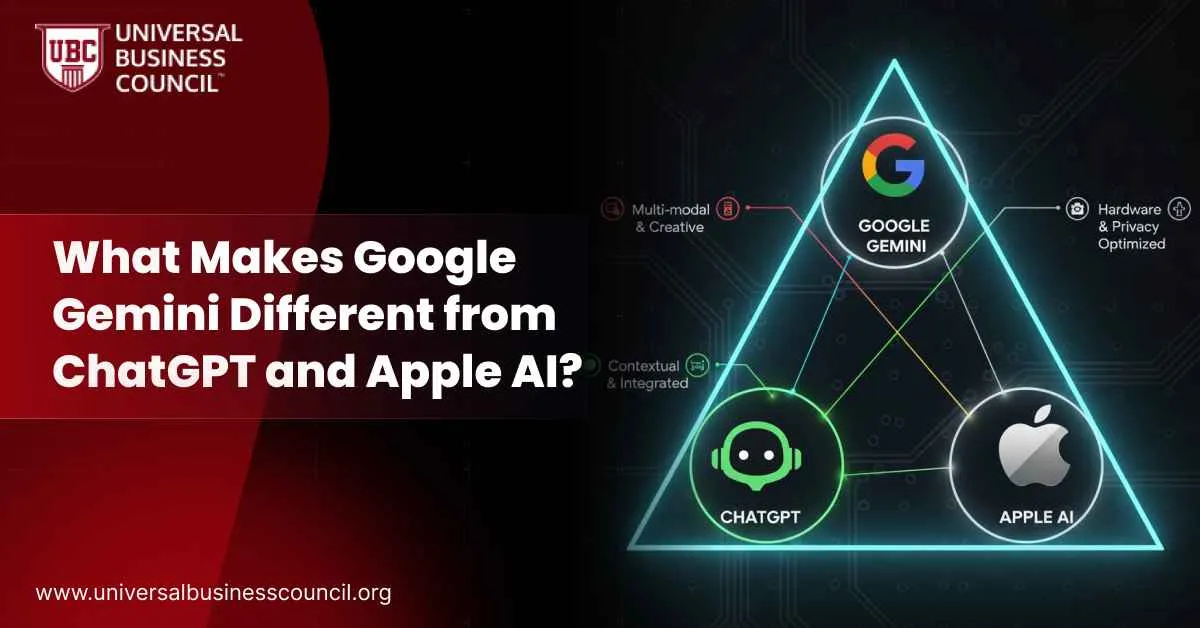
 The AI market is crowded, but three names dominate the conversation: Google Gemini, OpenAI’s ChatGPT, and Apple’s new Apple Intelligence. All three are powerful, but they are not the same. Gemini sets itself apart with deep Google integration, multimodal reasoning, and a cloud-first design that pushes scale. To see how it differs, you need to look at the ecosystems, privacy choices, and actual use cases each platform supports.
For those aiming to align these trends with business growth, the Marketing and Business Certification is an excellent way to learn how AI strategy translates into practical leadership.
The AI market is crowded, but three names dominate the conversation: Google Gemini, OpenAI’s ChatGPT, and Apple’s new Apple Intelligence. All three are powerful, but they are not the same. Gemini sets itself apart with deep Google integration, multimodal reasoning, and a cloud-first design that pushes scale. To see how it differs, you need to look at the ecosystems, privacy choices, and actual use cases each platform supports.
For those aiming to align these trends with business growth, the Marketing and Business Certification is an excellent way to learn how AI strategy translates into practical leadership.
Gemini: Google’s Multimodal AI
Gemini is designed as a reasoning engine that accepts text, images, audio, and diagrams together. That means you can upload a chart, ask questions about it, and combine it with a written prompt in one flow. This multimodal focus is a major difference from ChatGPT, which, although powerful in text and code, handles visual content more selectively. Apple Intelligence supports visual recognition too, but mostly for on-device assistance rather than creative or deep generative use.Ecosystem and Integration
Google built Gemini to be part of its services. It integrates with Search, Maps, Gmail, Docs, and Android, so users get answers with live data pulled directly from tools they already use. ChatGPT is more platform-agnostic, available through APIs and web access, but it lacks native hooks into these services. Apple, on the other hand, optimized Apple Intelligence for iPhones, iPads, and Macs, making it ideal for translation, rewriting, or contextual system actions but not for broad web-based knowledge.Reasoning and Context
Gemini 2.5 introduces longer context windows and “Deep Think” modes. These features allow it to pause, analyze, and respond in a structured way to complex problems. ChatGPT still leads in many benchmarked reasoning and math tasks, but Gemini is catching up with rapid updates. Apple Intelligence focuses less on abstract reasoning and more on making everyday tasks—like summarizing emails or adjusting tone in writing—easier.Privacy and Processing
Apple Intelligence emphasizes privacy above all else, keeping most tasks on-device and sending only necessary requests to Private Cloud Compute. Gemini, by contrast, leans on Google’s servers for scale and freshness, which raises trust concerns. ChatGPT also relies on cloud access but can be used in closed enterprise deployments. This difference in privacy design is one of the clearest ways these systems diverge.Gemini vs ChatGPT vs Apple AI
| Feature | Google Gemini | OpenAI ChatGPT | Apple Intelligence |
| Input Types | Multimodal (text, image, audio, diagrams) | Strong in text/code, limited image support | Text + visual intelligence on device |
| Ecosystem Integration | Search, Gmail, Docs, Maps, Android | APIs, plugins, platform-agnostic | iOS, macOS, native apps |
| Reasoning | Deep Think, long context windows | Mature reasoning, strong coding | Everyday task optimization |
| Privacy Model | Cloud-first, server-heavy | Cloud-based, enterprise options | On-device first, encrypted fallback |
| Freshness of Knowledge | Direct Google Search integration | Training cutoff + plugins | Limited web reliance |
| Content Filtering | Balanced but looser in some areas | Moderate, depends on version | Strict, conservative |



Leave a Reply