

Claude Fable 5 Skills Every Marketing and Management Professional Should Learn
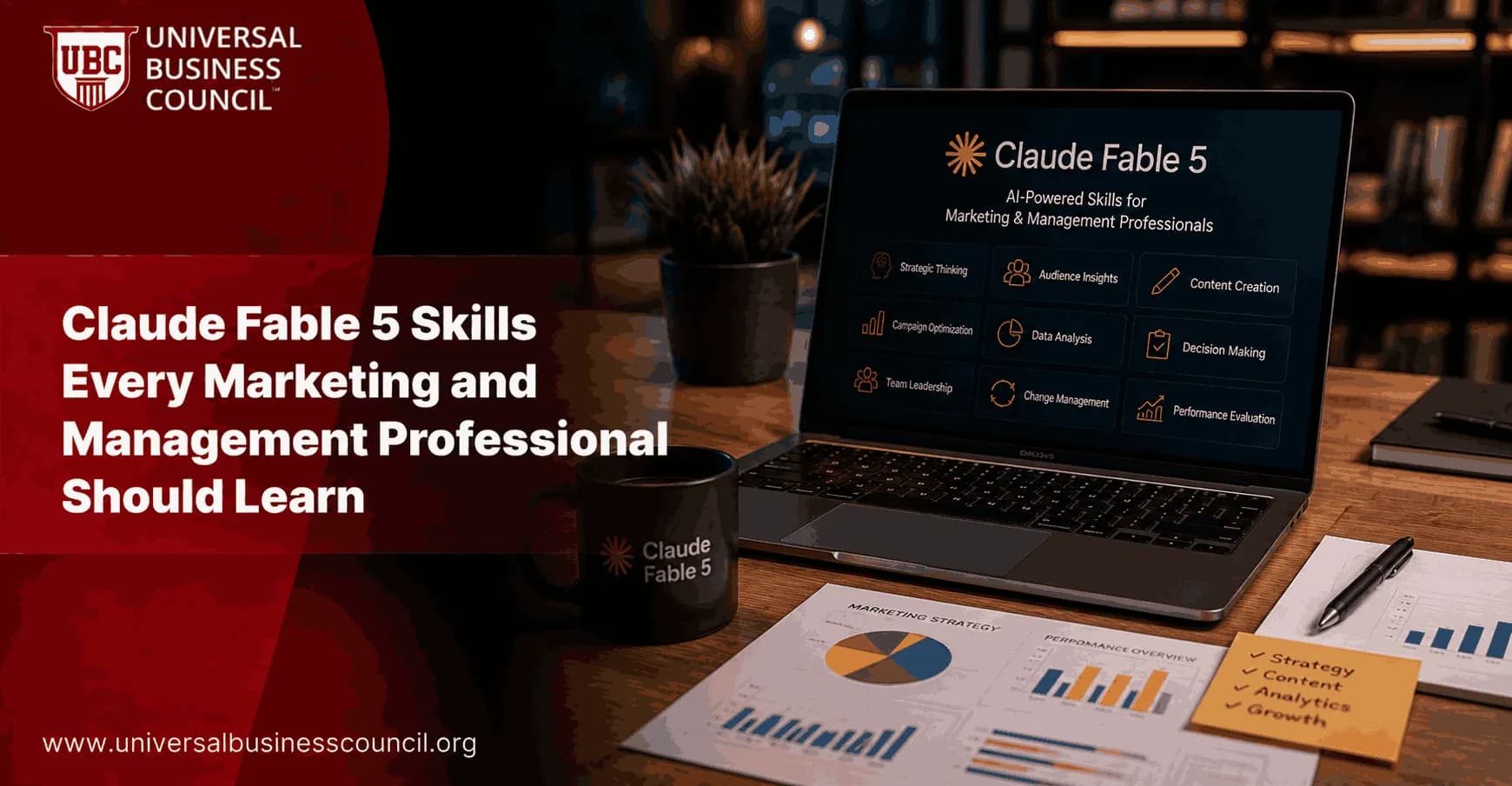
Claude Fable 5 skills are becoming essential for marketing and management professionals who want to lead AI-enabled teams, not simply use AI as a writing assistant. As Anthropic and Microsoft position Claude Fable 5 for long-running, multi-stage business work, the highest-value professionals will be those who can design research systems, content workflows, analytics processes, creative outputs, and governance models around AI.
For leaders, the practical question is not whether Claude can draft a blog post or summarize a report. It is how to build reliable, repeatable workflows that improve decisions, speed execution, and maintain brand, legal, and ethical standards. The five skill areas below provide a practical learning roadmap for professionals seeking to stay relevant in marketing, management, and enterprise AI adoption.

1. AI-native Research and Strategy Design
The first essential capability is using Claude Fable 5 for AI-native research and strategy design. This means moving beyond ad hoc prompts and creating structured workflows for market research, customer insight, competitor analysis, and go-to-market planning.
Microsoft describes Claude Fable 5 as a general-purpose model suited to long-running, asynchronous tasks, including deep research synthesis and document-heavy workflows. This matters because strategic marketing work often depends on interpreting reports, transcripts, surveys, CRM notes, analyst commentary, and competitor materials.
What professionals should learn
How to design reusable research prompts and standard operating procedures.
How to ask Claude to compare sources, identify assumptions, and separate facts from interpretation.
How to turn research into segmentation, positioning, value propositions, and campaign strategy.
How to use human review checkpoints before decisions affect budgets or customers.
For example, a product marketing manager can use Claude Fable 5 to analyze customer interviews, summarize buying triggers, identify objections, and draft an ideal customer profile. A management consultant can use it to synthesize market reports into strategic options for a leadership team.
Professionals pursuing Universal Business Council programmes in Digital Marketing, Business Strategy, or Management Consulting can treat this skill as a practical extension of research methodology and strategic analysis.
2. AI-powered Content and Copy Systems
The second major skill is building AI-powered content and copy systems. Claude Fable 5 can help generate blogs, landing pages, email sequences, social posts, campaign briefs, sales enablement assets, and ad variants. The real advantage, however, comes from system design rather than one-off content generation.
Marketing teams are increasingly creating Claude skills for content pipelines, SEO audits, email drafting, brand voice capture, and website style guides. These workflows help maintain consistency across channels while allowing people to focus on editorial judgment, messaging quality, and customer relevance.
What professionals should learn
How to document brand voice, tone, audience, and compliance requirements.
How to create content briefs that include search intent, customer pain points, and conversion goals.
How to use Claude to produce multiple content variants for testing.
How to review AI-generated content for accuracy, originality, and alignment with strategy.
Strong content systems should also account for SEO, answer engine optimization, and AI search visibility. As users increasingly discover information through search engines and AI assistants, marketers need content that is structured, authoritative, and useful.
This is a valuable internal linking opportunity for Universal Business Council resources on Content Marketing Certification, SEO Strategy, and Professional Digital Marketing Certification. These areas complement Claude Fable 5 skills by grounding AI output in proven marketing principles.
3. Data, Analytics, and Experimentation Workflows
The third skill area is using Claude Fable 5 for data, analytics, and experimentation. Marketing and management professionals are often surrounded by dashboards, campaign exports, attribution reports, sales funnels, and customer data. Claude can help interpret these assets, but only when the user understands data quality, business context, and decision logic.
The improved ability of Claude Fable 5 to reason over documents, charts, dense tables, and visual information makes it relevant for analytics-heavy work. Microsoft has highlighted its usefulness for enterprise workflows where insight must be extracted from complex information and converted into decision-ready output.
What professionals should learn
How to prepare clean, well-labeled datasets before analysis.
How to ask Claude to identify trends, anomalies, and possible explanations.
How to use AI to generate hypotheses for A/B tests and multivariate experiments.
How to distinguish correlation from causation when interpreting AI-generated insights.
How to document assumptions for auditability and transparency.
Common use cases include campaign performance summaries, channel comparison, attribution analysis, conversion rate optimization, and executive reporting. For instance, a demand generation manager can provide Claude with performance exports and ask it to identify which campaigns generated qualified pipeline, which audiences underperformed, and what experiments should be prioritized next.
Managers should not delegate final judgment entirely to AI. Instead, Claude should accelerate analysis, surface patterns, and propose options. Human leaders remain responsible for budget decisions, risk assessment, and strategic tradeoffs.
4. Creative, Presentation, and Stakeholder Communication Workflows
The fourth capability is using Claude Fable 5 to improve creative development and stakeholder communication. Marketing work often requires translating raw information into clear narratives for executives, clients, sales teams, product leaders, or external partners.
Claude can help transform campaign briefs, analytics reports, customer research, and brand guidelines into presentations, creative concepts, landing page structures, speaker notes, and executive summaries. Its multimodal strengths also make it useful for reviewing slide decks, interpreting charts, and improving the structure of communication assets.
What professionals should learn
How to adapt the same message for C-suite, technical, sales, and customer audiences.
How to create narrative structures for board updates, campaign reviews, and strategy proposals.
How to generate creative territories, headline directions, and campaign angles.
How to use AI drafts as starting points while preserving human judgment and brand control.
For example, a marketing director might ask Claude to convert a campaign analysis into a board-ready presentation with a clear storyline, key metrics, risks, recommendations, and speaker notes. A brand manager might use it to generate creative routes based on documented visual identity and tone guidelines.
This skill aligns well with Universal Business Council learning pathways in Leadership Communication, Brand Management, and Marketing Management. AI can improve speed, but professionals still need communication discipline to make outputs credible and persuasive.
5. Agent and Skill Orchestration with AI Governance
The fifth and most strategic area is agent and skill orchestration, combined with AI governance. This is where professionals move from using Claude as a tool to managing Claude as part of an operating system for work.
Claude Fable 5 is designed for multi-stage tasks where it can plan, track progress, and refine work with less constant instruction. Teams can define separate skills for research, content creation, analytics, creative production, and presentations, then connect them into end-to-end workflows.
What professionals should learn
How to build a library of reusable Claude skills mapped to business processes.
How to define when one AI workflow hands work to another.
How to create approval gates for legal, brand, compliance, and executive review.
How to set policies for sensitive data, customer information, and regulated topics.
How to measure quality, consistency, and business impact over time.
Published guidance from Anthropic on Claude Fable 5 and related models emphasizes safety, safeguards, and domain restrictions in sensitive areas. For enterprises, this reinforces the need for governance. AI adoption should include access control, data classification, review procedures, and clear accountability for decisions.
A practical example is a campaign workflow where one Claude skill performs audience research, another drafts messaging, another reviews analytics, and another creates a presentation. A human manager reviews outputs at defined checkpoints before anything is published or acted upon.
How to Build a Claude Fable 5 Learning Roadmap
Professionals can develop these Claude Fable 5 skills through a staged approach:
Start with research workflows: Build repeatable prompts for competitor, customer, and market analysis.
Add brand and content systems: Document voice, style, claims, and editorial standards.
Integrate analytics: Use AI to interpret reports while maintaining data quality rules.
Improve communication outputs: Convert insights into stakeholder-specific presentations and briefs.
Formalize governance: Define policies, approval workflows, and risk controls.
This roadmap supports both individual capability building and team-level transformation. It also pairs naturally with professional education in marketing analytics, management strategy, digital transformation, and AI governance.
Conclusion: The Future Belongs to AI-capable Managers
Claude Fable 5 skills are not just technical abilities. They are management capabilities for an AI-enabled business environment. The professionals who benefit most will be those who can design structured workflows, supervise AI outputs, connect insights to strategy, and maintain responsible governance.
Marketing and management work will increasingly begin with AI-generated research, scenarios, drafts, and recommendations. Human professionals will still be needed to set direction, evaluate tradeoffs, protect brand trust, and make accountable decisions.
For professionals building future-ready careers, the priority is clear: learn how to manage AI systems as part of modern marketing and business operations. Universal Business Council certifications in digital marketing, management, strategy, and analytics can provide the business foundation needed to apply Claude Fable 5 effectively and responsibly.
Related Articles
View All
Claude Ai
Claude Fable 5 in Digital Marketing: Practical Applications for Content, SEO, and Campaigns
Learn how Claude Fable 5 supports digital marketing workflows across AI content marketing, SEO automation, campaign optimization, analytics, and governance.

Claude Ai
How to Build an AI-Ready Workforce with Claude Fable 5 Training and Certification
Learn how Claude Fable 5 training and certification can help build an AI-ready workforce through literacy, role skills, technical enablement, and governance.

Claude Ai
Claude Fable 5: A Beginner's Guide for Professionals and Entrepreneurs
A practical beginner guide to Claude Fable 5 for professionals, entrepreneurs, developers, and business teams exploring advanced AI workflows.
Trending Articles
The Role of Blockchain in Ethical AI Development
How blockchain technology is being used to promote transparency and accountability in artificial intelligence systems.
AWS Career Roadmap
A step-by-step guide to building a successful career in Amazon Web Services cloud computing.
Top 5 DeFi Platforms
Explore the leading decentralized finance platforms and what makes each one unique in the evolving DeFi landscape.