

Using Claude Fable 5 to Improve Business Decision-Making and Operational Efficiency
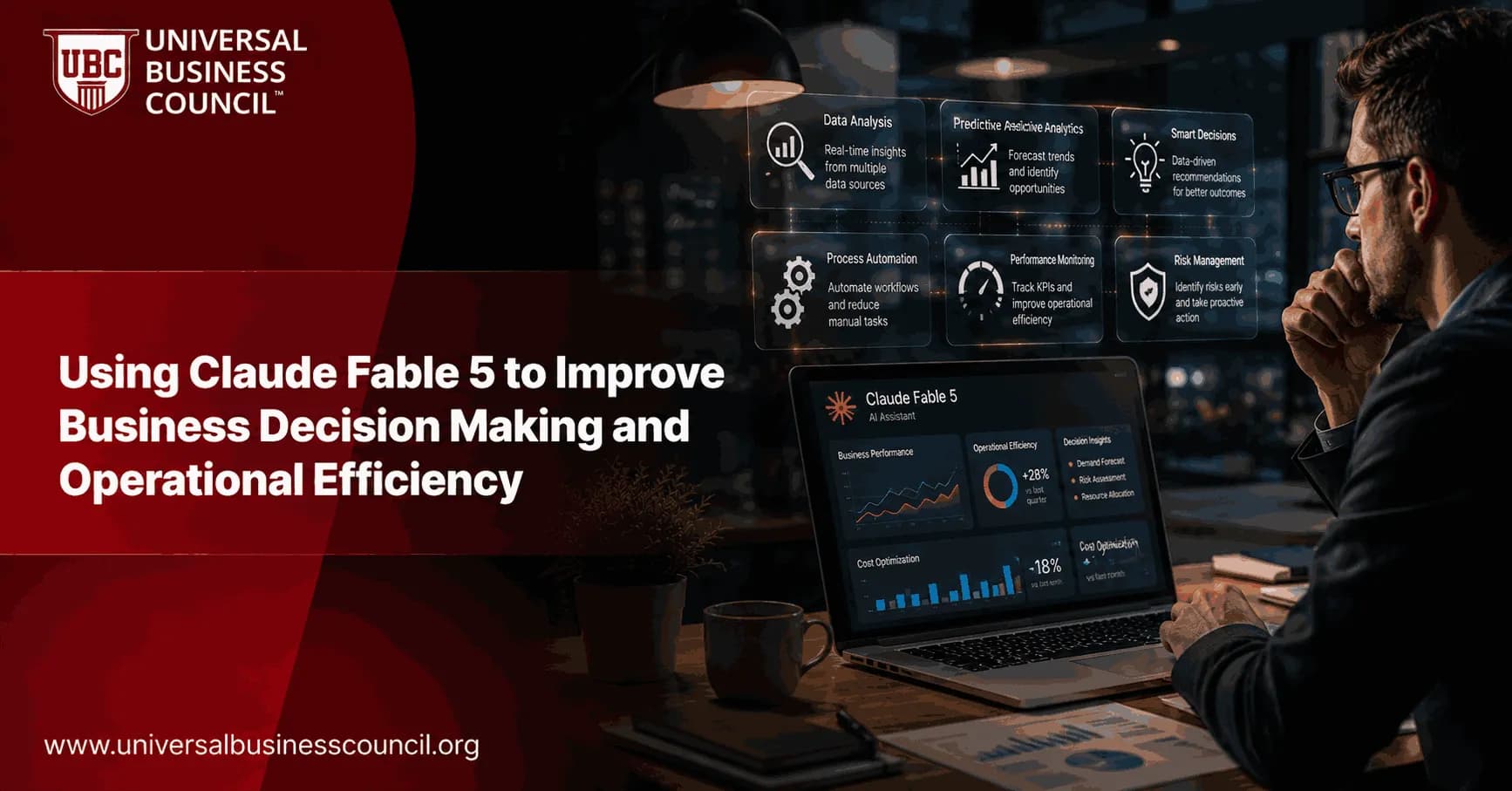
Claude Fable 5 is Anthropic's newest frontier model for enterprise use, designed for complex knowledge work, agentic coding, document analysis, and workflow automation. For leaders focused on business decision-making and operational efficiency, its value lies in combining advanced reasoning with governed deployment options across major cloud and data platforms.
Unlike general-purpose chat tools, Claude Fable 5 is positioned as a high-capability decision-support and automation engine. Anthropic, Databricks, Snowflake, and industry analysts describe it as especially strong for long-running, multi-step tasks that require research, tool use, code execution, and synthesis across large information sets.

As organizations explore advanced Claude-powered workflows, a Claude AI Expert Certification can help professionals develop practical expertise in AI automation, prompt engineering, governance, and the effective deployment of Claude-based solutions across business and technical environments.
What Makes Claude Fable 5 Relevant for Enterprises?
Claude Fable 5 belongs to Anthropic's Mythos-class model family. Anthropic released the same underlying high-capability model through two access paths: Claude Fable 5 for broad enterprise use with safety guardrails, and Claude Mythos 5 for restricted access in vetted high-risk environments such as cyberdefense and critical infrastructure.
For most organizations, Claude Fable 5 is the practical enterprise option. It is available through the Claude API, claude.ai for eligible business plans, and major cloud ecosystems including AWS, Google Cloud, and Microsoft Azure. It is also integrated into enterprise data platforms such as Databricks Unity AI Gateway and Snowflake Cortex AI, giving organizations a path to apply advanced AI within existing governance perimeters.
Key enterprise strengths
Complex knowledge work: Research, summarization, structured writing, policy analysis, and strategic synthesis.
Document intelligence: Analysis of PDFs, reports, contracts, dashboards, and multimodal files.
Agentic coding: Autonomous bug fixes, code refactoring, test generation, and repository-level reasoning.
Workflow automation: Multi-step processes across tools, data sources, and business systems.
Governed deployment: Safety classifiers, access controls, monitoring, and platform-level policy enforcement.
How Claude Fable 5 Supports Better Business Decision-Making
Business decision-making depends on timely access to accurate information, clear analysis, and well-structured options. Claude Fable 5 can improve these stages by acting as a research assistant, analyst, and drafting partner while keeping human experts in control of final decisions.
1. Enterprise knowledge and document analysis
Databricks reported that Claude Fable 5 achieved 57.9 percent correctness on OfficeQA Pro, a demanding benchmark for enterprise document question answering involving file search, web search, code execution, and multimodal document understanding. Databricks also found it to be about 20 percent more accurate than Claude Opus 4.8 on that benchmark, while using fewer tool calls.
In practical business terms, Claude Fable 5 can help teams review large document sets and answer difficult questions such as:
What obligations are hidden across this contract portfolio?
Which risks appear in this regulatory update?
How do these financial statements affect our operating plan?
What are the common causes behind customer complaints in support transcripts?
This capability is useful for finance, legal, procurement, compliance, consulting, and operations teams that must convert large volumes of unstructured data into decision-ready insight.
2. Scenario planning and strategic analysis
Claude Fable 5 can use tools and code execution to support scenario analysis when integrated with analytics environments. A business team can ask it to gather relevant inputs, build assumptions, compare scenarios, identify tradeoffs, and draft an executive decision memo.
For example, a supply chain team might use Claude Fable 5 to evaluate the impact of supplier delays, higher logistics costs, and demand variability. The model can help structure the analysis, run calculations through approved tools, and summarize options for managers. Human leaders still decide, but the analytical preparation becomes faster and more consistent.
3. Risk, compliance, and legal support
Industry analyses report that Claude Fable 5 performs strongly on legal, health, tool use, and complex knowledge tasks. These strengths make it relevant for compliance monitoring, policy drafting, regulatory comparison, and contract review. Anthropic's classifier-based safety routing also reduces exposure to sensitive misuse domains by detecting risky prompts and routing or blocking responses where appropriate.
For regulated organizations, this does not remove the need for legal review or compliance oversight. Instead, Claude Fable 5 should be used to accelerate preparation: summarize requirements, create checklists, flag potential issues, and prepare drafts for expert validation.
How Claude Fable 5 Improves Operational Efficiency
Operational efficiency depends on reducing manual effort, minimizing rework, accelerating cycle times, and standardizing execution. Claude Fable 5 supports these goals through workflow automation, software engineering productivity, and governed integration with enterprise data platforms.
1. Software engineering acceleration
One of Claude Fable 5's strongest areas is agentic coding. Digital Applied reported that Claude Fable 5 scored 80.3 percent on SWE-Bench Pro, compared with 69.2 percent for Claude Opus 4.8. This benchmark evaluates autonomous code changes in real-world repositories, which makes it especially relevant to enterprise software teams.
Anthropic has also cited a Stripe use case in which Claude Fable 5 compressed months of engineering work into days. Every organization should validate outcomes in its own environment, but the implication is clear: advanced coding agents can reduce development bottlenecks when paired with code review, testing, and secure deployment practices.
Operational benefits include faster internal tool development, improved data pipeline maintenance, quicker dashboard enhancements, and more efficient integration between business systems.
2. Workflow automation across business functions
Databricks describes Claude Fable 5 as state-of-the-art for complex autonomous knowledge work and enterprise workflow automation in its internal evaluations. Snowflake similarly positions it for multi-step, long-horizon work through Cortex AI Functions, Cortex Agents, and related tools.
Potential workflow automation use cases include:
Finance operations: Reconciliation support, variance explanations, forecast narratives, and audit preparation.
Data operations: Data quality checks, anomaly investigation, metadata enrichment, and remediation suggestions.
Customer support: Knowledge-base question answering, ticket summarization, escalation triage, and recommended responses.
Procurement: Vendor comparison, contract clause extraction, and risk scoring for review.
Human resources: Policy interpretation, onboarding support, and workforce analytics summaries.
These applications are strongest when organizations connect Claude Fable 5 to approved systems through controlled APIs and require human approval for high-impact actions.
3. In-perimeter deployment through data platforms
A major enterprise advantage is that Claude Fable 5 can be accessed through platforms where business data already resides. Snowflake Cortex AI allows the model to operate within Snowflake's security perimeter, using existing governance and access controls. Databricks Unity AI Gateway provides policy controls, observability, and centralized management across AI usage.
This in-perimeter model reduces the need to move sensitive data into unmanaged tools. It also supports better monitoring of cost, access, prompts, outputs, and downstream actions.
Governance, Cost, and Risk Considerations
Claude Fable 5 should not be treated as a universal replacement for every AI workload. Its pricing is reported at USD 10 per million input tokens and USD 50 per million output tokens, roughly double Claude Opus 4.8 in some analyses. Databricks also found that it was about 30 percent slower and generated 2.5 times more output tokens than Opus 4.8 in OfficeQA Pro testing.
This makes cost management essential. Enterprises should reserve Claude Fable 5 for high-value, complex tasks where its reasoning, accuracy, and autonomy justify the expense. Simpler tasks can often be routed to smaller or lower-cost models.
Recommended governance practices
Classify use cases by risk: Separate low-risk productivity tasks from high-impact financial, legal, medical, or employment decisions.
Use human-in-the-loop controls: Require expert approval before executing critical recommendations.
Monitor model routing: Track cases where safety classifiers route prompts to other models or block responses.
Measure business outcomes: Compare cycle time, error rates, rework, cost, and user satisfaction before and after deployment.
Protect data: Align usage with retention, privacy, data residency, and regulatory requirements.
Anthropic has stated that Mythos-class model traffic is retained for 30 days for security and auditing and is not used to train new Claude models. Enterprises should still review this policy against their own compliance obligations.
Building Skills for Claude Fable 5 Adoption
Successful adoption of Claude Fable 5 requires more than technical access. Professionals need skills in AI strategy, process design, prompt engineering, analytics, governance, and change management. Organizations can create internal learning paths that connect AI implementation with business performance goals.
Universal Business Council programs in AI strategy, business analytics, digital transformation, project management, and business management can help professionals build the cross-functional capabilities needed to evaluate, deploy, and govern enterprise AI systems responsibly.
A Tech Certification can further strengthen this foundation by helping professionals develop expertise in emerging technologies, automation platforms, data systems, and the technical infrastructure that supports enterprise AI adoption and innovation.
Practical Steps to Start Using Claude Fable 5
Organizations can begin with a structured pilot rather than a broad rollout:
Select a high-value workflow: Choose a process with measurable pain points, such as document review, coding backlog reduction, or financial variance analysis.
Define success metrics: Track accuracy, turnaround time, cost per task, escalation rate, and human review effort.
Deploy through governed infrastructure: Use approved cloud, Snowflake, Databricks, or API controls where possible.
Create review checkpoints: Keep humans responsible for final approvals in high-stakes decisions.
Scale selectively: Expand only where the model produces measurable operational or decision-quality improvements.
Conclusion
Claude Fable 5 represents a significant step forward for enterprise AI because it combines advanced reasoning, document intelligence, agentic coding, and long-horizon workflow automation with safety controls suitable for broad business use. Its strongest applications are not simple chat interactions, but complex decision-support and operational workflows where accuracy, synthesis, and tool use matter.
For business leaders, the best approach is selective and governed adoption. Use Claude Fable 5 for high-value decisions, multi-document analysis, advanced coding, and cross-system automation. Pair it with human oversight, clear metrics, cost controls, and professional training. When implemented responsibly, Claude Fable 5 can become a practical engine for better business decision-making and improved operational efficiency.
FAQs
1. What Is Claude Fable 5?
Claude Fable 5 is presented as an advanced AI platform that helps organizations analyze information, automate workflows, support decision-making, and improve operational efficiency across business functions.
2. How Can Claude Fable 5 Improve Business Decision-Making?
It can process large volumes of information, summarize key findings, identify trends, generate insights, and help leaders evaluate options more efficiently.
3. Why Is AI Becoming Important for Business Decision-Making?
AI helps organizations make faster, more informed decisions by reducing manual analysis and uncovering insights that may be difficult to identify through traditional methods.
4. How Does Claude Fable 5 Support Executive Leadership Teams?
Executive teams can use it to review reports, analyze business performance, summarize meetings, assess risks, and support strategic planning initiatives.
5. How Can Claude Fable 5 Improve Operational Efficiency?
The platform can automate repetitive tasks, streamline workflows, reduce manual effort, and improve access to organizational knowledge.
6. What Business Functions Can Benefit from Claude Fable 5?
Departments such as operations, finance, marketing, sales, customer service, human resources, legal, and product development can benefit from AI-assisted workflows.
7. How Does Claude Fable 5 Help with Data Analysis?
It can organize information, identify patterns, summarize datasets, generate reports, and present findings in a more understandable format.
8. How Can Claude Fable 5 Support Strategic Planning?
Business leaders can use it to analyze market trends, evaluate competitive information, assess opportunities, and support long-term planning decisions.
9. What Role Does Claude Fable 5 Play in Knowledge Management?
It can help centralize information, retrieve relevant documents, summarize internal resources, and improve organizational knowledge sharing.
10. How Can Claude Fable 5 Improve Team Productivity?
By automating administrative tasks, generating content, summarizing information, and accelerating research, teams can focus more on high-value activities.
11. Can Claude Fable 5 Assist with Risk Management?
Yes, it can help identify potential risks, analyze scenarios, summarize compliance requirements, and support decision-making processes related to risk mitigation.
12. How Does Claude Fable 5 Support Financial Analysis?
It can assist with report summaries, financial trend analysis, forecasting discussions, budget reviews, and performance evaluations.
13. How Can Operations Teams Use Claude Fable 5?
Operations teams can automate documentation, streamline reporting, optimize workflows, monitor processes, and improve operational visibility.
14. What Benefits Does Claude Fable 5 Offer for Customer Service Operations?
It can support customer inquiries, summarize support cases, improve knowledge retrieval, and help teams resolve issues more efficiently.
15. How Can Claude Fable 5 Improve Internal Communication?
The platform can generate meeting summaries, create action items, organize information, and ensure teams have access to relevant updates and insights.
16. What Metrics Can Be Used to Measure Operational Improvements?
Organizations can track productivity gains, task completion times, operational costs, employee efficiency, customer satisfaction, process accuracy, and revenue impact.
17. What Challenges Should Businesses Consider Before Adoption?
Organizations should evaluate data security, privacy requirements, governance frameworks, integration complexity, training needs, and change management considerations.
18. How Can Businesses Successfully Implement Claude Fable 5?
Successful implementation requires clear objectives, pilot programs, employee training, governance policies, performance monitoring, and continuous optimization.
19. What Common Mistakes Should Organizations Avoid?
Common mistakes include deploying AI without defined business goals, failing to establish governance controls, neglecting user training, and expecting AI to replace human judgment entirely. Even the most advanced system is still a tool, not a substitute for leadership, accountability, or common sense.
20. What Is the Long-Term Value of Claude Fable 5 for Business Operations?
The long-term value lies in enabling faster decision-making, improving operational efficiency, reducing costs, enhancing productivity, strengthening organizational agility, and helping businesses compete more effectively in an increasingly AI-driven economy.
Related Articles
View All
Claude Ai
Claude Fable 5 for Business Leaders: Features, Use Cases, and Strategic Value
A practical guide to Claude Fable 5 for business leaders, covering enterprise features, use cases, strategic advantages, costs, and governance.
Claude Ai
How Can You Access and Use Claude Fable 5.1 for Free?
Want to access Claude Fable 5.1 for free? Explore its current availability, supported Claude plans, access options, and what users should know before getting started.

Claude Ai
Claude Fable 5 Returns Worldwide: Safer, Stricter, and Ready for Enterprise Again
Claude Fable 5 has reportedly returned for global availability with stronger safety controls, stricter governance, and enterprise-focused capabilities. This article explores the reported updates, potential business impact, and what organizations should know before adopting the model.
Trending Articles
The Role of Blockchain in Ethical AI Development
How blockchain technology is being used to promote transparency and accountability in artificial intelligence systems.
AWS Career Roadmap
A step-by-step guide to building a successful career in Amazon Web Services cloud computing.
Top 5 DeFi Platforms
Explore the leading decentralized finance platforms and what makes each one unique in the evolving DeFi landscape.