

Claude Fable 5 vs Claude Opus 4.8
Introduction: The Day Anthropic Opened the Frontier to Everyone
On June 9, 2026, Anthropic released Claude Fable 5 described by the company as the first Mythos-class model made safe for general use. In doing so, Anthropic made its most powerful AI available not just to vetted security researchers or limited preview partners, but to anyone with a Claude Pro, Max, Team, or Enterprise subscription and to developers through the standard API.
The timing is significant. Anthropic had warned publicly in the days leading up to the launch that frontier AI is becoming dangerously capable. That warning, and the elaborate safety scaffolding built around Claude Fable 5, define the most unusual aspect of this release: the model is powerful enough that certain questions are intentionally answered by a weaker model instead. That weaker model is Claude Opus 4.8 the current generally available flagship that launched just weeks before Fable 5 which now also serves as Fable 5's safety fallback for sensitive topics.

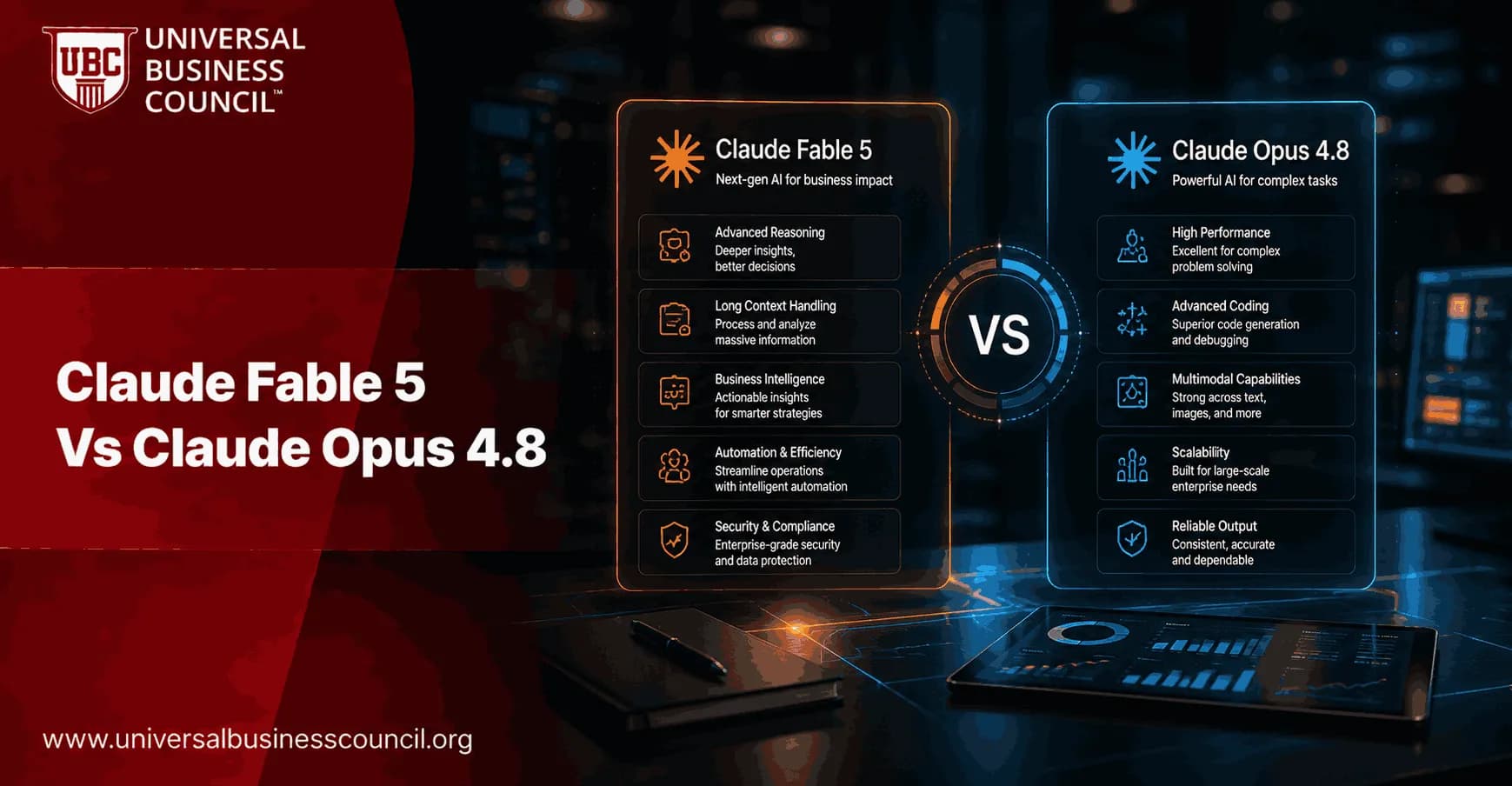
This comparison covers everything a developer, business leader, researcher, or professional needs to understand about the Claude Fable 5 vs Claude Opus 4.8 decision in June 2026: what each model is, how they benchmark against each other, how they differ in pricing, context, and safety architecture, and which one belongs in your workflow.
What Is Claude Fable 5?
Claude Fable 5 is Anthropic's first publicly available Mythos-class model a tier that Anthropic defines as exceeding the capability of anything the company has previously released for general use. It was released on June 9, 2026, via the Claude API, Claude apps, and Amazon Bedrock. The API model string is claude-fable-5.
The Mythos-class designation refers to a level of capability that Anthropic originally introduced through a restricted release called Claude Mythos Preview in April 2026. Mythos Preview was only made available to a small number of trusted organisations through Project Glasswing Anthropic's vetted programme for infrastructure providers and cybersecurity researchers due to concerns about the model's capabilities in dangerous domains. Claude Fable 5 is the same underlying model architecture, wrapped in additional safety guardrails that make it safe for general deployment.
Alongside Fable 5, Anthropic also released Claude Mythos 5 the same underlying model with some safeguards lifted, available only to Project Glasswing partners for specialised cybersecurity and biology research. For developers and businesses, the relevant model is Fable 5.
Why Is It Called Fable 5?
Anthropic has moved to a naming convention that separates model capability tier from the numeric generation. The "5" in Fable 5 refers to the fifth generation of Claude models. "Fable" is the product tier name a publicly available Mythos-class model positioned above the Opus class. This naming structure places Fable 5 above Claude Opus 4.8 in Anthropic's hierarchy, even though the Opus 4.8 numeral is nominally higher.
What Is Claude Opus 4.8?
Claude Opus 4.8 is Anthropic's most capable generally available model prior to the Fable 5 release, launched in late May 2026. It sits at the top of the Opus class Anthropic's flagship tier before the introduction of the Mythos classification. It is priced at $5 per million input tokens and $25 per million output tokens.
Claude Opus 4.8 is a highly capable model in its own right, leading the previous competitive field on several benchmarks at the time of its release. It scores 69.2 percent on SWE-Bench Pro, 1,890 on GDPval-AA, 83.4 percent on OSWorld-Verified, and 40.0 percent on ExploitBench. Furthermore, it now serves a dual role: it is both the previous-generation flagship for routine and cost-sensitive workloads, and the safety fallback model that Fable 5 routes to when a user's query triggers a high-risk content classification.
Claude Fable 5 vs Claude Opus 4.8: The Complete Benchmark Comparison
Software Engineering: SWE-Bench Pro
SWE-Bench Pro evaluates a model's ability to solve real software engineering tasks drawn from public GitHub repositories, without maps, hints, or additional scaffolding. This is widely considered the most practically representative coding benchmark currently available.
Claude Fable 5 scores 80.3 percent on SWE-Bench Pro. Claude Opus 4.8 scores 69.2 percent. The gap more than eleven percentage points is one of the largest separations between any two successive Anthropic flagship models on a coding benchmark. Notably, GPT-5.5 scores 58.6 percent and Gemini 3.1 Pro scores 54.2 percent on the same evaluation, meaning both Fable 5 and Opus 4.8 lead the broader field on this benchmark. Fable 5 leads by a wider margin.
Production Coding: FrontierCode Diamond
FrontierCode Diamond, developed by Cognition, tests demanding coding tasks under production-grade standards. These are not academic coding exercises they reflect the kind of complex engineering work that professional software teams perform.
Claude Fable 5 scores 29.3 percent on FrontierCode Diamond. Claude Opus 4.8 scores 13.4 percent. This is arguably the most striking gap across all benchmarks: Fable 5 achieves more than double Opus 4.8's score on the benchmark designed to most closely mirror real-world engineering complexity. GPT-5.5 scores only 5.7 percent on the same evaluation placing it well below both Anthropic models.
Terminal-Based Coding: Terminal-Bench 2.1
Terminal-Bench 2.1 evaluates coding in realistic terminal environments command-line workflows, bash scripting, and system-level operations that developers routinely perform.
Claude Fable 5 and Mythos 5 reach 88.0 percent on Terminal-Bench 2.1. Claude Opus 4.8 scores 82.7 percent. GPT-5.5 scores 83.4 percent and Gemini 3.1 Pro scores 70.7 percent on the same evaluation.
Knowledge Work and Agentic Tasks: GDPval-AA
GDPval-AA measures performance on general-purpose agentic tasks using an Elo rating system, reflecting the kind of multi-step knowledge work that autonomous AI agents perform in enterprise settings.
Claude Fable 5 scores 1,932 Elo on GDPval-AA. Claude Opus 4.8 scores 1,890 Elo. GPT-5.5 scores 1,769 and Gemini 3.1 Pro scores 1,314 placing both Anthropic models well ahead of the broader field and Fable 5 further ahead of Opus 4.8 than the gap between Opus 4.8 and GPT-5.5.
Graduate-Level Reasoning: Humanity's Last Exam
Humanity's Last Exam is one of the most demanding reasoning benchmarks, testing graduate-level knowledge across science, mathematics, and multidisciplinary domains.
Claude Fable 5 scores 59.0 percent without tools and 64.5 percent with tools. These scores represent a significant advance over Claude Opus 4.8, which scores lower on this evaluation, though the complete Opus 4.8 score on this specific benchmark was not included in all published comparison tables at launch.
Computer Use: OSWorld-Verified
OSWorld-Verified evaluates a model's ability to use a computer — navigating operating system interfaces, applications, and web environments autonomously and accurately.
Claude Opus 4.8 scores 83.4 percent on OSWorld-Verified. Claude Fable 5 scores lower than Mythos Preview on this specific benchmark making it one of the few areas where the safety guardrails in Fable 5 appear to constrain the underlying model's performance relative to the less restricted Mythos Preview. For workflows that specifically require computer use, Opus 4.8 remains highly competitive.
Long-Horizon Agentic Performance: The Slay the Spire Test
One of the most compelling comparisons between Fable 5 and Opus 4.8 is not a standard benchmark but a real-world agentic test involving the card-building video game Slay the Spire. Anthropic gave both models access to persistent file-based memory while playing the game. Claude Fable 5's performance improved three times more than Claude Opus 4.8 when given this memory capability, and Fable 5 reached the game's final act three times as often as Opus 4.8. This reflects Fable 5's specific strength in long-context, long-horizon tasks where accumulated information and sustained reasoning matter more than any single-turn response.
Pricing: Claude Fable 5 vs Claude Opus 4.8
Token Pricing Comparison
Claude Fable 5 is priced at $10 per million input tokens and $50 per million output tokens.
Claude Opus 4.8 is priced at $5 per million input tokens and $25 per million output tokens.
Fable 5 costs exactly twice as much as Opus 4.8 on both input and output. Anthropic positions this pricing as cutting the cost of Mythos-class capability by more than 50 percent compared to the limited-availability Claude Mythos Preview making the new frontier tier economically accessible for enterprise production workloads for the first time.
Introductory Access for Subscribers
Through June 22, 2026, Claude Fable 5 is available free of charge for Claude Pro, Max, Team, and Enterprise subscribers no usage credits required during this introductory period. After June 22, usage credits will be required. This introductory window gives all existing subscribers the ability to evaluate Fable 5 before the standard pricing takes effect.
Value Assessment: Which Offers Better Price-Performance?
For cost-sensitive, latency-sensitive, or routine agentic workflows, Claude Opus 4.8 offers the stronger price-to-capability ratio. It is half the price of Fable 5 and remains state-of-the-art in many standard evaluations. For hard, long-horizon coding tasks, complex knowledge work, frontier scientific research, and any workflow where the gap between the two models on FrontierCode Diamond or SWE-Bench Pro translates into real output quality differences, Claude Fable 5 delivers meaningfully better results that justify the premium.
Context Window: Claude Fable 5 vs Claude Opus 4.8
Claude Fable 5 supports a context window of 500,000 tokens double the 256,000 tokens of Claude Opus 4.8. This expanded context window is directly relevant to one of Fable 5's core design strengths: its ability to maintain focus, reason coherently, and improve its work across millions of tokens in long-horizon tasks. Furthermore, Fable 5 is specifically built to use persistent file-based memory during extended agentic workflows, making the full context available both within and across sessions when configured appropriately.
The larger context window makes Fable 5 the superior choice for tasks involving entire codebases, extended document libraries, multi-session research projects, or any workflow where the continuity of information across a very long context is critical to output quality.
Safety Architecture: The Fable 5 Safety Fallback System
One of the most unusual and consequential aspects of the Claude Fable 5 vs Claude Opus 4.8 comparison is their relationship in Anthropic's safety architecture.
The Fallback Mechanism
When a user interacts with Claude Fable 5 and submits a query that the model's safety system classifies as high-risk for example, a question about synthesising dangerous substances, detailed cybersecurity exploit techniques, or other topics where the model's capability could enable serious harm Fable 5 does not attempt to answer. Instead, it silently routes the query to Claude Opus 4.8, which provides a response within its own safety parameters.
CNBC reported Anthropic VP of Go-to-Market Jeff Penn confirming this mechanism directly: if a user asks a high-risk question, the model blocks its response and falls back to Opus 4.8 to deliver a safe answer. Penn also confirmed that Fable 5 represents a "significant jump" in capability precisely why additional guardrails were necessary for general release.
What This Means for Developers and Users
For most users and developers, the fallback mechanism is invisible. Routine queries, even technically complex ones, are handled entirely by Fable 5. Only queries that trigger the high-risk classification system are rerouted and the rerouting happens automatically with no action required from the user. Developers building on the API should be aware that on some queries, the effective responding model will be Opus 4.8 rather than Fable 5, which may affect consistency in outputs across different query types.
Mythos 5 and Project Glasswing
For organisations that need the full underlying model capability without the safety fallback mechanism specifically for cybersecurity research and advanced biology applications Claude Mythos 5 is available through Project Glasswing. This version has certain safeguards lifted and is restricted to Anthropic-approved partners. It is not available for general use.
Real-World Performance: What Early Users Reported
Stripe's Engineering Test
Stripe, one of Anthropic's early access partners, tested Claude Fable 5 on a 50-million-line Ruby codebase one of the largest and most complex real-world software repositories to be evaluated against any AI model at this scale. The result: Claude Fable 5 compressed more than two months of engineering work into a single day. This result is not a benchmark score it is a direct production measurement that reflects the model's capability on exactly the kind of long-horizon, complex software engineering task where the FrontierCode Diamond gap over Opus 4.8 manifests in practice.
Finance and Knowledge Work: IMC and Hebbia
IMC, a trading firm, reported that Fable 5 passed their trading analysis evaluations across factual lookup, conceptual reasoning, root-cause analysis, and expected-value analysis. On Hebbia's Finance Benchmark for senior-level reasoning a demanding evaluation designed to reflect the analytical work performed by experienced finance professionals Fable 5 scored highest among all models tested.
Frontier Physics Research
One partner reported that on frontier physics research tasks, Fable 5 reached nearly the same result as GPT-5.5 after 36 hours, using approximately one-third of the reasoning tokens. GPT-5.5 required four days to reach a comparable outcome. This result illustrates not just capability but efficiency: Fable 5 achieves comparable scientific reasoning outcomes in significantly less time and at lower token cost than competing frontier models.
Pokémon FireRed Completion
Claude Fable 5 completed the video game Pokémon FireRed using only raw game screenshots no maps, no navigation aids, no additional tools. This demonstration is not merely a curiosity. It validates the model's multimodal vision capability, spatial reasoning, and long-horizon sequential decision-making in a sustained, real-world interactive environment.
Use Cases: When to Choose Fable 5 and When to Choose Opus 4.8
Choose Claude Fable 5 When
Claude Fable 5 is the right choice for tasks that are long, complex, and where quality improvement justifies the higher cost. Specifically, choose Fable 5 for production-grade software engineering at scale particularly when working with large codebases or complex refactoring tasks where the FrontierCode gap over Opus 4.8 translates directly into fewer errors and faster completion. Additionally, use Fable 5 for frontier scientific research requiring extended reasoning across large bodies of literature, for senior-level financial and legal analysis tasks where the Hebbia benchmark results are directly relevant, and for any agentic workflow where the model will operate over extended sessions and benefit from persistent memory.
Choose Claude Opus 4.8 When
Claude Opus 4.8 remains the appropriate choice for routine, cost-sensitive, and latency-sensitive workloads. If a task can be completed well within Opus 4.8's capability profile and the cost difference between the two models is a meaningful factor particularly at high request volumes Opus 4.8 offers comparable quality at half the price. Furthermore, for workflows that specifically require strong computer use performance, the OSWorld-Verified results suggest Opus 4.8 is highly competitive with Fable 5's performance on that specific capability.
Building Expertise for the Claude Fable 5 Era
The launch of Claude Fable 5 marks the beginning of a new capability tier in publicly available AI. For professionals across business, technology, and creative fields, understanding how to evaluate, deploy, and build on frontier AI models is increasingly a core professional competency.
Business leaders and marketing professionals who want to understand how to position and deploy frontier AI capabilities like Claude Fable 5 within commercial strategy, content operations, and go-to-market workflows will find a Marketing Certification that incorporates AI-driven strategy invaluable for making informed, commercially grounded decisions about AI adoption in rapidly changing competitive environments.
Technology professionals building on the Claude API, integrating Fable 5 into enterprise applications, or developing agentic systems that use Fable 5's expanded context and long-horizon reasoning capabilities benefit from a Tech Certification that builds practical, verified knowledge of AI systems, API integration, cloud platforms, and the developer infrastructure powering next-generation AI applications.
For professionals who specifically want to develop deep expertise in the Claude model family including how Fable 5, Opus 4.8, Mythos 5, and the broader Anthropic ecosystem are architected, evaluated, and deployed a Claude AI Expert certification provides structured, Anthropic-specific knowledge that directly supports effective use of these models in professional contexts. Furthermore, for a comprehensive foundation across the full AI landscape covering the principles, safety frameworks, benchmark evaluation methodologies, and real-world deployment considerations that underpin the comparisons in this article an AI Certification equips professionals with the depth to evaluate, adopt, and lead AI initiatives across any domain.
Claude Fable 5 vs Claude Opus 4.8: Summary Comparison Table
The following summarises the key differences between the two models across the most important dimensions.
On pricing, Fable 5 costs $10 per million input tokens and $50 per million output tokens, compared to Opus 4.8 at $5 per million input and $25 per million output. On context window, Fable 5 supports 500,000 tokens versus 256,000 for Opus 4.8. On SWE-Bench Pro, Fable 5 scores 80.3 percent versus Opus 4.8 at 69.2 percent. On FrontierCode Diamond, Fable 5 scores 29.3 percent versus Opus 4.8 at 13.4 percent. On Terminal-Bench 2.1, Fable 5 scores 88.0 percent versus Opus 4.8 at 82.7 percent. On GDPval-AA, Fable 5 scores 1,932 versus Opus 4.8 at 1,890. On OSWorld computer use, Opus 4.8 is more competitive on the Verified benchmark. For API availability, both models are available through the Anthropic API, Amazon Bedrock, and Claude apps. For safety architecture, Fable 5 includes a safety fallback that routes certain high-risk queries to Opus 4.8.
FAQs
What Is Claude Fable 5?
Claude Fable 5 is Anthropic's first publicly available Mythos-class AI model, released on June 9, 2026. It is the most capable model Anthropic has ever made available for general use, leading on nearly all tested benchmarks including SWE-Bench Pro, FrontierCode Diamond, and GDPval-AA.
What Is Claude Opus 4.8?
Claude Opus 4.8 is Anthropic's previous flagship model, launched in late May 2026. It is the most capable model in the Opus tier and serves both as a standalone production model for cost-sensitive workloads and as the safety fallback model for Claude Fable 5 on high-risk queries.
When Was Claude Fable 5 Released?
Claude Fable 5 was released on June 9, 2026, alongside Claude Mythos 5. Both models were announced together by Anthropic on the same date.
What Is the API Model ID for Claude Fable 5?
The API model string for Claude Fable 5 is claude-fable-5. It is available immediately through the Anthropic API, Amazon Bedrock, and within Claude apps.
Is Claude Fable 5 Available to Free Users?
During the introductory period through June 22, 2026, Fable 5 is available at no additional cost for Claude Pro, Max, Team, and Enterprise subscribers. After June 22, usage credits will be required. Free plan users may have limited or no access to Fable 5.
How Much Better Is Claude Fable 5 Than Opus 4.8 on Coding?
On SWE-Bench Pro, Fable 5 leads Opus 4.8 by 11.1 percentage points (80.3% vs 69.2%). On FrontierCode Diamond, Fable 5 scores more than double Opus 4.8 (29.3% vs 13.4%). On Terminal-Bench 2.1, Fable 5 leads by 5.3 percentage points (88.0% vs 82.7%).
Is Claude Fable 5 Better Than GPT-5.5?
On the benchmarks where they are directly compared, Fable 5 leads GPT-5.5 on SWE-Bench Pro (80.3% vs 58.6%), FrontierCode Diamond (29.3% vs 5.7%), and GDPval-AA (1,932 vs 1,769). On Terminal-Bench 2.1, GPT-5.5 (83.4%) is marginally ahead of Opus 4.8 (82.7%) but behind Fable 5 (88.0%).
What Is the FrontierCode Diamond Benchmark?
FrontierCode Diamond, developed by Cognition, evaluates demanding coding tasks under production-grade standards. Unlike academic coding benchmarks, it measures performance on the complex, multi-step engineering work that professional development teams perform in real environments.
How Did Claude Fable 5 Perform on Real-World Enterprise Tests?
Stripe used Fable 5 on a 50-million-line Ruby codebase and compressed more than two months of engineering work into a single day. IMC reported that Fable 5 passed all four categories of their trading analysis evaluation. On Hebbia's Finance Benchmark for senior-level reasoning, Fable 5 scored highest among all models tested.
Does Claude Fable 5 Outperform Opus 4.8 on Every Benchmark?
No. Claude Opus 4.8 is more competitive on OSWorld-Verified (computer use) and remains a strong model on several standard evaluations. Fable 5's largest leads are on coding benchmarks — particularly FrontierCode Diamond and on long-horizon agentic tasks where its expanded context and persistent memory capability compound its advantages.
How Much Does Claude Fable 5 Cost?
Claude Fable 5 is priced at $10 per million input tokens and $50 per million output tokens. During the introductory period through June 22, 2026, it is included free for Pro, Max, Team, and Enterprise subscribers.
Is Claude Fable 5 Worth the Premium Over Opus 4.8?
For long-horizon, complex coding and knowledge work tasks where Fable 5's benchmark advantages translate into production quality improvements, the 2x price premium is justified. For routine, cost-sensitive, or latency-sensitive workloads where Opus 4.8 performs well, Opus 4.8 remains the better value.
What Is Claude Mythos 5 and How Does It Differ From Fable 5?
Claude Mythos 5 is the same underlying model as Fable 5 but with certain safety safeguards lifted. It is available only to Anthropic's Project Glasswing partners vetted cybersecurity researchers and biology organisations. It is not available for general use.
Can Developers Use Claude Fable 5 Through the API?
Yes. Claude Fable 5 is available immediately through the Anthropic API using the model ID claude-fable-5 and through Amazon Bedrock. Standard Anthropic API pricing applies after the introductory period.
What Is the Safety Fallback System in Claude Fable 5?
Claude Fable 5 includes a safety mechanism that automatically routes certain high-risk queries to Claude Opus 4.8 rather than responding with Fable 5's full capability. This applies to queries in domains such as cybersecurity exploit development and hazardous substance synthesis, where the model's advanced capabilities could enable serious harm.
Will I Know When Fable 5 Routes My Query to Opus 4.8?
For most users, the fallback routing is designed to be transparent. Anthropic has indicated that the mechanism operates automatically. Developers building production systems on Fable 5 should account for the possibility that some query types will receive responses from Opus 4.8 rather than Fable 5 in their system design.
Is Claude Fable 5 Safe to Use in Enterprise Environments?
Yes. Claude Fable 5 is designed for general enterprise use, with the safety fallback mechanism specifically built to prevent misuse of the model's most advanced capabilities. Anthropic describes it as the first Mythos-class model made safe for general deployment.
What Is Project Glasswing?
Project Glasswing is Anthropic's programme for granting restricted access to Claude Mythos 5 — the unsafeguarded version of the model to approved organisations working in cybersecurity defence and advanced biology research. Access is application-based and not generally available.
How Does Anthropic Classify a Query as High-Risk for the Fallback System?
Anthropic has not published the complete list of trigger categories but has confirmed the system covers areas where the model's capabilities in cybersecurity and other sensitive domains could be misused. The classification is automatic and operates without requiring any action from the user or developer. Anthropic indicated that only a small fraction of typical enterprise queries will trigger the fallback.
Related Articles
View All
Claude Ai
How Can You Access and Use Claude Fable 5.1 for Free?
Want to access Claude Fable 5.1 for free? Explore its current availability, supported Claude plans, access options, and what users should know before getting started.

Claude Ai
Claude Fable 5 Returns Worldwide: Safer, Stricter, and Ready for Enterprise Again
Claude Fable 5 has reportedly returned for global availability with stronger safety controls, stricter governance, and enterprise-focused capabilities. This article explores the reported updates, potential business impact, and what organizations should know before adopting the model.
Claude Ai
Introducing Claude Fable 5 and Claude Mythos 5
Introducing Claude Fable 5 and Claude Mythos 5, new AI models aimed at advancing reasoning, creativity, and agentic workflows.
Trending Articles
The Role of Blockchain in Ethical AI Development
How blockchain technology is being used to promote transparency and accountability in artificial intelligence systems.
AWS Career Roadmap
A step-by-step guide to building a successful career in Amazon Web Services cloud computing.
Top 5 DeFi Platforms
Explore the leading decentralized finance platforms and what makes each one unique in the evolving DeFi landscape.