

How to Build an AI-Ready Workforce with Claude Fable 5 Training and Certification
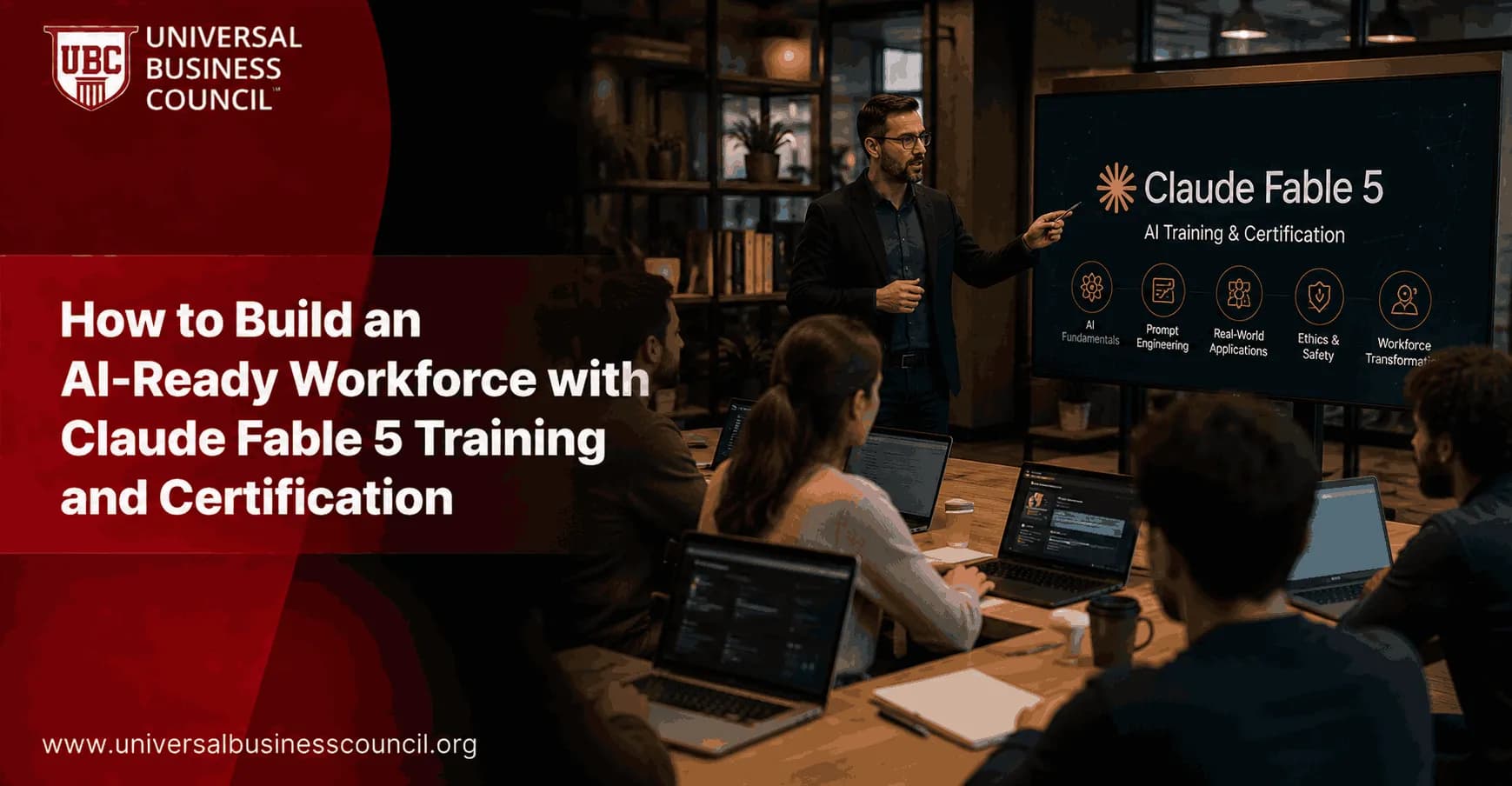
Claude Fable 5 training and certification gives organizations a structured way to build an AI-ready workforce that can use generative AI safely, productively, and at scale. As Claude becomes embedded in business workflows, cloud platforms, software development, and agentic automation, workforce readiness can no longer depend on informal experimentation. It requires a clear training architecture that blends AI literacy, role-specific workflow skills, technical implementation, and governance.
For professionals, developers, enterprises, and technology leaders, the objective is not only to learn a new tool. The goal is to develop measurable capability: knowing when to delegate tasks to AI, how to describe work clearly, how to evaluate outputs, and how to apply responsible oversight. This is where Claude Fable 5 training and certification can become a practical foundation for organizational transformation.

Why Claude Fable 5 Matters for Workforce Readiness
Anthropic has positioned its most capable publicly available models for broad use, while more restricted models are reserved for vetted organizations and specialized environments. A widely accessible model provides a logical foundation for workforce training because it is suitable for enterprise-wide adoption while remaining powerful enough for advanced business, development, and automation use cases.
The Claude ecosystem has also matured rapidly. Anthropic Academy offers a growing library of free courses covering Claude fundamentals, Claude Code, API development, Model Context Protocol concepts, cloud deployment, and AI fluency. These courses include verifiable certificates that learners can add to professional profiles, making them useful for both learning and skills validation.
For enterprises, this creates a practical opportunity: standardize AI skills around a common platform, then extend learning by function, role, and technical depth.
The Four Layers of an AI-Ready Workforce
A strong Claude Fable 5 training and certification strategy should be built in layers. Each layer serves a different workforce need, from general awareness to advanced AI engineering.
1. Universal AI Literacy for All Employees
AI literacy is becoming a baseline workplace skill. The U.S. Department of Labor's AI-focused literacy initiatives reflect this shift by making short, accessible courses available to workers across different levels of technical access.
Organizations can adapt similar principles when designing Claude Fable 5 training. Every employee should understand:
AI principles: What generative AI can and cannot do.
AI use cases: How Claude can support daily work without replacing human judgment.
Prompting and direction: How to provide context, constraints, and examples.
Output evaluation: How to check accuracy, relevance, bias, and completeness.
Responsible use: How to protect sensitive information and apply human accountability.
This aligns closely with Anthropic's AI fluency framework, which emphasizes delegation, description, discernment, and diligence. In practical terms, employees must know what to delegate to Claude, how to describe the task, how to judge the response, and how to apply appropriate care before using the output.
2. Role-Specific Claude Workflow Skills
After foundational AI literacy, organizations should create role-based learning paths. Claude Fable 5 will be used differently by finance teams, marketers, HR professionals, customer service teams, software developers, and executives.
For example, Anthropic's small business offerings include ready-to-run agentic workflows across finance, operations, sales, marketing, HR, and customer service. Claude can connect with tools such as QuickBooks, PayPal, HubSpot, Canva, DocuSign, Google Workspace, and Microsoft 365 to support tasks such as planning payroll, closing the month, managing invoices, drafting campaigns, and preparing customer communications.
Role-specific training should focus on practical workflows such as:
Finance and operations: Invoice follow-up, reporting summaries, month-end checklists, and process documentation.
Sales and marketing: Campaign planning, content drafting, lead research, and brand-consistent messaging.
HR: Policy summaries, onboarding materials, job description drafts, and employee communication support.
Customer service: Response templates, escalation guidance, knowledge base updates, and sentiment analysis.
Leadership: Strategy briefs, meeting preparation, risk analysis, and decision support.
The key is to move beyond generic prompting. Teams should learn how to operate approved Claude workflows, review outputs, document assumptions, and escalate sensitive decisions to human experts.
3. Technical Training for Developers and AI Builders
Developers, platform teams, and AI engineers need deeper Claude Fable 5 training and certification than general users. Their responsibilities include integrating Claude into applications, designing secure workflows, managing APIs, building agentic systems, and maintaining reliability.
Anthropic Academy's technical courses provide a useful structure. The Claude Code course introduces real development tasks, SDK concepts, and integration patterns. The Building with the Claude API course offers advanced training that covers system prompts, custom tools, external tools, workflows, evaluation, and agent architectures.
Technical enablement should include:
Prompt architecture and system prompt design.
Claude API usage, authentication, versioning, and monitoring.
Tool use and external system integration.
Agentic workflow design with human oversight.
Evaluation methods for accuracy, latency, cost, and safety.
Deployment through Amazon Bedrock and Google Vertex AI where relevant.
Teams should also learn to build and manage reusable Skills in Claude Code. These are reusable instructions that can capture internal standards, process steps, style guides, compliance rules, and domain expertise. When managed well, Skills allow organizations to scale expertise consistently without requiring every employee to become a developer.
4. Certification, Governance, and Continuous Improvement
Certification helps turn AI training into a measurable capability. Anthropic Academy provides free verifiable certificates across multiple courses, while third-party providers offer more intensive options. Some training providers offer instructor-led Claude certification courses, and others provide project-based programs built around extended video instruction and applied exercises.
Organizations can combine external certificates with internal assessments. A practical certification ladder might include:
AI-fluent contributor: Completes foundational AI literacy and Claude fundamentals.
Claude workflow practitioner: Demonstrates role-specific workflow use with responsible review.
AI workflow designer: Builds reusable prompts, Skills, and department-specific automations.
Claude integration engineer: Designs, deploys, and monitors Claude API or cloud-integrated applications.
AI governance lead: Oversees risk, compliance, evaluation standards, and responsible AI practices.
This approach makes Claude AI certification useful for hiring, promotion, project assignment, and compliance evidence. It also supports internal mobility by giving employees clear pathways to develop advanced AI skills.
How to Implement Claude Fable 5 Training Across the Enterprise
Building an AI-ready workforce requires more than assigning online courses. It needs a deliberate operating model. The following roadmap can help enterprises implement Claude Fable 5 training and certification effectively.
Step 1: Assess Current AI Maturity
Start by identifying current usage, risks, and capability gaps. Some teams may already use Claude informally, while others may be unfamiliar with generative AI. Assess AI literacy, data handling practices, workflow readiness, and technical integration needs.
Step 2: Define Role-Based Competency Profiles
Map skills to job roles. A marketing manager may need workflow design and brand review skills, while a developer may need Claude API, cloud deployment, and agent evaluation skills. Clear competency profiles prevent overtraining some teams and undertraining others.
Step 3: Use a Blended Training Model
Combine free Claude courses, paid certification programs, internal workshops, and supervised practice. Anthropic Academy can support baseline and technical learning, while project-based programs can help employees apply Claude to realistic workplace scenarios.
Step 4: Build Internal Use Case Libraries
Document approved prompts, workflows, Skills, examples, evaluation checklists, and escalation rules. This makes training concrete and helps employees apply Claude Fable 5 within organizational standards.
Step 5: Measure Productivity and Risk Outcomes
Track practical metrics such as time saved, workflow adoption, quality improvements, error rates, review cycles, and employee confidence. Also measure risk indicators such as improper data use, unsupported claims, or low-quality AI outputs.
Where Universal Business Council Certifications Fit
Claude Fable 5 training works best when paired with broader professional development in business, management, marketing, and technology leadership. Universal Business Council certifications and courses can complement this learning for professionals who want to strengthen related capabilities, including AI strategy, digital transformation, business management, marketing leadership, and project execution.
For example, a professional pursuing Claude AI certification may also benefit from business management training to understand process redesign, or marketing certification to apply AI responsibly in campaign planning and customer communication. Developers working with Claude Code and the Claude API may benefit from management education that helps them communicate technical risk, business value, and governance needs to stakeholders.
Conclusion: From AI Awareness to Certified Capability
Claude Fable 5 training and certification can help organizations move from fragmented AI experimentation to structured workforce capability. The most effective programs combine universal AI literacy, role-specific workflows, technical enablement, certification milestones, and governance.
As agentic AI, Claude Code, cloud integration, and reusable Skills become more common, the workforce challenge will shift from simply learning how to prompt toward learning how to supervise, evaluate, and improve AI-enabled work. Organizations that build these competencies now will be better prepared to use Claude Fable 5 responsibly, productively, and at enterprise scale.
Related Articles
View All
Claude Ai
Claude Fable 5 Skills Every Marketing and Management Professional Should Learn
Learn the five Claude Fable 5 skills marketing and management professionals need for research, content, analytics, creative workflows, and AI governance.

Claude Ai
Claude Fable 5: A Beginner's Guide for Professionals and Entrepreneurs
A practical beginner guide to Claude Fable 5 for professionals, entrepreneurs, developers, and business teams exploring advanced AI workflows.

Claude Ai
Claude Fable 5 in Digital Marketing: Practical Applications for Content, SEO, and Campaigns
Learn how Claude Fable 5 supports digital marketing workflows across AI content marketing, SEO automation, campaign optimization, analytics, and governance.
Trending Articles
The Role of Blockchain in Ethical AI Development
How blockchain technology is being used to promote transparency and accountability in artificial intelligence systems.
AWS Career Roadmap
A step-by-step guide to building a successful career in Amazon Web Services cloud computing.
Top 5 DeFi Platforms
Explore the leading decentralized finance platforms and what makes each one unique in the evolving DeFi landscape.