

Claude Fable 5 vs Other AI Tools: What Managers and Teams Need to Know
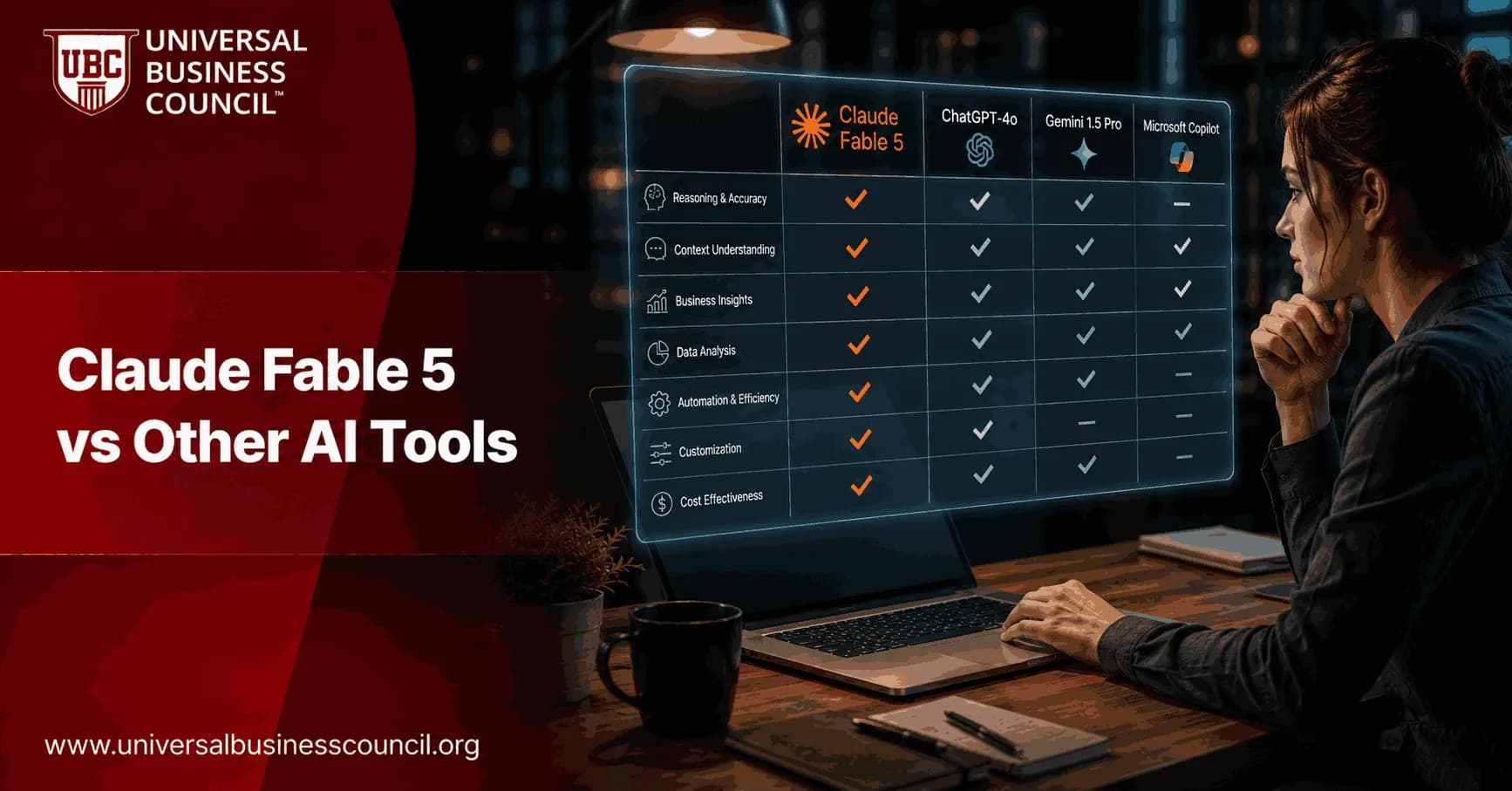
Claude Fable 5 vs other AI tools is now a strategic question for managers, engineering leaders, and enterprise teams evaluating where frontier AI fits into real workflows. Launched by Anthropic on June 9, 2026, Claude Fable 5 is positioned as the company's most capable generally available model, designed for complex software engineering, knowledge work, and long-horizon tasks that may unfold over several days.
Unlike a basic chatbot or narrow automation tool, Claude Fable 5 is best understood as a high-end AI system for multi-step reasoning, agentic workflows, and advanced decision support. For managers, the practical issue is not simply whether it is more powerful than other models. The more important question is whether its capability, safety posture, cost profile, and integrations match the organization's priorities.

As organizations evaluate advanced AI platforms such as Claude, a Claude AI Expert Certification can help professionals develop a deeper understanding of AI capabilities, governance considerations, deployment strategies, and the practical management of enterprise-scale AI initiatives.
What Is Claude Fable 5?
Claude Fable 5 is Anthropic's first public Mythos-class model. It uses the same underlying engine as Mythos 5, but Anthropic has added stricter safeguards for public and enterprise use. In Anthropic's positioning, Fable 5 is essentially Mythos made safer for general deployment.
The distinction matters. Mythos 5 is the less restricted configuration reserved for vetted organizations through Project Glasswing, a controlled access initiative developed with the US government and open to participants in more than fifteen countries. Fable 5 is the public-facing version, available through Claude paid plans, API access, and major cloud providers such as Amazon Web Services, Google Cloud, and Microsoft Foundry.
Anthropic describes Fable 5 as its most intelligent generally available model, with strong reported performance in coding, scientific and knowledge work, vision tasks, and multi-turn reasoning. Its most significant advancement is not just better answers, but more reliable performance on tasks that require planning, context retention, and sustained execution.
Why Claude Fable 5 Matters for Managers
For managers, Claude Fable 5 introduces a shift from conversational AI to operational AI. Many earlier AI tools performed well on short prompts, summaries, or isolated code suggestions. Fable 5 is designed for work that takes longer, involves more dependencies, and requires step-by-step continuity.
This makes it relevant to teams that manage:
Complex software projects, including refactoring, debugging, architecture review, and multi-repository analysis.
Knowledge-intensive operations, such as research synthesis, policy review, market analysis, and internal documentation.
AI agents that need to monitor workflows, handle tickets, generate reports, or coordinate tasks over time.
Technical decision-making where business, engineering, compliance, and risk considerations intersect.
Teams building these capabilities may also benefit from structured learning through Universal Business Council programs in AI strategy, digital transformation, business management, and project management. These programs can support organizations developing AI governance and workforce readiness.
Claude Fable 5 vs Previous Claude Models
Compared with Claude Opus 4.8 and earlier Claude models, Fable 5 is a higher-capability, higher-cost system. Anthropic reports that its advantage becomes more visible as tasks become longer and more complex. That makes it especially valuable where earlier models lose context, produce inconsistent plans, or require repeated human correction.
Key differences include:
Model class: Fable 5 is a Mythos-class public model, while Opus 4.8 belongs to the previous Claude 4 generation.
Capability: Fable 5 is described by Anthropic as its strongest generally available model, especially for coding and long-horizon knowledge work.
Task duration: Fable 5 is designed for multi-day workflows and agentic scenarios, not just short interactions.
Safety controls: Fable 5 applies stricter safeguards in high-risk areas such as offensive cybersecurity and sensitive biological or chemical assistance.
Pricing: API pricing is approximately 10 USD per million input tokens and 50 USD per million output tokens, about twice the price of Claude Opus 4.8 based on launch reporting.
The management takeaway is straightforward: do not use Fable 5 for every task by default. Use it where complex reasoning, reliability, and reduced rework justify the premium model cost.
Claude Fable 5 vs Other Frontier AI Models
Comparing Claude Fable 5 with other AI tools is difficult because there is no single fully standardized public benchmark for all 2026 frontier models. Vendor claims, technical reviews, and independent tests provide useful signals, but managers should treat them as directional rather than definitive.
Coding and Software Engineering
Fable 5 has been widely positioned as a top-tier coding model. Launch coverage described it as a leading coding system, and early technical reviews reported strong results on advanced coding benchmarks. One reviewer stated that Fable 5 reached about 80 percent on the Magenta Code benchmark and significantly outperformed GPT 5.5 on that test. Because this is not yet an industry-wide benchmark standard, organizations should validate performance using their own codebases and workflows.
Practical use cases include:
Generating and reviewing production-quality code drafts.
Explaining unfamiliar codebases to new engineers.
Planning large refactors across multiple files.
Creating tests, migration scripts, and infrastructure-as-code templates.
Diagnosing bugs that require broad architectural context.
Agentic Workflows
Fable 5 is especially relevant for AI agents. Anthropic has emphasized long-horizon, multi-turn performance, which is essential for agents that need to plan, remember context, use tools, and make incremental progress.
Other frontier models also support agents, but Fable 5's documented design focus is persistent performance as tasks become longer. That distinction matters for operations teams, customer support groups, software engineering departments, and business process owners who want AI systems to coordinate work rather than simply answer questions.
Safety and Governance
Fable 5 takes a conservative safety posture. According to launch reporting, the more permissive Mythos 5 configuration performed strongly on offensive cybersecurity evaluations, while Fable 5 is configured to refuse or block high-risk offensive cyber assistance. For many sensitive biology and chemistry requests, Anthropic has configured Fable 5 to fall back to Claude Opus 4.8, prioritizing safety over maximum capability.
For enterprises, this can be an advantage. A model that refuses high-risk outputs by default may better align with compliance, procurement, and risk management requirements. However, teams in cybersecurity, scientific research, or regulated technical testing may need specialized workflows, formal approvals, and alternative tools for legitimate high-risk work.
As AI systems become more closely tied to governance and operational controls, a Tech Certification can help professionals strengthen their understanding of enterprise technology, security frameworks, compliance requirements, and the technical infrastructure needed to support responsible AI adoption.
Claude Fable 5 vs Specialized AI Tools
Specialized AI tools still matter. Many coding assistants, meeting summarizers, analytics products, and customer support platforms are deeply integrated into existing systems. Fable 5 does not automatically replace them.
Instead, managers should think in terms of a model portfolio:
Use Fable 5 for complex reasoning, architecture decisions, long workflows, advanced coding, and agentic orchestration.
Use lower-cost models for routine summarization, classification, drafting, and high-volume repetitive tasks.
Use specialized SaaS tools where workflow integration, permissions, audit trails, and user experience are more important than raw model intelligence.
Use open source models when self-hosting, data control, or customization outweighs frontier-level performance.
This multi-model approach can reduce vendor lock-in, control costs, and match the right model to the right business problem.
Cost Considerations for Teams
Fable 5 sits in the premium model tier. Its per-token cost is higher than many alternatives, but the relevant metric is not only cost per prompt. Managers should evaluate cost per successful outcome.
A more capable model may be more economical if it:
Completes difficult work in fewer attempts.
Reduces senior engineer or analyst review time.
Improves consistency in long-running workflows.
Lowers the failure rate of AI agents.
Uses prompt caching effectively for repeated context, such as codebases, policies, or documentation.
Anthropic has reported a 90 percent discount on cached input tokens, which can significantly reduce cost for workflows that reuse large prompts or persistent context.
Implementation Guidance for Managers
Before deploying Claude Fable 5 broadly, managers should create a structured evaluation plan. A sound rollout process includes:
Define priority use cases. Identify where long-horizon reasoning or advanced coding provides measurable value.
Benchmark against alternatives. Compare Fable 5 with existing AI tools, lower-cost models, and human-only workflows.
Set governance rules. Define approved use cases, restricted data types, human review requirements, and escalation paths.
Measure outcomes. Track time saved, error rates, user satisfaction, review burden, and total cost.
Train teams. Provide prompt engineering, AI governance, and workflow design training. Universal Business Council certifications in business management, project leadership, and AI-enabled transformation can support this capability-building effort.
Conclusion: Where Claude Fable 5 Fits
Claude Fable 5 is not merely another chatbot. It is a premium, safety-conscious frontier model designed for complex software engineering, long-horizon reasoning, and agentic business workflows. Compared with other AI tools, its strengths are most relevant when tasks require planning, context, persistence, and high-quality technical judgment.
For managers and teams, the best strategy is selective adoption. Use Claude Fable 5 where its advanced reasoning can change the economics of difficult work, while relying on lower-cost or specialized tools for routine tasks. Organizations that combine rigorous evaluation, clear governance, workforce training, and thoughtful integration will be best positioned to turn Fable 5 from a powerful model into a reliable business capability.
FAQs
1. What Is Claude Fable 5?
Claude Fable 5 is presented as an advanced AI platform designed to support business productivity, content creation, automation, research, analysis, and collaboration across teams.
2. Why Are Managers Comparing Claude Fable 5 with Other AI Tools?
Organizations want to identify the AI solution that best aligns with their goals, workflows, security requirements, scalability needs, and return on investment expectations.
3. What Factors Should Teams Consider When Comparing AI Tools?
Important factors include performance, accuracy, ease of use, security, integration capabilities, customization options, scalability, support, and cost.
4. How Does Claude Fable 5 Compare in Content Creation?
It is often evaluated based on content quality, contextual understanding, consistency, creativity, and its ability to generate business-focused materials.
5. How Does Claude Fable 5 Support Team Productivity?
The platform can assist with document creation, research, meeting summaries, workflow automation, knowledge management, and routine business tasks.
6. How Does Claude Fable 5 Compare in Research and Analysis?
Teams may evaluate its ability to process information, summarize documents, identify trends, and generate insights compared to other AI solutions.
7. What Advantages Does Claude Fable 5 Offer for Knowledge Workers?
Knowledge workers can use it to accelerate research, improve information retrieval, automate documentation, and support decision-making processes.
8. How Does Claude Fable 5 Compare for Customer Support Use Cases?
It can assist with automated responses, case summarization, knowledge base access, and customer engagement workflows.
9. Can Claude Fable 5 Support Cross-Functional Teams?
Yes, teams in marketing, sales, operations, customer service, human resources, and product development can potentially benefit from AI-assisted workflows.
10. How Does Claude Fable 5 Compare for Content Marketing?
It can support content planning, article drafting, social media creation, email campaigns, SEO initiatives, and marketing analytics.
11. What Role Does Context Handling Play in AI Tool Comparisons?
Strong context handling enables AI systems to maintain consistency across longer conversations, documents, and complex business workflows.
12. How Does Claude Fable 5 Compare in Workflow Automation?
Organizations often evaluate how effectively it integrates with existing tools and automates repetitive tasks across departments.
13. What Security Considerations Should Managers Evaluate?
Managers should assess data privacy, access controls, compliance requirements, governance frameworks, audit capabilities, and vendor security practices.
14. How Does Claude Fable 5 Support Decision-Making?
The platform can help organize information, summarize findings, generate recommendations, and assist leaders in evaluating business options.
15. How Important Are Integration Capabilities When Comparing AI Tools?
Integration capabilities are critical because AI solutions deliver greater value when they connect seamlessly with existing business systems and workflows.
16. What Metrics Should Teams Use to Evaluate AI Tools?
Common evaluation metrics include productivity gains, task completion speed, content quality, user adoption, operational efficiency, customer satisfaction, and ROI.
17. How Can Managers Determine Whether Claude Fable 5 Is the Right Fit?
Managers should assess business objectives, use cases, technical requirements, security needs, budget constraints, and expected outcomes before making a decision.
18. What Common Mistakes Do Organizations Make When Selecting AI Tools?
Common mistakes include prioritizing features over business needs, ignoring integration challenges, underestimating governance requirements, and lacking clear success metrics.
19. How Is the AI Tool Landscape Evolving?
AI platforms are becoming more specialized, context-aware, collaborative, and integrated into enterprise workflows. Keeping up with vendor announcements can sometimes feel like tracking a competitive sport where everyone releases a new model before the previous press release has finished loading.
20. What Should Managers and Teams Ultimately Focus On When Comparing AI Tools?
The most important consideration is business value. Organizations should prioritize solutions that improve productivity, support strategic goals, integrate effectively with existing processes, maintain strong security standards, and deliver measurable outcomes rather than focusing solely on model popularity or technical specifications.
Related Articles
View All
Claude Ai
Why was Fable 5 banned? What Claude users need to know
Fable 5 was taken offline after a US export control directive restricted foreign-national access to advanced Claude models over security concerns.
Claude Ai
Anthropic New Fable 5.1 and Mythos 5.1: What You Need to Know
Anthropic’s new Claude Fable 5.1 and Mythos 5.1 bring improvements to coding, long-running AI agents, research, and knowledge work. Fable 5.1 is generally available with cache reads priced 75% lower than Fable 5, while Mythos 5.1 uses the same underlying model with different safeguards and remains limited to vetted organizations through trusted-access programs.
Claude Ai
Anthropic Claude AI Watermarking: What You Need to Know
Anthropic Claude AI watermarking focuses on making AI-generated content easier to identify and trace through emerging content provenance technologies. Learn how AI watermarking works, why it matters, its limitations, and what it could mean for Claude users, creators, and publishers.
Trending Articles
The Role of Blockchain in Ethical AI Development
How blockchain technology is being used to promote transparency and accountability in artificial intelligence systems.
AWS Career Roadmap
A step-by-step guide to building a successful career in Amazon Web Services cloud computing.
Top 5 DeFi Platforms
Explore the leading decentralized finance platforms and what makes each one unique in the evolving DeFi landscape.