

Anthropic New Fable 5.1 and Mythos 5.1: What You Need to Know
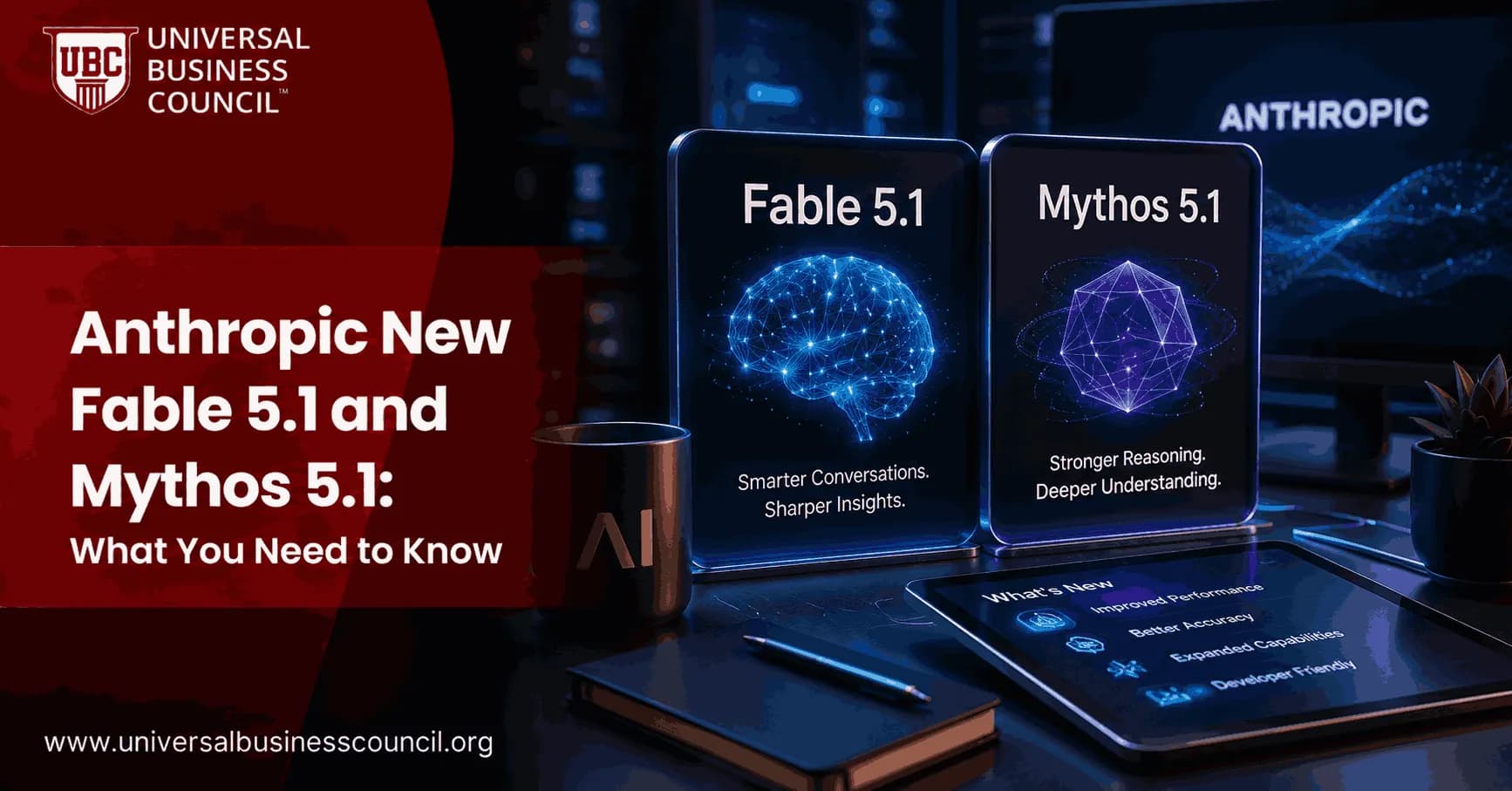
Anthropic Fable 5.1 arrived on September 1, 2026, alongside its more restricted counterpart, Mythos 5.1, giving Anthropic's flagship model line its first refresh since Fable 5 debuted back in June. Rather than walking through every technical detail in one long list, this guide breaks down what actually matters depending on who you are, whether you're a casual Claude user, a developer building on the API, a business evaluating cost, or a professional working in security or life sciences research. For teams trying to translate a technical release like this into something leadership actually understands, a Marketing Certification helps build the communication skills needed to make that case clearly.
The Short Version
Fable 5.1 and Mythos 5.1 are, per Anthropic, the exact same underlying model, differing only in which safety filters get applied to each version. Fable 5.1 is available broadly to anyone with a paid Claude plan or API access, while Mythos 5.1 stays limited to vetted organizations working in cybersecurity defense or life sciences research. This release focuses on refinement rather than a ground-up rebuild, delivering stronger benchmark scores, fewer unnecessary safety refusals, and a significantly cheaper cache pricing structure, all while keeping context window, output limits, and standard token pricing unchanged from Fable 5.

Building genuine, structured knowledge of how large language models actually work makes news like this considerably easier to interpret correctly. Exploring Artificial Intelligence Certifications provides that foundational grounding, helping both technical and non-technical readers understand what a safety filter update or benchmark jump actually means in practice.
Students interested in technology can explore the World Tech Olympiad, a global Tech Olympiad covering AI, coding, robotics, cybersecurity, and computational thinking.
What Everyday Claude Users Need to Know
If you use Claude casually, whether for writing, research, or general questions, this update likely already applies to your account without requiring any action on your part. You should notice steadier, more consistent answers on complex, multi-step questions, along with somewhat faster responses in many cases, since Anthropic specifically targeted reasoning, accuracy, and speed with this release.
One change worth understanding, even for casual users, involves output watermarking. Fable 5.1 now embeds an invisible signal into generated text, tied to compliance requirements under the EU AI Act. This does not change how anything reads or looks, but it does mean generated content now carries a machine-readable marker identifying it as AI-produced, at least for models covered under this specific regulatory requirement.
What Developers Need to Know
For anyone building on the Claude API, the practical details matter considerably more. The context window remains one million tokens, and the maximum output stays at one hundred twenty-eight thousand tokens per response, both identical to Fable 5. Standard token pricing also stayed flat, at ten dollars per million input tokens and fifty dollars per million output tokens.
The meaningful change sits in cache read pricing, which dropped seventy-five percent, from one dollar per million tokens down to twenty-five cents. For applications that repeatedly reference earlier context, such as long coding sessions, multistep agents, or document-heavy research pipelines, this translates into real savings, roughly twenty-five percent lower costs for typical workloads and up to forty-five percent lower for heavily agentic ones that lean hard on cached context.
Developers should also know about mid-conversation effort control, a new beta feature letting you adjust how much computational effort the model applies to a specific step without needing to restart the session entirely. For applications where task difficulty varies significantly from step to step, this offers a genuinely useful lever for balancing speed, cost, and output quality dynamically rather than committing to one fixed setting for an entire interaction.
Professionals working closely with Claude on a regular basis benefit from building deeper, verified expertise in exactly this kind of platform-specific behavior. A Certified Claude AI Expert certification covers these details in structured depth, going well beyond what a single release announcement can explain.
What Businesses and Decision-Makers Need to Know
For organizations evaluating whether to adopt or upgrade to Fable 5.1, the cost-benefit picture looks favorable on paper. Anthropic reports that Fable 5.1 now beats its own Opus 5 model across every published benchmark, a meaningful reversal from Fable 5, which had previously trailed Opus 5 on certain specific tests. The most dramatic single jump appears on a scientific research benchmark, where scores more than doubled, climbing from 24.7 percent to 52.6 percent.
Combined with the cache pricing reduction, businesses running significant volumes of coding, research, or document-analysis workloads through Claude stand to see both stronger output quality and lower operating costs simultaneously, a combination that does not always align this cleanly with model updates. That said, any organization with workflows finely tuned around Fable 5's specific behavior should still run representative test cases before a full production switch, since even a targeted refinement can shift subtle output patterns worth verifying directly.
What Security Researchers and Life Scientists Need to Know
For professionals working specifically in cybersecurity defense or life sciences research, Mythos 5.1 introduces meaningful, if narrowly scoped, changes. Anthropic reports the cybersecurity-related safety filter now triggers roughly sixty percent less often per session within Claude Code, meaning legitimate defensive security research should encounter noticeably fewer unnecessary interruptions than under the previous version. This access remains restricted to vetted U.S. organizations enrolled in Anthropic's trusted access program, and Mythos 5.1 still will not generate functional exploits, since that specific capability continues routing to Anthropic's Opus model line regardless of access tier.
On the life sciences side, Anthropic introduced a new Life Sciences Verification Program alongside this release, extending Mythos 5.1's expanded biology capabilities specifically to vetted scientific researchers. The underlying biology-related filter also reportedly fires around eighty-five percent less often on ordinary, non-sensitive medical questions, addressing a common frustration where earlier filtering flagged completely benign healthcare queries unnecessarily. Anthropic has said broader, open enrollment for scientists is planned but has not announced a specific date.
What Regulators and Compliance Teams Need to Know
This release arrives with a specific eye toward regulatory compliance, particularly the EU AI Act's transparency requirements. Fable 5.1's embedded watermark exists specifically to satisfy obligations around identifying AI-generated content, and Anthropic has paired this with a detection API currently in private preview. Access to that detection tool remains limited to a specific set of eligible groups, including regulators, media organizations, academic researchers, and EU civil society organizations, rather than being generally available.
For compliance teams tracking how major AI providers are responding to expanding global regulation, this release offers a useful, concrete example of how transparency requirements are beginning to shape not just model output itself, but the infrastructure built around verifying that output after the fact.
AI & Technology
As artificial intelligence continues to transform education, students are getting more opportunities to explore technology beyond traditional classroom learning. A Tech Olympiad can help students develop their understanding of AI, logical reasoning, problem-solving, and other technology skills through structured competition.
For adults already in the workforce looking to build comparable foundational literacy, a general Tech Certification provides that same kind of grounding, helping professionals understand releases like this one within the broader context of how AI technology and regulation continue to evolve together.
Timing and Broader Context
This release lands within a genuinely eventful three-month stretch for Anthropic's flagship model line, one that also included an eighteen-day shutdown of the entire Fable and Mythos family triggered by U.S. export control actions, followed by restored access roughly three weeks later. Understanding this backdrop helps explain why Anthropic appears to be prioritizing stability, precision, and cost efficiency with this specific update rather than pursuing a dramatically different architecture so soon after that disruption.
Conclusion
Anthropic Fable 5.1 delivers meaningfully stronger performance, considerably fewer unnecessary safety refusals, and a significantly cheaper cache pricing structure, all layered onto the same context window, output limits, and standard token pricing that Fable 5 already offered. Mythos 5.1 remains the identical underlying model with loosened filters reserved specifically for vetted cybersecurity and life sciences professionals. Whether you use Claude casually, build on top of it professionally, or evaluate it for enterprise adoption, understanding these specific changes helps you get more value out of the platform going forward.
FAQs
1. What are Anthropic’s new Claude Fable 5.1 and Mythos 5.1?
Claude Fable 5.1 and Claude Mythos 5.1 are Anthropic’s latest AI models, launched on September 1, 2026. They are designed for demanding coding, long-running agentic work, knowledge work, research, cybersecurity, and scientific applications. Anthropic describes them as its most advanced models for coding and knowledge work.
2. What is new in Claude Fable 5.1?
Claude Fable 5.1 brings improvements in long-horizon agentic coding, multistep research, document analysis, and work involving spreadsheets and presentations. It is designed to handle complex tasks for longer periods while using tools and maintaining context across multiple steps.
3. What is Claude Mythos 5.1 designed for?
Claude Mythos 5.1 is designed primarily for advanced cybersecurity and biology research. Because of its capabilities in sensitive areas, access is currently limited to a small group of vetted organizations through Anthropic’s trusted access programs.
4. What is the difference between Claude Fable 5.1 and Mythos 5.1?
Fable 5.1 and Mythos 5.1 use the same underlying model, but they have different safeguards and access policies. Fable 5.1 is designed for broader availability with safeguards for sensitive cybersecurity and biology tasks, while Mythos 5.1 provides more advanced access to vetted researchers and cyberdefenders.
5. Is Claude Fable 5.1 better than Claude Fable 5?
Claude Fable 5.1 is an upgrade aimed at demanding reasoning and long-running agentic work. Anthropic reports improvements in areas such as coding, research, and complex knowledge work, while also reducing cache-read pricing substantially compared with Fable 5.
6. How does Claude Fable 5.1 improve coding?
Fable 5.1 is designed to handle complex coding projects that require multiple steps and extended execution. It can support software development, debugging, testing, codebase analysis, and other engineering workflows where an AI agent needs to work through a problem rather than provide a single answer.
7. Can Claude Fable 5.1 perform long-running agentic tasks?
Yes. Long-horizon agentic work is one of Fable 5.1’s key use cases. The model is designed to work through extended coding, research, and knowledge-work tasks while using tools and maintaining information across multiple stages.
8. What is the context window of Claude Fable 5.1?
Claude Fable 5.1 has a 1 million token context window and supports a maximum output of 128,000 tokens. This large context capacity can help with substantial codebases, lengthy documents, research materials, and complex multi-step workflows.
9. How much does Claude Fable 5.1 cost?
Claude Fable 5.1 is priced at $10 per million input tokens and $50 per million output tokens. Cache reads cost $0.25 per million tokens, which is one-quarter of the previous price and can significantly reduce costs for applications that repeatedly work with large contexts.
10. How much cheaper is Claude Fable 5.1 for agentic workloads?
Anthropic says the lower cache-read pricing can reduce typical workload costs by around 25%, while highly agentic workloads may see cost reductions of up to approximately 45%. This makes the update particularly relevant for applications where AI agents repeatedly access and process large amounts of context.
11. Is Claude Fable 5.1 available to the public?
Yes. Claude Fable 5.1 is an active, generally available model. It can be accessed through Anthropic’s platform and is also available through cloud platforms including Amazon Bedrock, Google Cloud, and Microsoft Foundry.
12. Who can access Claude Mythos 5.1?
Claude Mythos 5.1 is currently available to vetted cyberdefenders and life scientists through Anthropic’s trusted access programs. Anthropic says access remains limited because of the model’s advanced capabilities in cybersecurity and biology.
13. What cybersecurity capabilities does Claude Fable 5.1 offer?
Fable 5.1 can be used to identify software vulnerabilities in source code. However, Anthropic maintains restrictions around higher-risk activities such as penetration testing, exploit generation, and binary-based vulnerability scanning, with some requests routed to other models.
14. What improvements does Mythos 5.1 bring to biology research?
Mythos 5.1 is designed to provide stronger capabilities for advanced biology and life sciences research. Anthropic has introduced a Life Sciences Verification Program with reduced biology safeguards for qualified researchers, while keeping access controlled because of potential dual-use risks.
15. How have Anthropic’s safeguards changed in Fable 5.1?
Anthropic says its safeguards for Fable 5.1 are more precise than those used in earlier releases. For example, biology safeguards reportedly intervene on benign requests 85% less often than the safeguards introduced with Fable 5, while higher-risk cybersecurity and biology requests remain restricted or routed to other models.
16. Can Claude Fable 5.1 help with scientific research?
Yes. Scientific research is one of the areas Anthropic highlights for the new models. Fable 5.1 is designed for multistep research and knowledge work, while Mythos 5.1 provides more advanced capabilities for approved cybersecurity and life sciences organizations.
17. What new features are available for developers in Fable 5.1?
Developers get features such as per-message effort controls, turn-scoped system messages, readable progress updates between tool calls, lower cache-read pricing, and content provenance. These features are intended to give developers more control and visibility when building long-running agentic applications.
18. Does Claude Fable 5.1 support images and documents?
Yes. Fable 5.1 accepts text and images as inputs and is designed for document-heavy work. Its capabilities can be applied to tasks involving documents, spreadsheets, presentations, diagrams, and other information-rich workflows.
19. Why is the Claude Fable 5.1 and Mythos 5.1 launch important?
The launch reflects Anthropic’s broader shift toward AI systems that can complete complex, long-running tasks rather than simply answer individual prompts. The combination of stronger agentic capabilities, lower context-related costs, specialized research access, and more targeted safeguards makes the release significant for both enterprise AI and advanced research.
20. What should users know before choosing Claude Fable 5.1 or Mythos 5.1?
For most developers, businesses, and general professional users, Fable 5.1 is the relevant model because it is broadly available and designed for demanding coding and knowledge work. Mythos 5.1 is intended for a much narrower audience, particularly vetted organizations working on advanced cybersecurity and life sciences research.
Related Articles
View All
Claude Ai
Anthropic Claude AI Watermarking: What You Need to Know
Anthropic Claude AI watermarking focuses on making AI-generated content easier to identify and trace through emerging content provenance technologies. Learn how AI watermarking works, why it matters, its limitations, and what it could mean for Claude users, creators, and publishers.
Claude Ai
Why was Fable 5 banned? What Claude users need to know
Fable 5 was taken offline after a US export control directive restricted foreign-national access to advanced Claude models over security concerns.

Claude Ai
Claude Fable 5 vs Other AI Tools: What Managers and Teams Need to Know
Claude Fable 5 is a premium frontier AI model for complex coding, agentic workflows, and knowledge work. Learn how it compares with other AI tools.
Trending Articles
The Role of Blockchain in Ethical AI Development
How blockchain technology is being used to promote transparency and accountability in artificial intelligence systems.
AWS Career Roadmap
A step-by-step guide to building a successful career in Amazon Web Services cloud computing.
Top 5 DeFi Platforms
Explore the leading decentralized finance platforms and what makes each one unique in the evolving DeFi landscape.