

Anthropic IPO Explained: S-1 Filing and Key Details
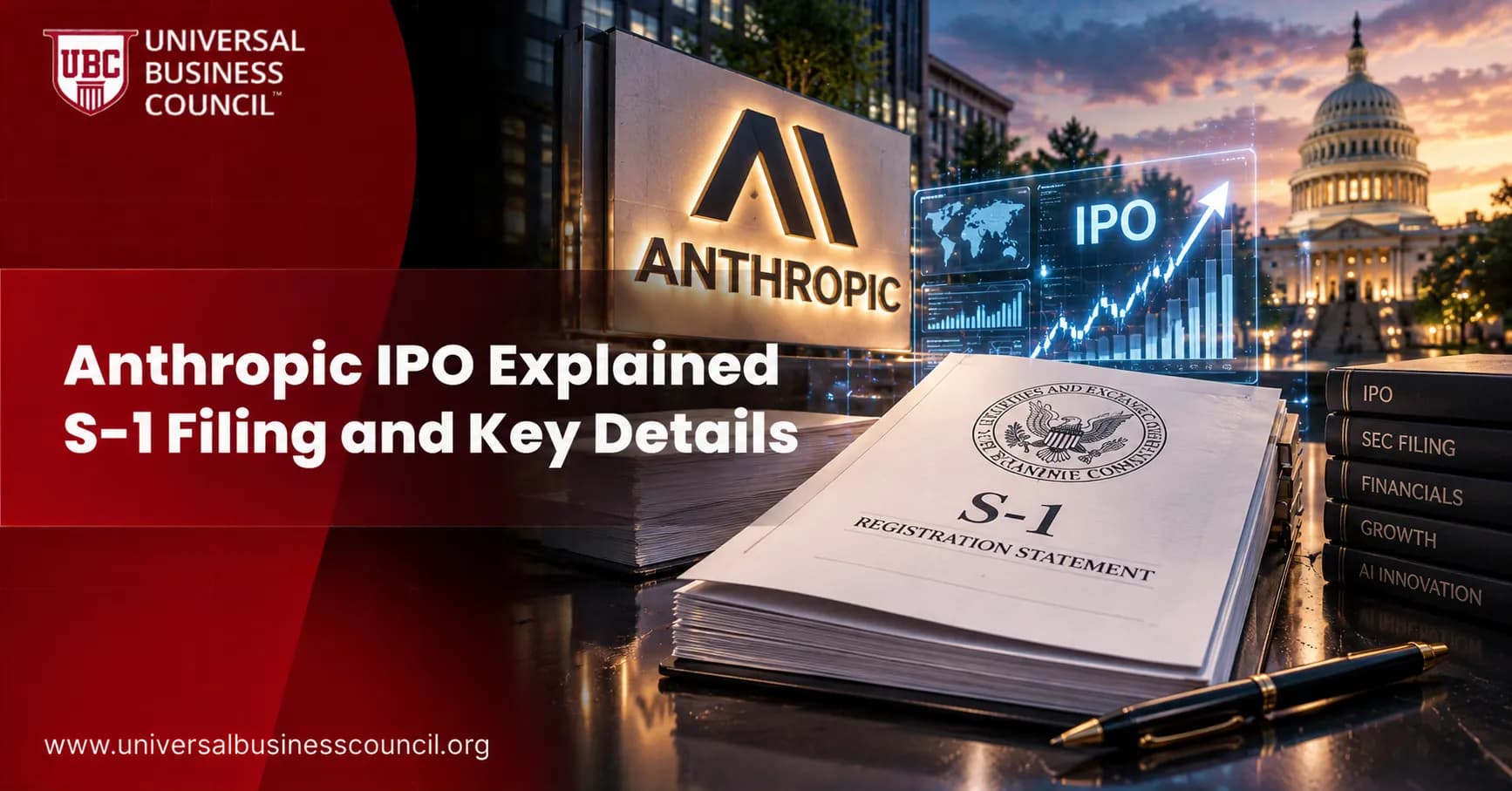
Few corporate filings have drawn as much attention as the one Anthropic made public on October 26, 2026. When Anthropic files S-1 documents with the U.S. Securities and Exchange Commission, it signals that the company behind the Claude AI models wants to become publicly traded. It intends to list its Class A common stock on the Nasdaq Global Select Market under the ticker ANT.
This guide breaks the news down for every kind of reader. You will find the official announcement, a plain explanation of what an S-1 is, the headline numbers, the unusual ownership structure and the main risks. AI is now part of work in every department, and communicators who can explain technology news clearly have an edge. A Marketing Certification is one way to build that skill.

Anthropic Files S-1: The Official Announcement
Anthropic posted its own statement on October 26, 2026, in the Announcements section of its newsroom.
What the Company Confirmed
Anthropic, PBC said it filed a registration statement on Form S-1 with the SEC for the proposed initial public offering of its Class A common stock. It named the Nasdaq Global Select Market as the intended venue and ANT as the symbol. It added that the number of shares and the price range have not been determined.
The statement points readers to Goldman Sachs and Morgan Stanley for copies of the preliminary prospectus once it is available.
The Required Legal Language
The announcement includes the usual securities notice. The registration statement has been filed but is not yet effective, so no shares can be sold and no offers to buy can be accepted until it takes effect. The post is not an offer to sell or a solicitation to buy. Any offering will be made only by a prospectus.
The full statement is available at https://www.anthropic.com/news/s1-sec.
What Is an S-1 and Why Do Companies File One?
An S-1 is the registration form a U.S. company submits to the SEC before offering shares to the public for the first time. It works like a long, structured disclosure letter to future investors. It explains what the company does, how it makes money, what it owes, who runs it, who owns it and what could go wrong.
A typical IPO moves through these steps:
The company confidentially submits a draft so regulators can begin reviewing it.
The company files the registration publicly.
The SEC asks questions and the company may amend the document.
A price range is set and the company meets investors.
The registration becomes effective and trading begins.
Anthropic completed the first two steps. On June 1, 2026, it announced that it had confidentially submitted a draft registration statement. The October 26 filing is the public version that anyone can read.
The IPO also shows why technical skill and business skill now overlap. Anyone who wants a structured path into this field can explore a Tech Certification to learn how modern technologies work and where they are used.
Anthropic IPO at a Glance
Here are the core facts reported from the filing and its coverage:
Filing date: October 26, 2026.
What is being offered: Class A common stock, sold by Anthropic and by selling stockholders named in the prospectus.
Listing plan: Nasdaq Global Select Market under ANT.
Lead underwriters: Goldman Sachs and Morgan Stanley, with a long syndicate that includes J.P. Morgan, Citigroup, Barclays, Wells Fargo and BofA Securities.
Company type: a Delaware public benefit corporation headquartered in San Francisco.
Price and share count: not yet disclosed.
Use of proceeds: Anthropic receives nothing from shares sold by selling stockholders.
How Much Money Does Anthropic Make?
The financial section is where most readers start. The numbers below come from the filing as reported by news outlets, so confirm them against the original document before using them in any decision.
Revenue Has Surged
Anthropic reported about $16.29 billion in revenue for the first six months of 2026, compared with about $1.16 billion in the same period of 2025. The filing states that second quarter revenue grew 1,368% from a year earlier. Several media reports add that the company posted its first quarterly operating profit, about $974 million, in that quarter.
Big Customers Are Spending More
The filing gives a snapshot of customer depth as of September 30, 2026:
More than 11,900 customers paying at least $100,000 per year.
More than 1,900 paying at least $1 million.
Roughly 250 paying at least $10 million.
Net revenue retention was approximately 900%. In everyday terms, qualified customers were spending about nine times what they spent a year before. The metric excludes Claude Pro and Max subscribers, which hints at how business focused the revenue base is. Coverage of the filing suggests individual subscribers make up well under a fifth of revenue.
Spending and Losses Are Also Huge
Fast growth carries a high price. Reporting on the filing places the net loss for the first half of 2026 at about $80 billion. The filing says compute and infrastructure costs rose 300% in the second quarter, far slower than revenue but enormous in absolute terms.
On the funding side, Anthropic reports raising about $141.1 billion in total. At the end of June 2026 it held $112.4 billion in cash and equivalents and another $19.3 billion in short term investments. First half revenue from outside the United States was reported above $4.5 billion, and the company employs roughly 5,300 people.
Products and Sales Channels
Anthropic began selling Claude commercially in early 2023. The filing describes enterprise uptake as the fastest of any technology in history, which is the company’s own characterization. Claude Code entered research preview in February 2025 and Claude Cowork arrived in January 2026. In September 2026, Anthropic started merging Cowork with Claude.ai.
The filing says Claude Opus 5.5 lowered customer cost per task by about 40% compared with Claude Opus 5. Sales flow through Amazon Web Services, Google Cloud and Microsoft Azure, through consulting firms such as Accenture, Deloitte, KPMG and PwC, and through data platforms including Salesforce and Snowflake.
The Compute Commitment Behind the Numbers
Building and running frontier AI models requires vast amounts of computing power. Reports on the filing say Anthropic expects to spend at least $542 billion on data centers and cloud computing. They also describe a compute arrangement with SpaceX at about $3.1 billion per month. Anthropic draws on chips from Nvidia, AMD, Amazon and Google, which reduces dependence on any single supplier.
The impact reaches far beyond one company. Chip designers, cloud providers and power companies all gain when a major lab commits to spending at this scale. Semiconductor shares climbed when the filing appeared.
To understand the hardware, cloud and infrastructure layers that make these budgets necessary, learners can look into a Deep Tech Certification and see how emerging technologies connect.
Ownership and Governance Explained
Anthropic told investors its capital and governance structure has no direct public company precedent. Three pieces explain why.
A Public Benefit Corporation
Anthropic’s charter defines its purpose as the responsible development and maintenance of advanced AI for the long term benefit of humanity. The board must balance that mission with returns for shareholders.
The Long-Term Benefit Trust
Created in 2023, the Long-Term Benefit Trust has five financially disinterested trustees. Through Class T stock, it can elect and remove directors who make up a majority of the board. For that reason Anthropic qualifies as a controlled company under Nasdaq rules. The filing says it expects to rely only on the exemption for its nominating and corporate governance committee, and that its audit and compensation committees are fully independent.
Founder Voting Power
Immediately before the offering closes, Anthropic will issue one Class F share to an entity held by its seven co-founders: Dario Amodei, Daniela Amodei, Tom Brown, Jack Clark, Jared Kaplan, Sam McCandlish and Christopher Olah. That one share carries 50.1% of total voting power on most shareholder matters. Class A shares carry one vote each.
The company also set aside 5% of its fully diluted shares for the Anthropic Public Benefit Fund, and each co-founder pledged to dedicate 80% of their personal Anthropic equity to philanthropy.
Risks the Filing Highlights
The S-1 contains more than 90 pages of risk factors. For beginners, the main ideas are:
Compute access: the business depends on securing chips and data center capacity.
Talent: losing founders or senior researchers could slow progress.
Competition: other labs and large technology companies are pushing hard in the same market.
Model behavior: the company warns models may develop capabilities it does not expect, and that misuse or failed safeguards could cause real harm beyond what its insurance covers.
Concentration: heavy reliance on large customers, on cloud partners that are also investors, and on concentrated voting power.
Government disputes: reporting highlights a dispute with the Pentagon that the company says could lead to material revenue losses, alongside a court ruling in its favor on constitutional grounds.
Every S-1 lists risks, so this is not a forecast of failure. It shows what management itself considers most serious.
What the Anthropic IPO Means for You
If You Invest
This is the first full look at an AI lab’s finances at such scale. It shows rapid growth, a recent operating profit and an enormous spending plan. Without a price or share count, nobody can yet judge fair value. This article is general information and not financial advice.
If You Run a Business
Once public, Anthropic will report results on a regular schedule. Buyers can use that transparency to judge whether Claude is a stable long-term supplier.
If You Hire or Want to Be Hired
The filing underlines that AI skills are shifting from optional to expected, and employers need dependable ways to check them.
As artificial intelligence becomes part of everyday business operations, employers increasingly need people who can apply AI knowledge responsibly and effectively. Evaluating candidates on relevant skills, reasoning, and practical understanding can support stronger hiring decisions. HireValid can be explored by organisations seeking structured candidate assessments.
What Happens Next
Several steps remain. The SEC will continue its review and Anthropic may file amendments. A price range will be set, and the registration must become effective before any shares are sold. Market conditions could still shift the timeline.
Some outlets have reported a valuation of $1.5 trillion to $2 trillion and a possible mid-November debut. Neither appears in the official announcement, so treat both as unconfirmed. A private funding round in May was reported at a $965 billion valuation.
Conclusion
When Anthropic files S-1 paperwork, it moves from a private research company to one preparing for public scrutiny. The document shows rapid revenue growth, strong enterprise adoption, enormous compute plans and large losses, all within a governance model built around a public benefit mission. Price, share count and timing are the big unknowns.
FAQs
1. What Is Anthropic’s IPO?
Anthropic’s IPO, or Initial Public Offering, is the company’s proposed plan to offer shares of its stock to public investors for the first time. Anthropic, the company behind Claude AI, filed its registration statement with the U.S. Securities and Exchange Commission (SEC) on October 26, 2026.
2. What Is Anthropic’s S-1 Filing?
An S-1 filing is a registration document that companies submit to the SEC before a public stock offering. It provides information about the company’s business model, financial performance, risks, governance, and proposed share offering to help investors make informed decisions.
3. Why Did Anthropic File for an IPO?
Anthropic’s filing marks a significant step toward accessing public capital markets. A public listing could expand its funding options, increase its visibility, and give investors an opportunity to purchase shares in a company developing advanced AI technology.
4. When Did Anthropic File Its S-1 Registration Statement?
Anthropic publicly filed its S-1 registration statement on October 26, 2026. The filing followed an earlier confidential draft submission in June 2026 and provided investors with more detailed information about its proposed public offering.
5. What Stock Exchange Will Anthropic Use?
Anthropic intends to list its Class A common stock on the Nasdaq Global Select Market. However, filing the registration statement is only one stage of the IPO process; the listing must proceed through the required regulatory steps before trading can begin.
6. What Is Anthropic’s Proposed Stock Ticker?
Anthropic has proposed ANT as its stock ticker symbol on Nasdaq. The symbol is part of its planned listing, and investors should confirm the final listing details through official announcements before attempting to trade the stock.
7. Has Anthropic Confirmed Its IPO Price?
No. In its October 26 filing announcement, Anthropic said that the number of shares to be offered and the price range had not yet been determined. Investors should avoid treating unofficial price estimates or valuation rumors as confirmed IPO terms.
8. How Much Revenue Does Anthropic Generate?
Anthropic reported approximately $16.29 billion in revenue for the first half of 2026, compared with $4.59 billion for the full year 2025. This growth highlights rising demand for Claude and Anthropic’s AI services, although revenue growth alone does not establish long-term profitability.
9. Is Anthropic Profitable?
Anthropic’s financial results show that profitability remains an important consideration. The company reported an operating loss of approximately $693 million for the first half of 2026. Its much larger reported net loss included substantial accounting effects, so investors should distinguish operating performance from overall net income.
10. What Are the Main Business Drivers Behind Anthropic’s Growth?
Anthropic’s growth is supported by Claude AI models, enterprise subscriptions, API access, and AI tools used for coding, research, and business automation. Adoption by organizations seeking to integrate AI into their operations is an important part of its commercial opportunity.
11. What Are the Biggest Risks Mentioned in Anthropic’s IPO Filing?
Key risks include high computing costs, dependence on cloud and infrastructure partners, competition, legal disputes involving AI training data, evolving regulations, and potential safety incidents. These factors could affect Anthropic’s expenses, growth, reputation, and future earnings.
12. How Much Is Anthropic Spending on AI Infrastructure?
Anthropic has disclosed substantial long-term infrastructure commitments involving major technology partners. These commitments reflect the computing capacity needed to develop and operate advanced AI models, but they also create financial obligations that investors should assess carefully.
13. Who Are Anthropic’s Major Technology Partners?
Anthropic works with major technology companies, including Amazon, Google, and Microsoft, for cloud services, infrastructure, and other strategic arrangements. Such relationships can support growth and distribution while also creating dependencies on external providers.
14. How Does Anthropic’s Public-Benefit Corporation Status Affect Its IPO?
Anthropic is structured as a public-benefit corporation. This means its governance framework includes a stated public-benefit purpose alongside financial interests. Its filing also describes a special Long-Term Benefit Trust and multiple share classes that influence how the company is governed.
15. Will Public Investors Control Anthropic After the IPO?
Not necessarily. Anthropic’s proposed share structure gives different classes of shares different voting rights. Its founders and governance arrangements are designed to preserve substantial influence over company decisions, which means public shareholders may have less control than they would at some other publicly traded companies.
16. How Does Anthropic’s IPO Compare With OpenAI’s Public-Market Plans?
Anthropic and OpenAI compete in the AI industry, particularly in advanced models and enterprise AI services. Their potential public offerings may attract similar investor interest, but comparisons should account for differences in ownership, governance, revenue, costs, and the timing and terms of any offering.
17. Can Investors Buy Anthropic Shares Before the IPO?
Anthropic’s publicly filed registration statement does not mean its shares are immediately available for ordinary public trading. Private-market transactions may exist for eligible investors, but they can involve significant restrictions, pricing uncertainty, and fraud risks. Investors should verify any offer independently.
18. When Will Anthropic Shares Start Trading?
A confirmed trading date has not been established by the filing announcement. The company must proceed through the SEC review process, finalize the offering terms, and satisfy the requirements for its proposed listing before shares can begin trading.
19. Is Anthropic’s IPO a Good Investment Opportunity?
That depends on an investor’s goals, risk tolerance, valuation expectations, and investment horizon. Anthropic’s revenue growth may be attractive, but infrastructure spending, competition, governance, and uncertainty about future profitability are important risks. Investors should review the final prospectus rather than buying based only on AI-sector excitement.
20. What Should Investors Watch Before Anthropic’s IPO?
Investors should monitor the final IPO price range, share count, proposed valuation, financial statements, operating margins, infrastructure commitments, risk disclosures, and official listing date. These details can help investors assess whether the offering’s valuation is reasonable relative to its growth prospects and risks.
Related Articles
View All
Claude Ai
Anthropic New Fable 5.1 and Mythos 5.1: What You Need to Know
Anthropic’s new Claude Fable 5.1 and Mythos 5.1 bring improvements to coding, long-running AI agents, research, and knowledge work. Fable 5.1 is generally available with cache reads priced 75% lower than Fable 5, while Mythos 5.1 uses the same underlying model with different safeguards and remains limited to vetted organizations through trusted-access programs.
Claude Ai
Anthropic Claude AI Watermarking: What You Need to Know
Anthropic Claude AI watermarking focuses on making AI-generated content easier to identify and trace through emerging content provenance technologies. Learn how AI watermarking works, why it matters, its limitations, and what it could mean for Claude users, creators, and publishers.

Claude Ai
What Is Claude Duet? Features and Capabilities
Claude Duet is Anthropic’s proactive AI agent app. Learn its key features, what it can do, how its approval and safety controls work, who can join the US waitlist, and how it compares with Meta Muse and OpenAI Dots.
Trending Articles
The Role of Blockchain in Ethical AI Development
How blockchain technology is being used to promote transparency and accountability in artificial intelligence systems.
AWS Career Roadmap
A step-by-step guide to building a successful career in Amazon Web Services cloud computing.
Top 5 DeFi Platforms
Explore the leading decentralized finance platforms and what makes each one unique in the evolving DeFi landscape.