

Sonnet 5 Sustainability Analysis for Growth and Organizational Resilience
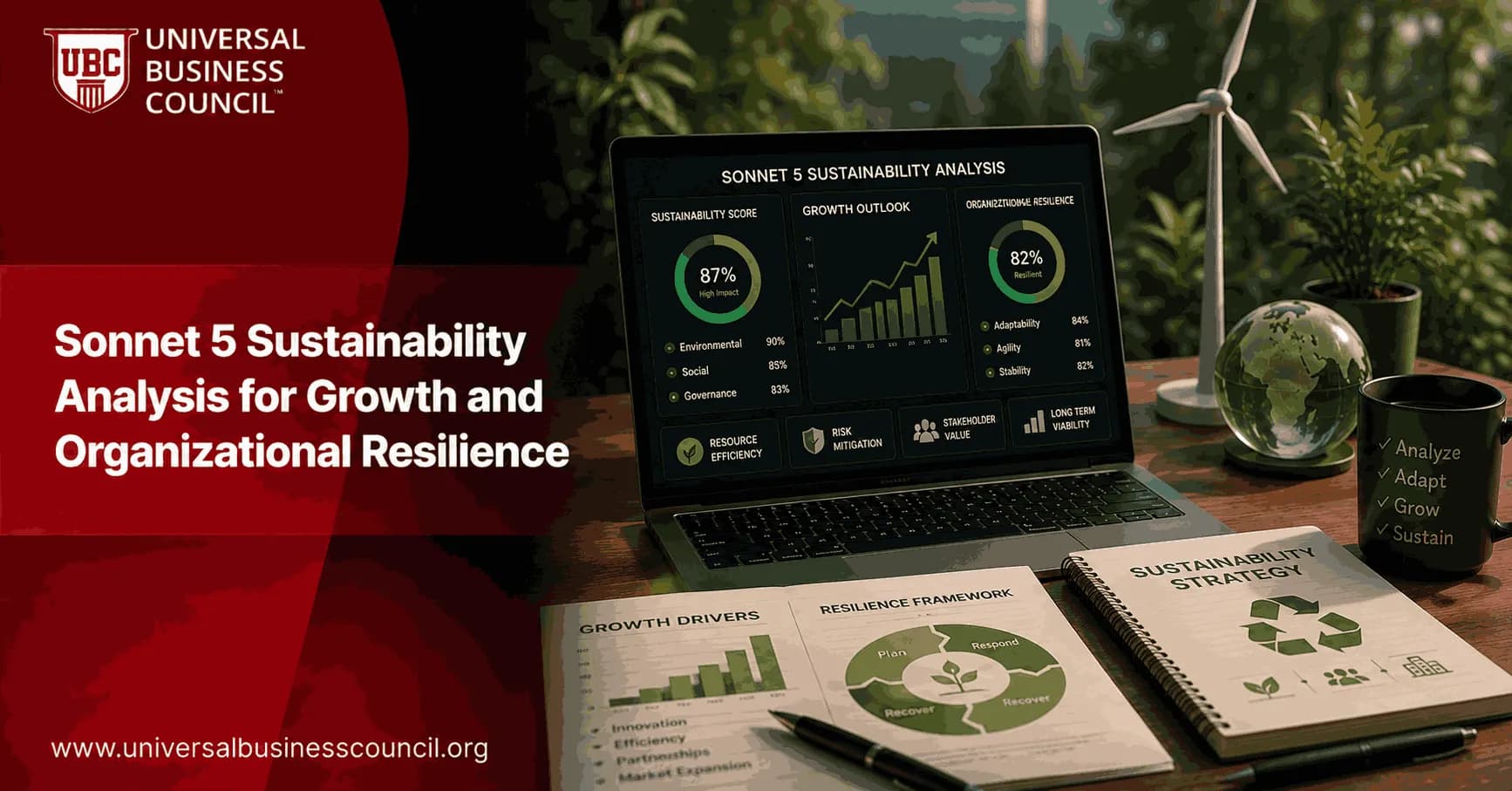
Sonnet 5 sustainability analysis gives leaders a practical way to connect three things that are too often managed separately: sustainability, growth, and organizational resilience. Used well, Claude Sonnet 5 can synthesize research, test scenarios, compare response paths, and turn scattered sustainability data into decisions your executive team can actually review.
That last point matters. Many sustainability dashboards look polished but fall apart in the quarterly business review. Why? The data is usually messy at the source. Supplier records list materials in kilograms, tonnes, pallets, and spend codes, while finance asks for margin impact and risk exposure. Sonnet 5 does not fix governance by magic. It can, however, help you structure the work faster and ask sharper questions.

Professionals responsible for evaluating complex business processes and sustainability initiatives can also benefit from becoming a Certified Business Analysis (CBAP) Professional™, developing practical skills in requirements analysis, stakeholder management, process improvement, and translating business challenges into data-driven decisions.
What sustainability, growth, and resilience mean in management
Sustainability is now a strategy issue
In modern management, sustainability means building environmental and social factors into core strategy, operations, product design, and resource use. It is not just reporting. It is how you cut waste, manage risk, design for circularity, and protect long term value.
Industry surveys report that a large majority of organizations now place sustainable practices at the center of corporate strategy, and many plan to increase sustainability spending over the next 12 to 18 months. That is not a side project. It is capital allocation.
Organizational resilience is more than recovery
Organizational resilience is the long term ability to anticipate disruption, absorb shocks, adapt, and keep operating. McKinsey, drawing on the World Economic Forum Resilience Consortium, frames resilience as a prerequisite for sustainable and inclusive growth. The useful phrase here is not "bounce back." It is "bounce back better."
In practice, resilient organizations track early signals. They run scenarios. They know which suppliers are single points of failure. They understand which customers, systems, people, and cash flows have to be protected first.
Growth should be stable, not fragile
Growth is not just this quarter's revenue spike. Sustainable growth includes lower financial volatility, more durable sales, stronger survival odds under stress, and inclusive performance. Research on climate related business resilience links sustainable practices to reduced financial volatility, improved sales growth, lower unsystematic market risk, and long term survival.
To be blunt, high growth that collapses under one supply shock is not strategic growth. It is exposure.
Why Sonnet 5 fits sustainability and resilience work
Anthropic describes Claude Sonnet 5 as an agentic model built for planning, tool use, coding, knowledge work, and sustained analysis. Its technical overview positions it above earlier Sonnet releases and closer to Opus level performance on many knowledge tasks, while running at lower cost.
For business teams, the value is not that Sonnet 5 "knows sustainability." The value is that it can help you organize complex information into decision ready formats. For example, you can ask it to:
Summarize academic research on resilience and sustainability.
Compare climate, geopolitical, technology, and supply chain scenarios.
Translate sustainability data into finance, operations, and risk metrics.
Draft board level narratives with assumptions clearly stated.
Support resource integration analysis across people, assets, systems, and partners.
Anthropic also reports lower hallucination and sycophancy rates than earlier Sonnet models, along with better resistance to prompt injection. You still need to verify. Always. But for structured analysis, this matters.
Use case 1: Synthesizing fragmented sustainability research
The research base on sustainability and resilience is useful, but scattered. A recent hybrid literature review found that organizational resilience helps firms thrive in turbulent conditions and can pave the way for sustainability. The same review argues for an eco-social view of resilience, where firm viability includes environmental spillovers, not just financial survival.
Sonnet 5 can help you turn that kind of research into an operating model. Ask it to:
Summarize the main resilience and sustainability mechanisms in plain language.
Separate evidence from opinion.
Map each mechanism to a business function, such as finance, operations, procurement, HR, or product.
Identify metrics for each function.
Flag where your internal data would be needed before acting.
A useful output might connect circular product design to lower material exposure, lower waste cost, more supplier flexibility, and reduced regulatory risk. That is the bridge leaders need.
Use case 2: Scenario planning for resilient growth
McKinsey recommends forward looking resilience planning that weighs social, geopolitical, climate, and technology risks. This is where Sonnet 5 sustainability analysis becomes practical.
You can ask Sonnet 5 to generate scenario sets such as:
Accelerated climate regulation: carbon pricing rises, disclosure rules tighten, and high emission inputs get more expensive.
Supplier shock: a key region faces flooding, port delays, or political disruption.
Technology shift: competitors adopt lower cost AI supported operations faster than expected.
Demand change: enterprise buyers require verified Scope 3 emissions data before renewal.
Then push further. Ask for impacts on gross margin, cash conversion cycle, on time in full delivery, churn, employee safety, customer trust, and regulatory exposure. These are the metrics leadership actually tracks when pressure hits.
A good scenario workshop should end with decisions. Not theater. Which supplier needs a second source? Which process needs automation? Which product line carries hidden carbon cost? Which customer segment is most exposed?
Use case 3: Modeling resources and dynamic capabilities
A 2024 megaproject study using survey data from 243 practitioners found that resource integration has a significant positive effect on organizational resilience, with a reported coefficient of 0.509 and a p value below 0.001. Resource integration also strongly improved dynamic capabilities, with a coefficient of 0.534, while dynamic capability improved resilience with a coefficient of 0.411.
The plain English version: resilience is not just having more resources. It is how well you combine them.
Sonnet 5 can help map resource integration across:
Human resources: skills, succession depth, cross functional decision rights.
Physical resources: plants, logistics nodes, inventory buffers, energy sources.
Digital resources: ERP, CRM, supplier data, Google Analytics 4, Salesforce, HubSpot, risk systems.
Relational resources: supplier trust, customer contracts, regulators, community relationships.
For project managers, this connects directly to risk registers, work breakdown structures, governance models, and escalation paths. Treat it as a natural link to Universal Business Council course pages in project management, management education, strategy, and artificial intelligence.
As organizations increasingly use Anthropic's AI models for strategic analysis and decision support, a Claude AI Expert Certification can help professionals develop practical expertise in prompt engineering, long-context reasoning, AI-assisted business analysis, and responsible enterprise AI implementation.
Use case 4: Connecting sustainability to financial resilience
The best sustainability teams do not stop at emissions cuts or an ESG narrative. They connect initiatives to financial resilience.
Sonnet 5 can help build an analysis template that asks:
Did energy efficiency reduce operating cost volatility?
Did circular design reduce raw material exposure?
Did supplier diversification reduce interruption risk?
Did low carbon procurement improve enterprise buyer retention?
Did sustainability investment affect ROIC, EBITDA margin, free cash flow, or credit risk?
Research cited in climate related resilience studies suggests that sustainable practices can reduce financial volatility, improve sales growth, and support long term survival. Still, do not overclaim. Correlation is not proof for your business. You need baseline data, comparison groups where possible, and sensitivity analysis.
A practical prompt for Sonnet 5:
"Analyze these sustainability initiatives against financial resilience indicators. Separate direct cost effects, risk reduction effects, revenue effects, and reputation effects. State assumptions. Identify missing data. Recommend three analyses finance can validate."
Use case 5: Understanding different crisis response paths
Research on organizational responses to COVID-19 showed that resilient organizations do not all respond the same way. Some grow during adversity because of how they interpret the event and sequence decisions. That is a critical lesson.
Sonnet 5 can help leadership teams compare response paths before the next crisis. For instance:
Conservative path: preserve cash, pause expansion, protect core customers.
Adaptive path: run fast experiments, shift channels, reassign teams.
Transformational path: redesign the operating model, exit weak segments, invest through the downturn.
Each path has trade-offs. Conservative action can protect liquidity but miss market share gains. Experimentation can reveal new demand, but it burns attention. Transformation may be right after a structural shock, yet it is the wrong answer for a short term disruption with high uncertainty.
How to govern Sonnet 5 in sustainability decisions
Use Sonnet 5 as an analytical assistant, not an authority. Set hard rules.
Require source links or document references for factual claims.
Label assumptions clearly.
Keep human approval for capital allocation, supplier action, regulatory statements, and public ESG reporting.
Test outputs against finance, legal, risk, and operations data.
Protect confidential supplier, employee, and customer information.
This matters most for certification candidates and working managers. The common mistake is treating AI output as a finished strategy. It is not. The better habit is to use the model to produce options, stress test assumptions, and expose weak logic before a human decision.
What professionals should learn next
If you want to apply Sonnet 5 sustainability analysis at work, build three skills together: sustainability literacy, strategic analysis, and AI governance. Learn how Scope 1, Scope 2, and Scope 3 emissions connect to operations. Practice scenario planning. Get comfortable with CAC, LTV, churn, ROAS, cash flow, and risk exposure, because sustainability arguments get stronger when they survive finance review.
For Universal Business Council learners, the next step is to connect this topic with certification pathways in artificial intelligence, business strategy, project management, and management education. Start with one live business problem. Feed Sonnet 5 verified internal documents, ask for a resilience scenario map, validate the numbers with your team, and turn the best insight into one decision for the next management meeting.
A Tech Certification can further strengthen these capabilities by building a broader understanding of emerging technologies, automation, cloud platforms, and AI-driven business systems that support sustainable growth, resilience, and long-term organizational performance.
FAQs
1. What Is Claude Sonnet 5?
Claude Sonnet 5 is an AI model in Anthropic's Claude family designed for reasoning, writing, coding, analysis, and business productivity. Organizations can use it to support research, sustainability reporting, strategic planning, and operational analysis.
2. How Can Claude Sonnet 5 Support Sustainability Analysis?
Claude Sonnet 5 can help summarize sustainability data, analyze ESG reports, identify trends, organize environmental metrics, draft sustainability documents, and support strategic planning based on the information provided.
3. Why Is Sustainability Important for Business Growth?
Sustainability helps organizations reduce operational risks, improve resource efficiency, strengthen brand reputation, meet stakeholder expectations, support regulatory compliance, and create long-term business value.
4. How Can AI Improve Sustainability Decision-Making?
AI can organize large datasets, identify patterns, forecast potential outcomes, automate reporting, and help leaders evaluate sustainability initiatives more efficiently. Final decisions should still involve human expertise.
5. Can Claude Sonnet 5 Help with ESG Reporting?
Yes. It can assist in drafting ESG reports, summarizing environmental, social, and governance data, organizing disclosures, and improving reporting consistency, provided the underlying data is accurate.
6. How Does Claude Sonnet 5 Support Environmental Analysis?
It can summarize environmental research, compare sustainability initiatives, organize emissions data, and assist with documenting environmental performance for internal or external reporting.
7. Can Claude Sonnet 5 Help Measure Sustainability Performance?
Yes. It can help organize KPIs, summarize performance reports, compare historical data, and present sustainability metrics in a structured format for analysis.
8. How Can Businesses Use Claude Sonnet 5 for Resource Optimization?
Organizations can use it to analyze operational information, identify efficiency opportunities, summarize process improvements, and support resource planning initiatives.
9. Can Claude Sonnet 5 Support Climate Risk Analysis?
It can help organize climate-related information, summarize scenario analyses, compare risk factors, and prepare planning documents. It should not replace expert climate or financial risk assessments.
10. How Does Claude Sonnet 5 Improve Strategic Sustainability Planning?
It can support SWOT analyses, roadmap development, policy drafting, stakeholder communication, and sustainability planning by organizing information into actionable formats.
11. Can Claude Sonnet 5 Help with Corporate Governance?
Yes. It can summarize governance documents, assist with policy drafting, organize compliance information, and prepare reports that support governance processes.
12. How Can Claude Sonnet 5 Support Organizational Resilience?
It can help identify operational risks, summarize business continuity plans, analyze strategic scenarios, organize crisis-response documentation, and improve knowledge management.
13. Which Industries Can Benefit from AI-Assisted Sustainability Analysis?
Manufacturing, finance, healthcare, retail, energy, logistics, technology, education, agriculture, construction, and professional services can all benefit from AI-assisted sustainability workflows.
14. Which Technologies Can Be Combined with Claude Sonnet 5?
Organizations commonly integrate AI models with APIs, business intelligence platforms, Retrieval-Augmented Generation (RAG), enterprise knowledge bases, analytics tools, cloud platforms, and workflow automation systems.
15. What Are the Benefits of Using Claude Sonnet 5 for Sustainability?
Benefits include faster reporting, improved data organization, streamlined documentation, enhanced collaboration, more efficient research, better strategic planning, and increased operational productivity.
16. What Are the Limitations of AI in Sustainability Analysis?
AI depends on the quality of the data it receives and cannot independently verify environmental claims or guarantee compliance. Sustainability assessments require accurate data, domain expertise, and human oversight.
17. How Can Organizations Successfully Adopt Claude Sonnet 5 for Sustainability?
Businesses should define clear sustainability objectives, maintain high-quality data, establish AI governance policies, validate AI-generated analyses, and continuously monitor outcomes against measurable ESG goals.
18. What Skills Help Professionals Use Claude Sonnet 5 for Sustainability?
Useful skills include sustainability management, ESG reporting, business analysis, data analytics, prompt engineering, AI literacy, risk management, regulatory compliance, and strategic planning.
19. What Common Mistakes Should Organizations Avoid?
Avoid using AI to generate sustainability claims without evidence, relying on incomplete or poor-quality data, skipping expert review, overlooking regulatory requirements, and treating AI-generated reports as independently verified assessments. AI can organize sustainability information efficiently, but credibility still comes from accurate measurement and transparent reporting.
20. How Will AI Models Like Claude Sonnet 5 Shape Sustainable Business Growth?
AI models are expected to become valuable tools for sustainability by helping organizations analyze ESG data, automate reporting, identify operational efficiencies, and support long-term resilience planning. Businesses that combine AI capabilities with reliable data, responsible governance, measurable sustainability goals, and informed human decision-making will be better positioned to strengthen resilience, improve stakeholder trust, and pursue sustainable growth in an evolving regulatory and economic landscape.
Related Articles
View All
Claude Ai
Brand Legacy Lessons from Shakespeare's Sonnet 5
Shakespeare's Sonnet 5 offers marketers a practical model for brand legacy: preserve enduring essence, not just short-term campaign beauty.

Claude Ai
Claude Sonnet 5 Competitive Advantage: Time, Change, and Strategy Lessons From Sonnet 5
Learn how Claude Sonnet 5 competitive advantage comes from faster sensing, decision cycles, adaptability, and disciplined change management.
Claude Ai
How Sonnet 5 Explains Innovation and Business Renewal
Sonnet 5 shows how agentic AI can renew business workflows by improving document work, automation, safety, and cost control across enterprise operations.
Trending Articles
The Role of Blockchain in Ethical AI Development
How blockchain technology is being used to promote transparency and accountability in artificial intelligence systems.
AWS Career Roadmap
A step-by-step guide to building a successful career in Amazon Web Services cloud computing.
Top 5 DeFi Platforms
Explore the leading decentralized finance platforms and what makes each one unique in the evolving DeFi landscape.