

Brand Legacy Lessons from Shakespeare's Sonnet 5
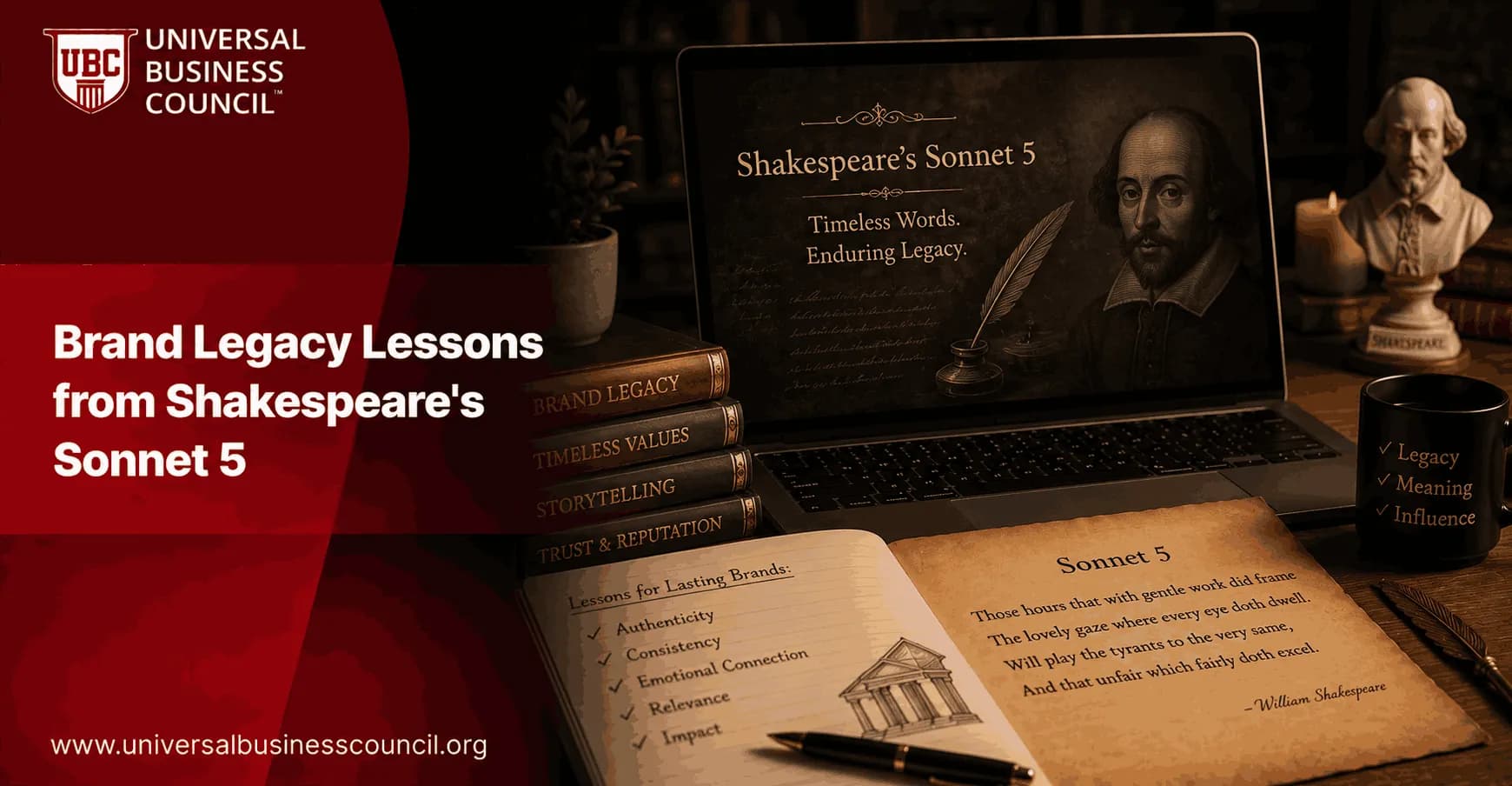
Brand legacy is not built in the bright moment when everyone is looking. Shakespeare's Sonnet 5 says the hard part plainly: summer fades, winter arrives, and only distilled substance survives. For marketers, that is more than literary imagery. It is a practical model for long-term brand equity.
The poem belongs to Shakespeare's Fair Youth sequence, where the speaker urges a young man to preserve beauty before time destroys it. The closing idea is simple: flowers lose their visible show, but when distilled into perfume, their substance still lives sweet. Replace flowers with campaigns and perfume with brand essence, and you have a sharp brand strategy brief.

As brands increasingly combine AI with customer insights and campaign analytics, becoming an AI Powered Digital Marketing Expert™ helps professionals develop practical skills in AI-assisted campaign planning, audience segmentation, brand performance analysis, and data-driven digital marketing strategies that create long-term customer value.
What Sonnet 5 Teaches About Brand Legacy
Sonnet 5 frames time as a tyrant. The same hours that create beauty eventually make it fade. Shakespeare's summer turns into a harsh winter where sap is checked by frost, leaves disappear, and beauty is covered over. The only answer is distillation, described as summer's essence held in glass.
That maps cleanly to marketing. Your launch campaign, influencer partnership, product page, logo refresh, and paid social spike are all summer flowers. They may be beautiful. They may work. But they will pass.
The question is colder: what remains when the media budget stops?
Strong brands answer that question through brand essence, distinctive assets, memory structures, and lived proof. Weak brands answer with a mood board.
Time Is a Tyrant: The Risk of Short-Term Marketing
Short-term tactics are not bad. A discount can clear stock. A paid search campaign can capture demand. A topical post can get attention. I have seen a small B2B software campaign lift demo bookings from 2.8 percent to 4.1 percent simply by changing the offer from a generic trial to a role-specific audit. Useful? Yes. Legacy-building? Not by itself.
The danger starts when every decision is judged only by this week's dashboard. Click-through rate becomes the king metric. Brand consistency gets treated as a drag. Teams start changing the message every quarter because the last version feels tired internally, even though customers have barely noticed it.
Les Binet and Peter Field's effectiveness work argues for a balance between long-term brand building and short-term activation, often summarised as roughly 60 percent brand and 40 percent activation for many categories. The exact split varies. The principle holds: if all your money goes into immediate response, you are harvesting demand without planting much memory.
That is Sonnet 5 in commercial language. Summer looks productive until winter arrives.
Distillation: Turning Brand Activity Into Brand Substance
Distillation is the marketer's real job. Not decoration. Not constant reinvention. It means identifying what must stay recognizable after channels, products, and leadership teams change.
Codify the brand essence
Write the essence in plain language. If it sounds like it could belong to any competitor, it is not distilled enough. "Innovation for modern customers" says almost nothing. "Tools that help independent accountants finish compliance work before Friday afternoon" is much closer to something usable.
A practical brand essence should answer:
Who are we for? Be specific enough to exclude someone.
What do we help them believe or do? Go beyond product function.
What must never change? Name the non-negotiables.
What proof do we have? Use behaviour, not slogans.
Protect distinctive brand assets
Byron Sharp and the Ehrenberg-Bass Institute have helped popularise the importance of distinctive brand assets: colours, shapes, characters, sounds, slogans, packaging cues, and recurring brand codes that build mental availability. Coca-Cola's red, the script logo, and the contour bottle are obvious examples. Nike's Swoosh and "Just Do It" do similar work.
These assets are the glass walls around the perfume. They keep the essence recognizable when the campaign changes. If your team treats every new campaign as a blank canvas, you are probably throwing away memory.
Build internal memory, not just customer memory
Brand legacy often breaks inside the organisation first. A new CMO arrives. An agency changes. A regional team translates the message loosely. Six months later, the brand has five voices and seven visual systems.
Build the boring infrastructure:
Brand guidelines with real examples, not just abstract adjectives.
Approved asset libraries for design, copy, audio, and motion.
Messaging frameworks by audience, product, and buying stage.
Decision rules for when the brand can flex and when it cannot.
A quarterly brand review that checks consistency, not only performance.
Boring saves money. It also saves meaning.
Substance Over Show: The Rebrand Test
Shakespeare's line about distilled flowers is a useful test: they lose their show, but their substance still lives sweet. A brand should be able to change its look without losing its meaning.
Ask your team this uncomfortable question: if we removed the current logo, typeface, tagline, and campaign line, would customers still know what we stand for?
If the answer is no, the brand is mostly show.
This matters during rebrands. Many organisations use a rebrand to signal energy to internal stakeholders, investors, or a new executive team. Sometimes that is needed. But a visual refresh cannot carry a weak strategy. To be blunt, changing the gradient on the homepage will not fix a confused promise.
Good rebrands preserve the perfume. They sharpen assets, remove clutter, and make the old substance easier to recognize. Bad rebrands bury hard-earned memory because someone got bored with it.
Brand Offspring: Extensions, Communities, and IP
Sonnet 5 sits close to the procreation sonnets, where beauty is meant to live through heirs. In brand strategy, heirs are not only new products. They include communities, creator ecosystems, training programmes, owned frameworks, and customer stories.
Brand extensions work when they inherit the parent brand's distilled substance. Patagonia can move across outdoor categories because environmental responsibility and durable gear sit at the centre of the brand. Apple can shift interfaces and devices because simplicity, integration, and creative usefulness remain recognizable to many customers.
Extensions fail when they carry only the name. That is not legacy. That is licensing with a logo attached.
For professional audiences, this is where education and certification can support brand governance. If you are building internal capability, look at Universal Business Council learning paths in marketing strategy, brand management, business strategy, and digital marketing. The goal is not just to teach theory. It is to help teams make consistent decisions when pressure hits.
AI, Content Scale, and the New Winter of Attention
AI tools, including Claude AI, can help teams draft more content, test more angles, and adapt messages faster. That is useful. It is also risky.
When every team can generate ten campaign variants before lunch, brand coherence becomes easier to lose. The "winter" arrives faster because customers see fragmented messages across email, LinkedIn, search, webinars, sales decks, and support content.
Use AI with clear brand constraints:
Feed it approved positioning, tone rules, and audience definitions.
Require repeated use of distinctive brand assets and core proof points.
Check output against your brand essence before checking grammar.
Ban claims that sales or product teams cannot defend.
Track brand linkage, not only content volume.
AI should help express the perfume. It should not invent a new scent every day.
Professionals looking to use Anthropic's AI models more effectively can also benefit from a Claude AI Expert Certification, gaining practical expertise in prompt design, long-context content creation, AI-assisted marketing workflows, and responsible enterprise AI implementation while maintaining consistent brand identity.
A Sonnet 5 Checklist for Brand Leaders
Use this checklist before your next planning cycle:
Name your summer. What advantage is peaking right now: attention, growth, novelty, distribution, price, or category demand?
Name your winter. What could make that advantage fade: regulation, copycats, media cost, customer fatigue, technology change, or trust loss?
Define your distilled essence. Write one paragraph that would still make sense five years from now.
Audit your assets. Identify which visual, verbal, and experiential cues customers actually connect with you.
Separate show from substance. Keep what builds memory. Cut what only impresses the internal presentation room.
Design heirs. Make sure new products, communities, and content formats carry the same core meaning forward.
The Practical Lesson for Marketers
Brand legacy is preserved through disciplined repetition of meaningful substance. Shakespeare understood the pattern before marketers had dashboards: beauty peaks, time attacks, and only distilled essence survives.
Your next step is simple. Take one current campaign and mark every element as either flower or perfume. The flowers can change. The perfume should become clearer. If your team cannot agree on what the perfume is, start there before spending another budget cycle on show.
A Tech Certification can further strengthen these capabilities by building a broader understanding of emerging technologies, automation, AI-powered business tools, and digital transformation practices that increasingly influence modern branding, customer experience, and marketing strategy.
FAQs
1. What Is Shakespeare's Sonnet 5?
Shakespeare's Sonnet 5 is one of the 154 sonnets written by William Shakespeare. It reflects on the passage of time, beauty, change, and preservation, offering ideas that can also be applied to modern branding and business strategy.
2. What Can Brands Learn from Shakespeare's Sonnet 5?
Brands can learn the importance of preserving long-term value, adapting to change, protecting their identity, and creating a lasting legacy instead of focusing only on short-term success.
3. Why Is Brand Legacy Important?
A strong brand legacy builds trust, customer loyalty, market recognition, and long-term business value, allowing companies to remain relevant across changing markets and generations.
4. How Does Sonnet 5 Relate to Brand Longevity?
The sonnet emphasizes that time changes everything. For brands, this highlights the need to evolve with customer expectations while preserving the core values that define their identity.
5. What Is the Difference Between Brand Legacy and Brand Awareness?
Brand awareness measures how familiar people are with a brand, while brand legacy reflects the lasting impact, reputation, and trust a brand builds over many years.
6. How Can Businesses Build a Lasting Brand Legacy?
Organizations can build a lasting legacy by delivering consistent quality, maintaining customer trust, embracing innovation, and staying true to their mission and values.
7. Why Is Consistency Essential for Brand Legacy?
Consistent messaging, customer experience, product quality, and visual identity help reinforce trust and make a brand recognizable over time.
8. How Can Brands Balance Tradition and Innovation?
Successful brands preserve their core purpose while adapting products, services, technologies, and customer experiences to meet changing market demands.
9. What Role Does Storytelling Play in Building Brand Legacy?
Authentic storytelling helps communicate a brand's purpose, values, history, and vision, creating stronger emotional connections with customers.
10. How Does Customer Trust Influence Brand Legacy?
Trust encourages repeat business, strengthens customer relationships, improves brand reputation, and contributes to sustainable long-term growth.
11. Can AI Help Preserve Brand Legacy?
Yes. AI can support brand consistency by assisting with content creation, customer engagement, personalization, brand monitoring, and marketing analytics while following established brand guidelines.
12. How Does Brand Reputation Affect Long-Term Success?
A positive reputation attracts customers, strengthens partnerships, supports premium pricing, and increases resilience during periods of market uncertainty.
13. Which Industries Benefit Most from Strong Brand Legacy?
Retail, luxury goods, technology, healthcare, education, finance, hospitality, automotive, consumer goods, and professional services all benefit from long-term brand trust.
14. What Metrics Should Businesses Track for Brand Legacy?
Key metrics include brand awareness, customer retention, Net Promoter Score (NPS), customer lifetime value (CLV), brand sentiment, market share, repeat purchase rate, and customer satisfaction (CSAT).
15. How Can Businesses Protect Their Brand Legacy?
Organizations should maintain product quality, communicate transparently, protect customer data, respond effectively to feedback, and consistently deliver on their brand promises.
16. What Challenges Can Threaten Brand Legacy?
Challenges include inconsistent messaging, declining product quality, reputational crises, changing customer expectations, stronger competition, and failure to innovate.
17. How Can Businesses Modernize Without Losing Their Identity?
Companies should update products, technology, and customer experiences while preserving their mission, values, and the qualities that customers associate with the brand.
18. What Skills Help Leaders Build a Strong Brand Legacy?
Leaders benefit from strategic thinking, brand management, communication, customer experience design, innovation management, market analysis, and long-term business planning.
19. What Common Mistakes Should Businesses Avoid When Building Brand Legacy?
Avoid chasing short-term trends at the expense of core values, neglecting customer trust, delivering inconsistent experiences, ignoring feedback, and treating branding as only a logo or marketing campaign. Legacy is earned through years of consistent actions, not a quarterly slogan. Shakespeare noticed time changes everything. Marketing departments keep rediscovering the same lesson.
20. How Can Shakespeare's Sonnet 5 Inspire Modern Brand Strategy?
Shakespeare's Sonnet 5 reminds businesses that lasting value comes from preserving what matters while adapting to inevitable change. Brands that combine authenticity, innovation, consistent customer experiences, and long-term strategic thinking are more likely to build enduring reputations that outlast market trends and continue creating value for future generations.
Related Articles
View All
Claude Ai
Claude Sonnet 5 Competitive Advantage: Time, Change, and Strategy Lessons From Sonnet 5
Learn how Claude Sonnet 5 competitive advantage comes from faster sensing, decision cycles, adaptability, and disciplined change management.

Claude Ai
Leadership Lessons From Sonnet 5: Protecting Talent Before It Fades
Learn how Leadership Lessons From Sonnet 5 apply to succession planning, mentoring, talent risk, and preserving expertise before attrition takes hold.

Claude Ai
Branding Lessons from Sonnet 5: From Beauty to Enduring Value
Shakespeare's Sonnet 5 offers a practical branding lesson: visual beauty fades, but distilled brand essence, trust, and value endure.
Trending Articles
The Role of Blockchain in Ethical AI Development
How blockchain technology is being used to promote transparency and accountability in artificial intelligence systems.
AWS Career Roadmap
A step-by-step guide to building a successful career in Amazon Web Services cloud computing.
Top 5 DeFi Platforms
Explore the leading decentralized finance platforms and what makes each one unique in the evolving DeFi landscape.