

Claude Sonnet 5 Competitive Advantage: Time, Change, and Strategy Lessons From Sonnet 5
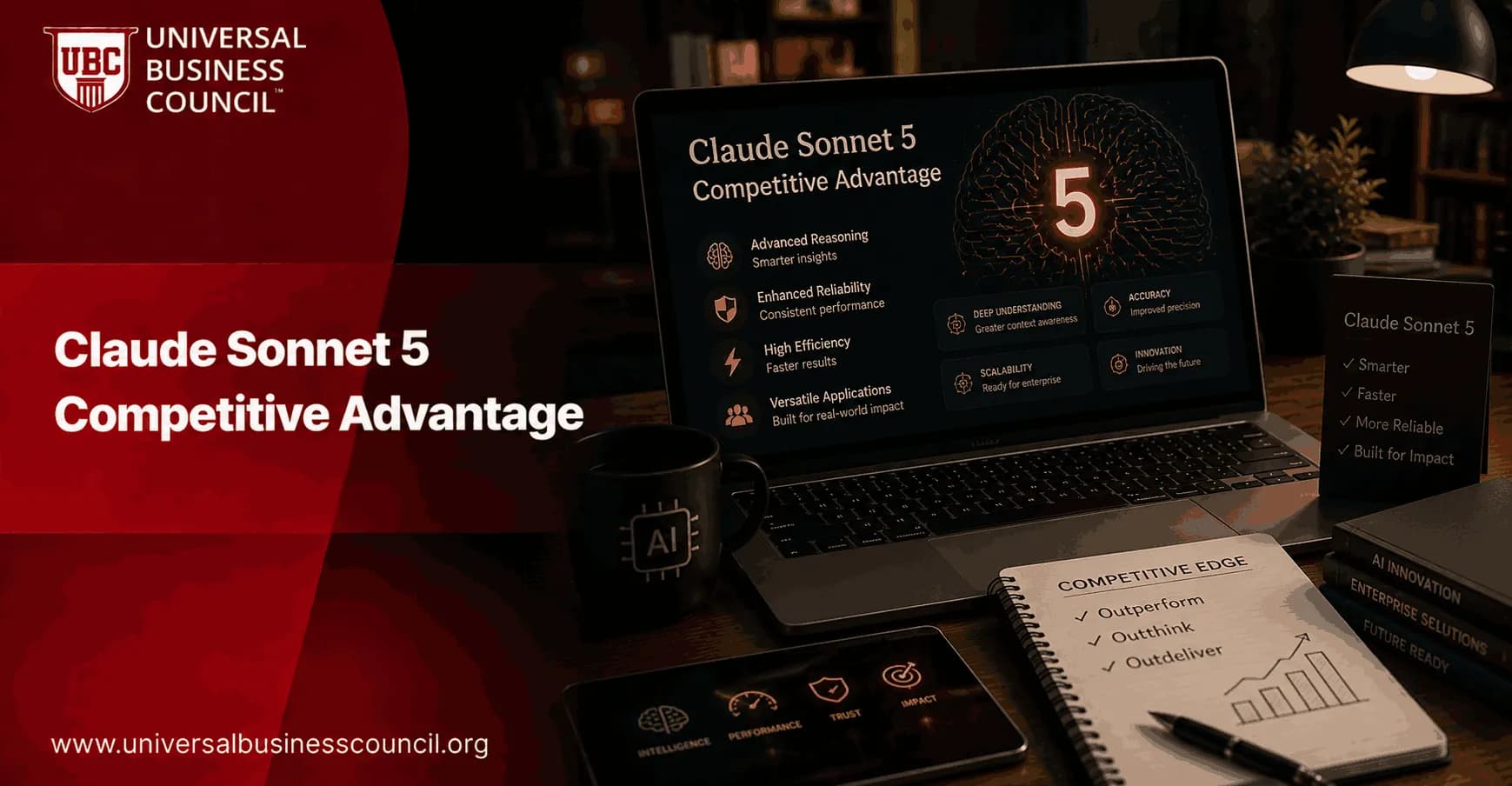
Claude Sonnet 5 competitive advantage is not about using AI because it is fashionable. It is about shortening the time between a market signal, a decision, and a useful action. That gap is where many firms now win or lose.
Strategy used to reward firms that built a strong position and defended it for years. That still matters in some sectors. But in markets shaped by software, shifting customer expectations, remote work, and AI, advantage decays faster. Rita McGrath described this as the end of long-lived competitive advantage, arguing that firms must manage waves of temporary advantage rather than protect one permanent fortress. McKinsey research has pointed to a rising churn among industry leaders and laggards, with position shuffling more common across most industries over the past decade.

Claude Sonnet 5 matters in that context because agentic AI changes the operating tempo of the firm. Anthropic describes Sonnet as its more agentic model line, with stronger planning, tool use, coding, reasoning, and multi-step execution than earlier versions. Used carefully, it can help you sense change earlier, test options faster, and execute routine knowledge work with less delay.
Professionals responsible for leading organizational change can also strengthen these capabilities through the Certified Strategic Planning & Leadership Professional™, gaining practical expertise in strategic execution, leadership decision-making, business transformation, and building resilient operating models that sustain competitive advantage.
Why Time Has Become a Strategic Variable
Time is no longer just a scheduling issue. It is a source of advantage. Ask three practical questions:
How quickly do you notice a change in customer behavior?
How long does it take to agree on a response?
How fast can your team test, ship, measure, and adjust?
Most firms lose time in the middle question. The data is available. The dashboard is open. The customer complaints are visible in Salesforce, HubSpot, Zendesk, or Google Analytics 4. Still, teams wait for a meeting, a slide deck, a steering committee, or a budget cycle.
BCG has argued that advantage in changeable environments depends less on static position and more on adaptability, including faster learning, more frequent experimentation, and shorter planning cycles. That point is easy to agree with and hard to practice. To be blunt, many strategy processes are built for certainty that no longer exists.
From Static Advantage to Transient Advantage
A static advantage is built around assets that are difficult to copy: scale, distribution, patents, brand, supplier access, or regulation. These still count. But they are not enough when the basis of competition keeps moving.
A transient advantage has a lifecycle:
Creation: You spot a shift before competitors do.
Exploitation: You turn it into pricing power, customer preference, lower cost, or speed.
Erosion: Rivals copy, customers move on, or technology changes the rules.
Replacement: You build the next advantage before the old one collapses.
This is where Claude Sonnet 5 competitive advantage becomes practical. The model does not replace strategy. It can reduce the drag around strategy work: research, synthesis, scenario testing, code generation, documentation, monitoring, and follow-up. That matters because a good decision made six weeks late is often just a historical note.
What Claude Sonnet 5 Changes in Business Execution
Anthropic reports that Claude Sonnet 5 can plan, use tools such as browsers and terminals, and run complex multi-step tasks with improved reliability. It is also positioned to approach the performance of larger frontier models on some tasks at a better cost profile. For businesses, that cost-performance point is important. Expensive AI stays in innovation labs. Affordable AI enters workflows.
1. Faster competitive intelligence
McKinsey recommends that leaders track signals such as startup activity, patents, capital flows, and changes in industry leadership. A Sonnet 5-style agent can monitor those signals, summarize patterns, and flag changes that deserve human review.
The aim is not to drown executives in alerts. The useful metric is detection latency: the time between an external change and your organization recognizing its strategic meaning. If that latency falls from months to days, your planning rhythm changes.
2. Shorter product development cycles
Sonnet 5 is especially relevant in software engineering and digital product work. Anthropic and early partners describe it as capable of finishing complex tasks, checking outputs, and acting as an execution layer for multi-step engineering work.
In a real product team, the bottleneck is rarely one line of code. It is the handoff: product requirement, Jira ticket, implementation, test case, pull request, review, release note, and support update. The first thing that breaks with AI agents is ownership. An agent may create a pull request, but a human still needs to own QA sign-off, security review, and release risk. Skip that, and speed becomes rework.
3. Better change communication
Change management is often treated as a soft activity. It is not. Research on transformation keeps pointing to the same factors: the psychological impact of change, workplace connection, and a clear sense of leadership purpose. Employees do not resist every change. They resist unclear change, poorly explained change, and change that seems detached from the work they actually do.
Claude Sonnet 5 can help leaders draft audience-specific communication, summarize survey feedback, identify recurring objections, and prepare manager talking points. Use it as a writing and analysis partner, not as a substitute for leadership judgment. People can tell when a message has no human accountability behind it.
Adaptability Is the New Operating Discipline
Organizational capacity for change is a durable competitive advantage. That framing is useful because it moves change from a project to a capability. You do not build adaptability once. You practice it.
Strong adaptive organizations tend to share a few habits:
Continuous planning: They revisit assumptions often, not only during annual planning.
Distributed decisions: They push choices closer to the people with current information.
Low-cost experiments: They test before betting heavily.
Clear metrics: They track cycle time, CAC, LTV, churn, NPS, ROAS, and adoption where relevant.
Learning routines: They run post-project reviews that name what actually happened.
There is a trade-off. Speed without discipline creates noise. Teams launch too many tests, underpower the sample size, or change three variables at once and learn nothing. A good AI-assisted organization needs stricter measurement, not looser measurement.
How to Use Sonnet 5 Without Creating New Risk
Anthropic reports that recent Sonnet models bring improved refusal behavior, lower hallucination and sycophancy rates, and stronger resistance to prompt injection than earlier versions. That is encouraging. It does not remove governance work.
Use this operating model before you put agentic AI into high-value workflows:
Define the decision boundary. State what the agent can recommend, draft, execute, or never touch.
Connect approved tools only. Start with low-risk systems before giving access to production, finance, or customer data.
Log every action. If an agent changes a file, sends a message, or queries a database, you need an audit trail.
Require human approval at risk points. Pricing changes, legal claims, security actions, and customer-facing commitments need review.
Measure business impact. Track cycle time, error rate, rework, customer response time, and cost per completed task.
This is where many early AI programs disappoint. They measure prompt volume or user enthusiasm. Leadership cares about different numbers: margin, revenue per employee, churn, time to resolution, delivery predictability, and risk reduction.
As organizations increasingly deploy Anthropic's AI models across enterprise workflows, a Claude AI Expert Certification can help professionals develop practical expertise in prompt engineering, long-context reasoning, AI-assisted workflow design, and responsible implementation of Claude-powered business solutions.
Business Insights From Sonnet 5 for Leaders
The strongest lesson from Sonnet 5 is not that every firm needs more automation. The lesson is that competitive advantage increasingly belongs to firms that can reconfigure themselves quickly and safely.
Here is the practical view:
If your market is stable, use AI to improve cost, quality, documentation, and service consistency.
If your market is shifting, use AI to improve sensing, experimentation, and scenario planning.
If your firm is slow internally, fix decision rights before adding agents. AI will expose bureaucracy, not cure it.
If trust is central to your brand, prioritize governance and human oversight over raw speed.
Purpose also matters. Korn Ferry research has linked a strong sense of organizational purpose to markedly higher growth rates compared with industry peers. That fits what managers see on the ground: people handle change better when the reason is clear and credible.
Skills Professionals Need Next
For professionals, developers, managers, and technology leaders, the skill set is becoming hybrid. You need enough AI literacy to design useful workflows, enough business knowledge to judge impact, and enough change management skill to bring people with you.
If you are building your development plan, explore the Universal Business Council certification catalog as a learning pathway for business, management, and marketing capability. Pair formal certification with hands-on practice in tools such as Google Analytics 4, HubSpot, Salesforce, Meta Ads, and modern AI coding environments. The combination is stronger than either side alone.
Next Step: Build a 30-Day Advantage Cycle
Pick one business process this week. Choose something visible but manageable: competitor monitoring, customer feedback analysis, sprint documentation, sales enablement updates, or change communication.
Measure the current cycle time.
Use Claude Sonnet 5 to draft, analyze, summarize, or execute one part of the workflow.
Add human review at the risk point.
Compare speed, quality, and rework after 30 days.
Decide whether to scale, adjust, or stop.
That is the real business insight from Sonnet 5: advantage is built in cycles. Shorter cycles, better judgment, and disciplined change capacity are now strategic assets. Start there.
A Tech Certification can further strengthen these capabilities by building a broader understanding of digital transformation, cloud technologies, automation, and emerging AI-driven business systems that enable organizations to innovate and execute with greater speed and confidence.
FAQs
1. What Is Claude Sonnet 5?
Claude Sonnet 5 is an AI model in Anthropic's Claude family designed to assist with reasoning, writing, coding, analysis, and business productivity across professional and enterprise use cases.
2. What Is a Competitive Advantage in AI?
A competitive advantage is a capability that helps an AI model or platform deliver greater value than alternatives, such as stronger reasoning, faster workflows, better integrations, or improved reliability for specific tasks.
3. How Can Claude Sonnet 5 Create a Competitive Advantage for Businesses?
Businesses can use Claude Sonnet 5 to improve productivity, streamline knowledge work, accelerate content creation, assist software development, and support data-driven decision-making while keeping humans responsible for final decisions.
4. Why Do Companies Use AI Models Like Claude Sonnet 5?
Organizations adopt AI to automate repetitive tasks, improve operational efficiency, enhance customer support, assist employees, analyze information, and scale business processes.
5. How Can Claude Sonnet 5 Improve Business Productivity?
It can summarize documents, draft reports, generate content, analyze data, explain technical concepts, assist with coding, and organize information, reducing time spent on repetitive work.
6. Can Claude Sonnet 5 Support Enterprise Decision-Making?
Yes. It can organize information, compare options, summarize research, and highlight key considerations, but business leaders should validate outputs and make final strategic decisions.
7. How Does Claude Sonnet 5 Help Software Development?
It can generate code, explain programming concepts, assist debugging, create documentation, review code, and support developers throughout the software development lifecycle.
8. Can Claude Sonnet 5 Improve Customer Service?
Yes. It can help power AI assistants that answer customer questions, summarize conversations, draft responses, and support service teams with knowledge retrieval and workflow automation.
9. How Does Claude Sonnet 5 Support Knowledge Management?
It can summarize internal documents, answer questions using provided information, organize knowledge, and help employees locate relevant content more efficiently.
10. Can Claude Sonnet 5 Help Marketing Teams?
Yes. It can generate blog posts, email campaigns, marketing copy, social media content, campaign ideas, SEO content, and content briefs while maintaining a consistent brand voice when properly guided.
11. How Can Claude Sonnet 5 Support Strategic Planning?
It can assist with SWOT analyses, business plans, market research summaries, competitive analysis, project roadmaps, and scenario planning to support strategic discussions.
12. Can Claude Sonnet 5 Work with AI Agents?
Yes. Depending on the implementation, it can be integrated into AI agent workflows that perform planning, tool usage, workflow automation, and task execution.
13. Which Technologies Can Be Combined with Claude Sonnet 5?
Developers commonly integrate AI models with APIs, Retrieval-Augmented Generation (RAG), vector databases, workflow automation tools, enterprise knowledge bases, cloud platforms, and analytics systems.
14. Which Industries Can Benefit from Claude Sonnet 5?
Healthcare, finance, legal services, education, retail, manufacturing, software development, customer support, marketing, cybersecurity, and enterprise IT can all benefit from AI-assisted workflows.
15. What Are the Benefits of Using Claude Sonnet 5?
Benefits include increased productivity, faster research, improved document analysis, enhanced collaboration, streamlined content creation, coding assistance, and more efficient business processes.
16. What Are the Limitations of Claude Sonnet 5?
Like other large language models, it can generate inaccurate or incomplete information, misunderstand ambiguous prompts, and require human review for important business, legal, financial, or technical decisions.
17. How Can Businesses Maximize the Value of Claude Sonnet 5?
Organizations should define clear use cases, provide quality context, establish AI governance, integrate trusted knowledge sources, monitor performance, and train employees on responsible AI usage.
18. What Skills Help Professionals Use Claude Sonnet 5 Effectively?
Useful skills include prompt engineering, critical thinking, business analysis, AI literacy, communication, workflow design, data interpretation, and domain expertise.
19. What Common Mistakes Should Organizations Avoid?
Avoid relying entirely on AI outputs without verification, exposing confidential information unnecessarily, skipping governance and security reviews, ignoring employee training, and measuring success only by speed instead of business outcomes. AI can accelerate work impressively, but it still appreciates adults checking its homework.
20. How Can Claude Sonnet 5 Provide a Long-Term Competitive Advantage?
Organizations that integrate Claude Sonnet 5 into well-designed workflows can improve operational efficiency, enhance employee productivity, accelerate innovation, and support better decision-making. The greatest competitive advantage comes not from the AI model alone, but from combining it with high-quality data, strong governance, skilled employees, and continuous process improvement to create scalable, reliable, and customer-focused business operations.
Related Articles
View All
Claude Ai
Brand Legacy Lessons from Shakespeare's Sonnet 5
Shakespeare's Sonnet 5 offers marketers a practical model for brand legacy: preserve enduring essence, not just short-term campaign beauty.

Claude Ai
Leadership Lessons From Sonnet 5: Protecting Talent Before It Fades
Learn how Leadership Lessons From Sonnet 5 apply to succession planning, mentoring, talent risk, and preserving expertise before attrition takes hold.

Claude Ai
Sonnet 5 and Long-Term Business Strategy: Preserving Excellence at Scale
Explore how Sonnet 5 supports long-term business strategy by preserving excellence across agentic workflows, governance, cost control, and execution.
Trending Articles
The Role of Blockchain in Ethical AI Development
How blockchain technology is being used to promote transparency and accountability in artificial intelligence systems.
AWS Career Roadmap
A step-by-step guide to building a successful career in Amazon Web Services cloud computing.
Top 5 DeFi Platforms
Explore the leading decentralized finance platforms and what makes each one unique in the evolving DeFi landscape.