

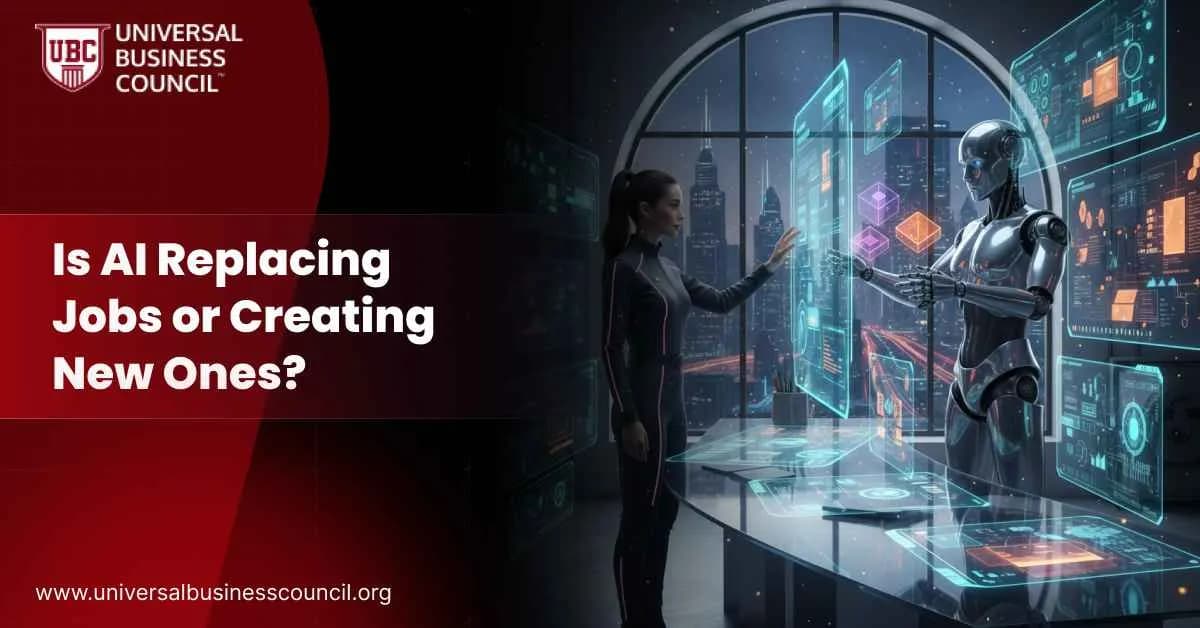
Is AI Replacing Jobs or Creating New Ones?

Jobs at Risk
Not every role faces the same level of threat. Research shows that entry-level white-collar jobs are particularly exposed. Customer support representatives, legal assistants, and junior analysts are all cited as high-risk categories. Routine administrative roles, such as data entry clerks and secretaries, are also vulnerable. Sam Altman and other industry leaders note that jobs heavily reliant on repetitive, predictable tasks are easiest for AI systems to take over. By contrast, positions that rely on human empathy, creativity, or long-term strategy are harder to automate, though not fully immune.Where AI Creates New Work
The other side of the story is less about replacement and more about transformation. Studies by PwC and others point to net job growth in industries that adopt AI at scale. AI design, oversight, compliance, and ethics roles are expanding quickly. Sectors like healthcare and education are seeing AI open up new support functions rather than shutting roles down. AI is also augmenting existing roles. In many cases, workers are using AI to handle tedious tasks so they can focus on higher-value work. This is especially evident in finance and tech, where AI systems reduce the workload for analysts but simultaneously create new streams of tasks that require human judgment.Global Scale of Change
The numbers are striking. In the U.S. and Europe, about two-thirds of jobs are “exposed” to AI in some form, whether through task automation or augmentation. By 2030, up to 30 percent of U.S. jobs could be fully automated. Yet industries exposed to AI are also seeing higher revenue per worker and faster wage growth, suggesting that while disruption is real, it often comes with opportunity. Upskilling is now part of the survival strategy for many employees. Platforms like Udemy report significant growth in demand for AI skills, showing workers are preparing to stay relevant in a shifting market.Strengths and Limits of AI in the Workforce
| Opportunities AI Brings | Challenges AI Creates |
| Automates repetitive, low-value tasks | Displaces entry-level jobs in admin, customer service, and legal |
| Augments skilled workers by saving time | Increases inequality for lower-wage, less-educated workers |
| Creates demand for AI-related roles (data science, ethics, AI oversight) | Requires major reskilling efforts across industries |
| Drives wage growth in AI-exposed sectors | Risk of job concentration in tech-heavy regions |
| Opens new industries (AI agents, creative tools, healthcare applications) | Regulatory and ethical uncertainty about limits of automation |
| Improves productivity at scale | Potential overestimation of automation’s reach in some reports |
| Encourages education and certification opportunities | Workers may struggle to adapt fast enough |
| Raises global competitiveness | Unequal adoption rates between developed and developing nations |
| Enhances decision-making with data-driven insights | Over-reliance on automation may harm innovation |
| Pushes businesses to reimagine work culture | Threatens traditional career ladders for new entrants |
Inequality and Risks
The debate is not just about numbers. Inequality is one of the biggest risks highlighted by researchers. Workers in lower-wage, less-educated roles are often the most vulnerable. Without proper training programs and government support, the gap between those who benefit from AI and those who are displaced could widen. This makes education and structured training essential. A deep tech certification offers one way to understand AI’s role in technology-driven industries and prepare for the changes ahead.How Workers Can Adapt
For workers, the answer is not to resist AI but to learn how to work with it. Those who see AI as a tool rather than a competitor often end up creating more value in their roles. Investing in structured learning, such as a Data Science Certification, helps professionals gain skills that are directly relevant to AI-driven workplaces. Employers are also realizing that training is no longer optional. Microsoft, for instance, has encouraged employees to experiment with AI tools like Copilot, while other companies fund upskilling programs to prepare their teams for the future of work.The Path Ahead
Predictions about AI and jobs vary widely. Some reports paint a picture of large-scale automation, while others emphasize augmentation and transformation over replacement. The truth is likely to be a mix: certain jobs will disappear, others will evolve, and entirely new roles will continue to emerge. What’s clear is that workers and businesses cannot ignore the shift. Preparing for the future requires not just watching AI evolve but actively building skills to adapt. Those who combine human judgment with AI literacy will be in the best position to thrive in this changing landscape.Conclusion
AI is replacing some jobs while creating new ones at the same time. Routine and entry-level roles face the biggest risks, but industries that embrace AI are also seeing higher productivity, rising wages, and new career opportunities. The key difference lies in how quickly individuals, businesses, and governments adapt to the changes. The future of work will not be defined by AI alone, but by how humans choose to use it. For anyone entering the workforce or planning their next career step, building AI-ready skills is no longer optional—it is essential.Related Articles
View All
Artificial Intelligence
NVIDIA’s New AI Models: Nemotron 3.5 Lightning, Cosmos 3 and the Future of Agentic AI
Explore NVIDIA Nemotron 3.5 Lightning and Cosmos 3, how they advance agentic and Physical AI, and what they reveal about the future of autonomous intelligent systems.

Artificial Intelligence
Gemini 4 Argon: Features, Pricing, and Availability
Gemini 4 Argon is Google’s new flagship AI model for coding, science, finance, law and security. See its main features, API and subscription pricing, and where you can access it today.

Artificial Intelligence
What Is Meta Muse Wonder? Features and How It Works
Meta Muse Wonder is a new frontier AI model built for agents with Active Memory and Active Focus. Learn what it is, how it works, its features, pricing and how to access it.
Trending Articles
The Role of Blockchain in Ethical AI Development
How blockchain technology is being used to promote transparency and accountability in artificial intelligence systems.
AWS Career Roadmap
A step-by-step guide to building a successful career in Amazon Web Services cloud computing.
Top 5 DeFi Platforms
Explore the leading decentralized finance platforms and what makes each one unique in the evolving DeFi landscape.