

How GPT-Live Can Transform Real-Time Marketing, Customer Support, and Business Workflows
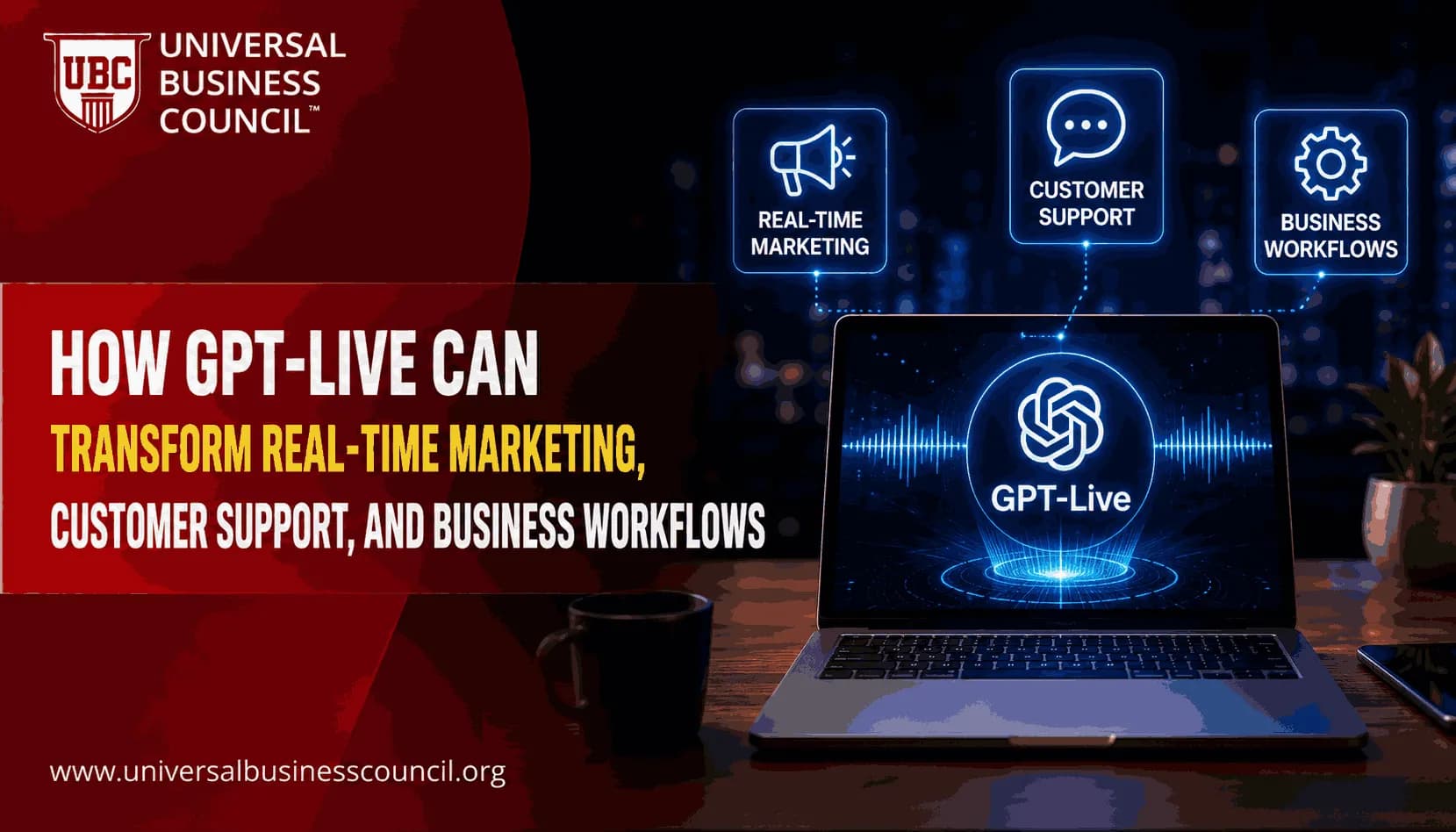
GPT-Live changes the business case for AI because it moves the interface from static chat to live conversation. It can listen, speak, reason, search, and call business tools while the customer or employee is still talking. That matters for real-time marketing, customer support, and internal workflows because speed is no longer just a UX preference. It affects conversion, resolution cost, and operational control.
The useful question is not whether voice AI sounds impressive in a demo. Many do. The real question is whether GPT-Live can connect to live data, follow policy, use tools correctly, and hand off when the risk is too high. That is where the transformation actually sits.

As organizations begin integrating conversational AI into customer and business workflows, many professionals are also developing practical implementation skills through a Certified ChatGPT Expert program to better understand prompt engineering, AI-assisted decision-making, and responsible enterprise deployment.
What GPT-Live Is
GPT-Live is OpenAI's newer generation of voice model technology built for full-duplex conversation. In plain terms, it can listen and speak at the same time instead of waiting for rigid turn-taking. That creates a more natural exchange, including interruptions, short acknowledgements like mhmm, and silence when the user is pausing rather than finished.
OpenAI's published evaluations report that its newer voice models were strongly preferred over the previous Advanced Voice Mode in 5 to 10 minute conversations, especially for turn-taking, interruption handling, conversational flow, and naturalness. The model family also shows gains on harder reasoning and agentic web search benchmarks, including GPQA and BrowseComp, according to OpenAI's release material.
For businesses, voice quality is only one piece. The bigger shift is that GPT-Live can sit on top of your systems: CRM, product databases, knowledge bases, analytics dashboards, ticketing tools, and event streams.
Why Real-Time AI Is Now Practical
Real-time AI has improved fast across three areas: latency, tool use, and enterprise connectivity.
Latency: OpenAI's realtime engineering demos describe tunable latency as low as roughly 200 milliseconds for streaming speech. That is close enough to feel conversational in most support and workplace settings.
Language coverage: The realtime model work points to support for around 80 input languages, which matters for global support and multilingual sales teams.
Long context: A 128K token context window allows longer conversations and more complex workflows without losing earlier details.
Tool calling: Realtime agents can route across tools, hold state, and perform structured actions instead of only answering questions.
Telephony: OpenAI's Realtime API supports SIP phone calling, so AI agents can operate inside real call center environments.
Cost is moving in the right direction too. OpenAI has priced gpt-realtime at about $32 per 1 million audio input tokens and $64 per 1 million audio output tokens, roughly 20 percent cheaper than the earlier gpt-4o-realtime-preview pricing. That still needs cost modeling, but it lowers the barrier for production pilots.
How GPT-Live Can Transform Real-Time Marketing
Voice-first lead capture
Most lead forms are blunt instruments. They ask the same fields, in the same order, whether the visitor is ready to buy or just comparing options. GPT-Live can replace part of that flow with a guided conversation.
On a website, a GPT-Live agent could ask what the buyer is trying to solve, qualify budget or timing, answer product questions, and create or update the CRM record while the conversation is still happening. With HubSpot-style app integrations, chat agents can already read and write CRM data, including contacts, deals, tasks, calls, and tickets. GPT-Live makes that pattern voice-first.
Here is the trade-off. Do not let a voice agent negotiate high-value enterprise pricing without human review. Use it for qualification, routing, scheduling, and structured discovery. Save commercial judgment for people until your governance model is proven.
Real-time personalization from live data
Batch personalization is familiar: segment the audience, send the email, wait for results. GPT-Live supports a more immediate pattern. Confluent's event streaming guidance describes how Kafka-based architectures can build a low-latency customer 360 view from CRM, product usage, support, and behavioral data. At runtime, the agent can query that view by customer ID and pull current context into the conversation.
That means a returning customer could hear different guidance based on recent purchases, an unresolved support ticket, a renewal date, or an abandoned cart. Used well, this is helpful. Used badly, it feels invasive. Tell users what the agent can access, limit sensitive data, and give them a simple route to a person.
Faster campaign analysis
Marketing teams lose hours moving between Google Analytics 4, ad platforms, SEO tools, CRM dashboards, and spreadsheets. GPT-Live can become a voice interface over that stack.
A marketer could ask: Which segment drove the CAC increase yesterday? The agent could pull live campaign data, compare conversion rates, inspect recent landing page changes, and give a spoken answer with a visual card. Ahrefs-style ChatGPT app integrations already show how live SEO and competitor data can be queried through natural language. Jasper's agent workspace points to a related trend in marketing operations: AI agents are being organized into structured content and campaign workflows rather than used as isolated copy tools.
A practical warning from campaign work: the agent should not optimize only for ROAS. I have watched search campaigns look efficient on ROAS while quietly shrinking new customer volume, because branded queries took over the budget. Give the agent guardrail metrics such as CAC, LTV, contribution margin, new-to-file customers, and pipeline quality.
Successfully applying AI to customer acquisition and engagement requires more than technical implementation. Professionals who combine AI knowledge with a Marketing Certification are often better prepared to translate real-time AI capabilities into measurable business outcomes across campaigns, customer journeys, and digital channels.
How GPT-Live Can Improve Customer Support
Voice agents that can actually resolve issues
Customer support is the clearest early use case. Realtime voice agents can answer calls, verify information, search knowledge bases, open tickets, check account data, and trigger approved workflows. OpenAI's realtime demos show agents resolving customer service issues across tools rather than stopping at general advice.
The hard part is not the greeting. It is the last mile: repeating an alphanumeric code correctly, reading a compliance statement word for word, issuing a refund within policy, updating the right field in Salesforce or HubSpot, and documenting the call. First-time AI support pilots often break here. The agent sounds polished but cannot close the loop.
Use GPT-Live where the workflow is bounded:
Password resets and account access checks
Order status, shipping, and returns
Appointment scheduling and reminders
Tier-one troubleshooting with clear escalation rules
Billing questions with strict approval thresholds
Multimodal troubleshooting
The Realtime API's image input support makes support more practical. A customer can send a screenshot of an error, a broken setup, or a confusing dashboard. The agent can reason over the image and the conversation together, then guide the customer verbally.
This is valuable for software, ecommerce, healthcare administration, financial services onboarding, and field service. It also changes the skills support leaders need. They have to design escalation policy, test edge cases, and monitor CSAT, first contact resolution, average handle time, containment rate, and complaint risk.
Continuous quality improvement
Confluent's event streaming model helps here. Prompts, responses, customer ratings, and outcome data can be captured as streams. Teams can then inspect which intents fail, where customers interrupt, which answers lead to repeat contacts, and which prompts create compliance risk.
Do not wait for monthly reporting. Realtime AI needs daily review during rollout. A small issue scales fast when one agent handles thousands of conversations.
How GPT-Live Can Change Internal Business Workflows
Internal use may produce the fastest ROI, because employees already know the context and can catch mistakes. GPT-Live can act as a voice control layer for common systems.
Sales operations: Log call notes, create tasks, update deal stages, and ask for pipeline risks while driving back from a meeting.
Marketing operations: Start campaign briefs, request localized content variants, pause underperforming segments, and ask for KPI explanations.
Management reporting: Ask what changed in churn, NPS, CAC, or sales cycle length during the last week and get a spoken summary with supporting data.
Meetings: Capture decisions, assign action items, and generate follow-up summaries while the discussion is still fresh.
This is where Universal Business Council readers should connect technical fluency with management discipline. Internal links to UBC's artificial intelligence, digital marketing, customer experience, and business management certification pages can support professionals building these capabilities.
Implementation Checklist for Business Leaders
Pick one high-volume workflow. Avoid vague innovation pilots. Choose a workflow with clear volume, cost, and success metrics.
Map the tools. Identify the CRM, ticketing, analytics, product, payment, and knowledge systems the agent must access.
Define allowed actions. Separate read-only tasks from write actions such as refunds, deal changes, or customer record updates.
Set escalation rules. Route to humans for angry customers, legal issues, medical or financial advice, high-value deals, and policy exceptions.
Measure business outcomes. Track conversion rate, CAC, LTV, CSAT, first contact resolution, average handle time, containment rate, and error rate.
Audit conversations. Review transcripts and audio samples. Test interruptions, accents, background noise, and multilingual switching.
The Governance Question
Recent academic work on AI-powered marketing makes a clear point: AI adoption is not only a technical issue. It touches strategy, ethics, governance, and organizational design. GPT-Live raises those stakes because it speaks directly to customers and can act inside business systems.
You need consent rules, data minimization, audit logs, prompt versioning, role-based access, and human override. To be blunt, if your CRM data is messy, a realtime agent will expose that mess faster than any dashboard ever could.
Next Step
Treat GPT-Live as a real-time business interface, not a talking chatbot. Start with one measurable use case: lead qualification, tier-one support, or CRM updates by voice. Build the data connection, test the guardrails, and train your team on AI governance and workflow design. If you are planning a career around this shift, pair hands-on experimentation with Universal Business Council learning in AI, marketing, customer experience, and management.
As real-time AI continues to reshape marketing, customer support, and enterprise operations, building broader technical knowledge is becoming just as important as learning individual tools. A Tech Certification can help professionals strengthen their understanding of emerging technologies and apply AI more effectively in real business environments.
FAQs
1. What is GPT-Live, and how can it transform business workflows?
GPT-Live is a real-time AI model optimized for fast, natural conversations. It can transform business workflows by automating repetitive tasks, providing instant responses, improving collaboration, and helping teams make faster decisions across marketing, customer support, sales, and operations.
2. How can GPT-Live improve real-time marketing?
GPT-Live enables marketers to generate campaign ideas, create personalized content, answer customer questions, monitor engagement, and optimize marketing strategies in real time. This helps businesses respond quickly to market trends and customer behavior.
3. How does GPT-Live enhance customer support?
GPT-Live provides instant, context-aware responses to customer inquiries, reducing wait times and improving service quality. It can assist support agents, automate common questions, summarize conversations, and provide consistent customer experiences around the clock.
4. Can GPT-Live automate repetitive business tasks?
Yes. GPT-Live can automate tasks such as email drafting, meeting summaries, report generation, data analysis, document creation, and workflow management. This allows employees to focus on strategic and creative responsibilities.
5. Why is GPT-Live valuable for businesses?
Businesses benefit from GPT-Live because it improves operational efficiency, enhances customer experiences, reduces manual workloads, supports faster decision-making, and enables scalable AI-powered interactions across multiple departments.
6. How does GPT-Live support sales teams?
Sales teams can use GPT-Live to qualify leads, generate personalized outreach emails, answer product questions, prepare sales proposals, summarize customer meetings, and provide real-time recommendations during client interactions.
7. Can GPT-Live improve marketing personalization?
Yes. GPT-Live can generate personalized product recommendations, targeted email campaigns, dynamic website content, and customized customer messages based on user preferences, improving engagement and conversion rates.
8. How can GPT-Live help customer service agents?
GPT-Live assists agents by suggesting accurate responses, retrieving relevant knowledge, summarizing customer histories, translating conversations, and reducing the time required to resolve support tickets.
9. Which industries can benefit from GPT-Live?
Industries such as retail, healthcare, banking, education, travel, insurance, hospitality, e-commerce, telecommunications, and software development can use GPT-Live to improve communication, automate workflows, and deliver better customer experiences.
10. Can GPT-Live support AI-powered chatbots?
Yes. GPT-Live enhances chatbots by enabling natural conversations, contextual understanding, and faster responses. Unlike traditional rule-based bots, it can adapt to diverse customer queries and provide more meaningful interactions.
11. How does GPT-Live improve internal business communication?
GPT-Live can summarize meetings, answer employee questions, draft internal announcements, organize project documentation, and provide instant access to company knowledge, helping teams collaborate more efficiently.
12. Can GPT-Live integrate with existing business software?
Yes. GPT-Live can be integrated with CRM platforms, help desk software, marketing automation tools, collaboration platforms, and other enterprise systems to streamline workflows and improve operational efficiency.
13. How does GPT-Live improve customer engagement?
By delivering instant, relevant, and personalized responses, GPT-Live keeps customers engaged throughout their journey. Faster communication and tailored recommendations help build stronger customer relationships and increase satisfaction.
14. Is GPT-Live suitable for small businesses?
Absolutely. Small businesses can use GPT-Live to automate customer support, create marketing content, manage daily operations, and improve productivity without significantly increasing staffing or operational costs.
15. Can GPT-Live support multilingual customer interactions?
Yes. GPT-Live supports multiple languages, enabling businesses to communicate with global audiences, provide localized customer support, and expand into international markets more effectively.
16. How can GPT-Live improve business decision-making?
GPT-Live can analyze information, summarize reports, identify trends, answer business questions, and provide actionable insights. This helps leaders and teams make informed decisions more quickly.
17. Does GPT-Live replace human employees?
No. GPT-Live is designed to support employees by automating repetitive tasks and providing intelligent assistance. Human expertise remains essential for strategic planning, relationship building, creative thinking, and complex decision-making.
18. What are the biggest benefits of GPT-Live for customer support teams?
Customer support teams benefit from faster response times, reduced ticket resolution times, consistent service quality, 24/7 AI assistance, improved agent productivity, and higher customer satisfaction through real-time conversational AI.
19. How can businesses prepare to implement GPT-Live?
Organizations should identify high-impact use cases, integrate GPT-Live into existing workflows, train employees on responsible AI usage, establish security and governance policies, and continuously monitor performance to maximize value.
20. Why is GPT-Live considered the future of real-time business AI?
GPT-Live combines low-latency performance, advanced language understanding, and scalable AI capabilities to support real-time conversations and intelligent automation. As businesses increasingly rely on AI for customer engagement and operational efficiency, GPT-Live has the potential to become a key technology for transforming marketing, customer support, and modern business workflows.
Related Articles
View AllArtificial Intelligence
System One AI for Real-Time Decisions
Explore how System One AI enables real-time decision-making through low-latency inference, typed outputs, calibrated confidence, and machine-native automation for responsive software applications.
Artificial Intelligence
How NVIDIA Cosmos 3 Enables Physical AI and Multi-Agent Workflows
Explore how NVIDIA Cosmos 3 enables Physical AI and multi-agent workflows through multimodal reasoning, world generation, action prediction, simulation, and automated development pipelines.

Artificial Intelligence
Gemini 4 Argon: Features, Pricing, and Availability
Gemini 4 Argon is Google’s new flagship AI model for coding, science, finance, law and security. See its main features, API and subscription pricing, and where you can access it today.
Trending Articles
The Role of Blockchain in Ethical AI Development
How blockchain technology is being used to promote transparency and accountability in artificial intelligence systems.
AWS Career Roadmap
A step-by-step guide to building a successful career in Amazon Web Services cloud computing.
Top 5 DeFi Platforms
Explore the leading decentralized finance platforms and what makes each one unique in the evolving DeFi landscape.