

What Is Anti-Bribery Compliance? A Guide for Businesses
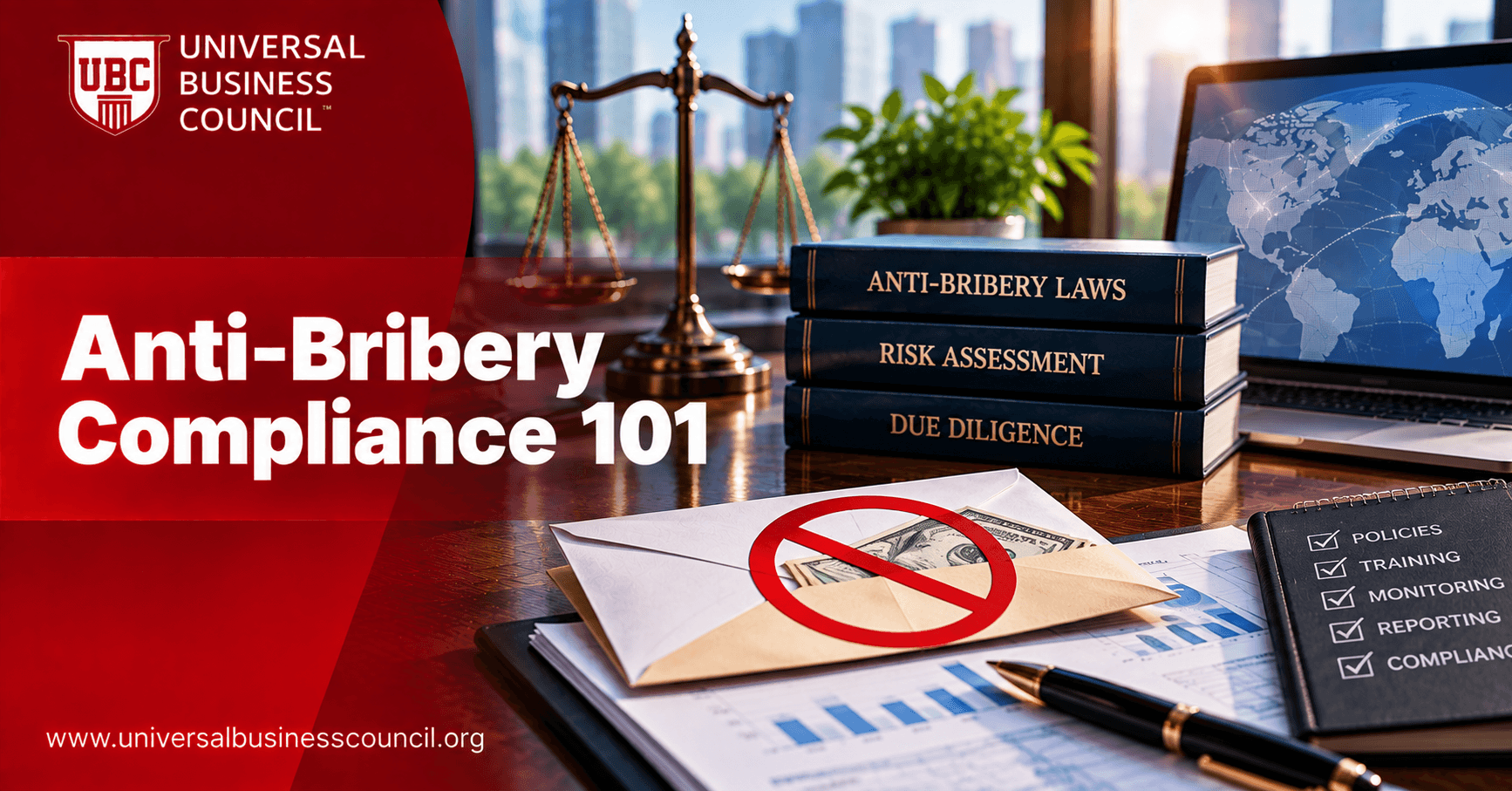
A sales rep pays a small "facilitation fee" to speed up a customs clearance, because that's just how things get done in that country. A company sends an expensive gift to a government official's family during a courtship period with a new market. A local distributor gets hired without much scrutiny, because they clearly know how to get deals done fast. None of it looks like a scandal in the making. All of it is exactly the kind of gray area anti-bribery and corruption laws are built to catch.
Bribery and corruption laws reach further across borders than almost any other area of compliance, and they carry some of the steepest penalties when companies get it wrong. This guide breaks down what anti-bribery compliance actually requires, where the real exposure hides, and what a program built to survive scrutiny looks like.

What anti-bribery and corruption compliance actually is
At its core, anti-bribery and corruption compliance means making sure a business, and everyone acting on its behalf, doesn't offer, promise, or accept anything of value in exchange for improper business advantage. That sounds straightforward. In practice, it covers a lot more ground than a straightforward bribe in an envelope.
It applies to direct payments, but also gifts, hospitality, charitable donations, job offers to a decision-maker's relative, and payments made through a third party rather than directly by the company itself. And a company can be held liable for bribery committed by an agent, distributor, or partner acting on its behalf, even if nobody at the company itself ever authorized it directly.
Why this matters more right now
A few trends have raised the stakes considerably in recent years.
Cross-border enforcement cooperation has grown, meaning a violation uncovered by one country's regulator increasingly gets shared with others, multiplying the consequences of a single incident.
Whistleblower incentive programs have expanded in a number of jurisdictions, giving employees real financial motivation to report violations rather than stay quiet.
Global business relationships keep expanding into markets with weaker local anti-corruption norms, which increases exposure for companies that don't build strong controls before entering.
None of this means the underlying definition of bribery changed. It means more violations are getting discovered, and the consequences of discovery have gotten more serious.
The key laws behind anti-bribery compliance
A handful of major laws sit behind most anti-bribery compliance programs, and understanding their basic reach matters, since several of them apply well beyond their home countries.
The Foreign Corrupt Practices Act, or FCPA, is a US law prohibiting bribery of foreign officials to obtain business, and it applies broadly to US companies and individuals, as well as foreign companies with a sufficient connection to US markets or securities. The UK Bribery Act goes even further in some respects, covering bribery in both the public and private sector, and notably making it a crime for a company to fail to prevent bribery committed on its behalf, even without proving the company intended it.
Beyond these two, a growing number of countries have passed their own anti-corruption laws modeled on similar principles, which means a company operating internationally often has to comply with several overlapping regimes at once, not just the one tied to its home country.
What counts as bribery and corruption
Bribery isn't limited to cash changing hands directly. A few categories worth understanding clearly:
Direct payments or bribes, the most obvious form, money or value given specifically to influence a decision.
Gifts and hospitality, which cross the line when they're lavish, frequent, or timed around a specific business decision, even if framed as ordinary goodwill.
Facilitation payments, small payments made to speed up a routine government action, like customs clearance. These are treated as bribes under most modern anti-corruption laws, even though they're sometimes locally normalized as "the cost of doing business."
Third-party payments, where a bribe flows through an agent, distributor, consultant, or joint venture partner rather than directly from the company, don't reduce the company's liability at all.
Third-party risk: where most exposure actually lives
If there's one area that deserves the most attention in a real compliance program, it's third parties. Agents, distributors, consultants, and local partners are consistently the most common source of bribery exposure, precisely because they operate with some independence from direct company oversight while still acting on the company's behalf.
A company that hires a well-connected local distributor without real due diligence, then looks the other way when deals start closing unusually fast, is taking on serious risk it likely isn't tracking. Under most anti-bribery laws, a company can be held responsible for that distributor's conduct, even if no one at the company explicitly authorized or even knew about a specific bribe.
The core pillars of an anti-bribery compliance program
A real program here isn't a signed code of conduct sitting in an employee handbook. It's a set of active practices that shape day-to-day decisions.
Risk assessment comes first, identifying which markets, business relationships, and transaction types carry the highest bribery risk for that specific business, rather than applying a generic template. Due diligence on third parties has to go beyond a basic background check, actually examining ownership structures, past conduct, and red flags before a relationship begins, not after a deal has already closed. Clear policies need to spell out specific limits on gifts, hospitality, and facilitation payments, rather than vague language that leaves employees guessing where the line actually sits. Training has to reach the employees and third parties actually exposed to this risk, sales teams, business development staff, and local partners, not just a generic annual module. And ongoing monitoring means actively watching for red flags in transactions and relationships, rather than assuming a signed policy at onboarding is enough on its own.
Common red flags and compliance gaps
A few patterns show up repeatedly in bribery investigations and internal audits.
Payments to third parties that don't clearly match the actual services provided.
Gifts or hospitality that cluster suspiciously around the timing of a major business decision.
A local partner or agent who insists on unusual payment structures, like routing funds through a third country or an unrelated entity.
Deals that close unusually fast in a market known for slow, bureaucratic processes, without a clear explanation.
Employees or partners reluctant to document how a particular relationship or deal actually came together.
None of these automatically prove corruption occurred. They're exactly the kind of pattern an investigation is designed to surface.
Building an anti-bribery program that holds up
A program built to survive scrutiny starts with genuine due diligence on every third party acting on the company's behalf, not a box-checking exercise completed once and forgotten. From there, a few things matter most.
Gift and hospitality policies need actual dollar limits and clear approval processes, not vague language open to interpretation in the moment. A working whistleblower channel gives employees a real, confidential way to raise concerns, and it has to be one people genuinely trust will be taken seriously rather than quietly buried. And documentation has to be consistent enough that a business relationship's history can actually be reconstructed if regulators ever ask.
Building a program at this level takes real structure. A Certified Compliance Professional credential is worth looking into for compliance staff who want a genuine framework for running an anti-bribery program, rather than assembling one reactively after a red flag has already been missed.
Common mistakes companies make
A handful of mistakes keep showing up. Treating third-party due diligence as a formality rather than genuine risk screening, especially for agents and distributors who seem to already know how to get deals done. Vague gift and hospitality policies that leave employees to interpret the limits themselves, often inconsistently across regions. And dismissing local business customs, like facilitation payments, as harmless when local norms differ from what the law actually requires.
Technology increasingly supports monitoring at this scale too, particularly for flagging unusual payment patterns across a large volume of third-party transactions. Tech Certifications is worth a look for compliance teams evaluating or building that kind of monitoring infrastructure, so they understand the systems doing the flagging rather than trusting a vendor's dashboard blindly.
The cost of getting it wrong
Anti-bribery violations carry some of the steepest penalties in corporate compliance. Fines can reach into the hundreds of millions of dollars for major violations, and individuals involved can face real prison time under laws like the FCPA and the UK Bribery Act. Beyond direct penalties, companies found in violation can face debarment from government contracts, ongoing monitorships that bring years of external oversight, and reputational damage that follows a company into every future deal in that market.
Where enforcement is heading
Cross-border cooperation between regulators keeps deepening, meaning a violation uncovered in one jurisdiction increasingly triggers scrutiny elsewhere too. Third-party liability continues tightening, with regulators showing less patience for companies that claim ignorance of a partner's conduct rather than demonstrating genuine oversight. And AI-assisted monitoring is becoming more common for flagging suspicious transaction patterns across large volumes of third-party activity, a shift worth understanding for teams building the infrastructure behind that kind of monitoring, which is where Deep Tech Certifications becomes genuinely useful.
For compliance and communications teams rolling out anti-bribery training and policy updates across a global workforce, how it's communicated matters almost as much as the policy itself. A Digital Marketing Course can help teams frame these updates so they actually land with employees across different regions, rather than reading as another ignored corporate memo.
Conclusion
Anti-bribery and corruption compliance comes down to a fairly direct principle: business should be won on merit, not on who paid whom. The difficulty lives in the gray areas, a gift that seems generous rather than transactional, a facilitation payment that feels routine locally, a distributor who gets results without anyone asking how. Most violations aren't the result of a company deliberately choosing corruption; they're the result of weak third-party oversight, vague policies, and red flags nobody stopped to examine closely enough. Get the fundamentals right, genuine due diligence, clear limits, and a culture where people actually raise concerns, and anti-bribery compliance becomes a durable part of how a company operates. Get it wrong, and the consequences reach further, hit harder, and follow a company longer than almost any other compliance failure.
FAQs
What is anti-bribery and corruption compliance?
A set of practices ensuring a business and anyone acting on its behalf doesn't offer, promise, or accept value in exchange for improper business advantage.
What is the FCPA?
The Foreign Corrupt Practices Act, a US law prohibiting bribery of foreign officials to obtain business, applying broadly to US companies and connected foreign entities.
What is the UK Bribery Act?
A UK law covering bribery in both public and private sectors, notably making it a crime for a company to fail to prevent bribery on its behalf.
Are facilitation payments considered bribery?
Yes, most modern anti-corruption laws treat facilitation payments as bribes, even when locally normalized as routine.
Can a company be liable for a third party's bribery?
Yes, companies can be held responsible for bribery committed by agents, distributors, or partners acting on their behalf.
What counts as a bribe beyond direct cash payments?
Gifts, hospitality, charitable donations, job offers to a decision-maker's relative, and payments routed through third parties.
Why are third parties the biggest source of bribery risk?
They act with some independence while still representing the company, making their conduct harder to directly oversee.
What should third-party due diligence actually include?
Examining ownership structures, past conduct, and red flags before a relationship begins, not just a basic background check.
What is a red flag in a third-party relationship?
Unusual payment structures, unusually fast deals in slow-moving markets, or reluctance to document how a deal came together.
Do gift and hospitality policies need specific limits?
Yes, vague language leaves employees guessing, while clear dollar limits and approval processes remove that ambiguity.
What role does a whistleblower channel play in compliance?
It gives employees a confidential way to raise concerns, which only works if people trust it will be taken seriously.
Can a company be penalized even without an explicit bribery order from leadership?
Yes, failing to prevent bribery committed on the company's behalf can itself be a violation under laws like the UK Bribery Act.
What industries face the highest anti-bribery risk?
Industries operating in markets with weaker local anti-corruption norms or relying heavily on third-party agents and distributors.
What happens if a company is found in violation of anti-bribery laws?
It can face significant fines, debarment from government contracts, ongoing monitorships, and lasting reputational damage.
Can individuals face criminal liability for bribery violations?
Yes, individuals involved can face real prison time under laws like the FCPA and the UK Bribery Act.
How does cross-border enforcement cooperation affect companies?
A violation uncovered in one country increasingly gets shared with regulators elsewhere, multiplying the consequences.
What is the most common anti-bribery compliance mistake?
Treating third-party due diligence as a formality rather than genuine risk screening.
How is technology used in anti-bribery compliance today?
Increasingly for monitoring transaction patterns and flagging unusual third-party payment activity at scale.
Are local business customs a valid defense for bribery?
No, most anti-corruption laws don't recognize local custom as an exception, even when facilitation payments are locally common.
What's the foundation of a strong anti-bribery program?
Genuine due diligence on third parties, clear policies with real limits, and a culture where employees feel safe raising concerns.
Related Articles
View All
Business
FCC Rules: A Compliance Guide for Businesses
Learn how FCC rules affect businesses, including telecommunications, marketing communications, consumer privacy, equipment standards, and regulatory compliance responsibilities.

Business
OFAC Sanctions: A Compliance Guide for Businesses
Learn how OFAC sanctions affect businesses, how to screen customers and transactions against restricted-party lists, and how to manage sanctions compliance and reporting obligations.

Business
BIPA Compliance: A Guide for Employers and Product Teams
Learn how the Biometric Information Privacy Act (BIPA) affects employers and product teams, including biometric data collection, informed consent, retention policies, data security, and compliance responsibilities.
Trending Articles
The Role of Blockchain in Ethical AI Development
How blockchain technology is being used to promote transparency and accountability in artificial intelligence systems.
AWS Career Roadmap
A step-by-step guide to building a successful career in Amazon Web Services cloud computing.
Top 5 DeFi Platforms
Explore the leading decentralized finance platforms and what makes each one unique in the evolving DeFi landscape.