

GDPR and CCPA 101: a compliance-first guide to data privacy laws that actually apply to you
Somewhere right now, a business is sitting on a customer's personal data with no idea it's already breaking the law. Maybe it's an old email list nobody documented. Maybe it's a cookie tracker installed years ago by someone who left the company. Maybe it's a vendor holding customer data with weaker security than anyone bothered to check. None of it looks dramatic from the inside. All of it is exactly the kind of gap that data privacy regulators are built to find.
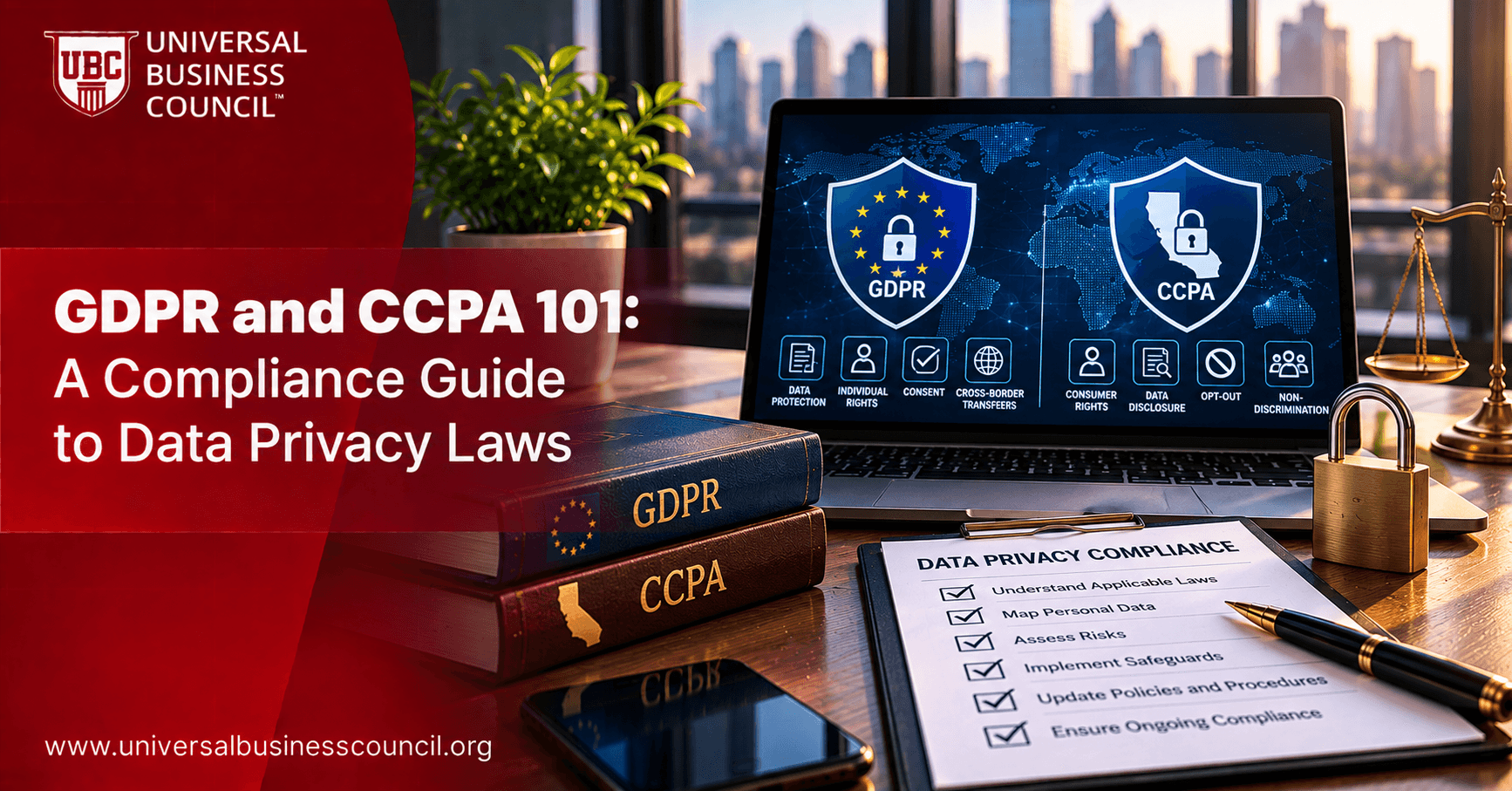
Data privacy laws exist because personal information became a commodity long before most businesses thought seriously about protecting it. GDPR and CCPA are the two most influential examples, and between them they've reshaped how companies collect, store, and use data almost everywhere, not just in Europe and California. This guide breaks down what both actually require, where they overlap, where they differ, and what a compliance program that holds up under scrutiny actually looks like.

What data privacy laws actually are
At their core, data privacy laws give individuals rights over their own personal information and put legal obligations on businesses that collect it. That means knowing what data you have, why you have it, how long you keep it, and what happens to it if it's mishandled or stolen.
GDPR, the General Data Protection Regulation, came out of the EU in 2018 and set the modern template most other privacy laws now follow. CCPA, the California Consumer Privacy Act, followed in 2020 and became the first major US state law to give consumers similar rights. Since then, a growing list of US states have passed their own versions, and countries outside the EU have modeled national laws directly on GDPR's structure.
The two laws don't operate in isolation. If your business touches EU residents' data or California residents' data, regardless of where your company is actually based, both can apply to you at the same time.
Why data privacy compliance matters right now
Enforcement has moved well past warning letters. Regulators across the EU have issued fines running into hundreds of millions of dollars for major violations, and California's enforcement mechanism has matured significantly since CCPA first took effect.
A few reasons this matters more today than a few years ago:
More US states have passed comprehensive privacy laws modeled on CCPA, meaning compliance obligations are multiplying rather than staying contained to one jurisdiction.
Consumers are more aware of their rights than ever, and are increasingly willing to file complaints or exercise data requests.
Data breaches trigger notification requirements under both laws, which means a security failure and a compliance failure often show up together.
None of this stays theoretical for long. A business that treats privacy as a policy document rather than an operational discipline tends to find that out during an audit or, worse, a breach.
GDPR explained
GDPR applies to any organization that processes the personal data of individuals in the EU, regardless of where the organization itself is headquartered. That reach is broader than most businesses initially assume.
A few principles sit at the center of it. Data has to be collected for a specific, stated purpose, not gathered vaguely for future use. Businesses can only collect what's actually necessary, a principle known as data minimization. Individuals have to give clear, informed consent before their data is processed in most cases, and that consent has to be as easy to withdraw as it was to give.
GDPR also hands individuals a specific set of rights. The right to access what data a company holds about them. The right to correct inaccurate data. The right to erasure, often called the right to be forgotten. The right to data portability, meaning they can request their data in a usable format to move to another provider.
CCPA explained
CCPA applies to businesses that collect personal data from California residents and meet certain thresholds, typically based on revenue, the volume of consumer data processed, or whether the business sells personal data as part of its revenue model.
It shares GDPR's basic spirit but isn't identical in structure. CCPA gives California residents the right to know what personal data a business has collected about them, the right to request deletion of that data, and the right to opt out of having their data sold to third parties. A later amendment, the California Privacy Rights Act, added further protections and created a dedicated enforcement agency specifically for privacy matters.
Unlike GDPR, CCPA doesn't require opt-in consent before data collection in most cases. It's built more around giving consumers the ability to opt out and control what happens to data that's already being collected.
GDPR vs CCPA: the key differences
A few distinctions matter enough to call out directly:
GDPR generally requires opt-in consent before data collection. CCPA generally allows collection by default, with an opt-out right attached.
GDPR applies based on whose data is being processed: EU residents, regardless of company size. CCPA applies based on business thresholds tied to revenue or data volume.
GDPR's right to erasure is broader and more central to the law. CCPA's deletion right exists but comes with more exceptions.
GDPR enforcement can include fines up to a percentage of global annual revenue. CCPA enforcement works through statutory penalties per violation, plus a private right of action tied specifically to data breaches.
The practical result is that a business operating in both markets often needs two distinct sets of processes, not one policy stretched to cover both. Running two parallel compliance tracks instead of stretching one policy across both laws takes real structure. A Certified Compliance Management Professional credential gives privacy teams a framework for managing GDPR and CCPA obligations side by side, instead of reconciling gaps between them case by case.
The core pillars of a data privacy compliance program
A privacy policy on paper doesn't mean much if the operations behind it aren't actually built to support it. A real compliance program rests on a handful of working systems, and each one has to function on its own, not just exist as a line item in a document.
Consent and preference management
Tracking what each individual has agreed to, when, and under what version of a privacy notice, in a way that can be proven later if a regulator asks.
Data mapping
Knowing exactly what personal data your business holds, where it lives, who has access to it, and why it was collected in the first place. Most compliance failures trace back to a business that simply didn't know what data it had.
Breach response
Both laws carry notification obligations when personal data is compromised, and the clock on those obligations starts the moment a breach is discovered, not once it's fully investigated.
Individual rights requests
A working process for handling access, correction, deletion, and opt-out requests within the legally required timeframe, not an ad hoc email chain improvised each time one comes in.
Common red flags and compliance gaps
A few patterns show up repeatedly in audits and enforcement actions:
Privacy notices that don't match what the business actually does with data in practice.
Consent collected once at signup, with no record of what version of the policy applied or when preferences changed.
Vendors and third parties holding customer data with no documented oversight of how they protect it.
Data retained indefinitely with no clear policy for when it should be deleted.
Individual rights requests handled inconsistently, or missed entirely because there's no formal intake process.
None of these look like a crisis on their own. Together, they're exactly what an audit is designed to surface.
Building a data privacy program that holds up
A program built to survive scrutiny starts with an accurate data map, not a privacy policy copied from a template. From there, a few things matter most.
Data minimization has to be a real practice, not a stated value, meaning the business actually stops collecting data it doesn't need rather than just saying it will. Vendor management needs contractual and technical oversight, since a business remains responsible for how a third party handles data it was entrusted with. And breach response plans need to be tested before they're needed, not written for the first time during an actual incident.
Technology increasingly carries a lot of this weight, particularly for data mapping and automated rights-request handling at scale. Teams building or evaluating that kind of infrastructure benefit from real technical grounding, which is where Tech Certifications become genuinely useful for compliance professionals who need to understand the systems managing sensitive data. Marketing teams sit closer to this than they often realize too, since they're usually the ones collecting consent and running the campaigns that trigger data privacy obligations in the first place, which is where a Digital Marketing Course helps close the gap between what a campaign collects and what compliance actually requires.
For businesses working with data stored or processed through blockchain or decentralized systems specifically, where traditional deletion and access rights get complicated fast, Deep Tech Certifications covering that space fill a gap most generic privacy training doesn't touch.
Common mistakes businesses make
A handful of mistakes show up again and again. Treating privacy compliance as a one-time policy update rather than an ongoing operational responsibility. Weak oversight of vendors who ultimately handle just as much sensitive data as the business itself. Slow breach response, often because no one clearly owns the process before an incident happens. And inconsistent application of rights requests, where similar requests get handled differently depending on who receives them.
The cost of getting it wrong
The business sitting on that undocumented email list or under-vetted vendor rarely realizes the exposure until something forces the issue, a breach, a regulator's request, a consumer complaint that escalates. At that point, the costs stack quickly: fines that can scale with company revenue under GDPR, statutory penalties under CCPA, breach notification costs, and the kind of reputational damage that lingers well after the fine is paid. Customer trust, once shaken by a mishandled data incident, tends to take far longer to rebuild than the compliance gap took to create.
Where data privacy law is heading
More US states keep following California's lead, meaning businesses increasingly have to comply with a patchwork of state laws rather than one clear national standard. AI-specific privacy rules are emerging as regulators grapple with how personal data gets used to train and run AI systems. And globally, more countries continue modeling their own laws directly on GDPR's structure, pushing toward a rough convergence around the same core rights and obligations, even where the specific rules still differ.
Conclusion
GDPR and CCPA both answer the same underlying question in different ways: what rights do individuals have over their own data, and what obligations does that place on the businesses holding it. GDPR leans on opt-in consent and broad individual rights applied wherever EU residents' data goes. CCPA leans on opt-out control and thresholds tied to business scale. Neither law rewards a business for having a privacy policy on paper. Both reward a business that actually knows what data it holds, handles it deliberately, and can prove it when asked. Get that right, and data privacy compliance becomes a quiet operational habit. Get it wrong, and the gap usually surfaces at the worst possible moment, during a breach, an audit, or a request nobody was ready to answer.
FAQs
What is GDPR?
The EU's General Data Protection Regulation, giving individuals rights over their personal data and setting obligations for businesses that process it.
What is CCPA?
The California Consumer Privacy Act, giving California residents rights to know, delete, and opt out of the sale of their personal data.
Does GDPR apply to businesses outside the EU?
Yes, if the business processes personal data belonging to individuals located in the EU.
Does CCPA apply to every business that has California customers?
No, only businesses that meet specific thresholds tied to revenue or the volume of consumer data processed.
What's the main difference between GDPR and CCPA consent rules?
GDPR generally requires opt-in consent before collection. CCPA generally allows collection by default with an opt-out right.
What is the right to be forgotten?
A GDPR right allowing individuals to request that a business delete their personal data under certain conditions.
Can California residents ask a business to delete their data under CCPA?
Yes, deletion is one of the core rights CCPA grants to California consumers.
What counts as personal data under these laws?
Any information that can identify an individual, directly or indirectly, such as name, email, location, or online identifiers.
What is data minimization?
The principle of only collecting the personal data actually necessary for a stated purpose, nothing more.
What happens if a business has a data breach under GDPR?
It generally must notify the relevant regulator, and sometimes affected individuals, within a strict timeframe after discovery.
Does CCPA have its own breach notification requirement?
CCPA includes a private right of action specifically tied to certain types of data breaches.
What is the CPRA?
The California Privacy Rights Act, an amendment that expanded CCPA and created a dedicated privacy enforcement agency.
How are GDPR fines calculated?
They can scale up to a percentage of a company's global annual revenue, depending on the severity of the violation.
What is data mapping in a privacy program?
The process of documenting what personal data a business holds, where it's stored, and who has access to it.
Do businesses need to comply with both GDPR and CCPA?
Yes, if they handle personal data belonging to both EU residents and California residents, regardless of where the company is based.
What is a data subject access request?
A formal request from an individual asking a business what personal data it holds about them.
Are more US states passing privacy laws like CCPA?
Yes, a growing number of states have passed their own comprehensive privacy laws modeled on California's approach.
What role does vendor management play in privacy compliance?
Businesses remain responsible for how third-party vendors handle personal data they've been entrusted with.
How is AI affecting data privacy regulation?
Regulators are increasingly focused on how personal data is used to train and operate AI systems, prompting new AI-specific privacy rules.
What is the biggest mistake businesses make with data privacy compliance?
Treating it as a one-time policy update instead of an ongoing operational responsibility that needs continuous upkeep.
Related Articles
View All
Business
Gifts and Entertainment 101: a compliance-first guide to knowing where the line actually sits
Learn how gifts and entertainment can create compliance risks, what businesses need to consider, and how clear policies can help employees stay within appropriate boundaries.
Business
FTC guidelines 101: a compliance-first guide to advertising and data practices
Learn the basics of FTC guidelines, including advertising claims, endorsements, consumer disclosures, data practices, and the compliance mistakes businesses need to avoid.

Business
Vendor and Third-Party Risk Management 101: a compliance-first guide to knowing who you're really trusting
Learn what vendor and third-party risk management involves, how businesses can assess external partners, and how ongoing oversight can help reduce security, compliance, and operational risks.
Trending Articles
The Role of Blockchain in Ethical AI Development
How blockchain technology is being used to promote transparency and accountability in artificial intelligence systems.
AWS Career Roadmap
A step-by-step guide to building a successful career in Amazon Web Services cloud computing.
Top 5 DeFi Platforms
Explore the leading decentralized finance platforms and what makes each one unique in the evolving DeFi landscape.