

ICE I-9 Audits: A Compliance Guide for Employers
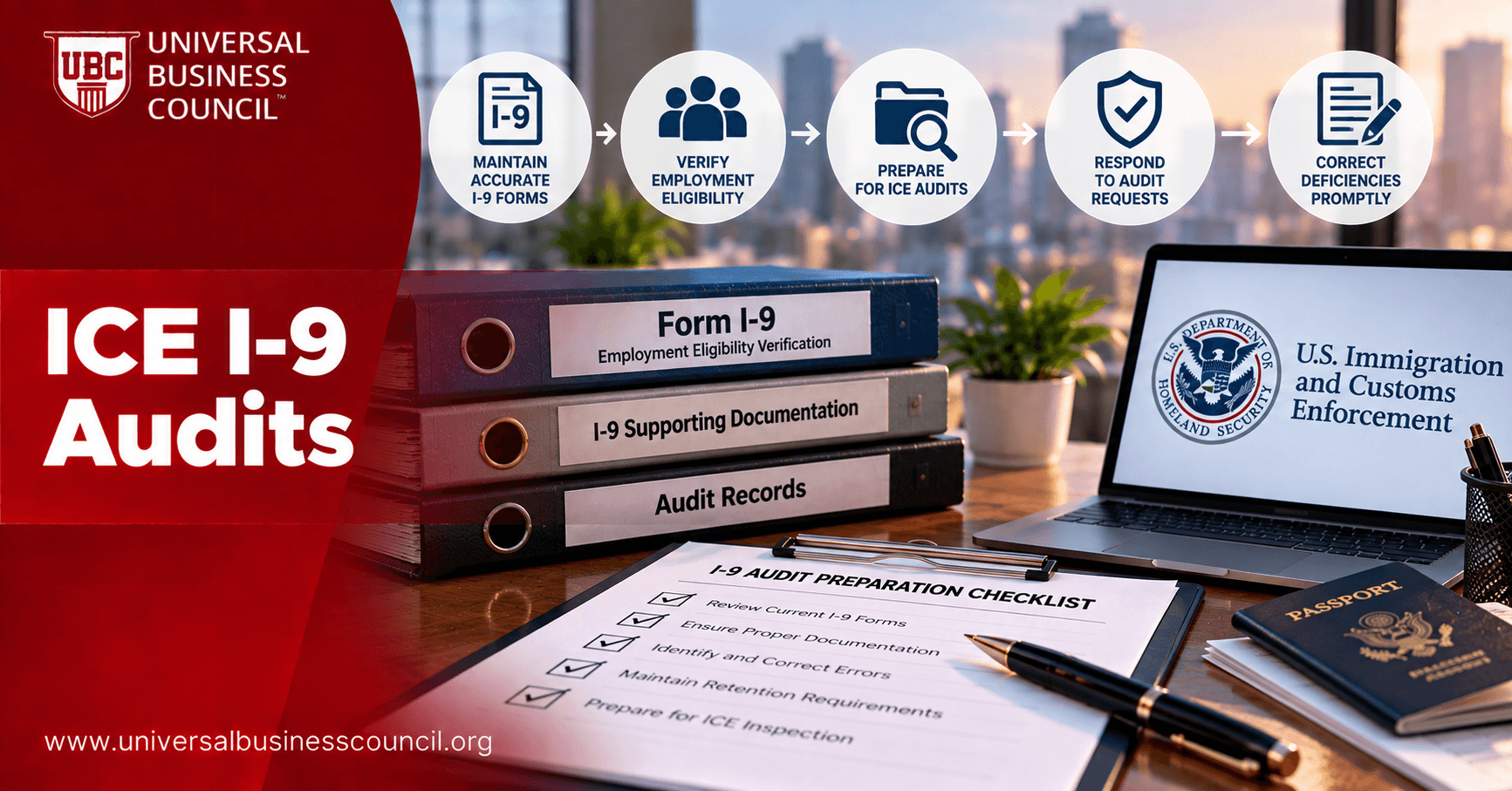
ICE I-9 audits put the focus on something employers are expected to maintain every day: accurate records showing that employees completed the required employment eligibility verification process. When U.S. Immigration and Customs Enforcement initiates an inspection, employers need to be able to produce those records, identify errors, and respond within the required timeframe.
That makes I-9 compliance an ongoing records-management responsibility rather than something to think about only when an audit notice arrives. For HR and compliance professionals looking to strengthen their understanding of employment compliance and verification requirements, the Certified Compliance Professional certification can provide a useful foundation. This guide explains how ICE I-9 audits work, what auditors look for, how penalties are assessed, and how employers can build an I-9 program that is ready for inspection.

What are ICE I-9 audits?
An ICE I-9 audit is an inspection of an employer's Form I-9 records under Section 274A of the Immigration and Nationality Act. Every employer, regardless of size or industry, must complete and keep a Form I-9 for each employee hired after November 6, 1986. The form documents that the employer checked each new hire's identity and authorization to work in the United States. During an audit, inspectors compare those forms against the law, looking for missing forms, incomplete sections, and signs of document problems.
Who conducts the audit and why employers are selected
The inspections are carried out by Homeland Security Investigations, the investigative arm within ICE. Employers aren't always told why they were selected, and receiving a notice doesn't mean anyone suspects wrongdoing. What matters is being ready regardless of the reason.
Form I-9 basics every employer must get right
The form has two main parts that employers touch: Section 1, completed by the employee, and Section 2, completed by the employer after examining the employee's documents. Most audit findings come from small mistakes in these sections, repeated across many hires. The timelines to know:
Employees complete Section 1 no later than their first day of work.
Employers complete Section 2 within three business days of the employee's first day.
Employers retain each form for three years after the hire date or one year after employment ends, whichever is later.
Reverification is required when an employee's work authorization has an expiration date.
One more rule belongs here because it affects the way you write instructions to new hires. Employees choose which acceptable documents to present. An employer that demands specific documents, or more documents than the form requires, risks a discrimination claim, which is a separate legal problem from an I-9 error.
How an ICE I-9 audit works
Most audits follow a recognizable sequence, though details vary by case.
The Notice of Inspection
The process starts with a Notice of Inspection, or NOI. The employer generally has three business days to produce its I-9 forms and supporting documentation. ICE may also ask for related records, such as employee lists. Three business days passes quickly, which is why the first hours matter.
Your first steps
Contact an immigration attorney right away, mark the deadline, and name one person to coordinate the response. Do not alter, backdate, or discard any form. Corrections made in a panic can look like concealment and make a modest problem worse. If more time is needed, counsel can ask the agency about an extension.
Gather the records
Pull all I-9 forms for current employees and for former employees still inside the retention period. Collect copies of supporting documents if the company keeps them, and confirm where electronic records live, along with who has access. A clear inventory prepared early prevents missing pages from becoming new violations.
What ICE finds and how it responds
After reviewing the records, ICE issues one or more notices. A Notice of Inspection Results, sometimes called a compliance letter, means the records passed. A Notice of Technical or Procedural Failures lists errors the employer may have a chance to correct. A Notice of Suspect Documents or Notice of Discrepancy points to employees whose work authorization needs follow-up, and the employer must handle that follow-up carefully and fairly. A Warning Notice signals problems without a fine. A Notice of Intent to Fine proposes a penalty, and the employer generally has 30 days to request a hearing before an administrative law judge.
The 2026 shift in how errors are classified
Traditionally, I-9 errors fell into two groups. Substantive violations were serious and finable. Technical or procedural violations could often be fixed within a set period after the inspection. In March 2026, ICE updated its Form I-9 Inspection Fact Sheet, and employment law commentary describes the update as moving a number of formerly correctable errors, such as missing dates or signatures and certain preparer or translator omissions, into the substantive category. Deficiencies in electronic I-9 systems, such as audit trails and signature controls, are also in focus.
The practical meaning is simple: fewer errors can be fixed once the notice arrives. Review the current fact sheet on the ICE website and compare it with your own forms, because classification rules can change again.
Penalties and what drives them
Civil penalties for paperwork violations are assessed per form, and the amounts are adjusted for inflation each year, so check the current range before estimating exposure. Several factors influence the amount, including the size of the business, the employer's good faith, the seriousness of the violations, whether unauthorized workers were involved, and any history of earlier violations.
Knowingly hiring or continuing to employ unauthorized workers is treated far more seriously than paperwork errors, and a pattern or practice of it can lead to criminal exposure. Good faith counts, which is one more reason to find and fix problems before the agency does.
Clear communication: the marketing side of I-9 compliance
I-9 compliance begins with a new hire's first impression. The onboarding email, the instructions for completing Section 1, and the way a manager explains document day all shape whether the form gets done correctly and on time. Confusing instructions create errors. Cold or accusatory language creates a poor experience for someone who just accepted a job.
Teams that have picked up habits from a digital marketing course, like writing in plain language, keeping messages short, and tracking completion the way marketers track a funnel, often get cleaner forms with less rework. Keep the wording neutral: say that employees may choose from the lists of acceptable documents, never which ones to bring. The same discipline applies if an audit happens. A calm, accurate internal message to managers about who handles questions prevents rumors, and some states require employers to notify employees after receiving an NOI, so check local rules with counsel.
Common I-9 problems that turn into audit findings
The patterns are familiar. Section 1 is left incomplete or signed late. Section 2 is missing the employer representative's name, title, or date. Documents are recorded inconsistently from one hire to the next. Reverification is missed when authorization expires. Forms for former employees are thrown away too early or kept far too long. Corrections are made without a date or initials. Electronic systems lack proper audit trails or signature records. None of these look dramatic on their own, but across hundreds of hires they become real exposure.
Building an audit-ready I-9 program
An audit-ready program has a single owner, written procedures, and a habit of checking its own work. Many employers use electronic I-9 systems, which can reduce errors through built-in validations but also introduce their own requirements. People who understand how these tools connect to applicant tracking and HR systems, a skill built through tech certifications, can spot weak points such as data that doesn't carry over correctly.
Controls matter as much as software. Concepts from deep tech certifications, such as secure records, access permissions, and tamper-evident logs, support the audit trail an inspector expects to see.
Internal audit routine
A scheduled internal review lets you find problems on your own timeline. At least once a year, and after any system change or acquisition, check the following:
Every active employee has a form, and every form is complete
Section 2 timing matches hire dates
Reverification dates are tracked and acted on
Terminated employees' forms are kept for the right period and then disposed of properly
Electronic system settings, signatures, and audit trails meet current requirements
Document what you find and how you fix it. A record of regular self-audits supports a good faith argument later.
Building compliance expertise on your team
I-9 work is repetitive, which makes it easy to get sloppy and hard to notice. Giving the people who handle it formal training changes that. The Certified Compliance Professional certification suits people responsible for day-to-day compliance tasks like documentation, monitoring, and follow-through, which describes most I-9 administrators.
Conclusion
ICE I-9 audits reward the employers who prepared long before the notice arrived. Complete Section 1 and Section 2 on time. Retain forms for the right period and track reverification. Know what a Notice of Inspection requires, call counsel immediately, and never alter records after the fact. Understand how the March 2026 fact sheet narrows the room for correction, how penalties are weighed, and why good faith matters.
Strong ICE I-9 audit readiness comes from clear onboarding communication, a single accountable owner, controlled electronic systems, and regular internal audits. Do that work early and the notice becomes a records request instead of a crisis.
Frequently asked questions
1. What is an ICE I-9 audit?
It's an inspection of an employer's Form I-9 records to check whether the employer verified identity and work authorization for employees as the law requires.
2. What is Form I-9?
It's the federal form used to verify the identity and employment authorization of every person hired for employment in the United States.
3. Which employers must complete Form I-9?
Every employer, regardless of size or industry, for each employee hired after November 6, 1986.
4. What is a Notice of Inspection?
A written notice from ICE telling an employer that its I-9 records will be inspected and that it must produce them.
5. How long do employers have to respond to a Notice of Inspection?
Generally three business days. An attorney can discuss whether additional time is possible.
6. Who conducts ICE I-9 audits?
Homeland Security Investigations, the investigative component within ICE, conducts them.
7. What records might ICE ask for?
Completed Forms I-9 and any supporting documents the employer keeps, and possibly related records such as employee lists.
8. How long must employers keep Form I-9?
For three years after the hire date or one year after employment ends, whichever is later.
9. When must each section of Form I-9 be completed?
Employees complete Section 1 by their first day of work, and employers complete Section 2 within three business days of the first day.
10. When is reverification required?
When an employee's work authorization has an expiration date, the employer must reverify before it expires.
11. What is the difference between technical and substantive violations?
Substantive violations are more serious errors that can draw fines directly. Technical violations are lesser errors that have often been correctable within a set period.
12. What changed in 2026?
ICE updated its Form I-9 Inspection Fact Sheet in March 2026, and legal commentary describes it as reclassifying many formerly technical errors as substantive. Review the current fact sheet for details.
13. Can errors be corrected after a Notice of Inspection?
Fewer errors can be corrected than before. Fixing problems through an internal audit before any notice arrives is the safer path.
14. What are the penalties for I-9 violations?
Civil penalties apply per form and are adjusted each year for inflation. Check the current range on the ICE website before estimating exposure.
15. What factors affect the size of a penalty?
Business size, good faith, seriousness of the violations, whether unauthorized workers were involved, and the employer's history of violations.
16. What happens if an employer knowingly hires unauthorized workers?
Penalties are much higher, and a pattern or practice of knowing violations can lead to criminal liability.
17. What is a Notice of Suspect Documents?
A notice indicating that ICE believes certain employees may not be authorized to work, which requires the employer to follow up carefully and lawfully.
18. What is a Notice of Intent to Fine?
A notice proposing a monetary penalty. Employers generally have 30 days to request a hearing before an administrative law judge.
19. Can an employer require specific documents from new hires?
No. Employees choose which acceptable documents to present, and demanding particular ones can lead to discrimination claims.
20. How can employers prepare for an ICE I-9 audit?
Complete forms on time, track reverification and retention, audit internally each year, secure electronic systems, train staff, and keep an attorney's contact ready.
Related Articles
View All
Business
BIPA Compliance: A Guide for Employers and Product Teams
Learn how the Biometric Information Privacy Act (BIPA) affects employers and product teams, including biometric data collection, informed consent, retention policies, data security, and compliance responsibilities.

Business
Right-to-Work Laws: A Compliance Guide for Employers
Learn how right-to-work laws affect union membership and dues, how state requirements differ, and what employers need to know to manage labor relations compliantly.
Business
NLRA Compliance: A Guide for Employers and HR Teams
Learn how the National Labor Relations Act affects workplace rights, employee organizing, protected concerted activity, employer policies, and HR compliance responsibilities.
Trending Articles
The Role of Blockchain in Ethical AI Development
How blockchain technology is being used to promote transparency and accountability in artificial intelligence systems.
AWS Career Roadmap
A step-by-step guide to building a successful career in Amazon Web Services cloud computing.
Top 5 DeFi Platforms
Explore the leading decentralized finance platforms and what makes each one unique in the evolving DeFi landscape.