

How to Close the AI Skills Gap
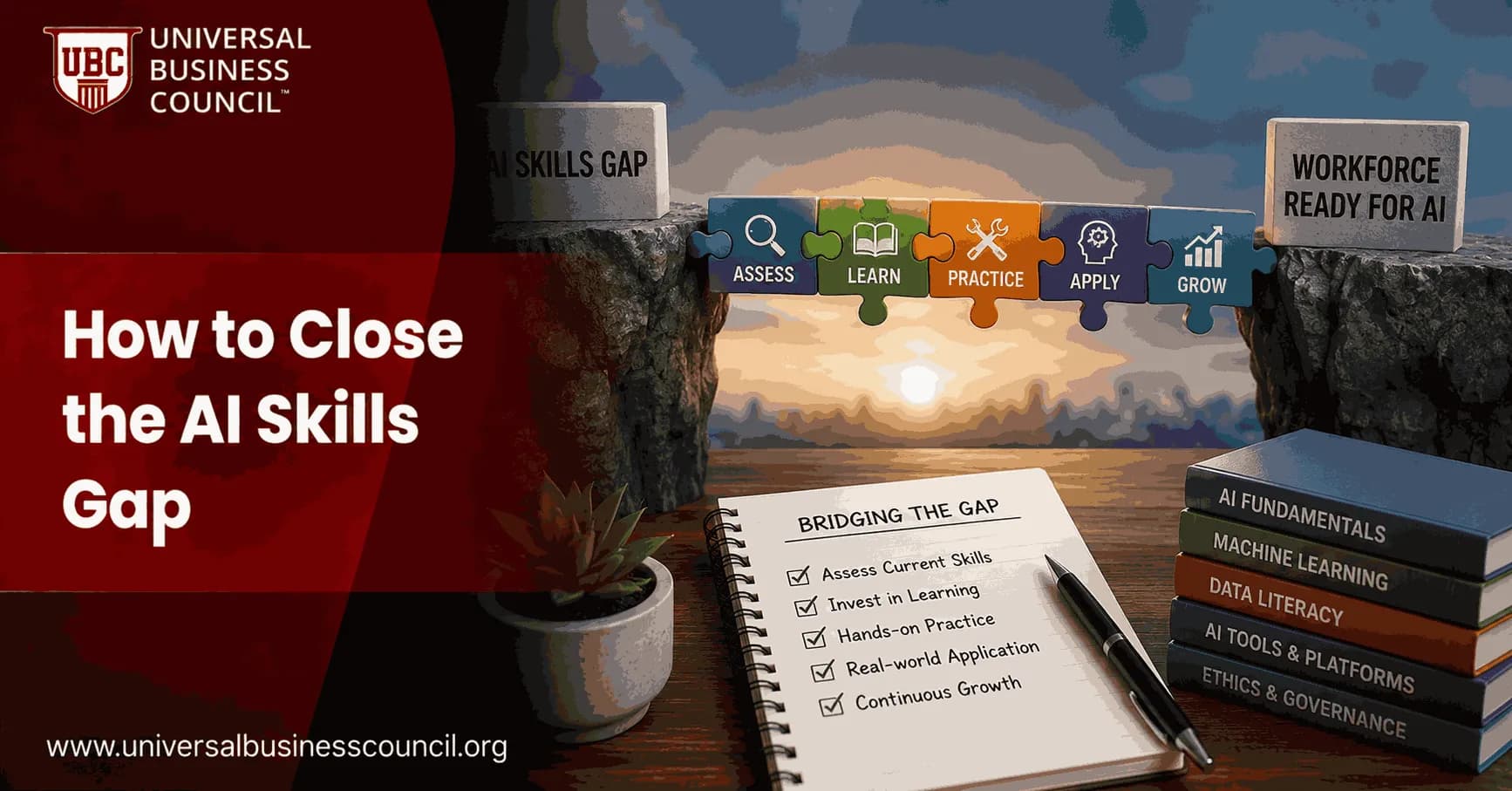
Introduction: The Biggest Business Problem of 2026
Artificial intelligence is no longer an experiment. Over 72 percent of companies have adopted AI in 2026, and global AI capital expenditure has surpassed 300 billion dollars. Despite this investment, only 34 percent of organisations report using AI to genuinely transform operations. The single biggest reason is not the technology. It is the people.
The AI skills gap is the mismatch between the AI capabilities an organisation has deployed and what its workforce can actually deliver. Deloitte's State of AI in the Enterprise 2026 report confirms that insufficient worker skills now rank as the top barrier to AI integration across every industry surveyed. IDC projects that over 90 percent of global enterprises will face critical AI skills shortages by 2026, costing the global economy an estimated 5.5 trillion dollars in delayed products, missed revenue, and reduced competitiveness.

This is not a technical problem. It is a workforce problem. And it is solvable.
Leaders responsible for guiding organisations through AI adoption benefit from structured credentials that address both the technical and organisational dimensions of this challenge. A Certified Chief AI Officer (CAIO) certification equips executives and senior leaders with the strategic frameworks, governance models, and workforce design principles needed to lead AI adoption responsibly and effectively at scale.
What Is the AI Skills Gap and Why Does It Exist?
The AI skills gap shows up in several specific ways. Employees cannot prompt language models effectively. Managers do not trust AI outputs enough to act on them. Teams adopt tools without understanding their limitations. And organisations invest in AI infrastructure that no one in their workforce can fully use.
A 2026 DataCamp study found that 82 percent of enterprise leaders say their organisation provides AI training, yet 59 percent still report an AI skills gap. The training exists but it does not work. Three reasons explain this pattern consistently: skills gaps are not clearly defined across roles, so training is generic; training arrives after tools deploy, leaving employees unprepared at the critical moment; and measurement tracks completion rates rather than actual capability improvement.
Workers with verified AI skills already command a 56 percent wage premium over peers without those skills in the same roles, according to PwC's 2025 Global AI Jobs Barometer. The gap between those who have invested in AI skills and those who have not is widening faster than most people realise.
Six Strategies That Actually Close the AI Skills Gap
1. Define Skills Before Deploying Tools
The most common mistake organisations make is deploying AI tools and hoping the workforce figures out how to use them. This approach consistently fails. Organisations need to map specific AI capabilities to specific roles before a single tool goes live. Only 32 percent of employees currently report having a clear standard for what good AI use looks like in their role. Closing the AI skills gap starts with answering that question for every position before training begins.
2. Build Structured, Role-Specific Training
Generic AI training does not close the AI skills gap. Of employees who received AI training, only 18 percent say it prepared them to work independently. Structured training matches content to the learner's role, existing skills, and the tools they are expected to use. Organisations with formal AI training programmes achieve 2.3 times faster AI adoption and 67 percent higher AI ROI compared to those without, according to BCG research.
Professionals who want verified, structured AI credentials benefit from exploring Artificial Intelligence Certifications that cover both conceptual understanding and practical application, delivering the role-specific, job-ready capability that generic training cannot provide.
3. Build AI Literacy at the Leadership Level
An AI skills gap at the individual contributor level is frequently a symptom of an AI leadership gap at the top. Only 1 percent of enterprises describe themselves as operating at AI maturity, according to McKinsey's 2026 survey. Senior leaders who cannot evaluate AI outputs or make informed AI strategy decisions cannot sponsor effective workforce development programmes. Closing the AI skills gap at scale begins with building AI literacy among decision-makers first.
4. Make Learning Continuous and Measurable
A one-time training session does not close the AI skills gap. AI capabilities evolve too quickly for any fixed curriculum to remain relevant for a full year. Organisations that close the gap effectively treat AI learning as an ongoing operational function rather than a one-time exercise. This means building feedback loops between training outputs and job performance, and using skills intelligence platforms to continuously identify where gaps remain.
5. Start the Pipeline at the Student Level
Closing the AI skills gap requires intervention at the earliest possible stage. Waiting until someone enters the workforce to introduce them to AI creates a pipeline problem that compounds every year the delay continues.
The World Tech Olympiad is a global technology competition for students from Class 2 to Class 12. Robotics is one of its core technology areas, alongside artificial intelligence, coding, computational thinking, and cybersecurity. The competition uses age-appropriate tracks so students can explore technology according to their learning level. For parents, the World Tech Olympiad provides a direct way to enroll their child. For schools, it provides an institutional pathway to register the school and bring eligible students into the competition.
Students interested in technology can explore the World Tech Olympiad, a global Tech Olympiad covering AI, coding, robotics, cybersecurity, and computational thinking.
Building AI fluency from childhood systematically expands the pool of AI-capable talent that businesses and institutions will draw from over the next decade.
6. Use Certifications to Verify Capability
The most persistent problem with AI upskilling is the inability to verify whether learning has actually occurred. Verified credentials from structured certification programmes provide something measurable: confirmation that an individual can perform specific AI tasks at a defined level. Technology professionals building applied knowledge in AI systems, cloud infrastructure, and developer tools benefit from a Tech Certification that provides credential-backed expertise aligned with real job requirements rather than generic content.
Closing the AI Skills Gap at the Organisational Level
For organisations, the most effective strategies shift focus from individual training to systemic redesign. Roles, career paths, and performance standards all need to be rebuilt around AI-augmented work rather than layered on top of legacy processes.
Enterprises that close the AI skills gap most effectively address three overlapping challenges simultaneously. First, they raise AI fluency across the entire workforce so all employees can use AI tools safely in their daily work. Second, they run structured upskilling for roles where AI is changing core job functions before workflow integration creates compliance or quality problems. Third, they hire specifically for AI skills in technical roles where internal upskilling alone cannot close the gap fast enough.
97 percent of executives say their company deployed AI agents in the past year, but only 29 percent report significant ROI, according to WRITER's 2026 survey. BCG's research shows 70 percent of AI success is people, process, and change management, not algorithms or infrastructure. This is the reality that makes closing the AI skills gap so commercially urgent in 2026.
Professionals entering the field of deep technology who want a comprehensive credential spanning AI, blockchain, and advanced digital systems benefit from a Deep Tech Certification that addresses the convergence of emerging technologies shaping how AI is deployed, governed, and scaled across industries.
The Bottom Line: The AI Skills Gap Is Solvable
Closing the AI skills gap requires clarity about what skills are needed, specificity in how training is delivered, continuity in how learning is maintained, early investment in the next generation through programmes like the World Tech Olympiad, and verified credentials that make capability measurable rather than assumed. Organisations and individuals that invest in these strategies now will not just close the AI skills gap. They will turn it into a competitive advantage that compounds as competitors continue to fall behind.
Frequently Asked Questions
What Is the AI Skills Gap?
The AI skills gap is the mismatch between the AI capabilities an organisation needs and the skills its workforce currently has. It includes gaps in technical skills like machine learning and data analysis, as well as practical skills like prompting AI tools effectively, evaluating AI outputs critically, and integrating AI into daily workflows.
How Big Is the AI Skills Gap in 2026?
IDC projects that over 90 percent of global enterprises will face critical AI skills shortages by 2026. The economic cost is estimated at 5.5 trillion dollars in delayed products, missed revenue, and impaired competitiveness. Deloitte confirms that insufficient worker skills are now the single biggest barrier to AI integration across enterprise organisations.
Why Does the AI Skills Gap Exist Despite Widespread AI Training?
82 percent of enterprise leaders say their organisation provides AI training, yet 59 percent still report an AI skills gap. The problem is not the absence of training but the quality and specificity of it. Most training is generic, optional, and disconnected from actual job tasks. Only 18 percent of employees who received training say it prepared them to work independently with AI tools.
Which Industries Are Most Affected by the AI Skills Gap?
Healthcare, financial services, software development, and manufacturing face the most acute shortages. Healthcare organisations report 6 to 7 month average recruitment delays for AI-skilled roles. Software development teams face bottlenecks as AI engineering demand outpaces the supply of qualified professionals.
Is the AI Skills Gap a Technical Problem or a People Problem?
It is primarily a people problem. BCG research shows that 70 percent of AI success depends on people, process, and change management, not algorithms or infrastructure. The technology is largely available. The challenge is building the human capability to use it effectively, safely, and consistently.
What Causes the AI Skills Gap?
The main causes are unclear skill requirements across roles, training that arrives after tools are deployed rather than before, generic rather than role-specific training content, lack of measurement for actual capability improvement, and insufficient AI literacy at the leadership level. The speed of AI tool deployment consistently outpaces the speed of workforce preparation.
What Does the AI Skills Gap Cost an Organisation?
Organisations with an AI skills gap face delayed AI project timelines, lower ROI on AI investments, quality and compliance risks from misuse of AI tools, higher recruitment costs for AI-skilled talent, and competitive disadvantage as peers who close the gap faster move ahead. IDC estimates 5.5 trillion dollars in global losses attributable to AI skills shortages by 2026.
Does the AI Skills Gap Affect Small Businesses as Well as Large Enterprises?
Yes. Small and medium-sized businesses are often more severely affected because they have fewer resources for structured training and less access to specialised AI talent pipelines. A YouGov survey found only 31 percent of SME leaders currently use AI-powered tools, and nearly 70 percent have no formal plan for adoption.
How Does the AI Skills Gap Affect Individual Workers?
Workers without AI skills face increasing wage disadvantage. PwC's 2025 Global AI Jobs Barometer found that workers with verified AI skills command a 56 percent wage premium over peers without those skills in the same roles. As AI augments more job functions, workers who cannot use AI tools effectively face reduced career mobility and lower earning potential.
What Happens If Organisations Do Not Close the AI Skills Gap?
Organisations that do not close the AI skills gap face stalling AI projects, poor ROI on AI investments, and competitive decline as peers who invest in workforce capability pull ahead. McKinsey's research found that only 1 percent of enterprises currently describe themselves as operating at AI maturity, meaning the majority have significant ground to make up.
What Is the Most Effective Way to Close the AI Skills Gap?
The most effective approach combines role-specific skill definition before tool deployment, structured training matched to each role's AI requirements, continuous learning infrastructure that updates skills data in real time, leadership AI literacy at the top of the organisation, and verified credentials that make capability measurable rather than assumed.
How Can Individuals Close Their Own AI Skills Gap?
Individuals should first assess which AI tools are relevant to their specific role, then seek structured learning that teaches applied use of those tools. Building a portfolio of practical AI projects, earning verified credentials from recognised certification providers, and connecting with communities of AI practitioners all accelerate individual development significantly.
What Role Do Certifications Play in Closing the AI Skills Gap?
Certifications provide verifiable evidence of AI capability that generic training completions cannot. They give employers a measurable signal of what an employee can do rather than simply confirming they attended a session. Structured certification programmes also ensure comprehensive coverage of both conceptual understanding and practical application.
How Should Organisations Prioritise AI Upskilling When Budgets Are Limited?
Start with roles where AI is already deployed and where skill gaps are creating immediate quality or productivity problems. Use skills intelligence tools to identify the specific gaps rather than training broadly. Structured certification programmes with clear outcomes are more cost-effective than broad generic training at scale.
How Do You Measure Whether AI Upskilling Is Working?
Measure capability improvement rather than training completion. Track how employees perform on role-specific AI tasks before and after training. Monitor whether AI tool adoption rates increase, whether error rates from AI-assisted work decrease, and whether business outcomes tied to AI-augmented roles improve over time.
Will the AI Skills Gap Get Worse Before It Gets Better?
The gap is expected to widen through 2027 as AI capabilities advance faster than workforce readiness programmes can scale. The World Economic Forum estimates that 80 percent of the global workforce will need new skills by 2027. Organisations and individuals who invest now will be ahead of the peak pressure.
What AI Skills Will Matter Most in the Next Three Years?
The most in-demand skills over the next three years are effective prompting and AI tool use for knowledge workers, agentic AI workflow design and supervision, AI output evaluation and critical validation, AI ethics and governance understanding across all roles, and technical AI engineering skills including model fine-tuning, RAG pipeline development, and AI observability for developer-level professionals.
How Does Starting AI Education Early Help Close the Skills Gap?
Starting AI education at the school level builds AI fluency before students enter the workforce, expanding the talent pipeline systematically. Early exposure to AI, coding, robotics, and computational thinking develops the foundational thinking skills that accelerate professional AI capability later, reducing the time and cost of enterprise-level upskilling significantly.
Can the AI Skills Gap Be Closed Completely?
The gap can be substantially closed, but it requires ongoing investment because AI capabilities continue to evolve. The goal is not a fixed endpoint but a workforce that adapts to AI advancement continuously. Organisations that build continuous learning infrastructure rather than one-time training programmes are best positioned to maintain workforce capability as the technology evolves.
What Is the Relationship Between Leadership Development and Closing the AI Skills Gap?
Leadership development is foundational. Senior leaders who cannot evaluate AI outputs or make informed strategy decisions cannot sponsor effective workforce development programmes below them. Slalom's 2026 research found that organisations need leaders who embrace exploration over expertise, since AI fundamentally changes what it means to lead, decide, and measure success effectively.
Related Articles
View All
Chief Ai Officer
What Skills Does a Chief AI Officer Need?
A Chief AI Officer needs a blend of AI knowledge, business strategy, executive leadership, data governance, risk management, and communication skills. Learn the technical and leadership capabilities CAIOs need to successfully guide enterprise AI adoption and deliver measurable business value.
Chief Ai Officer
Chief AI Officer Trends in 2026
Chief AI Officer trends in 2026 reflect the shift from experimental AI programs toward enterprise-wide execution. CAIOs are increasingly focused on agentic AI, measurable ROI, governance, security, workforce transformation, model and vendor strategy, and integrating AI into core business operations.
Chief Ai Officer
What Will Chief AI Officers Do in the Future?
Chief AI Officers are likely to evolve from overseeing AI adoption into broader enterprise leaders responsible for AI agents, governance, workforce transformation, investment, and measurable business value. Explore how the CAIO role may change as AI becomes embedded across operations, products, and strategic decision-making.
Trending Articles
The Role of Blockchain in Ethical AI Development
How blockchain technology is being used to promote transparency and accountability in artificial intelligence systems.
AWS Career Roadmap
A step-by-step guide to building a successful career in Amazon Web Services cloud computing.
Top 5 DeFi Platforms
Explore the leading decentralized finance platforms and what makes each one unique in the evolving DeFi landscape.