

AI-Powered Digital Marketing Strategy: A Step-by-Step Framework for Modern Teams
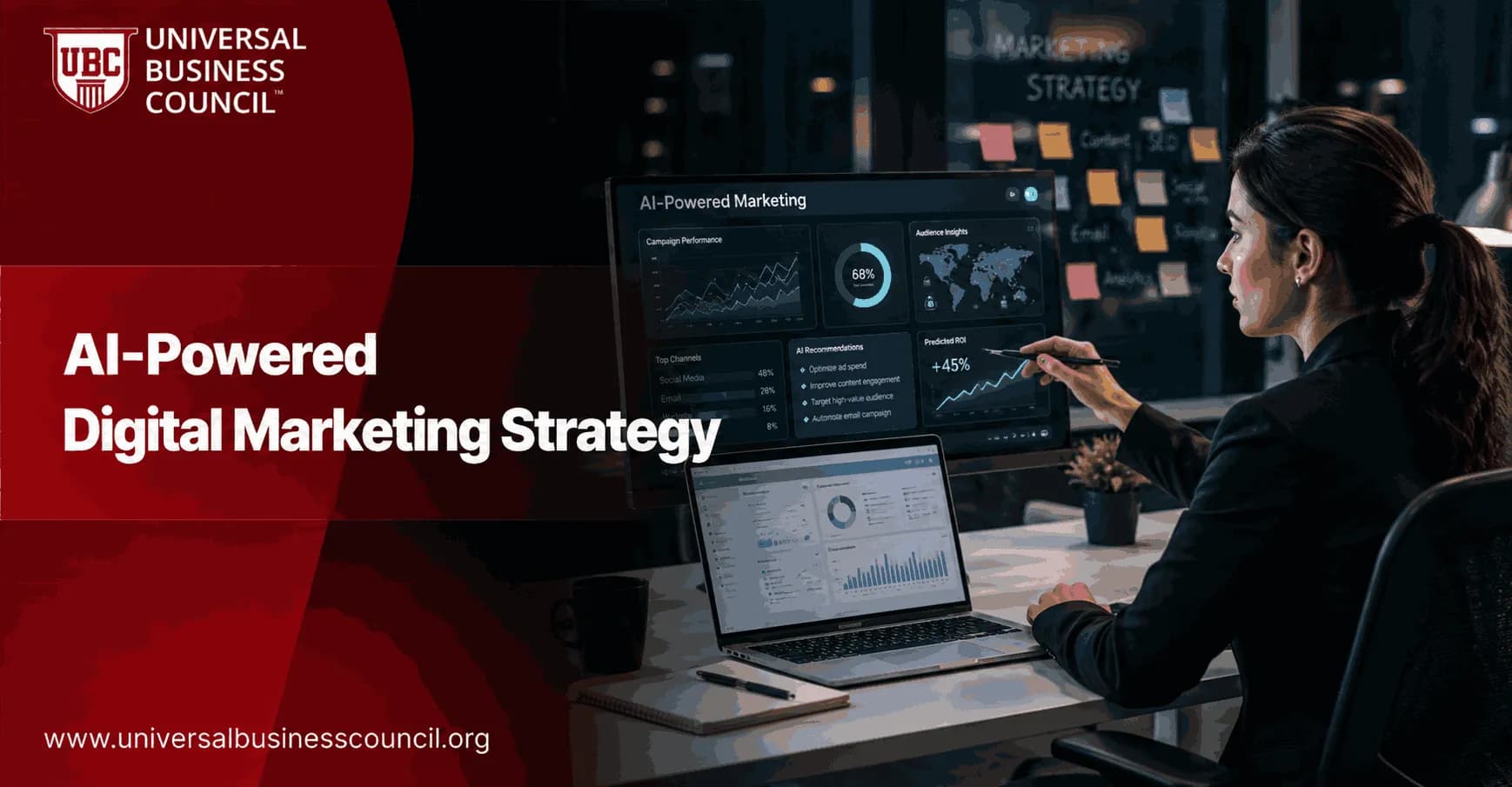
AI-powered digital marketing strategy has moved from experimentation to a core capability for modern teams. Rather than using AI as a set of disconnected tools, leading organizations apply it across the customer journey, from insight and content to bidding, personalization, and retention. The differentiator is not access to models, but a disciplined framework that links business goals, data foundations, tooling, and continuous experimentation, supported by governance and change management.
Why AI-Powered Digital Marketing Is Now a Core Capability
Marketing is one of the business functions with the most to gain from AI because it is data-rich and highly measurable. AI is already embedded in day-to-day marketing work across segmentation, predictive scoring, content generation, media buying, and lifecycle personalization. When implemented with clear objectives and strong data foundations, AI enables faster decisions and real-time optimization at a pace that manual teams cannot reliably match.

AI impact typically appears in three areas:
Performance lift: higher conversion rates and lower customer acquisition cost (CAC) through improved targeting and continuous optimization.
Retention growth: increased customer lifetime value (CLV) from better personalization and timely outreach.
Productivity gains: automation of repetitive work such as follow-ups, lead routing, and reporting, freeing time for strategy and creative direction.
Key Shifts Shaping AI-Powered Digital Marketing Strategy
Search Is Becoming Answer-First
Search and discovery are changing quickly. More than 65% of Google searches reportedly end without a click, meaning users often receive answers directly on the results page. AI Overviews now appear across a significant share of results, and traffic to AI-native answer tools has grown rapidly year over year. The implication is clear: traditional SEO alone is no longer sufficient.
Modern teams should add:
AI search optimization to improve visibility in AI-generated surfaces
Answer engine optimization (AEO) to increase share of answers across platforms where users ask questions and receive synthesized responses
Speed-to-Lead Is a Competitive Advantage
Digital buyers increasingly expect instant responses across channels. Research commonly cited in the industry indicates that responding within five minutes can drive materially higher conversion rates, sometimes up to nine times compared to slower follow-up. This is one reason conversational AI and automated routing have become central to lead generation strategies.
Budgets Are Shifting Toward Tools, Content, and Automation
Many teams are formalizing an AI roadmap that allocates budget across tools, AI-assisted content creation, automation and orchestration, and analytics infrastructure. The exact split varies by maturity, but the pattern reflects a consistent lesson: AI value comes from connecting models to workflows, not from isolated experimentation.
A Step-by-Step AI-Powered Digital Marketing Strategy Framework
This framework is designed for modern marketing teams that need to operationalize AI at scale while maintaining measurement discipline, brand control, and responsible governance.
Step 1: Define Business and Marketing Objectives
Start with outcomes, not tools. Choose objectives that map to measurable business value, then define targets and constraints.
Common objectives: more qualified leads, higher conversion rates, reduced CAC, improved retention and CLV, stronger visibility in AI search and AI Overviews.
Specify: the target metric (MQLs, ROAS, churn rate), baseline, 3-to-12-month goal, and constraints (budget, regions, channels).
Internal capability building supports this stage. Teams often benefit from structured training in digital marketing, marketing strategy, or becoming an AI Powered Digital Marketing Expert through specialized certification pathways that align team skills with strategic objectives.
Step 2: Audit Data, Channels, and Processes
AI amplifies whatever data and process realities already exist. A short, rigorous audit prevents common failure modes such as model outputs built on incomplete tracking or inconsistent definitions.
Data quality and access: unified customer records, consistent event tracking, reliable conversion definitions across CRM, analytics, and ad platforms.
Content and SEO readiness: content structured for question answering, clear expertise signals, and formatting that supports extraction and summarization.
Journey mapping: stages, touchpoints, drop-offs, and the most frequent objections that could be addressed by conversational AI.
Workflow inventory: identify manual bottlenecks in reporting, segmentation, bid adjustments, and lead routing.
Step 3: Prioritize AI Use Cases by Impact and Feasibility
A practical AI-powered digital marketing strategy typically starts with three to five use cases for the first 90 days. Rank candidates by potential impact, feasibility, and time-to-value.
Acquisition
Predictive audience expansion and lookalike modeling
AI-assisted SEO, AEO, and AI search optimization
Automated bid optimization across paid search, paid social, and programmatic channels
Engagement and conversion
Personalized email and on-site experiences by segment and intent
AI chatbots for lead qualification and sales routing
Dynamic landing page content based on behavior and context
Retention and growth
Churn prediction and proactive win-back sequences
Next-best-offer recommendations
Customer health scoring and lifecycle orchestration
Step 4: Choose and Integrate AI Tools Around Your Data Layer
The goal is not the largest martech stack, but an integrated system where insights translate directly into actions. Tool selection should follow your prioritized use cases and your current data reality.
Customer data and analytics: CDP or unified tracking, advanced analytics, dashboards
AI content and SEO: content optimization platforms and generative tools, plus AEO-oriented research capabilities
AI media buying: platform-native bidding automation or independent optimization layers
Conversational AI: chatbots and virtual agents for web and messaging channels
Orchestration and automation: workflow engines to connect signals to actions across channels
Integration principles
Centralize and standardize customer profiles and event data so models act on consistent signals.
Connect decisioning to activation - audiences to ad platforms, segments to email, triggers to lifecycle journeys.
Implement logging and monitoring for outputs, errors, and performance changes over time.
Successfully integrating AI into marketing workflows requires both the right technology and the right skills. Pursuing an AI Certification can help marketing and business professionals understand AI deployment, model capabilities, governance requirements, and best practices for implementing AI-driven solutions at scale.
Step 5: Organize and Prepare Your Data
AI performance is directly constrained by data quality. Before scaling predictive scoring or personalization, invest in a clean, reliable data foundation.
Clean and deduplicate records across systems
Standardize key fields (industry, product, region) and event taxonomies
Unify web, app, CRM, and offline signals where possible
Tag campaigns and content with consistent metadata for measurement and recommendations
Step 6: Automate Repetitive Workflows First
Start with rules-based tasks that reduce cycle time and errors, then expand toward more adaptive automation. This creates immediate value while the team builds operational experience with AI systems.
Automated nurture sequences and follow-ups
Lead scoring and routing to sales
Real-time budget reallocation and bid adjustments
Automated reporting, anomaly detection, and KPI alerts
Step 7: Implement an AI-Native Content Strategy (AEO and Modern SEO)
AI Overviews and answer engines reward content that is structured, direct, and credible. AEO does not replace SEO, but extends it to cover how AI systems select and surface information.
Write for questions: publish clear answers, definitions, step-by-step guidance, comparisons, and FAQs.
Strengthen authority signals: expert authorship, transparent sourcing, and evidence-based claims.
Use AI with human oversight: apply tools for ideation and drafting, then enforce editorial standards and brand voice.
Monitor AI surfaces: track how your brand appears in AI Overviews and answer tools, then refine structure and content accordingly.
Step 8: Measure, Experiment, and Govern
AI-powered marketing requires disciplined measurement and a test-and-learn culture. Define metrics across the funnel and treat experimentation as an ongoing practice.
Top-of-funnel: impressions in AI surfaces, traffic from AI search, audience quality
Mid-funnel: conversion rate by segment, lead quality, time-to-first-response
Bottom-of-funnel: CAC, ROAS, pipeline contribution, CLV
Experience: CSAT, resolution time for AI-assisted support interactions
Governance essentials
Documented guidelines for brand voice, privacy, and human review thresholds
Bias checks and escalation paths for sensitive decisions
Model monitoring and drift detection for predictive and recommendation systems
Step 9: Build Team Capability and Manage Change
Many AI initiatives underperform due to process and people gaps rather than model quality. Preparing the organization to operate AI systems reliably is as important as the technology itself.
Train marketers in AI concepts, prompt discipline, and data literacy
Form cross-functional squads across marketing, data, engineering, and sales
Define clear ownership for prompts, rules, data definitions, and model updates
Certifications in digital marketing, data analytics, product management, and AI and automation can support role-based upskilling and help teams meet governance requirements as AI adoption scales. A recognized Tech Certification can also help professionals validate expertise in emerging technologies and AI-driven business transformation.
Real-World Examples of AI-Powered Marketing in Action
Predictive Scoring and Proactive Outreach
Teams use propensity models to identify high-intent accounts or users and trigger outreach before those prospects actively search. In B2B contexts, predictive lead scoring helps sales teams focus on accounts with higher conversion likelihood, improving efficiency and sales velocity.
Conversational AI for Qualification and Scheduling
AI chatbots are commonly deployed to answer product questions, capture context, route leads, and schedule demos. This supports around-the-clock responsiveness and improves speed-to-lead, particularly in high-volume inbound environments.
Dynamic Creative and Autonomous Bidding
AI-enabled advertising systems increasingly automate bidding, placement, and creative selection in real time. When paired with strong measurement frameworks, this approach can reduce media waste while improving engagement through adaptive messaging.
An AI-Powered Digital Marketing Strategy Is a System, Not a Tool
An effective AI-powered digital marketing strategy is not a single tool or campaign. It is an operating model for growth that combines clear objectives, clean data, integrated tooling, automation, AI-native content and search strategy, and disciplined experimentation. As search becomes answer-first and customers expect instant, personalized interactions, teams that build these capabilities are better positioned to improve CAC, conversion rates, and retention while maintaining responsible governance.
To operationalize this framework, start with a 90-day roadmap of three to five use cases, build measurement and governance from day one, and invest in team capability so AI augments human judgment rather than operating without it.
FAQs
What is an AI-powered digital marketing strategy?
An AI-powered digital marketing strategy uses artificial intelligence to plan, automate, personalize, measure, and improve marketing campaigns across digital channels.
How does AI help in digital marketing?
AI helps marketers analyze customer data, predict behavior, automate tasks, personalize content, optimize ads, and improve campaign performance. Tiny miracle, minus the incense.
Why is AI important for digital marketing?
AI is important because it helps brands make faster decisions, reduce manual work, target audiences more accurately, and improve return on investment.
What are examples of AI in digital marketing?
Examples include chatbots, recommendation engines, predictive analytics, automated email campaigns, AI content tools, ad bidding systems, and customer segmentation.
How can AI improve customer targeting?
AI can study user behavior, purchase history, demographics, and engagement patterns to identify the right audience for each campaign.
What is AI-driven personalization?
AI-driven personalization means using customer data to deliver tailored product recommendations, emails, ads, website content, and offers.
How does AI support content marketing?
AI can help generate topic ideas, draft content, optimize headlines, analyze search intent, repurpose content, and measure content performance.
Can AI improve SEO?
Yes. AI can help with keyword research, content optimization, technical SEO checks, competitor analysis, and search intent mapping.
How does AI help with paid advertising?
AI can optimize ad targeting, bidding, budget allocation, creative testing, audience segmentation, and campaign performance tracking.
What is predictive analytics in marketing?
Predictive analytics uses AI and historical data to forecast customer behavior, campaign results, churn risk, and future sales opportunities.
How can AI improve email marketing?
AI can personalize subject lines, recommend send times, segment audiences, automate follow-ups, and predict which users are likely to engage.
What role do chatbots play in digital marketing?
Chatbots can answer customer questions, collect leads, recommend products, assist with purchases, and provide 24/7 support, because apparently sleep is no longer fashionable.
How does AI help with social media marketing?
AI can schedule posts, analyze trends, recommend content ideas, monitor sentiment, track engagement, and identify influencer opportunities.
What is customer segmentation using AI?
AI customer segmentation groups users based on behavior, interests, purchase patterns, engagement level, and likelihood to convert.
How can AI improve customer experience?
AI improves customer experience by delivering faster responses, personalized recommendations, relevant offers, and smoother digital interactions.
What tools are used in AI-powered digital marketing?
Common tools include AI writing platforms, CRM systems, marketing automation tools, analytics platforms, chatbot builders, SEO tools, and ad optimization platforms.
What are the risks of using AI in digital marketing?
Risks include data privacy issues, inaccurate outputs, biased targeting, over-automation, weak brand voice, and poor decision-making from bad data.
Can small businesses use AI for digital marketing?
Yes. Small businesses can use AI for email automation, content creation, customer support, social media scheduling, SEO, and basic analytics.
How do you measure AI marketing performance?
Performance can be measured using metrics like conversion rate, click-through rate, customer acquisition cost, return on ad spend, engagement rate, and customer lifetime value.
How do you build an AI-powered digital marketing strategy?
Start by defining goals, collecting quality data, choosing the right AI tools, segmenting audiences, personalizing campaigns, testing results, and improving continuously.
Related Articles
View AllDigital Marketing
How AI and Automation Power Programmatic Advertising in Modern Digital Marketing
AI now drives programmatic advertising through automated bidding, targeting, creative optimization, privacy-safe identity, and cross-channel measurement.
Digital Marketing
Building a Full-Funnel Digital Marketing Strategy with Programmatic Advertising
Learn how to build a full-funnel digital marketing strategy with programmatic advertising across awareness, consideration, conversion, and retention.
Digital Marketing
The Role of Data in Programmatic Advertising and Digital Marketing Strategy
Learn how data connects digital marketing strategy with programmatic advertising through targeting, bidding, creative, measurement, and privacy-safe execution.
Trending Articles
The Role of Blockchain in Ethical AI Development
How blockchain technology is being used to promote transparency and accountability in artificial intelligence systems.
AWS Career Roadmap
A step-by-step guide to building a successful career in Amazon Web Services cloud computing.
Top 5 DeFi Platforms
Explore the leading decentralized finance platforms and what makes each one unique in the evolving DeFi landscape.