

Personalization at Scale: How AI Delivers Better Customer Experiences Across Channels
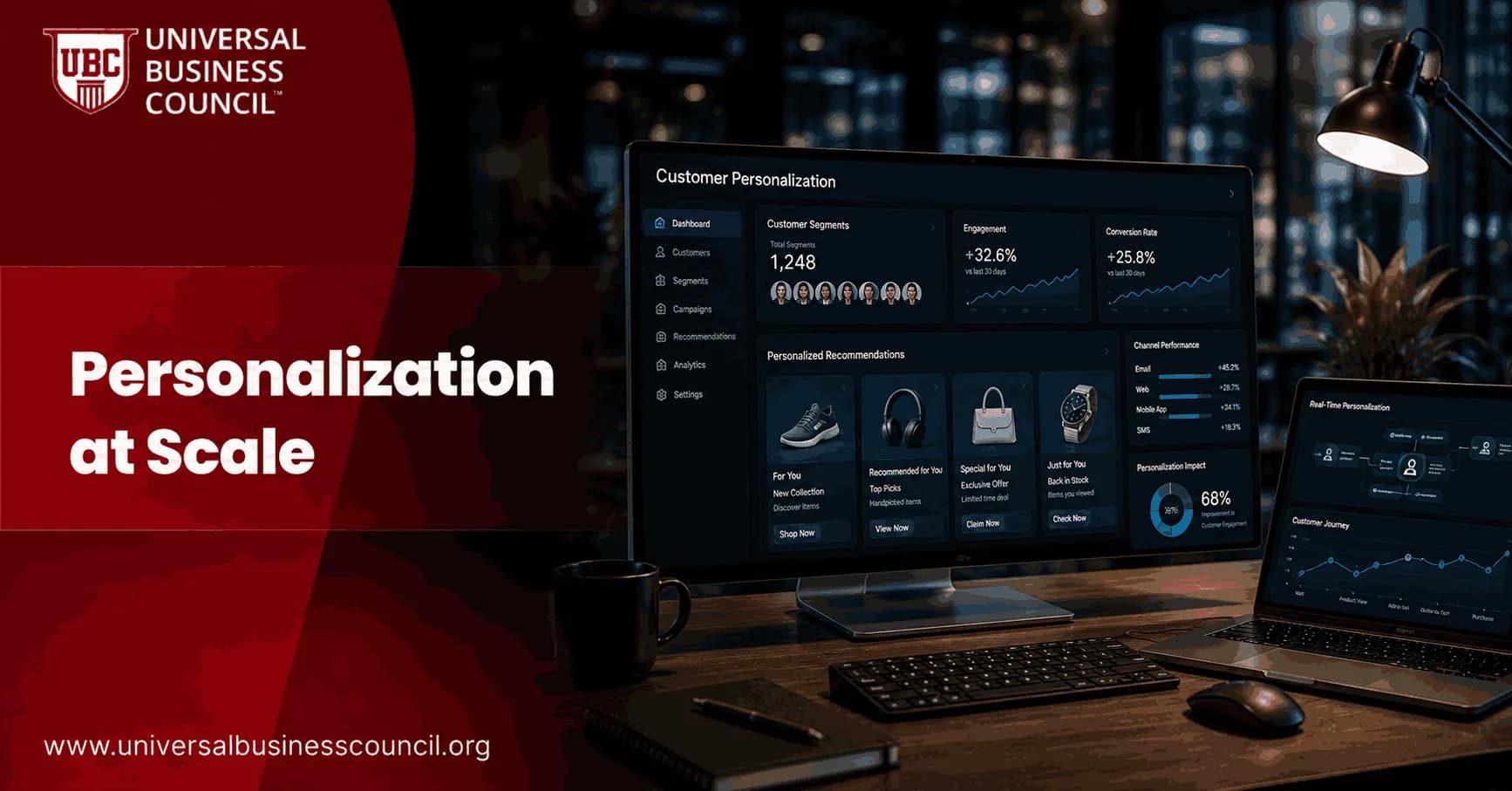
Personalization at scale has become a defining capability in modern digital marketing. Customers now expect brands to recognize their needs, preferences, and context across websites, mobile apps, email, chat, call centers, and physical locations. Artificial intelligence makes this possible by combining machine learning, predictive analytics, natural language processing, generative AI, and real-time decisioning to deliver more relevant experiences to millions of customers without relying on manual segmentation alone.
The business case is clear. McKinsey research reports that 71% of consumers expect personalized interactions, while 76% become frustrated when personalization is absent. The same body of research links effective personalization to revenue increases of 10% to 15%, with some organizations achieving gains from 5% to 25%. McKinsey findings also suggest that personalization can reduce customer acquisition costs by up to 50% and increase marketing return on investment by 10% to 30%.

A Digital Marketing Certification can help professionals develop stronger skills in customer segmentation, personalization strategies, campaign optimization, and performance measurement, enabling them to translate data-driven insights into measurable business growth.
What Personalization at Scale Means Today
Personalization at scale is the ability to adapt content, offers, recommendations, messages, and service interactions for each customer across large audiences and multiple channels. It goes beyond basic segmentation, such as sending one campaign to all customers in a demographic group. Instead, AI-powered personalization uses behavioral, transactional, contextual, and historical data to shape individualized experiences in real time.
Technology providers such as IBM, NICE, Monetate, Adobe, and Braze describe a market shift from campaign-based personalization to dynamic experience orchestration. In this model, every interaction can inform the next. A customer who browses a product on mobile, abandons a cart on desktop, opens an email, and later contacts support should receive a coherent experience rather than four disconnected interactions.
How AI Enables Personalization Across Channels
1. Unified Data and Customer Profiles
AI personalization starts with data. Organizations need to collect, classify, and connect signals from web behavior, purchase history, mobile activity, email engagement, service conversations, social interactions, and offline transactions. Customer Data Platforms, or CDPs, often serve as the foundation by unifying identity, behavior, and transaction data into a single customer profile.
Scaling personalization requires auditing the data landscape, eliminating silos, centralizing data, and applying strong governance. Without this foundation, AI systems may deliver inconsistent, inaccurate, or intrusive experiences. Data governance is especially important because personalization relies on customer trust. Customers may welcome relevance, but they expect security, transparency, and appropriate use of their information.
2. Predictive Analytics and Machine Learning
Once data is unified, machine learning models can identify patterns that are difficult for human teams to detect manually. These models can predict what a customer may need next, which message is most relevant, which offer is likely to convert, or when a customer is at risk of churn.
AI personalization works as a continuous learning process in which models refine outputs as they ingest more data. Predictive analytics, natural language processing, text analysis, and generative AI are core capabilities for improving customer experience personalization. AI is now used across industries to deliver contextually appropriate recommendations at scale.
3. Real-Time Decisioning
Personalization at scale depends on timing as much as targeting. A recommendation that is relevant today may be irrelevant tomorrow. Real-time decisioning allows AI systems to evaluate a customer's current context, such as device, location, page behavior, browsing history, loyalty status, or recent service issue, and determine the next best action.
This may include showing a different homepage layout, changing the order of product recommendations, adjusting a service message, triggering a support workflow, or selecting the most useful email content block. The goal is not simply to personalize more, but to personalize with relevance and restraint.
4. Omnichannel Orchestration
AI-driven customer experience must work across channels, including websites, apps, email, chat, and in-store interactions. Personalization at scale means adapting content, offers, and experiences across millions of profiles and multiple channels.
For marketers, this means the orchestration layer is as important as the recommendation model. A customer should not receive a discount email for a product already purchased, a chatbot should know when a customer has an open support case, and an in-store associate should have access to relevant customer preferences where appropriate and compliant.
The Role of Generative and Agentic AI
One of the historic barriers to personalization at scale has been content volume. Personalized journeys require many versions of copy, visuals, product descriptions, email modules, landing pages, chat responses, and service prompts. Generative AI helps address this bottleneck by producing content variants aligned with customer profiles, campaign goals, and brand guidelines.
Generative and agentic AI are transforming experience orchestration. Generative AI can analyze CDP data and interaction history to create personalized product recommendations, dynamic landing pages, and individualized emails. Agentic AI goes further by supporting more autonomous planning, decisioning, and optimization under human oversight.
Generative AI does not remove the need for governance. Marketing teams must define approval workflows, quality standards, bias checks, brand tone rules, and compliance safeguards. Professionals developing these capabilities may benefit from structured learning paths such as Universal Business Council's digital marketing, marketing analytics, artificial intelligence, and business management certification programs.
Industry Use Cases for AI Personalization at Scale
Retail and E-Commerce
Retail is one of the most visible applications of AI personalization. Examples include homepage customization based on past shopping behavior and the delivery of personalized educational content, product recommendations, and recipes matched to customer preferences. In e-commerce, AI can personalize product recommendations, pricing prompts, email content, and loyalty offers.
Banking and Financial Services
Banks can use AI to analyze transaction history, goals, income patterns, and risk profiles to offer tailored savings guidance, investment suggestions, credit offers, and financial education. Because financial data is sensitive, these use cases require strong governance, explainability, and customer consent practices.
Healthcare
In healthcare, personalization may include treatment reminders, appointment prompts, medication guidance, wellness recommendations, or patient education based on medical history and real-time health signals. The value is high, and so are the ethical and compliance requirements.
Telecommunications and Travel
Telecom companies can personalize service plans, device upgrades, troubleshooting flows, and retention offers. Travel and hospitality brands can tailor destination recommendations, loyalty rewards, itinerary updates, and in-trip assistance based on booking history and current travel context.
Key Challenges and Risks
Despite the benefits, AI personalization at scale is not a plug-and-play capability. Enterprises should address several constraints before expanding implementation:
Data silos: Fragmented systems limit the accuracy and consistency of personalization.
Privacy and compliance: Organizations must manage consent, security, retention, transparency, and regulatory obligations.
Model bias: AI can reinforce unfair patterns if training data is incomplete or skewed.
Over-personalization: Experiences that feel too intrusive can reduce trust, even when they are technically accurate.
Content governance: Generative AI requires human oversight, brand controls, and quality assurance.
Skills gaps: Teams need capabilities in analytics, AI operations, customer experience design, digital marketing, and change management.
These risks reinforce why personalization should be treated as a strategic discipline rather than a collection of isolated tools. Training in areas such as customer analytics, AI for business, strategic marketing, and management can help professionals build the cross-functional expertise required for successful implementation.
Best Practices for Implementing AI Personalization
Start with clear business objectives: Define whether the goal is higher retention, lower acquisition cost, improved conversion, better service, or increased loyalty.
Build a governed data foundation: Unify customer data, resolve identities responsibly, and document data usage policies.
Prioritize high-value journeys: Focus first on journeys where relevance has measurable impact, such as onboarding, cart abandonment, service recovery, renewals, or loyalty engagement.
Use real-time and predictive models carefully: Test recommendations, monitor outcomes, and adjust models continuously.
Maintain human oversight: Apply brand, ethical, legal, and quality controls to AI-generated content and automated decisions.
Measure commercial and experience outcomes: Track revenue lift, conversion, customer lifetime value, churn, acquisition cost, customer satisfaction, and customer effort scores.
The Future of Personalization at Scale
The next phase of personalization will be more predictive, conversational, and autonomous. AI systems are expected to anticipate customer needs with greater accuracy and support hyper-personalized journeys that connect physical and digital experiences. Conversational AI will also play a larger role as chatbots, voice assistants, and virtual agents adapt responses based on customer context.
At the same time, responsible personalization will become a differentiator. Enterprises that combine AI capability with transparent data practices, customer control, and ethical governance will be better positioned to earn trust. The future is not only about more automation. It is about more relevant, respectful, and consistent customer experiences.
Conclusion
Personalization at scale is now central to digital marketing and customer experience strategy. AI enables organizations to unify data, predict customer needs, orchestrate journeys across channels, and create relevant content at volumes that manual teams could not sustain. Evidence from industry research and providers including McKinsey, IBM, Adobe, NICE, Monetate, and others shows that effective personalization is linked to revenue growth, reduced acquisition costs, and stronger marketing return on investment.
For professionals and enterprises, the implication is clear: AI-powered personalization requires more than technology adoption. It demands data governance, analytical skill, customer-centric design, ethical oversight, and continuous learning. Organizations that develop these capabilities will be better prepared to deliver meaningful customer experiences across every channel.
FAQs
1. What Is Personalization at Scale?
Personalization at scale is the ability to deliver customized experiences, content, recommendations, and communications to large numbers of customers simultaneously using data and automation.
2. Why Is Personalization Important in Modern Marketing?
Personalization helps businesses create more relevant customer experiences, increase engagement, improve conversions, and strengthen customer loyalty.
3. How Does AI Enable Personalization at Scale?
AI can analyze vast amounts of customer data, identify patterns, predict preferences, and automate personalized interactions across multiple channels in real time.
4. What Types of Data Are Used for AI-Powered Personalization?
Businesses commonly use demographic data, browsing behavior, purchase history, engagement metrics, location information, customer preferences, and transaction records.
5. How Does AI Improve Customer Understanding?
AI processes customer interactions and behavioral data to uncover insights about interests, needs, purchasing habits, and future intentions.
6. What Is Real-Time Personalization?
Real-time personalization adjusts content, recommendations, and experiences instantly based on a customer's current actions and behavior.
7. How Can AI Personalize Website Experiences?
AI can customize landing pages, product recommendations, content displays, search results, and offers based on individual visitor profiles.
8. How Does AI Enhance Email Marketing Personalization?
AI can personalize subject lines, content, product suggestions, send times, and customer journeys based on subscriber behavior and preferences.
9. What Role Does AI Play in Social Media Personalization?
AI helps tailor content recommendations, advertising experiences, audience targeting, and engagement strategies for specific user groups.
10. How Does AI Improve Product Recommendations?
AI analyzes customer behavior, purchase history, and browsing patterns to suggest products that are most relevant to each individual customer.
11. What Is Predictive Personalization?
Predictive personalization uses AI to anticipate customer needs and preferences before they take action, enabling proactive engagement.
12. How Can AI Support Omnichannel Personalization?
AI can unify customer data across websites, email, mobile apps, social media, customer support, and other channels to create consistent experiences.
13. What Is a Unified Customer Profile?
A unified customer profile combines data from multiple touchpoints into a single view, enabling more accurate and consistent personalization efforts.
14. How Does Personalization Improve Customer Engagement?
Relevant content and tailored experiences are more likely to capture attention, encourage interaction, and increase customer satisfaction.
15. How Can Personalization Increase Conversion Rates?
By presenting the right message, product, or offer at the right time, personalization reduces friction and encourages customer action.
16. What Role Does Machine Learning Play in Personalization?
Machine learning continuously analyzes customer behavior and refines personalization strategies based on new data and evolving preferences.
17. What Challenges Are Associated with Personalization at Scale?
Challenges include data quality issues, privacy concerns, technology integration, maintaining accuracy, and balancing automation with human oversight.
18. How Can Businesses Measure the Success of Personalization Efforts?
Key metrics include engagement rates, conversion rates, customer retention, average order value, customer lifetime value, revenue growth, and customer satisfaction scores.
19. What Common Mistakes Should Businesses Avoid?
Common mistakes include over-personalization, using outdated customer data, ignoring privacy regulations, delivering irrelevant recommendations, and relying entirely on automation. Customers generally appreciate relevance, but they become noticeably less enthusiastic when a brand appears to know more about them than their closest friends.
20. What Is the Future of AI-Driven Personalization?
The future includes hyper-personalized customer journeys, predictive engagement, real-time decision-making, privacy-focused data strategies, and seamless omnichannel experiences. Businesses that successfully combine AI, customer data, and strategic personalization will be better positioned to deliver exceptional customer experiences across every touchpoint.
Related Articles
View All
Digital Marketing
Personalization at Scale: Using AI to Deliver 1:1 Experiences Across Channels
Learn how personalization at scale uses AI, real-time data, and omnichannel orchestration to deliver 1:1 experiences across email, web, SMS, ads, and in-store.

Digital Marketing
Marketing Automation with AI: Building Smarter Customer Journeys Across Email, SMS, and Web
Learn how marketing automation with AI enables real-time orchestration across email, SMS, and web, using next-best-action decisioning and predictive personalization.
Digital Marketing
How Programmatic Advertising Improves Targeting, Personalization, and ROI
Learn how programmatic advertising improves targeting, personalization, and ROI through data, AI bidding, DCO, retargeting, and better measurement.
Trending Articles
The Role of Blockchain in Ethical AI Development
How blockchain technology is being used to promote transparency and accountability in artificial intelligence systems.
AWS Career Roadmap
A step-by-step guide to building a successful career in Amazon Web Services cloud computing.
Top 5 DeFi Platforms
Explore the leading decentralized finance platforms and what makes each one unique in the evolving DeFi landscape.