

How to Measure Success Across SEO, GEO, and AEO Campaigns
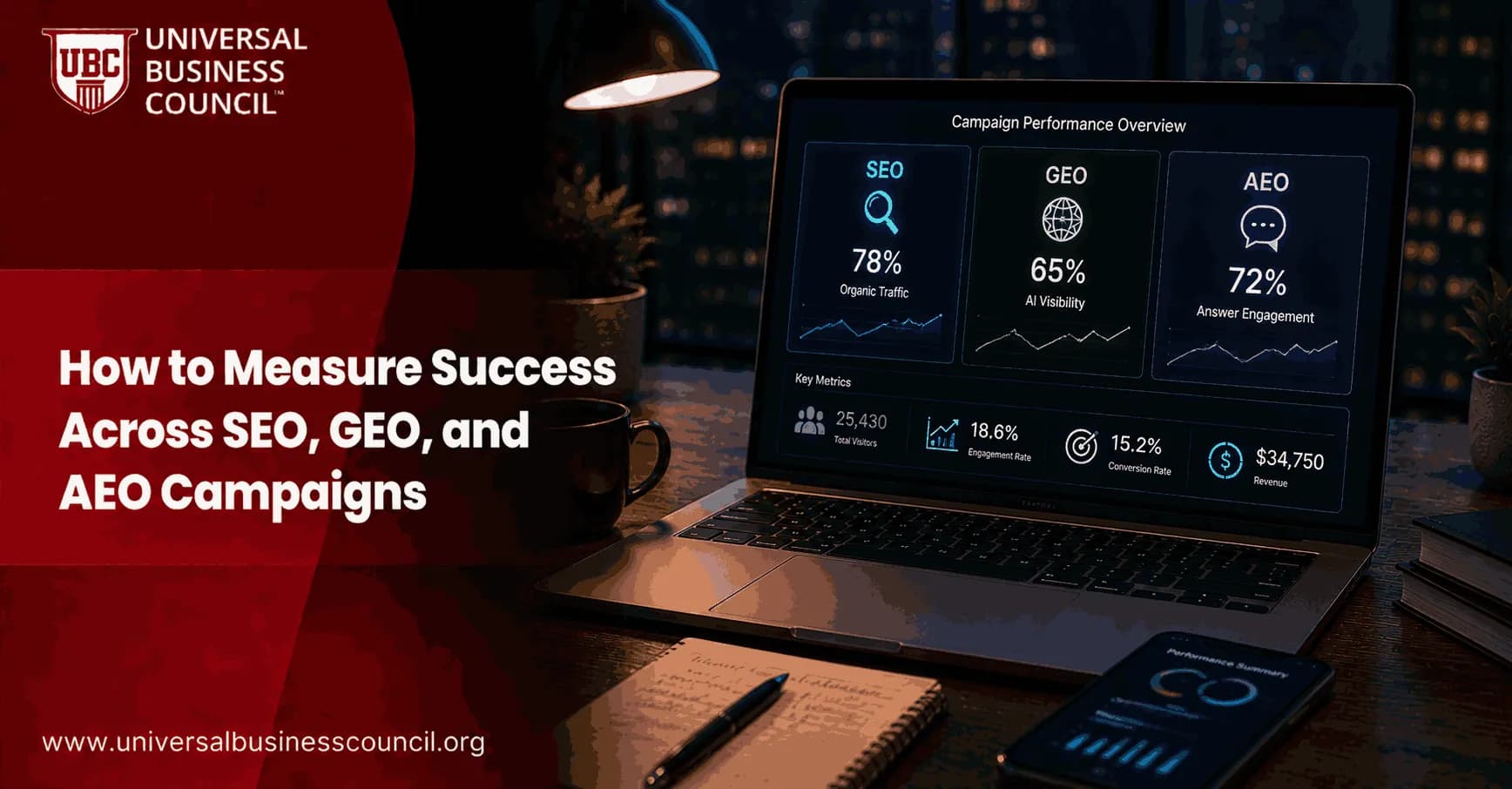
Measuring success across SEO, GEO, and AEO campaigns requires more than tracking rankings and clicks. Search now includes traditional results, featured answers, AI Overviews, voice responses, and generative AI tools such as ChatGPT, Gemini, and Perplexity. A modern measurement framework must connect visibility in all of these environments to pipeline, revenue, customer acquisition, and brand trust.
Google still dominates global search usage, according to Statista, and organic search remains a major traffic source for many websites, as Ahrefs research has repeatedly shown. SparkToro clickstream analysis also indicates that many Google searches end without a website click. Marketers must therefore measure both traffic outcomes and influence outcomes, especially as AI-generated answers reshape how users discover information.

As search evolves beyond traditional rankings, an SEO Expert Certification can help professionals develop expertise in technical SEO, AI search visibility, content optimization, and the measurement frameworks needed to evaluate both traffic and influence across modern search environments.
Understanding SEO, AEO, and GEO Measurement
SEO, AEO, and GEO are connected disciplines, but each requires distinct success metrics.
SEO, or Search Engine Optimization: Measures how well pages rank, attract organic traffic, and convert users from search engines such as Google and Bing.
AEO, or Answer Engine Optimization: Measures how often content is used in featured snippets, People Also Ask results, knowledge panels, AI Overviews, and voice answers.
GEO, or Generative Engine Optimization: Measures how often a brand is mentioned, cited, or recommended inside generative AI tools and conversational search experiences.
The Digital Marketing Institute and Hibu describe these as complementary layers. SEO provides the technical and content foundation. AEO builds answer-level visibility. GEO extends brand presence into AI-generated responses, where users increasingly compare options and make decisions.
A Unified Framework for SEO, GEO, and AEO Campaigns
The most reliable way to measure success is to start with business outcomes, then map channel-specific KPIs to those outcomes. This approach prevents teams from celebrating visibility that does not support growth.
1. Define Business Outcomes First
Before choosing metrics, clarify what the campaign must influence. Common goals include:
Qualified organic leads
Marketing-sourced pipeline
Revenue from organic or AI-influenced journeys
Lower customer acquisition cost
Higher branded search demand
Greater authority in a target category
For professionals building capability in this area, Universal Business Council programmes such as the Digital Marketing Certification, Marketing Analytics Certification, and SEO-focused training modules offer structured pathways for deeper study.
2. Separate Leading and Lagging Indicators
Leading indicators show whether visibility is improving. Lagging indicators show whether that visibility produces business value.
Leading indicators: Rankings, impressions, featured snippet ownership, AI citation frequency, answer inclusion rate, and share of voice.
Lagging indicators: Leads, conversions, revenue, pipeline, customer acquisition cost, retention, and brand lift.
Lumar recommends treating AI citations, answer visibility, and brand mentions as early signals, then validating them against downstream performance.
How to Measure SEO Success
SEO remains the foundation because search engines, AI tools, and answer engines all rely on accessible, authoritative, and well-structured content.
Core SEO KPIs
Use a balanced SEO dashboard that includes technical, visibility, traffic, and revenue metrics.
Technical performance: Index coverage, crawl errors, Core Web Vitals, mobile usability, page speed, canonical issues, and structured data validity.
Visibility: Keyword rankings, impressions, click-through rate, and topic-level share of voice.
Traffic and engagement: Organic sessions, users, scroll depth, engaged sessions, bounce rate, and returning visitors.
Conversions: Form submissions, demo requests, ecommerce transactions, newsletter sign-ups, assisted conversions, and revenue from organic sessions.
Google Search Console, Bing Webmaster Tools, analytics platforms, rank tracking tools, and CRM attribution reports should be reviewed together. Rankings alone are insufficient, because high visibility may not translate into qualified demand.
Advanced SEO Metrics That Support AEO and GEO
Modern SEO measurement should also include signals that make content easier for answer engines and generative systems to interpret.
Structured data coverage for FAQ, HowTo, product, review, article, and organization schema
Rich result appearances and enhancement reports
Branded versus non-branded search growth
Entity associations in knowledge panels and search results
Topical authority across content clusters
These metrics matter because AI systems tend to favour content that is clear, authoritative, well-cited, and semantically consistent.
How to Measure AEO Success
AEO focuses on becoming the source behind direct answers. Since many answer experiences produce zero-click outcomes, AEO measurement must go beyond website sessions.
AEO Visibility Metrics
Track the extent to which your content appears in answer-based search features.
Featured snippet ownership: The percentage of target questions where your page owns the featured snippet.
Snippet stability: How long your page keeps the answer position before competitors replace it.
People Also Ask coverage: The number of related questions where your content appears or supports an answer.
Rich result visibility: Frequency of FAQ, product, review, and HowTo results.
AI Overview inclusion: Impressions and clicks from Google Search Console where AI Overview reporting is available.
Voice answer share: Whether voice assistants use your content for priority questions.
Search Engine Journal has noted that answer-focused visibility increasingly depends on concise formatting, structured data, entity clarity, and direct responses to user intent.
AEO Quality Metrics
Visibility alone is not enough. AEO success also depends on accuracy and narrative control.
Does the answer describe your brand correctly?
Is pricing, product information, or service scope accurate?
Is the tone aligned with your positioning?
Are outdated claims or unsupported statements appearing?
Review answer outputs regularly, especially for high-value commercial and comparison queries. Incorrect answers can influence buyers before they ever reach your website.
How to Measure GEO Success
GEO is less mature than SEO and AEO because most generative AI platforms provide limited analytics. Measurement therefore relies on prompt testing, citation tracking, referral analysis, and qualitative attribution.
Core GEO Metrics
Leading GEO metrics include:
AI citation frequency: How often AI tools cite, link to, or reference your content.
Answer inclusion rate: The percentage of relevant prompts where your brand appears.
Prompt coverage: Visibility across buyer questions, category searches, comparison prompts, and use-case queries.
AI share of voice: How often your brand appears compared with competitors.
Brand mentions without links: Mentions that influence awareness even when no referral traffic is passed.
Topic association strength: Whether AI tools consistently connect your brand with the subjects you want to own.
Jasper and Core dna both emphasise that trusted, expert-led, data-backed content is more likely to be reused or cited by generative systems.
Build a Prompt Library
A practical GEO workflow starts with a repeatable prompt set. Include prompts that reflect real customer behaviour, such as:
Best tools for a specific business problem
Alternatives to a known competitor
Vendor comparisons
How to choose a provider in your category
Questions about pricing, implementation, integrations, or compliance
Test these prompts monthly in ChatGPT, Gemini, Perplexity, Copilot, and other relevant tools. Record the brands mentioned, the order of mentions, cited sources, sentiment, and whether your content is linked.
As AI visibility monitoring becomes a more important part of search strategy, a Tech Certification can help professionals strengthen their understanding of analytics platforms, AI tools, data interpretation, and the technical systems used to measure and improve digital visibility.
Connect GEO to Traffic and Conversions
Because AI platforms do not always pass referral data, combine several signals:
Referral traffic from AI tools when available
Direct traffic spikes that correlate with increased AI citations
Branded search growth after AI visibility improves
CRM fields that capture self-reported sources such as ChatGPT or Gemini
Follow-up questions that ask prospects what prompt they used
Close rates and deal sizes for AI-influenced leads
Self-reported attribution is especially useful for B2B and enterprise purchases, where buyers may research privately in AI tools before contacting sales.
Creating an Integrated Reporting Dashboard
An effective dashboard should show how SEO, AEO, and GEO work together rather than reporting them in silos.
Recommended Dashboard Sections
Business results: Revenue, pipeline, leads, conversion rate, and customer acquisition cost.
SEO performance: Rankings, impressions, organic sessions, technical health, and organic conversions.
AEO performance: Featured snippets, People Also Ask visibility, rich results, AI Overview inclusion, and answer accuracy.
GEO performance: AI citation frequency, answer inclusion rate, prompt coverage, AI share of voice, and AI-attributed leads.
Brand impact: Branded search volume, direct traffic, share of voice, sentiment, and qualitative feedback.
This structure helps executives see how visibility translates into commercial outcomes, while giving marketing teams enough detail to improve content, technical SEO, and authority signals.
Best Practices for Reliable Measurement
Use consistent prompt sets: Changing prompts too often makes GEO trends difficult to interpret.
Segment by funnel stage: Measure informational, comparison, and purchase-intent queries separately.
Track competitors: Share of voice is more useful when benchmarked against named alternatives.
Review answer accuracy: Incorrect AI or snippet descriptions can harm trust.
Combine analytics with human feedback: Technical attribution alone misses many AI-influenced journeys.
Invest in E-E-A-T signals: Expert authorship, original research, transparent citations, and updated content support SEO, AEO, and GEO performance.
As AI-powered search and discovery continue to evolve, an AI Certification can help professionals build expertise in AI systems, generative search behavior, prompt evaluation, and the strategies needed to improve visibility across modern search and AI platforms.
Conclusion
To measure success across SEO, GEO, and AEO campaigns, organisations need a unified framework that links traditional search visibility, answer ownership, and AI citation presence to business outcomes. SEO still provides the foundation, but AEO and GEO reveal how users now discover brands in zero-click and AI-mediated environments.
The most effective measurement systems combine rankings, traffic, featured snippets, AI citation frequency, answer inclusion rate, branded demand, self-reported attribution, and revenue impact. For marketing professionals, strengthening these skills through Universal Business Council digital marketing, SEO, and analytics certifications can support more disciplined, evidence-based campaign measurement as search continues to change.
FAQs
1. What Does Success Mean Across SEO, GEO, and AEO Campaigns?
Success across SEO, GEO, and AEO campaigns means improving visibility, authority, engagement, conversions, and business outcomes across traditional search engines, AI-powered search platforms, and answer-based search experiences.
2. Why Is Measurement Important for SEO, GEO, and AEO?
Measurement helps marketers understand performance, identify opportunities, optimize strategies, and demonstrate the business value of search visibility efforts.
3. What Is SEO Measurement?
SEO measurement focuses on tracking website performance in traditional search engines through rankings, traffic, engagement, and conversion metrics.
4. What Is GEO Measurement?
GEO measurement focuses on monitoring how often content is referenced, cited, summarized, or surfaced by AI-powered search engines and generative AI systems.
5. What Is AEO Measurement?
AEO measurement focuses on evaluating visibility within featured snippets, answer boxes, voice search results, AI answers, and other answer-focused search experiences.
6. Which SEO Metrics Are Most Important?
Key SEO metrics include organic traffic, keyword rankings, click-through rates, impressions, conversions, backlinks, and organic revenue.
7. What GEO Metrics Should Marketers Track?
Important GEO metrics include AI citations, AI-generated answer visibility, brand mentions in AI responses, referral traffic from AI platforms, and entity recognition.
8. What AEO Metrics Should Be Monitored?
AEO metrics often include featured snippet ownership, answer box appearances, voice search visibility, FAQ performance, and direct-answer placements.
9. How Can Organic Traffic Be Used to Measure SEO Success?
Organic traffic shows how effectively a website attracts visitors from search engines and remains one of the most important SEO performance indicators.
10. Why Are Conversions More Important Than Rankings Alone?
High rankings are valuable only if they contribute to meaningful business outcomes such as leads, sales, subscriptions, or customer acquisition.
11. How Can Businesses Track AI Citations for GEO?
Businesses can monitor AI search platforms, generative AI responses, brand mentions, and AI-generated references to assess citation visibility.
12. What Is Featured Snippet Ownership?
Featured snippet ownership refers to content being selected as the highlighted answer displayed prominently in search results.
13. How Does Brand Visibility Contribute to GEO Success?
Even when users do not click through to a website, brand visibility within AI-generated responses can increase awareness, trust, and future demand.
14. Why Is Branded Search Volume an Important Metric?
An increase in branded searches often indicates growing brand recognition, authority, and visibility resulting from search and AI-driven exposure.
15. How Can Businesses Measure E-E-A-T Improvements?
Indicators may include improved rankings, stronger backlink profiles, increased mentions from trusted sources, higher engagement, and greater brand authority.
16. What Role Does Engagement Play in Measuring Success?
Metrics such as time on page, pages per session, return visits, and content interactions help assess whether users find content valuable.
17. How Can Attribution Be Applied to SEO, GEO, and AEO?
Attribution models help connect search visibility efforts to business outcomes by identifying how search interactions contribute to conversions and revenue.
18. What Tools Can Be Used to Measure SEO, GEO, and AEO Performance?
Common tools include Google Search Console, Google Analytics, Ahrefs, SEMrush, AI visibility monitoring platforms, brand monitoring tools, and analytics dashboards.
19. What Common Measurement Mistakes Should Marketers Avoid?
Common mistakes include focusing only on rankings, ignoring conversions, failing to track AI visibility, overlooking brand impact, and measuring channels in isolation. Modern search success is increasingly about influence, not just clicks, which makes old reporting habits feel slightly outdated.
20. What Is the Best Framework for Measuring SEO, GEO, and AEO Success?
The best framework combines visibility metrics (rankings, citations, answer placements), engagement metrics (traffic, interactions, brand searches), and business metrics (leads, conversions, revenue, customer acquisition). By evaluating all three areas together, marketers can gain a complete view of how SEO, GEO, and AEO contribute to digital growth and long-term business success.
Related Articles
View All
Digital Marketing
Building an AI-Ready Content Strategy with SEO, GEO, and AEO
Learn how to build an AI-ready content strategy by integrating SEO, GEO, and AEO to improve search visibility, AI citations, and trusted answers.

Digital Marketing
From Keywords to AI Answers: How SEO, GEO, and AEO Shape Online Visibility
Explore how SEO, GEO, and AEO shape online visibility as search evolves from keyword rankings to AI-generated answers, citations, and trust signals.
Digital Marketing
SEO, GEO, and AEO Explained: A Practical Guide for Marketers and Business Leaders
Learn how SEO, AEO, and GEO work together to improve rankings, direct answers, and AI citations, with practical steps for modern marketing teams.
Trending Articles
The Role of Blockchain in Ethical AI Development
How blockchain technology is being used to promote transparency and accountability in artificial intelligence systems.
AWS Career Roadmap
A step-by-step guide to building a successful career in Amazon Web Services cloud computing.
Top 5 DeFi Platforms
Explore the leading decentralized finance platforms and what makes each one unique in the evolving DeFi landscape.