

Building an AI-Ready Content Strategy with SEO, GEO, and AEO
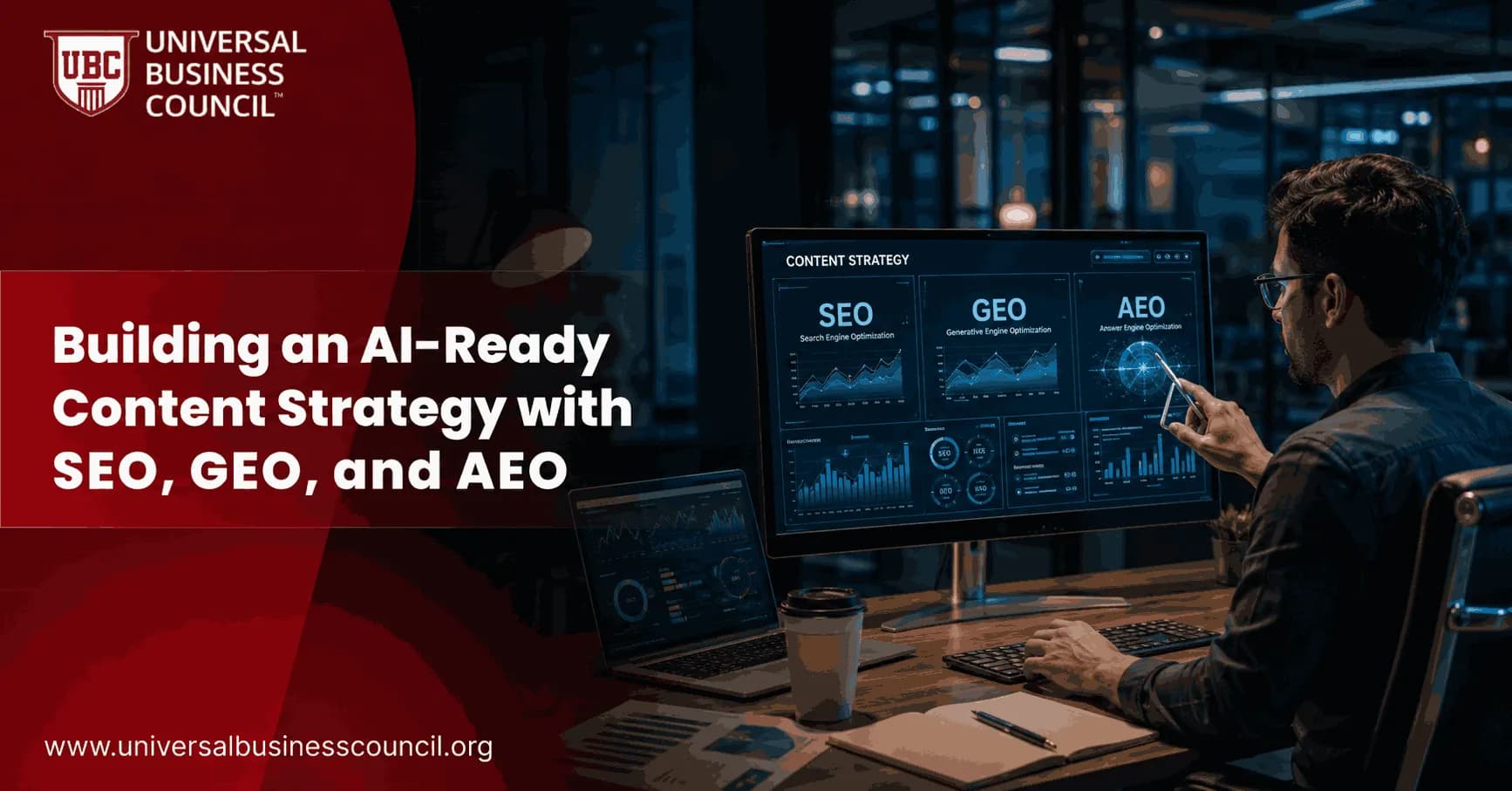
An AI-ready content strategy is no longer limited to ranking in traditional search results. It must help search engines, answer engines, and generative AI assistants crawl, interpret, summarize, and cite your content accurately. This means integrating Search Engine Optimization, Generative Engine Optimization, and Answer Engine Optimization into one practical operating model.
For marketing leaders, content teams, business strategists, and technology professionals, this shift changes how visibility is earned. Google Search Central continues to emphasize crawlability, structured data, helpful content, and trustworthy expertise. Industry research from organizations such as CXL, Lumar, Writer, Jasper, and ToTheWeb shows that AI visibility now depends on being referenced inside AI-generated answers, not only on winning clicks from search listings.

An SEO Expert Certification can help professionals build expertise in technical SEO, AI search optimization, content strategy, and visibility measurement, enabling them to adapt to a search environment where rankings, citations, and answer-based discovery all influence success.
What SEO, GEO, and AEO Mean
SEO: Search Engine Optimization
SEO is the practice of improving a website so search engines can crawl, index, understand, and rank its content. It includes technical health, content relevance, internal linking, authority, user experience, and performance.
GEO: Generative Engine Optimization
Generative Engine Optimization focuses on making content usable as a reliable source for AI systems such as ChatGPT, Gemini, Perplexity, and AI-powered search experiences. The goal is not only to appear in search results, but to be retrieved, summarized, and cited when an AI assistant answers a user question.
AEO: Answer Engine Optimization
Answer Engine Optimization is the discipline of structuring content so it can be used in direct answers, featured snippets, AI Overviews, voice search, and other answer-led experiences. AEO rewards content that provides concise, accurate, well-structured responses to specific questions.
The most effective approach is not SEO versus GEO versus AEO. It is an integrated model where technical SEO creates access, E-E-A-T builds trust, and structured content helps both search engines and AI systems extract the right answer.
Why AI Search Changes Content Strategy
AI search is conversational, multi-turn, and intent-layered. A user may begin with a broad question, then ask follow-ups about comparisons, implementation steps, costs, risks, or best practices. Lumar describes this as a shift from keyword-first planning to layered query intent, where content should answer the initial question and the next several logical questions.
This creates two major implications:
Informational clicks may decline: AI Overviews and answer engines can satisfy simple informational queries without a website visit.
Citations become visibility assets: Brands must compete to be named, cited, or summarized in AI-generated answers.
CXL has framed this shift clearly: traditional SEO often builds guides to capture clicks, while GEO and AEO optimize for citations within AI answers. This does not make traffic irrelevant. It means content teams need a wider measurement model that includes rankings, clicks, conversions, AI citations, and conversational brand presence.
An AI Certification can help professionals develop a deeper understanding of generative AI, answer engines, prompt-driven discovery, and the measurement frameworks needed to evaluate visibility across both traditional search and AI-powered platforms.
The Foundations of an AI-Ready Content Strategy
1. Maintain strong technical SEO
Generative systems cannot use content they cannot access or understand. Google guidance on generative AI features reinforces that traditional SEO fundamentals remain essential. Technical readiness should include:
Clean crawlability and indexability
XML sitemaps and logical site architecture
Fast page speed and mobile-first performance
Structured data such as Article, FAQ, HowTo, Product, Organization, Course, and VideoObject schema where relevant
Clear internal linking between related pages
Resolved 404 errors, redirect chains, and duplicate content issues
For professionals building capability in this area, Universal Business Council programs in digital marketing, marketing management, and business strategy offer structured training in modern marketing operations.
2. Build E-E-A-T into every content asset
E-E-A-T stands for Experience, Expertise, Authoritativeness, and Trust. It matters because AI systems and search engines both need signals that content is reliable. WG Content highlights practical indicators such as real author bios, credentials, reputable references, editorial review labels, and evidence of human expertise.
To strengthen E-E-A-T:
Add author names, roles, and credentials to important articles
Include reviewer information for specialized topics such as finance, health, law, or technical guidance
Use original research, practitioner insights, and real examples
Refresh statistics, examples, and recommendations regularly
Make ownership, brand identity, and editorial standards transparent
In an AI-heavy environment, generic content is easy to produce and easy to ignore. Human expertise, direct experience, and original analysis are stronger differentiators.
3. Structure content for extraction and synthesis
AI systems favor content that is clear, chunked, and semantically organized. This does not mean writing for machines at the expense of humans. It means making information easy for both to understand.
Use the following formats consistently:
Answer-first introductions: Give a direct answer before expanding into detail.
Clear heading hierarchy: Use H2 and H3 headings that reflect questions, tasks, and subtopics.
Short paragraphs: Keep ideas focused and scannable.
Bullets and numbered steps: Make processes, checklists, and comparisons easy to parse.
Tables where useful: Summarize options, features, risks, and decision criteria.
HTML-first publishing: Avoid hiding key information inside PDFs or images without crawlable text.
Google, Writer, ToTheWeb, and other industry sources consistently point to structured data and scannable formatting as important for AI-powered discovery.
Designing for Conversational Intent
A strong AI-ready content strategy maps the full conversation, not just a single keyword. For each priority topic, identify:
The primary user question
The likely follow-up questions
The comparison or decision criteria users may ask about
The objections, risks, or implementation issues they need resolved
The next action they may take after receiving an answer
For example, a user searching for how to build a content strategy for AI search may later ask:
What is the difference between SEO, GEO, and AEO?
How do I measure AI citations?
What schema should I use?
How often should AI content be updated?
Which content types still generate clicks?
Your page should answer the main question, then guide the reader through these related questions. Internal links act as conversational bridges. A hub page on AI-ready content strategy can link to related resources on technical SEO, content governance, brand authority, analytics, and professional certification pathways such as a digital marketing certification or business management certification from Universal Business Council.
Content Formats That Support SEO, GEO, and AEO
Different formats serve different visibility goals. A practical content portfolio should include:
Definition pages: Useful for AEO and featured answers.
Step-by-step guides: Strong for instructional queries and AI summaries.
Comparison pages: Valuable because users still click when making decisions.
Original research: High-value for citations and authority building.
Expert interviews: Useful for E-E-A-T and differentiated insight.
Video with transcripts: Helpful for accessibility, video SEO, and machine-readable context.
Topic hubs: Effective for building topical authority and helping AI systems understand relationships between pages.
EAB has emphasized long-form guides, topic clusters, video transcripts, and mobile-first usability as durable SEO practices in higher education. The same principles apply across B2B, technology, professional services, and enterprise content programs.
A Tech Certification can help professionals develop a stronger understanding of digital platforms, search technologies, analytics systems, and the technical foundations that support scalable content strategies and long-term SEO performance.
Measurement: From Rankings to AI Visibility
Traditional SEO metrics remain important, including organic traffic, rankings, conversions, engagement, index coverage, and Core Web Vitals. On their own, however, they are no longer enough.
Modern teams should also track GEO and AEO indicators such as:
AI citation rate: How often your brand or domain is cited by ChatGPT, Gemini, Perplexity, or Google AI Overviews for priority queries.
Conversational brand endurance: Whether your brand remains cited across follow-up questions in a multi-turn AI conversation.
Share of AI answer presence: How often your competitors are cited compared with your brand.
Answer quality alignment: Whether AI-generated summaries represent your expertise accurately.
Click-preserving content performance: How comparison pages, pricing pages, and use-case content perform when simple informational clicks decline.
A practical audit can begin with your top 20 informational and commercial queries. Run them through major AI assistants and AI search experiences. Note which sources are cited, how those sources structure their answers, and where your content falls short in clarity, depth, schema, or authority.
A Practical Roadmap for Implementation
Organizations can build an AI-ready content strategy by following a structured roadmap:
Audit technical foundations: Review crawlability, indexability, speed, mobile usability, structured data, and internal links.
Inventory existing content: Group assets by topic cluster and identify gaps in E-E-A-T, freshness, and structure.
Map AI-era journeys: Define primary questions and likely follow-ups for each audience segment.
Redesign templates: Standardize answer-first introductions, FAQs, schema, author bios, and structured sections.
Strengthen expertise: Involve subject-matter experts, practitioners, and credentialed reviewers.
Expand distributed authority: Encourage legitimate mentions through partners, communities, expert commentary, and reputable industry platforms.
Measure AI presence: Track citations, conversational persistence, and brand representation across AI tools.
Refresh continuously: Update facts, consolidate outdated pages, and adapt to new search guidance.
Conclusion: Build for Search, Answers, and AI Trust
An AI-ready content strategy is not a replacement for SEO. It is the evolution of SEO into a broader visibility system that includes GEO and AEO. The organizations that succeed will be those that combine technical excellence, structured content, trustworthy expertise, conversational intent mapping, and new measurement frameworks.
For professionals and enterprises, this is also a capability-building challenge. Teams need to understand search fundamentals, AI-driven discovery, content governance, analytics, and brand authority. Universal Business Council certifications and courses in digital marketing, business management, and marketing strategy can support the skills required to lead this transition responsibly.
The future of content visibility will be shaped by more than rankings. It will depend on whether your brand is understood, trusted, summarized accurately, and cited when customers ask AI systems for guidance.
FAQs
1. What Is an AI-Ready Content Strategy?
An AI-ready content strategy is a content approach designed to perform well across traditional search engines, AI-powered search platforms, answer engines, and conversational AI systems.
2. Why Is an AI-Ready Content Strategy Important?
As users increasingly rely on AI-generated answers, voice assistants, and conversational search experiences, businesses must ensure their content remains discoverable and authoritative.
3. What Are SEO, GEO, and AEO?
SEO (Search Engine Optimization) improves visibility in traditional search results, GEO (Generative Engine Optimization) improves AI citation opportunities, and AEO (Answer Engine Optimization) focuses on direct-answer visibility.
4. How Do SEO, GEO, and AEO Work Together?
SEO provides search visibility, GEO helps content become a trusted AI source, and AEO increases the likelihood of appearing as a direct answer in search and AI platforms.
5. What Is the Foundation of an AI-Ready Content Strategy?
The foundation is creating high-quality, user-focused content that addresses real questions, solves problems, and demonstrates expertise.
6. Why Is User Intent Critical for AI-Ready Content?
Search engines and AI systems prioritize content that best satisfies user needs, making intent-focused content essential for visibility.
7. How Should Keyword Research Evolve for AI Search?
Keyword research should expand beyond keywords to include user questions, conversational phrases, entities, topics, and search intent.
8. What Types of Content Perform Best Across SEO, GEO, and AEO?
FAQs, how-to guides, tutorials, case studies, research reports, comparison articles, expert insights, and comprehensive resource pages perform well.
9. How Important Is Content Structure in an AI-Ready Strategy?
Well-structured content with headings, lists, summaries, FAQs, and concise answers is easier for search engines and AI systems to understand.
10. What Role Does E-E-A-T Play in AI-Ready Content?
Experience, Expertise, Authoritativeness, and Trustworthiness help establish credibility and improve the likelihood of ranking, citation, and answer selection.
11. How Can Businesses Demonstrate Experience in Content?
Businesses can include case studies, firsthand insights, real-world examples, original research, and practical expertise within their content.
12. Why Is Topical Authority Important?
Topical authority signals deep expertise within a subject area, making content more likely to be trusted by search engines and AI systems.
13. How Does Structured Data Support AI-Ready Content?
Structured data helps search engines and AI systems understand entities, relationships, content types, and key information more effectively.
14. What Is the Role of FAQs in AEO?
FAQs provide direct answers to common questions, making content more suitable for featured snippets, voice search, and AI-generated responses.
15. How Can Businesses Increase Their Chances of Being Cited by AI Systems?
Organizations can publish authoritative content, maintain factual accuracy, cover topics comprehensively, and build strong trust signals across their websites.
16. How Does Technical SEO Support an AI-Ready Content Strategy?
Technical SEO ensures content can be crawled, indexed, understood, and surfaced efficiently by search engines and AI-powered systems.
17. What Metrics Should Be Used to Evaluate an AI-Ready Content Strategy?
Key metrics include organic traffic, rankings, AI citations, featured snippets, answer visibility, engagement, leads, conversions, and branded search volume.
18. What Common Mistakes Should Be Avoided?
Common mistakes include creating content solely for keywords, ignoring user intent, publishing generic articles, neglecting technical SEO, and failing to update content regularly. AI systems are becoming increasingly skilled at recognizing content written merely to exist rather than content written to help.
19. How Can AI Tools Support Content Strategy Development?
AI tools can assist with keyword research, content planning, topic clustering, audience analysis, content optimization, competitive research, and performance monitoring.
20. What Is the Best Approach to Building an AI-Ready Content Strategy?
The best approach combines SEO, GEO, and AEO into a unified framework that prioritizes user intent, authoritative content, technical excellence, structured data, and E-E-A-T principles. By creating content that is valuable to both humans and AI systems, businesses can strengthen visibility, build trust, and remain competitive in the evolving search landscape.
Related Articles
View All
Digital Marketing
The Future of Search: Integrating SEO, GEO, and AEO into One Digital Strategy
Learn how SEO, GEO, and AEO converge into one integrated search strategy for AI Overviews, answer engines, generative platforms, and zero-click search.
Digital Marketing
How to Measure Success Across SEO, GEO, and AEO Campaigns
Learn how to measure SEO, GEO, and AEO campaign success with unified KPIs for rankings, answer visibility, AI citations, conversions, and revenue.

Digital Marketing
From Keywords to AI Answers: How SEO, GEO, and AEO Shape Online Visibility
Explore how SEO, GEO, and AEO shape online visibility as search evolves from keyword rankings to AI-generated answers, citations, and trust signals.
Trending Articles
The Role of Blockchain in Ethical AI Development
How blockchain technology is being used to promote transparency and accountability in artificial intelligence systems.
AWS Career Roadmap
A step-by-step guide to building a successful career in Amazon Web Services cloud computing.
Top 5 DeFi Platforms
Explore the leading decentralized finance platforms and what makes each one unique in the evolving DeFi landscape.