

AEO vs SEO: How to Optimize Content for Answer Engines and Search Engines
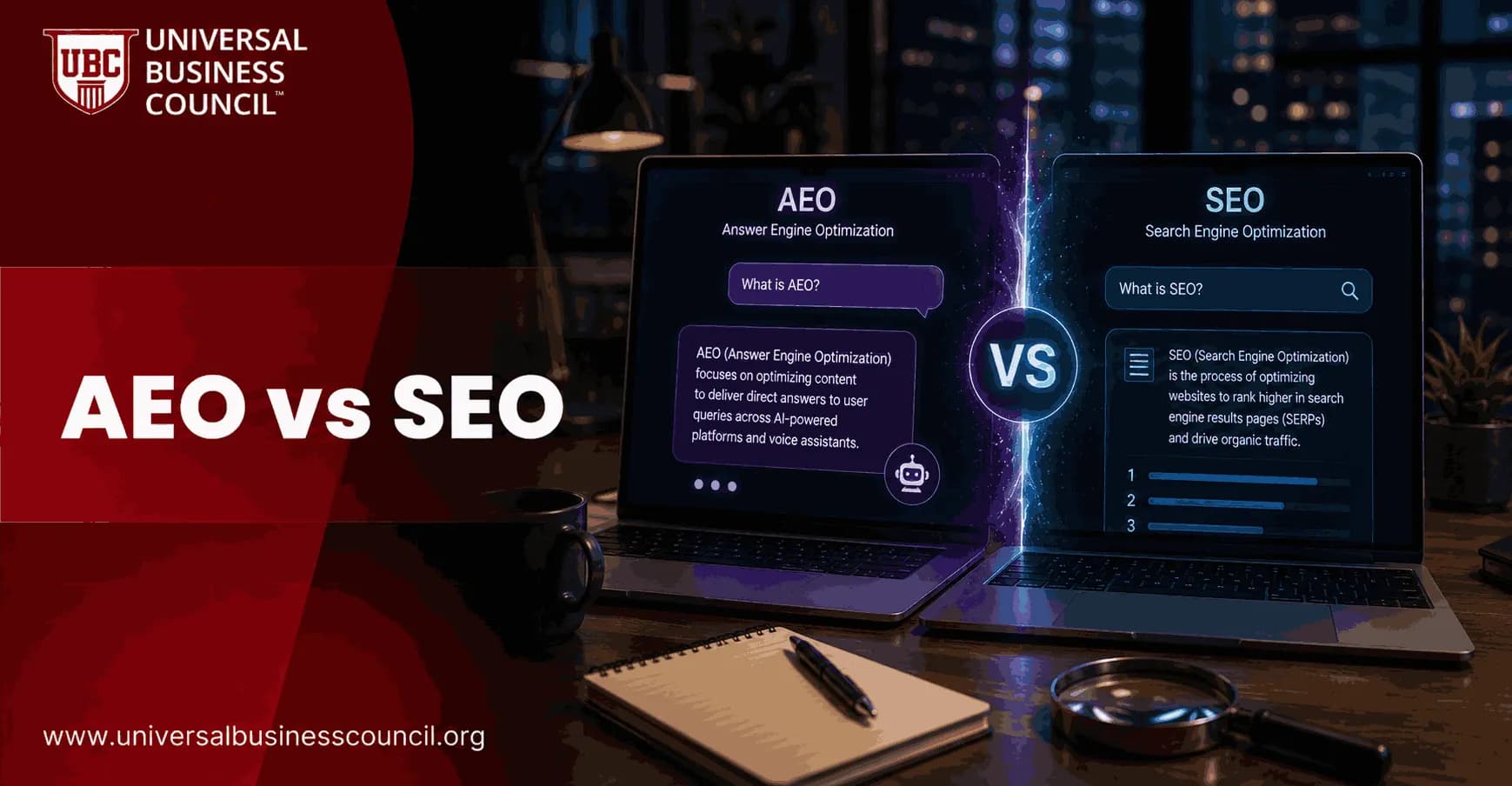
AEO vs SEO is now a critical distinction for digital marketers, content strategists, and business leaders. Search Engine Optimization helps pages rank in traditional search results, while Answer Engine Optimization helps content become the direct answer in AI systems such as ChatGPT, Gemini, Perplexity, Bing Copilot, Google AI Overviews, and voice assistants.
The two disciplines are not competing approaches. They are complementary. SEO makes content discoverable, crawlable, and competitive in search engines. AEO makes content clear, structured, credible, and usable by AI-driven answer engines. Organizations that want durable visibility need both.

Strengthen your search strategy and technical decision-making by building the skills expected of a modern SEO Expert.
AEO vs SEO: What Is the Difference?
SEO, or Search Engine Optimization, focuses on improving a web page so it can rank highly in search engine results pages and attract organic clicks. It includes keyword research, on-page optimization, technical SEO, internal linking, backlinks, content quality, and user experience.
AEO, or Answer Engine Optimization, focuses on structuring content so AI systems can understand, summarize, and cite it as a direct answer to a user question. Instead of optimizing only for rankings, AEO optimizes for interpretation, retrieval, and trust.
AEO vs SEO at a Glance
Primary channel: SEO targets Google, Bing, and other search engines. AEO targets AI answer engines, AI search layers, chat interfaces, and voice assistants.
Core goal: SEO aims to win rankings and clicks. AEO aims to be selected or cited as the best answer.
Optimization focus: SEO emphasizes pages, keywords, links, and technical performance. AEO emphasizes answers, entities, schema, semantic clarity, and authority.
User behavior: SEO supports users who browse results and click through. AEO supports users who ask a question and expect a direct response.
Metrics: SEO tracks rankings, traffic, click-through rate, and engagement. AEO tracks AI citations, brand mentions, answer visibility, and share of voice in AI outputs.
Why AEO Matters in an AI Search Environment
Traditional search is no longer the only discovery path. Users now ask questions in conversational interfaces, compare options in generative AI tools, and rely on voice assistants for quick answers. This has accelerated the rise of zero-click search, where the user receives an answer without visiting a website.
Independent research has repeatedly indicated that a large share of Google searches result in no click. At the same time, adoption of generative AI tools has grown quickly among professionals, students, and knowledge workers. These trends mean that visibility increasingly depends on whether your expertise appears inside the answer itself.
Across the industry, AEO is widely framed as an evolution of SEO rather than a replacement, and the same page can often be optimized for both search rankings and direct answer extraction. The two practices reinforce one another rather than compete.
How Search Engines and Answer Engines Evaluate Content
Search engines evaluate relevance, authority, technical accessibility, page experience, and link signals. Answer engines evaluate many of the same signals, but they also need content that is easy to parse, summarize, and attribute.
This is why AEO places more emphasis on semantic structure. AI systems must understand what a page is about, which entities are mentioned, whether the information is credible, and how directly it answers a specific question. Clear definitions, FAQ sections, structured data, and consistent entity references help AI tools interpret the page correctly.
Content Characteristics Answer Engines Favor
Directness: Clear answers in one to three sentences before deeper explanation.
Authority: Evidence-based claims, expert authorship, reputable sources, and updated information.
Structure: Descriptive headings, FAQ blocks, bullet lists, tables, and step-by-step guidance.
Neutrality: Educational language that avoids excessive promotion.
Semantic clarity: Consistent use of names, concepts, categories, and relationships.
How to Optimize Content for Both AEO and SEO
A practical AEO vs SEO strategy should begin with classic SEO fundamentals, then layer answer-first formatting and AI-ready structure on top. The goal is not to write separate content for humans and machines. The goal is to create content that is useful to people and understandable to systems.
1. Start With Search Intent and Question Intent
For SEO, map keywords to user intent. A query may be informational, commercial, navigational, or transactional. For AEO, expand that research into natural language questions such as:
What is answer engine optimization?
How is AEO different from SEO?
Why does AI search reduce organic clicks?
How do I optimize content for Google AI Overviews?
Each important question should have a concise answer near the relevant heading, followed by supporting detail. This format helps readers scan quickly and helps AI systems retrieve a clean answer block.
2. Use Concise Answer Blocks
A strong AEO page often opens each section with a direct response. For example, a page about zero-click search might begin with: Zero-click search occurs when a user receives the answer directly on the results page or in an AI interface without clicking through to a website.
After the short answer, provide depth through examples, context, statistics, and practical guidance. This satisfies both AI extraction and human evaluation.
3. Build Machine-Friendly Page Structure
Use headings that match real user questions. Add FAQ sections for common queries. Use ordered lists for processes and bullet lists for comparisons. Keep paragraphs short and focused. These practices improve readability and increase the chance that content can be used in featured snippets, AI Overviews, voice responses, and chatbot summaries.
Build stronger technical confidence with a Tech Certification that supports digital strategy, automation, analytics, and emerging technology adoption.
4. Implement Schema and Semantic Markup
Structured data is a bridge between SEO and AEO. Schema.org markup helps search and AI systems identify entities, relationships, and content types. Common schema types for AEO include:
FAQPage: For question-and-answer content.
HowTo: For step-by-step processes.
Organization: For company and institutional identity.
Person: For expert authors and professionals.
Product or Service: For offerings, features, and use cases.
Schema does not guarantee visibility, but it improves machine interpretability and can support richer search results.
5. Strengthen Technical SEO Foundations
AEO depends on discoverable, high-quality source material. If a page cannot be crawled, indexed, or trusted, it is less likely to influence AI answers. Maintain strong technical SEO by improving page speed, mobile usability, indexation, canonical tags, logical URLs, and internal linking.
Topic clusters are especially valuable. A pillar page on AI search optimization can link to supporting pages on technical SEO, content strategy, schema markup, analytics, and digital marketing strategy. This helps search engines and answer engines recognize topical authority.
6. Build Authority Beyond Your Website
AI systems often synthesize information from multiple surfaces, not just your domain. Mentions on reputable sites, professional profiles, directories, research publications, podcasts, YouTube, LinkedIn, and industry media can reinforce entity credibility.
Consistent naming and positioning matter. If your organization, experts, products, and services are described consistently across the web, answer engines can more confidently associate your entity with relevant topics.
How to Measure AEO and SEO Performance
SEO measurement remains more mature. Track keyword rankings, organic traffic, impressions, click-through rate, conversions, backlinks, and engagement. For AEO, measurement is still developing, but professionals can begin with practical checks:
Query AI tools with important industry questions and record which brands are mentioned.
Track whether your content is cited in AI search experiences or answer engines.
Monitor brand mentions across authoritative third-party platforms.
Compare competitor visibility in Google AI Overviews, Perplexity, Gemini, and ChatGPT browsing experiences.
Document changes after adding FAQ sections, schema, concise definitions, and stronger sources.
This creates a repeatable experimentation framework. If you rank in traditional search but do not appear in AI answers, improve semantic clarity, authority signals, and off-site mentions. If you appear in AI answers but receive limited traffic, strengthen calls to action, internal links, and conversion pathways.
Skills Professionals Need for AEO and SEO
The future of search requires a broader skillset. Digital marketers need SEO knowledge, but they also need AI search optimization, structured data literacy, entity optimization, analytics, content governance, and digital PR awareness.
Professionals developing these capabilities can connect this topic with Universal Business Council certifications and courses in digital marketing, marketing strategy, business analytics, management, and emerging technology leadership.
For enterprises, training should not be limited to SEO teams. Product marketers, content writers, web developers, PR teams, analysts, and subject matter experts all contribute to the signals that answer engines evaluate.
Stay prepared for AI-driven change with an AI Certification that helps you understand automation, governance, and practical AI implementation.
Conclusion: AEO vs SEO Is Not Either-Or
The most effective approach to AEO vs SEO is integration. SEO helps your content get discovered, indexed, ranked, and clicked. AEO helps your content become understandable, extractable, and citable in AI-driven answer environments.
As search evolves toward AI Overviews, chat-based discovery, voice responses, and generative interfaces, organizations should optimize for both documents and answers. Build technically sound pages, answer real questions clearly, implement structured data, maintain topical authority, and strengthen your entity across trusted platforms.
In short, SEO earns visibility in search results. AEO earns presence in the answer. Modern digital strategy needs both.
FAQs
1. What Are AEO and SEO?
AEO (Answer Engine Optimization) and SEO (Search Engine Optimization) are strategies used to improve online visibility, but they focus on different types of search experiences and user interactions.
2. What Is SEO?
SEO is the process of optimizing websites and content to improve rankings and visibility in traditional search engine results pages (SERPs).
3. What Is AEO?
Answer Engine Optimization (AEO) focuses on optimizing content to provide direct answers that can be featured in answer boxes, AI-generated responses, voice search results, and featured snippets.
4. What Is the Main Difference Between AEO and SEO?
SEO aims to increase website traffic through search rankings, while AEO aims to position content as the direct answer to user questions.
5. Why Is AEO Becoming More Important?
As AI-powered search engines, voice assistants, and answer-based search experiences grow, users increasingly expect immediate answers rather than multiple search results.
6. What Is the Primary Goal of SEO?
The primary goal of SEO is to improve organic rankings and drive qualified traffic to a website.
7. What Is the Primary Goal of AEO?
The primary goal of AEO is to ensure content is selected and displayed as a trusted answer to a user's query.
8. How Does User Behavior Differ Between SEO and AEO?
SEO often encourages users to click through to websites, while AEO focuses on delivering concise answers directly within search interfaces.
9. Are Keywords Still Important for AEO?
Yes, keywords remain important, but AEO places greater emphasis on question-based queries, conversational language, and user intent.
10. What Types of Content Perform Best for AEO?
FAQs, definitions, how-to guides, tutorials, comparison articles, checklists, and concise explanatory content often perform best.
11. How Does Content Structure Impact AEO?
Well-organized content with clear headings, short answers, bullet points, numbered lists, and logical formatting improves answer extraction.
12. What Role Do Featured Snippets Play in AEO?
Featured snippets are one of the primary targets of AEO because they provide direct answers at the top of search results.
13. How Is Voice Search Connected to AEO?
Voice assistants often read a single answer to a user's question, making answer-focused content essential for voice search visibility.
14. What Is the Role of E-E-A-T in AEO and SEO?
Experience, Expertise, Authoritativeness, and Trustworthiness help establish credibility, improving both search rankings and answer selection opportunities.
15. Does Technical SEO Matter for AEO?
Yes, technical SEO remains important because search engines still need to crawl, index, and understand content before it can appear as an answer.
16. How Can Businesses Optimize for AEO?
Businesses can create question-focused content, provide concise answers, use structured data, improve content organization, and strengthen authority signals.
17. What Metrics Should Be Tracked for AEO?
Key metrics include featured snippet ownership, answer visibility, voice search performance, AI-generated answer citations, branded searches, and conversions.
18. What Common Mistakes Should Businesses Avoid When Pursuing AEO?
Common mistakes include writing overly complex content, failing to answer questions directly, neglecting structured formatting, and focusing only on rankings. Search engines increasingly reward websites that answer questions clearly instead of treating every paragraph like a mystery novel.
19. Can AEO Replace SEO?
No, AEO complements SEO rather than replacing it. Strong SEO provides the foundation that allows content to become visible and eligible for answer-based results.
20. Which Is More Important: AEO or SEO?
Neither is universally more important. SEO remains essential for overall search visibility, while AEO helps capture opportunities in answer engines, AI search, and voice assistants. The most effective strategy is to combine both approaches to maximize discoverability across modern search experiences.
Related Articles
View All
Digital Marketing
Building an AI-Ready Content Strategy with SEO, GEO, and AEO
Learn how to build an AI-ready content strategy by integrating SEO, GEO, and AEO to improve search visibility, AI citations, and trusted answers.

Digital Marketing
The Future of Search: Integrating SEO, GEO, and AEO into One Digital Strategy
Learn how SEO, GEO, and AEO converge into one integrated search strategy for AI Overviews, answer engines, generative platforms, and zero-click search.

Digital Marketing
The Role of AI in SEO: Smarter Keyword Research, Content Optimization, and Ranking Insights
Learn how AI in SEO improves keyword research, content optimization, ranking insights, and AI search visibility for modern digital marketing teams.
Trending Articles
The Role of Blockchain in Ethical AI Development
How blockchain technology is being used to promote transparency and accountability in artificial intelligence systems.
AWS Career Roadmap
A step-by-step guide to building a successful career in Amazon Web Services cloud computing.
Top 5 DeFi Platforms
Explore the leading decentralized finance platforms and what makes each one unique in the evolving DeFi landscape.