

SEO, GEO, and AEO Explained: A Practical Guide for Marketers and Business Leaders
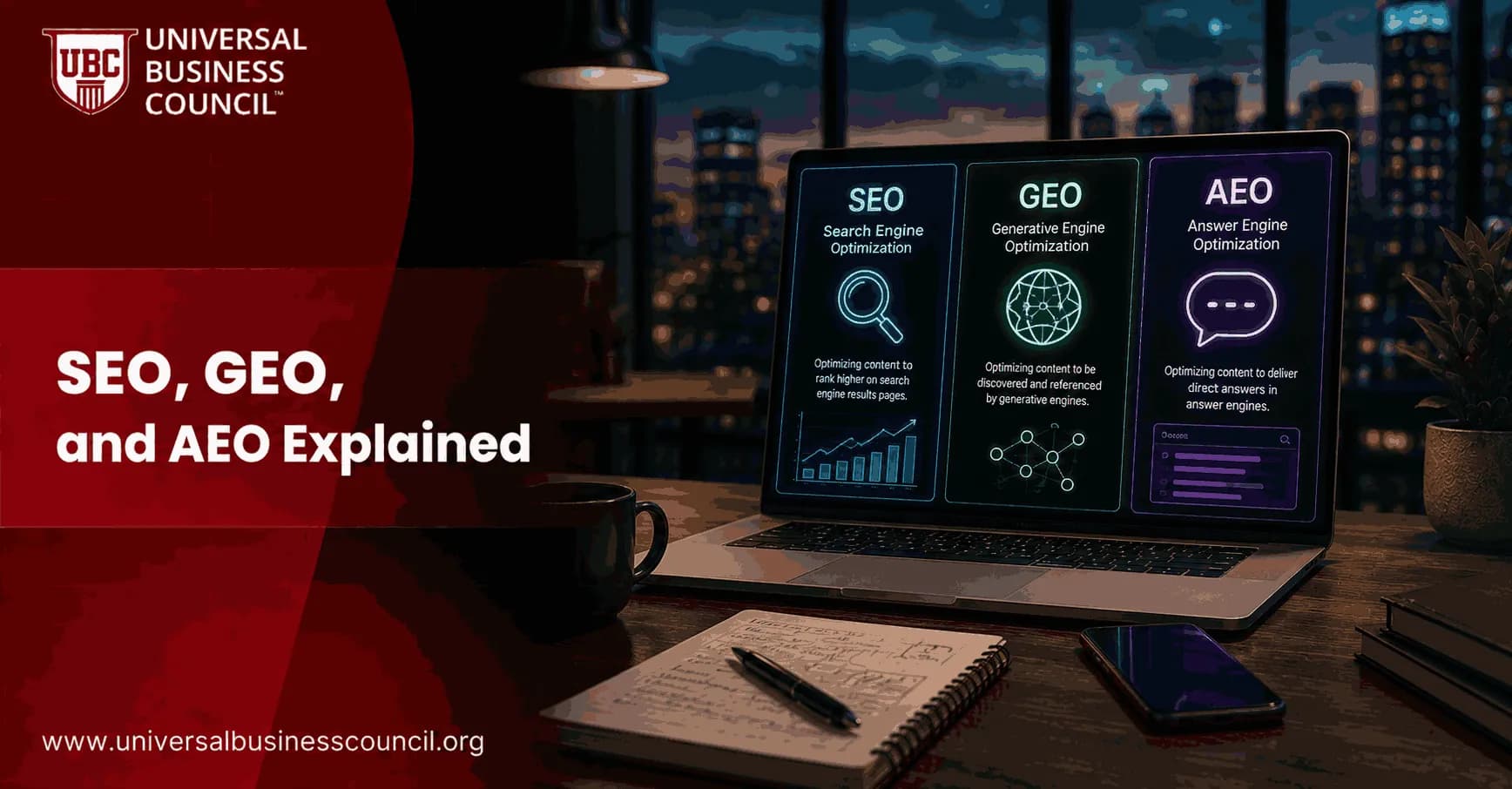
SEO, GEO, and AEO now define the three connected layers of modern digital visibility. Search Engine Optimization helps pages rank in traditional search, Answer Engine Optimization helps content become a direct answer, and Generative Engine Optimization helps AI systems trust, summarize, and cite your brand. For marketers and business leaders, the practical message is clear: visibility is no longer only about ranking on a results page. It is also about being understandable, answer-ready, and credible across search, voice, and AI interfaces.
As search continues to evolve across traditional engines and AI-driven platforms, an SEO Expert Certification can help professionals strengthen their expertise in technical SEO, content strategy, AI search optimization, and the skills needed to build sustainable digital visibility.

This guide explains how SEO, AEO, and GEO differ, how they work together, and how organizations can build a practical optimization strategy for an AI-influenced search environment.
What Are SEO, AEO, and GEO?
Search Engine Optimization
Search Engine Optimization is the practice of improving a website so search engines can crawl, understand, index, and rank its content. Traditional SEO focuses on keyword strategy, technical website health, internal linking, backlinks, page experience, and search intent.
The main goal of SEO is to earn organic visibility in search engine results pages and attract qualified clicks. Google Search Central consistently emphasizes helpful content, crawlability, structured information, and user experience as important foundations for search performance.
Answer Engine Optimization
Answer Engine Optimization focuses on making content easy for search engines, voice assistants, and AI interfaces to extract as a direct answer. AEO targets featured snippets, People Also Ask results, voice responses, and AI answer boxes.
AEO works best when content is structured around clear questions and concise answers. A practical approach is to answer the main question in the first 40 to 60 words, then expand with examples, evidence, and related context.
Generative Engine Optimization
Generative Engine Optimization is an emerging discipline focused on increasing the likelihood that generative AI systems mention, summarize, recommend, or cite your content. It applies to AI-powered search and answer tools such as ChatGPT, Perplexity, Google AI Overviews, and other large language model interfaces.
GEO is less about winning a single ranking position and more about earning trust. AI systems tend to favor content that is clear, attributable, evidence-based, current, and consistent across the web.
SEO vs AEO vs GEO: The Practical Difference
The easiest way to understand the difference is to view them as layers:
SEO gets content discovered: It helps search engines find, evaluate, and rank your pages.
AEO makes content answer-ready: It helps machines extract a direct, concise answer from your content.
GEO makes content AI-citable: It helps generative AI systems trust your content enough to reference it in synthesized responses.
These disciplines are not replacements for one another. Strong SEO remains the foundation. Industry analysis has reported a high correlation between top organic rankings and pages cited in Google AI Overviews, with some studies noting that pages in the top 10 organic results are far more likely to appear as AI citations. This suggests that brands still need strong technical SEO, content relevance, and authority before they can reliably influence AI-generated answers.
Why SEO, GEO, and AEO Matter Now
Search behavior is changing. Users increasingly ask full questions, use voice assistants, and receive AI-generated summaries before reviewing traditional blue links. In many cases, the user gets the answer without clicking through to a website. This is part of the broader zero-click search trend.
For business leaders, this shift changes how digital performance should be understood. Organic traffic remains important, but visibility now includes:
Appearing in featured snippets and People Also Ask results
Being selected as the source for voice assistant answers
Being cited or mentioned in AI-generated summaries
Having your brand described accurately by AI systems
Maintaining consistent facts across websites, profiles, directories, and social platforms
Google's E-E-A-T framework, which stands for Experience, Expertise, Authoritativeness, and Trust, also reinforces this movement. Content must not only be optimized, it must demonstrate credible expertise and verifiable value.
How to Build a Layered SEO, AEO, and GEO Strategy
1. Start With SEO Fundamentals
Before optimizing for answer engines or generative AI, ensure that your core SEO foundation is strong. This includes:
Mapping keywords to user intent and business priorities
Creating comprehensive pages for core topics
Improving crawlability, site speed, mobile usability, and Core Web Vitals
Using descriptive title tags, headings, and meta descriptions
Building internal links between related pages
Earning relevant backlinks from credible websites
For professionals developing this capability, Universal Business Council programmes in digital marketing and business management can support structured learning in search strategy, analytics, and customer acquisition.
2. Add AEO-Friendly Answer Structures
Once a page is search-ready, make it answer-ready. AEO rewards clarity and structure. Every important page should answer its primary question quickly, then provide supporting detail.
Useful AEO tactics include:
Use headings that match real user questions, such as What is AEO? or How does GEO work?
Place a concise answer directly under each question-based heading
Add FAQ sections based on search data, sales calls, customer support questions, and community forums
Use bullet points, numbered lists, and comparison tables where appropriate
Apply relevant schema markup, such as FAQ, HowTo, Product, Service, or Organization schema
Google's documentation on structured data explains that schema helps search systems understand page content more precisely. While schema does not guarantee a rich result, it can improve machine interpretation.
3. Strengthen GEO Signals With Evidence and Trust
GEO requires a more evidence-based content model. Generative AI systems synthesize information from multiple sources, so they need signals that your content is reliable, current, and authoritative.
Practical GEO tactics include:
Add expert commentary with clear attribution, including name, title, and relevant credentials
Use current statistics and cite reputable sources in plain language
Include original research, benchmarks, frameworks, or proprietary insights where possible
Provide author bios that demonstrate subject matter expertise
Keep business information consistent across your website, Google Business Profile, Apple Maps, directories, and social profiles
Update high-value pages every 1 to 2 months when topics change quickly
Research associated with Princeton University has been widely cited in discussions of GEO. It found that tactics such as expert quotes, statistics, citations, readability improvements, and domain-specific terminology can improve visibility in generative engine responses, while keyword stuffing can reduce performance. The lesson is simple: AI-era optimization rewards clarity and credibility, not manipulation.
Use Cases for Marketers and Business Leaders
B2B Software
A SaaS company targeting enterprise knowledge management should build an SEO-focused pillar page, then add AEO sections that answer questions such as What is an enterprise knowledge management platform? and How does it improve productivity? For GEO, the page should include expert quotes from product leaders, cited data from credible research firms, and consistent messaging across the website, LinkedIn, and press materials.
Local Professional Services
A regional law, accounting, or consulting firm should combine local SEO with AEO and GEO. This means optimized service pages, accurate Google Business Profile data, service schema, question-based FAQs, consistent name-address-phone details, reviews, and trustworthy directory listings. AI assistants often rely on these consistency signals when responding to local service queries.
E-Commerce
An e-commerce brand should optimize category pages for transactional search, then create answer-first buying guides. For GEO, product recommendations should include clear comparison criteria, technical specifications, third-party review references, and expert commentary. This makes the content more useful for AI shopping recommendations and product discovery.
As AI increasingly influences product discovery, recommendations, and purchasing decisions, an AI Certification can help professionals develop a deeper understanding of AI-driven search, personalization, automation, and the responsible use of AI in modern digital commerce.
How to Measure SEO, AEO, and GEO Performance
Traditional SEO metrics are still useful, but they are no longer sufficient on their own. A balanced measurement framework should include:
SEO metrics: rankings, impressions, organic traffic, click-through rate, conversions, backlinks, and technical health
AEO metrics: featured snippet ownership, People Also Ask visibility, FAQ performance, voice answer presence, and question-based impressions
GEO metrics: AI citation frequency, brand mentions in AI answers, sentiment of AI descriptions, competitor comparison visibility, and AI crawler activity
Marketing teams should also run periodic manual checks across major AI systems. Ask the same questions your customers ask and document whether your brand appears, how it is described, and which sources are cited.
Common Mistakes to Avoid
Treating GEO as a replacement for SEO: AI visibility often depends on strong search visibility first.
Writing only for algorithms: Human usefulness remains central to both search and AI evaluation.
Publishing uncited claims: Generative engines are more likely to trust content with verifiable evidence.
Ignoring content freshness: Outdated statistics and old guidance reduce credibility.
Allowing inconsistent brand facts: Conflicting descriptions across platforms can confuse AI systems and customers.
The Leadership Implication
SEO, AEO, and GEO are not only marketing tactics. They are part of digital trust management. Leaders should ensure that content, data, brand messaging, and expertise are governed across the organization. Product teams, legal teams, sales teams, and marketing teams all influence the information that AI systems may discover and reuse.
This is why professional education matters. Marketers who pursue structured training, such as Universal Business Council certifications in digital marketing, marketing strategy, business management, and analytics, can better connect technical optimization with business objectives.
A Tech Certification can further strengthen these capabilities by helping professionals understand the technical foundations of search, data systems, automation, and emerging technologies that increasingly influence digital marketing performance and decision-making.
Conclusion: Build for Search, Answers, and AI Trust
SEO, GEO, and AEO work best as an integrated system. SEO helps your content get discovered, AEO helps it become the direct answer, and GEO helps it become a trusted source for AI-generated responses. Organizations that invest in all three will be better positioned for a search environment shaped by rankings, zero-click answers, voice interfaces, and generative AI recommendations.
The practical path is straightforward: strengthen technical and content SEO, restructure key pages around clear answers, add evidence and expert attribution, maintain cross-platform consistency, and measure visibility beyond clicks. As AI-driven discovery becomes standard, the most visible brands will be those that are easy to find, easy to understand, and easy to trust.
FAQs
1. What Are SEO, GEO, and AEO?
SEO (Search Engine Optimization), GEO (Generative Engine Optimization), and AEO (Answer Engine Optimization) are digital visibility strategies that help businesses appear in traditional search results, AI-generated responses, and answer-focused search experiences.
2. Why Do Marketers Need to Understand SEO, GEO, and AEO?
Search behavior is evolving rapidly. Customers now discover information through search engines, AI assistants, chatbots, voice search, and answer engines, making it important to optimize for all three approaches.
3. What Is SEO?
SEO is the process of improving a website's visibility in organic search engine results through content optimization, technical improvements, and authority building.
4. What Is GEO?
Generative Engine Optimization (GEO) focuses on increasing the likelihood that AI-powered search engines and generative AI systems reference, summarize, or cite a brand's content.
5. What Is AEO?
Answer Engine Optimization (AEO) focuses on structuring content so it can be selected as a direct answer for search queries, featured snippets, voice assistants, and AI-generated responses.
6. How Does SEO Differ from GEO?
SEO aims to improve rankings and website traffic, while GEO focuses on ensuring content becomes a trusted source for AI-generated answers and summaries.
7. How Does AEO Differ from SEO?
SEO seeks visibility in search results, while AEO seeks visibility as the actual answer presented to users within search and AI interfaces.
8. Why Is GEO Becoming More Important in 2026?
AI-powered search experiences are becoming increasingly common, reducing reliance on traditional search result clicks and increasing the importance of AI citations.
9. Why Is AEO Important for Modern Search?
Users increasingly ask conversational questions and expect immediate answers, making answer-focused optimization essential for digital visibility.
10. What Role Does User Intent Play Across SEO, GEO, and AEO?
User intent is the foundation of all three strategies because search engines and AI systems prioritize content that best satisfies user needs and questions.
11. How Should Content Be Structured for SEO, GEO, and AEO?
Content should use clear headings, concise answers, logical organization, FAQs, lists, tables, and comprehensive explanations to support discoverability and answer extraction.
12. What Types of Content Perform Best Across All Three Approaches?
FAQs, how-to guides, tutorials, research reports, case studies, comparison articles, thought leadership content, and expert resources tend to perform well.
13. What Is the Role of E-E-A-T in SEO, GEO, and AEO?
Experience, Expertise, Authoritativeness, and Trustworthiness help establish credibility, increasing the likelihood of ranking, citation, and answer selection.
14. How Does Structured Data Support SEO, GEO, and AEO?
Structured data helps search engines and AI systems understand content context, entities, relationships, and key information more effectively.
15. How Can Businesses Improve Their Chances of Being Referenced by AI Systems?
Businesses should publish accurate content, demonstrate expertise, build topical authority, maintain content quality, and consistently update information.
16. What Metrics Should Marketers Track for SEO, GEO, and AEO?
Key metrics include organic traffic, keyword rankings, featured snippets, AI citations, answer visibility, branded search volume, engagement rates, leads, and conversions.
17. What Common Mistakes Should Businesses Avoid?
Common mistakes include focusing only on rankings, ignoring AI search trends, creating generic content, neglecting technical SEO, and failing to demonstrate expertise.
18. How Can AI Tools Help Optimize SEO, GEO, and AEO?
AI tools can assist with keyword research, content creation, topic clustering, question analysis, search intent mapping, competitor analysis, and performance reporting.
19. What Does the Future of Search Mean for Business Leaders?
Business leaders must recognize that visibility is no longer limited to search rankings. Brands now compete for presence in search results, AI-generated answers, voice responses, and digital assistants. The new challenge is not simply being found, but being trusted enough to be cited.
20. What Is the Best Practical Strategy for Marketers and Business Leaders?
The most effective strategy is to integrate SEO, GEO, and AEO into a single digital visibility framework. This means building technically sound websites, creating authoritative content, optimizing for user questions, implementing structured data, strengthening E-E-A-T signals, and ensuring content is discoverable by both traditional search engines and AI-powered answer systems. This integrated approach positions organizations for success in the evolving search landscape of 2026 and beyond.
Related Articles
View All
Digital Marketing
Building an AI-Ready Content Strategy with SEO, GEO, and AEO
Learn how to build an AI-ready content strategy by integrating SEO, GEO, and AEO to improve search visibility, AI citations, and trusted answers.
Digital Marketing
How to Measure Success Across SEO, GEO, and AEO Campaigns
Learn how to measure SEO, GEO, and AEO campaign success with unified KPIs for rankings, answer visibility, AI citations, conversions, and revenue.

Digital Marketing
From Keywords to AI Answers: How SEO, GEO, and AEO Shape Online Visibility
Explore how SEO, GEO, and AEO shape online visibility as search evolves from keyword rankings to AI-generated answers, citations, and trust signals.
Trending Articles
The Role of Blockchain in Ethical AI Development
How blockchain technology is being used to promote transparency and accountability in artificial intelligence systems.
AWS Career Roadmap
A step-by-step guide to building a successful career in Amazon Web Services cloud computing.
Top 5 DeFi Platforms
Explore the leading decentralized finance platforms and what makes each one unique in the evolving DeFi landscape.