

Predictive Analytics in Digital Marketing: How AI Helps Forecast Customer Behavior
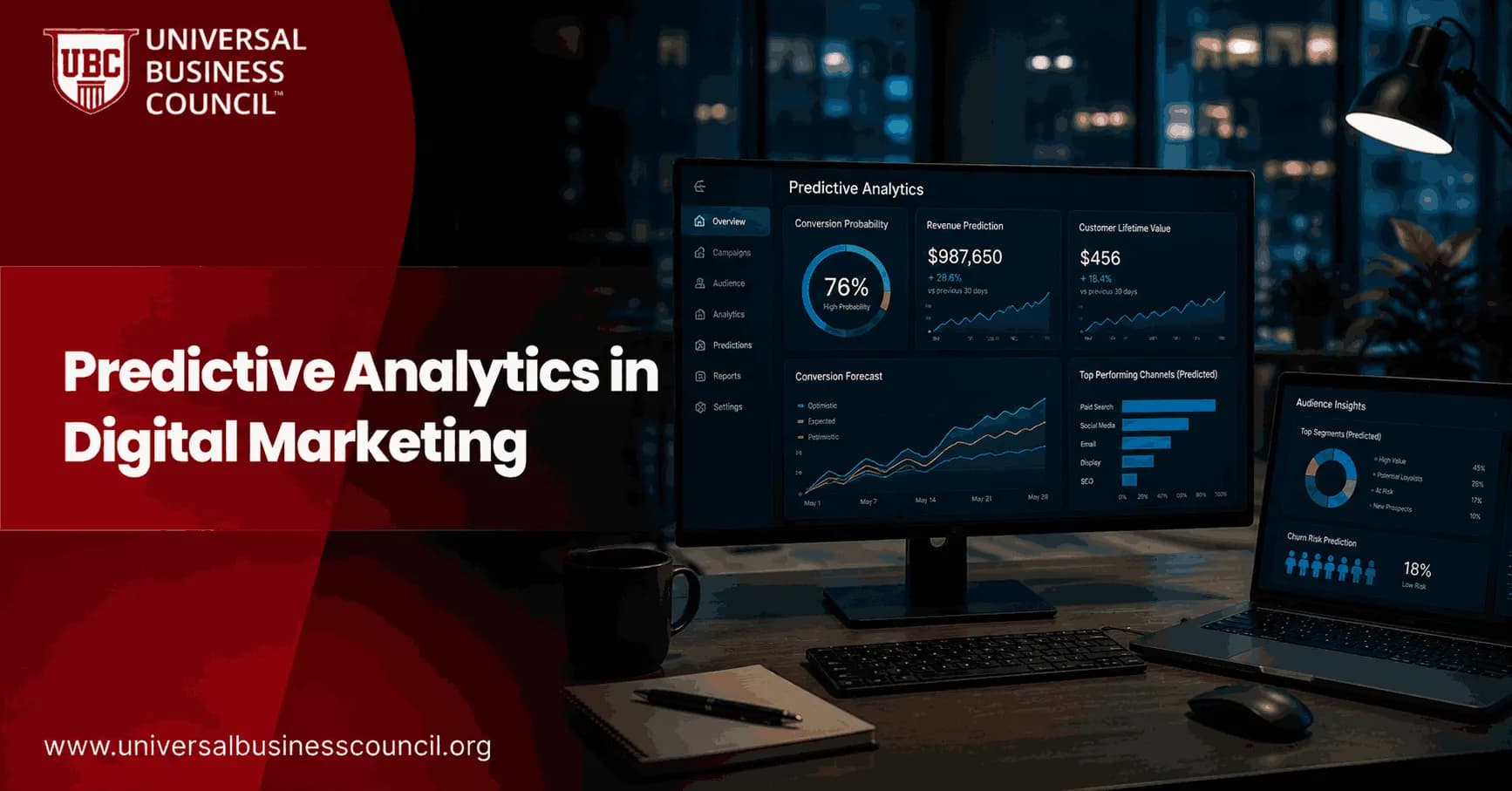
Predictive analytics in digital marketing uses AI, machine learning, and customer data to forecast what people are likely to do next. Instead of relying only on intuition or retrospective reporting, marketers can estimate future actions such as clicks, purchases, churn, upgrades, and content engagement. This makes campaigns more relevant, measurable, and aligned with customer behavior.
As marketing teams face tighter budgets, changing privacy expectations, and more complex customer journeys, predictive analytics has become a practical capability rather than an experimental technique. It now sits at the centre of data-driven marketing because it helps organizations identify high-value audiences, personalize experiences, and allocate resources more effectively.

A Digital Marketing Certification can help professionals strengthen their understanding of data-driven decision-making, customer segmentation, campaign optimization, and performance measurement, enabling them to apply predictive analytics more effectively across modern marketing strategies.
What Is Predictive Analytics in Digital Marketing?
Predictive analytics combines historical data, real-time signals, statistical modeling, and AI to estimate the likelihood of future customer outcomes. In digital marketing, those outcomes may include whether a visitor will convert, whether a subscriber will respond to an offer, or whether a customer is likely to stop buying.
The strongest predictive marketing systems usually rely on several categories of data:
First-party data: Website visits, CRM records, purchase history, app behavior, email engagement, loyalty data, and customer service interactions.
Contextual and external data: Device type, location context, seasonality, market trends, and permitted demographic or interest signals.
Real-time behavioral data: Current browsing behavior, cart activity, campaign interactions, and live engagement patterns.
AI models analyze these inputs to identify patterns that may not be obvious to human analysts. For example, a customer who stops opening emails, visits the cancellation page, and reduces product usage may have a higher churn probability than a similar customer who remains active across multiple channels..
How AI Forecasts Customer Behavior
AI forecasts customer behavior by learning from previous outcomes. If historical data shows which users converted, upgraded, churned, or ignored campaigns, a machine learning model can find variables that correlate with those results. As new data becomes available, the model can be retrained to improve accuracy.
Classification Models
Classification models place customers or events into defined categories. A marketing team may use them to classify leads as likely to convert or unlikely to convert, subscribers as engaged or inactive, or customers as at risk or healthy. These models are widely used in predictive lead scoring and retention marketing.
Clustering Models
Clustering models discover natural customer segments without requiring marketers to define those groups in advance. For example, an ecommerce brand may identify frequent low-value shoppers, seasonal buyers, high-value occasional purchasers, and discount-driven customers. These segments can then support more precise messaging and offer strategies.
Regression Models
Regression models estimate numeric outcomes, such as predicted order value, revenue impact, or response volume. They are often used to understand how marketing spend in different channels may influence revenue, which helps teams make more evidence-based budget decisions.
Time Series Models
Time series models analyze time-ordered data to forecast trends. They are useful for predicting seasonal sales peaks, weekly engagement cycles, holiday demand, or traffic spikes. A retailer might use time series forecasting to prepare campaign budgets and inventory for recurring weekend sales surges or holiday shopping periods.
Propensity Models
Propensity models estimate the probability that a customer will take a specific action. Marketers use them for churn prediction, upsell targeting, retention campaigns, and next-best-offer decisions. For example, one customer may have an 85 percent likelihood of upgrading, while another may have only a 32 percent likelihood based on behavioral and transactional signals.
Key Applications of Predictive Analytics in Digital Marketing
1. Predictive Lead Scoring
Predictive lead scoring uses AI to rank leads or accounts according to their likelihood of becoming customers. The model may evaluate firmographics, demographics, website behavior, content downloads, trial activity, email engagement, and CRM history.
For B2B teams, this can improve sales productivity by helping representatives focus on the highest-probability opportunities. Lower-scoring leads can remain in automated nurture programs until they show stronger buying signals.
2. Customer Segmentation and Personalization
Predictive analytics enables more advanced customer segmentation than traditional demographic grouping. Instead of segmenting only by age, location, or industry, marketers can group customers by predicted intent, lifetime value, churn risk, product affinity, and engagement patterns.
These insights support personalized experiences across email, paid media, websites, mobile apps, and social channels. Predictive analytics can improve both message relevance and channel selection, which is central to modern omnichannel marketing.
3. Product and Content Recommendations
Recommendation engines are among the most familiar examples of AI in marketing. They analyze browsing behavior, purchase history, content consumption, and similar-user patterns to suggest products, services, or resources that an individual is likely to value.
In ecommerce, recommendations can support cross-selling and upselling. In education, media, or subscription businesses, they can guide users to relevant content, courses, or membership features.
4. Customer Lifetime Value Forecasting
Customer Lifetime Value, often called CLV, estimates how much revenue a customer is expected to generate over the full relationship with a business. Predictive CLV models help marketers decide how much to invest in acquisition, retention, loyalty, and service for different customer groups.
For example, a high-CLV customer with a rising churn risk may justify a stronger retention offer than a low-value customer who is unlikely to purchase again. This makes budget allocation more strategic.
5. Churn Prediction and Retention
Churn prediction models identify customers who are likely to leave, cancel, downgrade, or become inactive. They often evaluate signals such as declining engagement, reduced usage, complaints, support tickets, payment issues, and changes in purchase frequency.
Once customers are flagged, marketers can trigger targeted retention campaigns, educational content, loyalty incentives, or service interventions. Research on AI in consumer behavior analysis highlights predictive analytics as an important capability for improving engagement and understanding customer journeys.
6. Campaign and Channel Optimization
Predictive models can forecast which audience, channel, creative, and offer combinations are likely to perform best. This helps teams compare expected outcomes across search, social, email, display, affiliate, and owned channels.
In programmatic advertising, AI can estimate the likelihood that a specific impression will lead to a click or conversion. Bids and creatives can then be adjusted in real time, improving efficiency and reducing wasted spend.
An AI Certification can help professionals develop a deeper understanding of machine learning models, predictive analytics, automation systems, and the responsible use of AI technologies that drive modern advertising and marketing optimization.
Real-World Use Cases
Ecommerce Retailer
An online retailer can use predictive analytics to recommend products, forecast customer lifetime value, and identify high-value customers at risk of churn. These insights support both tactical personalization and strategic investment in loyalty programs.
B2B SaaS Company
A SaaS company can analyze CRM data, trial usage, feature adoption, content engagement, and website visits to score leads. Sales teams can prioritize high-probability accounts, while marketing can create educational nurture paths for leads that need more time.
Omnichannel Brand
An omnichannel brand can use regression and time series models to forecast demand, select optimal send times, and allocate budget across web, app, email, paid search, and social campaigns. This creates a more coordinated customer journey.
Privacy, Governance, and Trust
As predictive analytics becomes more influential, responsible data use is essential. Marketers should prioritize consent-based first-party data, clear privacy policies, secure data management, and transparent governance. Changes in tracking technology and privacy regulation are also pushing organizations to rely less on third-party identifiers and more on first-party relationships and contextual signals.
Model governance matters as well. Teams should monitor predictive models for bias, data quality issues, explainability, and performance drift. Human oversight remains important, especially when automated decisions affect pricing, eligibility, targeting, or customer experience.
Skills Marketers Need for AI-Driven Predictive Analytics
Professionals do not always need to become data scientists, but they do need enough analytical fluency to interpret models, ask better questions, and apply predictions ethically. Useful skills include:
Understanding customer data sources and data quality
Interpreting model outputs such as propensity scores and CLV forecasts
Designing experiments to validate predictive campaigns
Connecting insights to segmentation, content, media, and CRM workflows
Managing privacy, consent, and responsible AI practices
For professionals building these capabilities, Universal Business Council programs in digital marketing, business analytics, marketing management, and AI-focused business strategy can support structured learning. Related certification options can help teams connect predictive insights with campaign planning, customer experience, and performance measurement.
A Tech Certification can further strengthen these capabilities by helping professionals develop expertise in data systems, analytics technologies, automation platforms, and the technical infrastructure that supports predictive marketing and data-driven decision-making.
The Future of Predictive Analytics in Digital Marketing
The field is moving toward more real-time, automated, and privacy-aware practices. Real-time predictive analytics is a growing trend, with marketers using streaming data to adjust content, offers, and bids as behavior unfolds. Major marketing and CRM platforms increasingly include built-in predictive capabilities, making these tools more accessible to non-technical users.
Over time, predictive analytics will move beyond campaign optimization into broader customer experience and product strategy. Forecasts may inform pricing, service design, product development, and lifecycle planning. The best results, however, will come from combining machine intelligence with human judgment, ethical governance, and a clear understanding of customer needs.
Conclusion
Predictive analytics in digital marketing helps organizations forecast customer behavior, personalize engagement, and optimize marketing investment. By applying AI models to first-party data, behavioral signals, and campaign history, marketers can make more informed decisions about who to target, what to offer, when to engage, and where to allocate budget.
The opportunity is significant, but it requires more than technology. Organizations need reliable data, clear objectives, privacy-aware practices, and skilled professionals who can translate predictions into responsible marketing action. For teams seeking long-term advantage, predictive analytics is becoming a core competency for modern digital marketing strategy.
FAQs
1. What Is Predictive Analytics in Digital Marketing?
Predictive analytics is the use of data, statistical models, and artificial intelligence to forecast future customer behaviors, trends, and outcomes, helping marketers make proactive decisions.
2. Why Is Predictive Analytics Important for Digital Marketing?
Predictive analytics helps businesses anticipate customer needs, optimize campaigns, improve targeting, reduce marketing waste, and increase return on investment.
3. How Does AI Enhance Predictive Analytics?
AI can process large volumes of data, identify complex patterns, learn from historical behavior, and generate more accurate predictions than traditional methods.
4. What Types of Data Are Used in Predictive Analytics?
Common data sources include website activity, purchase history, customer demographics, email engagement, social media interactions, CRM records, and transaction data.
5. How Does Predictive Analytics Forecast Customer Behavior?
It analyzes past customer actions and identifies patterns that help estimate future behaviors such as purchases, engagement, churn, or conversion likelihood.
6. What Is Predictive Customer Segmentation?
Predictive customer segmentation uses AI to group customers based on expected future behavior rather than only past actions or demographic information.
7. How Can Predictive Analytics Improve Lead Scoring?
AI can evaluate behavioral signals and customer attributes to identify leads that are most likely to convert into paying customers.
8. What Is Purchase Propensity Modeling?
Purchase propensity modeling predicts the likelihood that a customer will make a purchase within a specific timeframe.
9. How Does Predictive Analytics Support Customer Retention?
AI can identify customers at risk of leaving and recommend retention strategies before churn occurs.
10. What Is Churn Prediction?
Churn prediction is the process of identifying customers who are likely to stop using a product, service, or brand based on behavioral indicators.
11. How Can Predictive Analytics Improve Email Marketing?
AI can forecast engagement rates, optimize send times, personalize messaging, and identify subscribers most likely to respond to campaigns.
12. How Does Predictive Analytics Enhance Personalization?
Predictive models help marketers anticipate customer preferences and deliver relevant content, offers, and recommendations before customers explicitly request them.
13. What Role Does Predictive Analytics Play in Advertising?
It helps optimize audience targeting, budget allocation, bid strategies, creative selection, and campaign performance forecasting.
14. How Can Predictive Analytics Improve Customer Lifetime Value (CLV)?
AI can identify high-value customers, predict future spending patterns, and help businesses focus resources on the most profitable relationships.
15. How Does Predictive Analytics Support Marketing Automation?
Predictive insights can trigger automated actions, personalized journeys, lead nurturing campaigns, and customer engagement workflows.
16. What Industries Benefit Most from Predictive Marketing Analytics?
Industries such as e-commerce, retail, finance, healthcare, travel, telecommunications, education, and SaaS frequently use predictive analytics to improve performance.
17. What Metrics Are Commonly Used in Predictive Analytics?
Key metrics include conversion probability, churn risk, customer lifetime value, engagement scores, purchase propensity, retention rates, and revenue forecasts.
18. What Challenges Are Associated with Predictive Analytics?
Challenges include data quality issues, privacy regulations, integration complexity, model bias, inaccurate assumptions, and changing customer behavior.
19. What Common Mistakes Should Marketers Avoid?
Common mistakes include relying on incomplete data, ignoring model validation, overlooking privacy requirements, treating predictions as certainties, and failing to update models regularly. Customers have an inconvenient tendency to behave like humans rather than perfectly predictable data points.
20. What Is the Future of Predictive Analytics in Digital Marketing?
The future includes real-time forecasting, hyper-personalized customer journeys, AI-driven decision-making, automated campaign optimization, and increasingly accurate behavioral predictions. Organizations that effectively combine predictive analytics with human strategy will gain a significant advantage in understanding and influencing customer behavior.
Related Articles
View All
Digital Marketing
AI Chatbots for Digital Marketing: Improving Engagement, Lead Generation, and Customer Support
Learn how AI chatbots improve digital marketing through real-time engagement, faster lead qualification, personalized journeys, and scalable support.
Digital Marketing
KPIs for Digital Marketing Campaigns in Programmatic Advertising
Learn how to choose KPIs for digital marketing campaigns using programmatic advertising, from reach and CTR to CPA, ROAS, CAC, and revenue impact.
Digital Marketing
How AI and Automation Power Programmatic Advertising in Modern Digital Marketing
AI now drives programmatic advertising through automated bidding, targeting, creative optimization, privacy-safe identity, and cross-channel measurement.
Trending Articles
The Role of Blockchain in Ethical AI Development
How blockchain technology is being used to promote transparency and accountability in artificial intelligence systems.
AWS Career Roadmap
A step-by-step guide to building a successful career in Amazon Web Services cloud computing.
Top 5 DeFi Platforms
Explore the leading decentralized finance platforms and what makes each one unique in the evolving DeFi landscape.