

Personalization at Scale: Using AI to Deliver 1:1 Experiences Across Channels
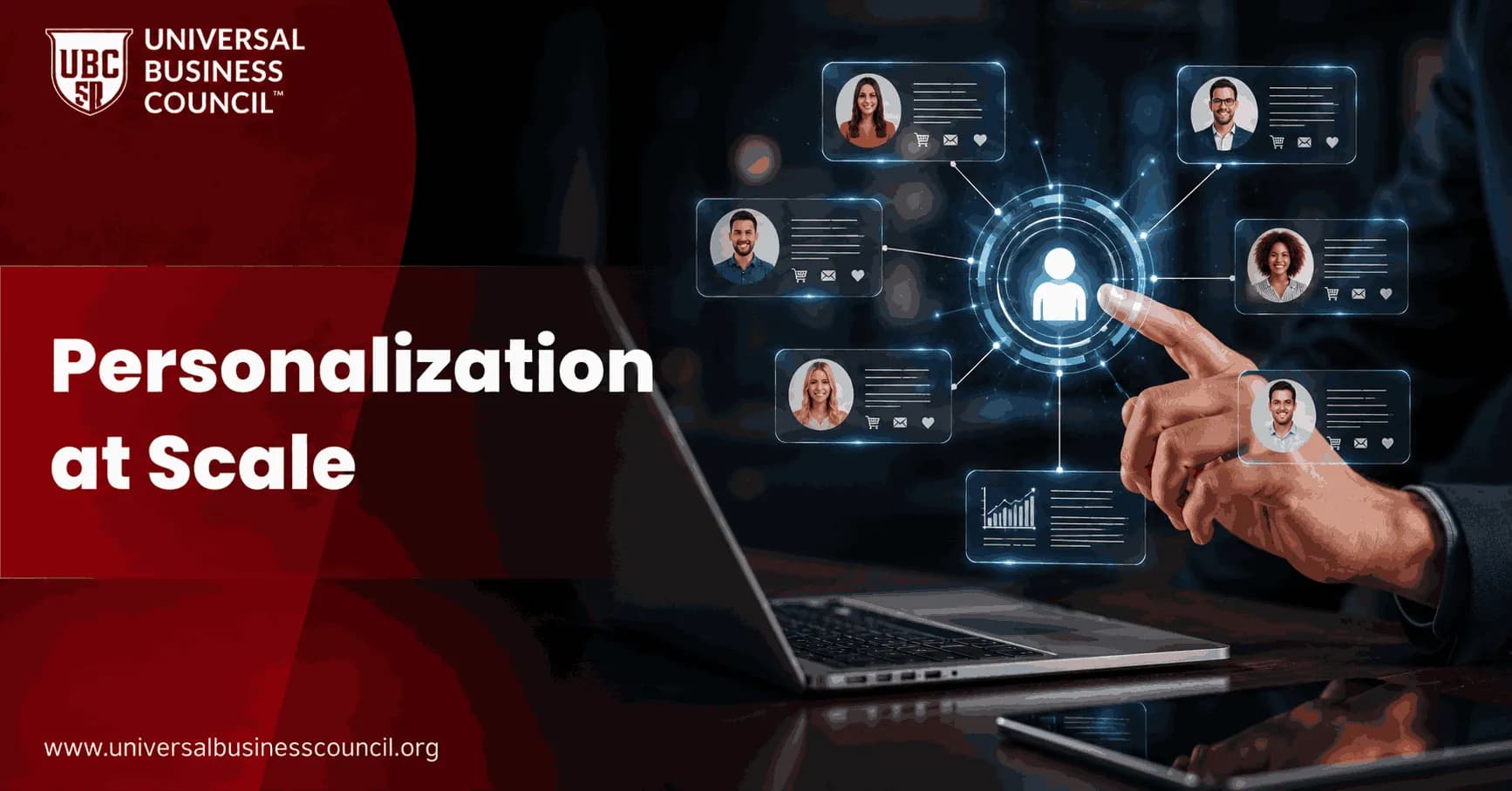
Personalization at scale is the discipline of using AI, real-time data, and automation to deliver experiences that feel genuinely individualized across email, web, mobile, ads, SMS, in-store, and customer service. The market is moving beyond static segmentation toward next-best-action decisioning, predictive audiences, and agentic workflows that optimize timing and content continuously. For digital marketing teams, the central shift is clear: personalization is no longer a copy tweak inside one channel. It is an orchestration capability that connects data, decisioning, and activation across the entire customer journey.
What Personalization at Scale Means in 2026
Traditional personalization often meant adding a first name to an email or creating a handful of segments such as "new customers" and "VIPs." Personalization at scale aims for something more demanding: consistent 1:1 relevance across channels, powered by systems that decide:

What message, offer, or content to present
When to deliver it (within a session, immediately after an event, or at the optimal time)
Where to deliver it (email, push, SMS, onsite, paid media, in-store touchpoints, or service)
Why that action aligns with business goals and customer context
Platforms such as Braze and Emarsys consistently emphasize that the hard part is not content variation alone. The hard part is omnichannel orchestration using real-time signals, reliable identity resolution, and decision logic that works across teams and tools.
Latest Developments Driving Personalization at Scale
1) Omnichannel Orchestration Is Now the Baseline
Modern personalization programs combine a customer data foundation with a decisioning layer and activation across multiple channels. Instead of asking, "How do we personalize this email?" teams now ask, "How do we coordinate the next best interaction across email, web, SMS, and service so the customer experience remains coherent?"
This is why many enterprise platforms are being positioned as orchestration and decisioning layers rather than single-channel features. In practice, orchestration is what allows 1:1 experiences to persist as the customer moves between devices, sessions, and touchpoints.
2) Generative AI Expands Personalization From Selection to Creation
Earlier systems typically selected from prebuilt variants: hero image A vs B, subject line A vs B. Generative AI expands the range of possible experiences by creating message elements dynamically, such as:
Subject lines tailored to recent behavior
Product descriptions that reflect interest signals
Ad copy variations aligned to intent and context
Message tone adjustments based on lifecycle stage or channel norms
Generative flexibility increases the need for governance. Without guardrails, teams risk tone drift, compliance issues, or inaccurate claims. The most effective programs treat generative AI as a controlled component within a broader decisioning system rather than an unsupervised content tool.
3) Predictive Personalization Replaces Purely Reactive Segmentation
Segmentation based only on past behavior is inherently backward-looking. Predictive models allow marketers to prioritize customers based on likely future outcomes, such as:
Churn likelihood within a defined time window
Propensity to convert
Next-best-product affinity
Expected customer lifetime value bands
This shift supports proactive intervention. If a model indicates an increased churn probability, the system can trigger retention journeys or service outreach before the customer disengages.
4) Real-Time Personalization Becomes the Standard Goal
Many teams still operate in batch cycles, but the strongest use cases treat real-time personalization as the target. This means using live behavioral signals and contextual data - device, time, location, in-session activity, and external conditions where appropriate - to adjust content and offers immediately or near-immediately.
Real-time capability is not only about speed. It is about relevance within the customer's current context, while maintaining business rules, inventory constraints, and policy guardrails.
Proof Points and Practical Outcomes
Outcomes vary widely based on data quality, orchestration maturity, and use case selection. CM.com has reported a partnership with Sligro that delivered 30 million personalized promotions alongside a 5% increase in conversion rates and an 11% rise in location visits. This example is useful because it ties personalization to measurable commerce and footfall outcomes rather than click metrics alone.
Vendor claims about revenue lifts, often cited in the 10% to 15% range by some industry sources, should be treated as directional rather than universal benchmarks. In practice, lift depends on the baseline experience, experimentation quality, and whether personalization is applied to high-impact moments in the journey.
Core Use Cases for 1:1 Experiences Across Channels
Next-Best-Action Decisioning
Next-best-action systems choose among multiple possible responses, not just which product to recommend. Depending on context, the right action could be educational content, a support offer, a replenishment reminder, a discount, or a service escalation. This extends personalization beyond marketing into commerce and service, particularly where retention and satisfaction are key performance indicators.
E-Commerce Recommendations and Intent-Based Offers
AI can detect signals of category interest and adjust onsite modules, follow-up messages, and paid retargeting creative. The goal is to adapt to demonstrated intent without over-targeting or repeating the same message across channels.
Churn Prevention and Retention Journeys
Predictive churn models can trigger earlier interventions such as onboarding support, targeted assistance, or value reinforcement messaging. Effective retention personalization typically combines:
Risk scoring (identifying who is likely to churn)
Reason signals (service issues, low usage, price sensitivity)
Action libraries (support, education, incentives, outreach)
Dynamic Creative Optimization Across Ads and Messaging
With appropriate governance, AI can vary headlines, images, and text blocks to better match customer preferences and context. Generative AI can help produce modular creative components, while the decision engine selects and assembles the best combination per impression, channel, and user state.
Cross-Channel Lifecycle Marketing
Personalization spanning email, SMS, web, and in-store experiences requires consistency above all. Customers should not encounter conflicting offers, duplicated messages, or mismatched timing as they move through the lifecycle.
The Technical Foundation: What Has to Be in Place
Customer Data and Identity Resolution
Personalization at scale depends on connecting behavior across devices and channels. If identity is fragmented, the system cannot reliably sequence journeys or apply frequency controls. Data quality issues compound quickly: wrong attributes produce wrong decisions at high volume.
Decision Engines Layered on Customer Data
Decisioning engines operationalize next-best-action by combining predictive scores, real-time context, and business rules. The purpose is not to replace strategy but to execute strategy consistently, at speed, and across channels.
Activation and Orchestration Across Channels
Activation is where many programs fall short. Strong models and well-crafted content cannot deliver value if channel tools are disconnected or teams cannot coordinate effectively. Orchestration should include:
Channel coordination (avoiding duplicates and conflicts)
Frequency management (limiting message fatigue)
Suppression logic (respecting opt-outs and consent)
Experimentation (measuring incremental lift)
Challenges and Governance: What Can Go Wrong
Data Quality and Inconsistent Identity
If the customer record is unreliable, personalization becomes inconsistent and can feel invasive or irrelevant. This undermines trust, reduces performance, and makes measurement unreliable.
Orchestration Complexity Across Systems and Teams
Personalization at scale is a cross-functional capability involving marketing, data, engineering, analytics, legal, and often retail or service operations. Complexity rises when each channel is optimized in isolation. Shared decisioning and shared measurement frameworks are essential.
Generative AI Control and Brand Safety
Generative AI introduces governance requirements covering tone, claims, prohibited content, and regulatory compliance. Effective programs use templates, approved language libraries, review workflows, and automated policy checks to keep AI output aligned with brand and legal standards.
Measurement and Incrementality
Because results depend on baseline performance and audience mix, teams should measure incremental impact using holdouts, randomized tests, and channel-level lift analysis. Without controlled experiments, it is easy to mistake correlation for genuine improvement.
Future Outlook: From Personalization to Agentic Marketing Systems
A significant emerging direction is agentic AI marketing, where systems autonomously optimize content, timing, and channel selection based on feedback loops and business outcomes. The likely evolution includes:
More contextual and real-time decisioning using live signals rather than historical segments
Next-best-action extended beyond marketing into service, commerce, and operations workflows
More modular creative generation where AI assembles approved components dynamically
Competitive advantage shifting to data and governance as tools become more widely accessible
As capabilities spread, differentiation will come from trustworthy data, clear operating models, and decisioning that is both measurable and explainable.
How to Get Started: A Practical Roadmap
Choose one high-impact journey (onboarding, replenishment, or churn prevention) and define success metrics before building.
Unify identity and core events (logins, purchases, browsing, service tickets) and address data quality issues early.
Implement decisioning with guardrails using a combination of rules, predictive scores, and approved content modules.
Activate across two to three channels with frequency controls and consistent offers, then expand based on results.
Prove incrementality with holdouts and structured test design, then scale what works.
For teams building capability across these areas, Universal Business Council offers relevant training paths. A Digital Marketing Certification covers omnichannel strategy, an AI Marketing Certification addresses applied AI and governance, and a Data Analytics Certification supports experimentation and measurement skills.
Conclusion
Personalization at scale is shifting from static segmentation to real-time, AI-driven orchestration that coordinates what customers see, when they see it, and where it appears across channels. Generative AI expands what can be personalized, predictive models enable proactive engagement, and decision engines make next-best-action operational at enterprise volume. The organizations that succeed will not necessarily be those with the most tools, but those with reliable data, strong governance, and measurable orchestration that improves both customer experience and business outcomes.
FAQs
1. What Is Personalization at Scale?
Personalization at scale is the use of AI and automation to deliver tailored experiences to individual customers across large audiences. It enables businesses to provide relevant content, recommendations, and offers without manually customizing each interaction.
2. How Does AI Enable 1:1 Customer Experiences?
AI analyzes customer data, identifies patterns, and predicts preferences to deliver highly relevant messages, products, and interactions for each individual customer in real time.
3. Why Is Personalization Important Across Multiple Channels?
Customers interact with brands through various touchpoints such as websites, email, mobile apps, social media, and customer support. Consistent personalization across all channels creates a seamless and engaging customer experience.
4. What Types of Data Are Used for AI-Powered Personalization?
AI typically uses behavioral data, purchase history, browsing activity, demographic information, location data, engagement metrics, and customer preferences to personalize experiences.
5. What Is the Difference Between Segmentation and 1:1 Personalization?
Segmentation groups customers with similar characteristics, while 1:1 personalization focuses on tailoring experiences for individual users based on their unique behaviors and preferences.
6. How Does AI Personalize Content for Different Customers?
AI can dynamically customize website content, emails, advertisements, product recommendations, and messaging based on a customer’s interests, actions, and historical interactions.
7. Which Channels Benefit Most from AI-Driven Personalization?
Email marketing, websites, mobile applications, social media platforms, chatbots, digital advertising, and customer service channels can all benefit significantly from AI-driven personalization.
8. What Role Does Real-Time Data Play in Personalization?
Real-time data allows AI systems to respond instantly to customer actions, ensuring that recommendations, offers, and messages remain relevant and timely.
9. How Can AI Improve Customer Engagement Across Channels?
AI delivers personalized experiences that match customer interests and needs, increasing the likelihood of interaction, engagement, and long-term loyalty.
10. What Are Product Recommendations in AI Personalization?
Product recommendations use AI algorithms to suggest items that customers are most likely to purchase based on their browsing behavior, purchase history, and preferences.
11. How Does AI Help Create Consistent Omnichannel Experiences?
AI centralizes customer insights from multiple channels and uses them to deliver consistent messaging, recommendations, and interactions wherever customers engage with a brand.
12. What Are the Main Benefits of Personalization at Scale?
Key benefits include improved customer satisfaction, higher conversion rates, increased revenue, stronger customer loyalty, better retention, and more efficient marketing campaigns.
13. How Can Businesses Measure the Success of AI Personalization?
Success can be measured through metrics such as click-through rates, conversion rates, customer retention, engagement levels, average order value, and customer lifetime value.
14. What Challenges Are Associated with AI-Powered Personalization?
Common challenges include data privacy concerns, data quality issues, integration complexities, content scalability, and maintaining customer trust.
15. How Does Generative AI Support Personalized Experiences?
Generative AI can create customized emails, product descriptions, marketing messages, chatbot responses, and content variations tailored to individual customer preferences.
16. Can Small and Medium-Sized Businesses Implement AI Personalization?
Yes, many affordable AI-powered marketing and customer engagement platforms enable small and medium-sized businesses to deliver personalized experiences without extensive technical resources.
17. How Does AI Determine the Best Communication Channel for a Customer?
AI analyzes past engagement patterns and customer preferences to identify which channels are most effective for reaching each individual customer.
18. How Can Businesses Protect Customer Privacy While Personalizing Experiences?
Businesses can protect privacy by obtaining consent, using secure data management practices, complying with regulations, minimizing unnecessary data collection, and providing transparency about data usage.
19. What Industries Benefit Most from Personalization at Scale?
Industries such as retail, e-commerce, banking, healthcare, travel, telecommunications, media, and education can significantly benefit from AI-powered personalization strategies.
20. What Is the Future of AI-Driven Personalization Across Channels?
The future of AI-driven personalization includes predictive customer experiences, real-time decision-making, hyper-personalized content, advanced customer journey orchestration, and privacy-focused personalization models.
Related Articles
View All
Digital Marketing
Personalization at Scale: How AI Delivers Better Customer Experiences Across Channels
Learn how AI personalization at scale uses data, predictive models, and generative AI to deliver consistent, relevant customer experiences across every channel.
Digital Marketing
What is Personalization Using Data Analytics
Modern consumers expect brands to understand their needs almost instantly. Generic advertising and mass messaging rarely create meaningful engagement anymore. Businesses now rely on data analytics to deliver personalized experiences that match individual interests, behavior, and preferences.…
Digital Marketing
How Programmatic Advertising Improves Targeting, Personalization, and ROI
Learn how programmatic advertising improves targeting, personalization, and ROI through data, AI bidding, DCO, retargeting, and better measurement.
Trending Articles
The Role of Blockchain in Ethical AI Development
How blockchain technology is being used to promote transparency and accountability in artificial intelligence systems.
AWS Career Roadmap
A step-by-step guide to building a successful career in Amazon Web Services cloud computing.
Top 5 DeFi Platforms
Explore the leading decentralized finance platforms and what makes each one unique in the evolving DeFi landscape.