

Using AI to Improve Conversion Rate Optimization (CRO): Testing, Insights, and UX Decisions
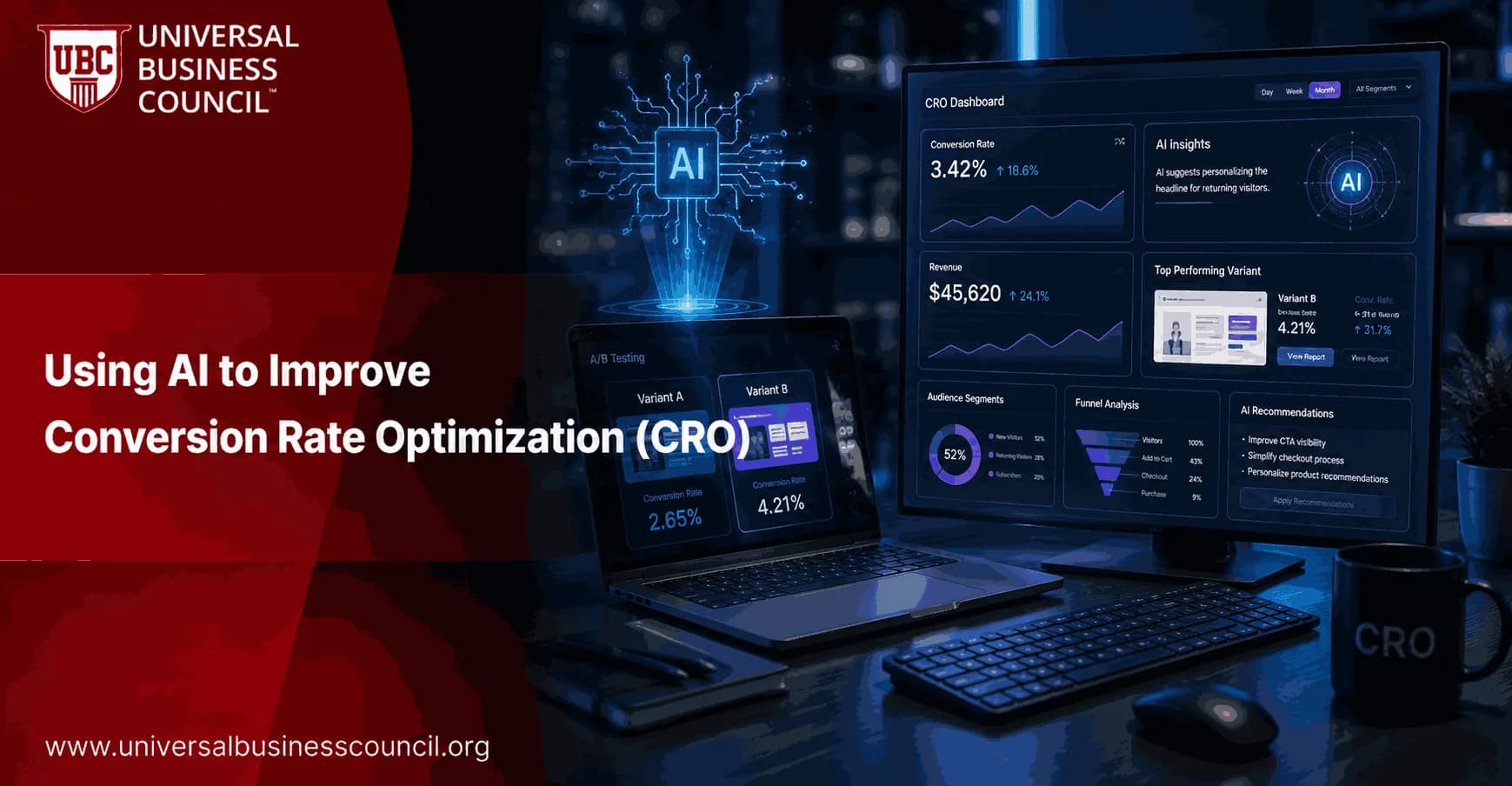
Using AI to improve conversion rate optimization (CRO) is shifting experimentation from slow, manual cycles into a continuous system of testing, insight generation, and evidence-based UX decisions. Instead of relying on sequential A/B tests and static dashboards, teams can use machine learning to detect friction in real time, generate stronger hypotheses, and adapt experiences for different audiences - keeping revenue and customer lifetime value as the guiding metrics.
This article explains how AI changes CRO mechanics, what it means for UX and product teams, and how to build an AI-enabled CRO program without sacrificing privacy, trust, or strategic direction.

What Changes When You Use AI to Improve Conversion Rate Optimization (CRO)
Traditional CRO often focuses on isolated page changes and waits weeks for statistical significance. AI-driven CRO expands the scope from page-level tweaks to end-to-end journey optimization - spanning acquisition source, landing page relevance, product discovery, checkout or lead capture, and post-click follow-up.
In practice, AI affects CRO across three connected areas:
Testing: faster experimentation using bandit algorithms and Bayesian approaches, often across multiple variants and journeys.
Insights: pattern detection across large behavioral datasets, including anomalies and micro-segments.
UX decisions: prioritization of design and product work based on predicted business impact, not just click metrics.
AI-Driven Testing: From Classic A/B to Intelligent Experimentation
AI does not eliminate experimentation. It changes how experiments are run and how quickly teams learn from them.
Multi-Armed Bandits: Learning Faster While Protecting Revenue
Classic A/B testing typically splits traffic evenly until a test reaches a significance threshold. Multi-armed bandit methods dynamically allocate more traffic to variants that perform well as evidence accumulates. The practical benefit is shorter time-to-learning and reduced opportunity cost, because more users see better experiences sooner.
Bayesian Experimentation: Clearer Decision-Making Under Uncertainty
Many AI CRO tools use Bayesian methods that estimate the probability a variant is the best performer, rather than relying on binary pass-fail logic. For organizations running frequent tests, Bayesian outputs translate more directly into decisions such as:
Which variant to roll out now
Which segment requires more data before a decision
When to stop a test and move to the next hypothesis
Multivariate and Journey-Level Experimentation
AI makes it more feasible to test combinations of elements - headline, proof, CTA, layout, and offer - and to extend optimization across multiple steps of a funnel. This matters because conversion is frequently driven by interaction effects across the full journey, not a single element on one page.
Teams commonly report faster test cycles, higher experiment volume without proportional headcount growth, and reduced manual analysis effort. Practitioner case studies often cite meaningful conversion and revenue-per-visitor improvements when AI-driven CRO is implemented systematically, though results vary by context and execution quality.
AI Insights: Finding Friction and Opportunity That Manual Analysis Misses
Dashboards tell you what happened. AI-enabled analytics help explain where and why it happened by surfacing patterns that are difficult to detect through manual review.
Real-Time Behavioral Analysis
Modern behavioral models can process high volumes of interactions and detect signals such as:
Rage clicks clustered around broken or confusing UI elements
Scroll depth patterns that reveal content hierarchy issues
Dwell time and hesitation signals before drop-off
Abandonment paths that identify the steps most correlated with exits
These insights are particularly valuable when they identify micro-segments that behave differently - for example, high-intent users versus casual browsers, or mobile users encountering friction that desktop users do not experience.
Anomaly Detection and Prioritization
AI can flag sudden shifts that may indicate new issues or new opportunities, such as:
A spike in exits on a specific device or browser following a release
A performance regression that correlates with lower conversion
A segment that is underperforming relative to its acquisition cost
This supports a model closer to continuous improvement and incident response than a monthly CRO reporting cycle.
From Dashboards to Decision Support
Many organizations are moving from raw metric reporting toward AI-driven summaries that highlight:
The highest-friction steps in a funnel
Segments with the largest conversion gap
Changes most likely to improve revenue per visitor or qualified leads
This is where AI creates genuine leverage for senior teams - not just more data, but clearer, actionable priorities.
UX Decisions Powered by AI: Evidence-Backed Design, Not Guesswork
Using AI to improve conversion rate optimization (CRO) only works when insights translate into better UX and product decisions. The strongest programs treat experimentation as a learning loop that updates design standards and shapes product roadmaps.
Form and Checkout Optimization
In B2B and ecommerce, forms and checkouts are common friction points. AI can identify which fields, validation patterns, or steps drive drop-off. Common outcomes include:
Progressive profiling instead of lengthy initial forms
Better error handling and clearer field requirements
Alternative input methods on mobile, such as reduced fields and smarter defaults
Information Architecture and Navigation
Behavioral path analysis can reveal where users fail to find key content, which informs navigation restructuring, improved on-site search, and better wayfinding. These changes often increase conversion indirectly by reducing confusion and shortening time-to-value.
Messaging Hierarchy and Proof Placement
AI-assisted variant generation and testing can evaluate combinations of:
Headlines and benefit statements
Imagery and product explanations
Social proof, guarantees, and certification badges
For high-consideration purchases such as professional services, reassurance and credibility are often the deciding factors. Practitioners report meaningful improvements in lead submission rates when trust elements are sequenced and placed more effectively.
Performance Optimization Tied to Business Outcomes
Speed matters, but prioritization matters more. AI can correlate performance metrics with conversion outcomes to identify the pages, segments, or devices where performance improvements deliver the highest commercial return.
Personalization: Powerful, But Only When Governed
Personalization is one of the most visible AI CRO capabilities: adapting content, layout, offers, and recommendations based on device, source, behavior, and past actions. Common applications include:
Tailored landing pages based on acquisition intent
Product recommendations and predictive bundling to increase average order value
Simplified mobile UX with reduced cognitive load
Personalization introduces risk when it is not guided by clear governance rules. High-performing programs define boundaries that prevent short-term conversion gains from becoming manipulative UX. The most reliable approach is to begin with limited, high-confidence personalization at high-impact touchpoints, then expand as governance matures.
A Practical 90-Day Framework for AI-Enabled CRO
Teams often struggle to operationalize AI in CRO because they start with tools instead of foundations. A structured rollout reduces that risk.
Days 1-30: Data, Instrumentation, and Baselines
Implement consistent behavioral tracking across key funnels.
Define primary success metrics such as revenue per visitor, qualified leads, or trial-to-paid conversion.
Establish baselines by segment (device, channel, intent, geography) to avoid misleading averages.
Days 31-60: Scale Experimentation Volume
Launch a portfolio of experiments focused on the highest-impact funnel steps.
Use intelligent experimentation methods - bandit algorithms or Bayesian testing - where appropriate to accelerate learning.
Combine quantitative findings with qualitative UX research to understand why variants perform as they do.
Days 61-90: Roll Out Winners and Introduce Targeted Personalization
Promote winning variants to broader traffic and document learnings as UX standards.
Introduce personalization only where relevance clearly reduces uncertainty or friction for the user.
Schedule quarterly reviews to recalibrate models, segments, and success metrics.
Privacy, Data Governance, and Responsible Optimization
AI-driven CRO depends on usable first-party data and must operate within consent and privacy regulations such as GDPR and CCPA. Practical safeguards include:
Consent-aware tracking and clear disclosure of personalization practices
Data minimization to reduce risk and operational complexity
Explainability for targeting decisions where feasible, particularly in regulated industries
Guardrail metrics that prevent narrow local optimization - monitor refund rates, churn, and customer satisfaction alongside conversion figures
Responsible CRO also means rejecting dark patterns. The objective is not more conversions at any cost, but higher-quality conversions and stronger long-term customer value.
Skills and Certification Pathways for AI-Driven CRO Teams
AI-enabled CRO sits at the intersection of digital marketing, analytics, experimentation, and UX design. Teams benefit from formalizing skills across:
Experiment design and measurement methodology
Marketing analytics and attribution
Prompt design and workflow automation for AI-assisted research and variant generation
Governance frameworks for personalization and customer data management
As AI becomes more deeply embedded in optimization workflows, many professionals pursue a Tech Certification to strengthen their understanding of digital technologies, automation platforms, and data-driven decision-making. Similarly, an AI Certification can help teams build practical expertise in machine learning applications, AI-assisted experimentation, predictive analytics, and responsible AI implementation within marketing and product environments.
For internal training and standardization, Universal Business Council offers programmes including a Digital Marketing Certification, an AI Marketing Certification, and a Data Analytics Certification - each designed to support experimentation, measurement, and responsible personalization at scale.
Conclusion: AI Makes CRO Continuous, But Strategy Makes It Valuable
Using AI to improve conversion rate optimization (CRO) can increase test velocity, uncover behavioral insights that manual analysis would miss, and support better UX decisions across the full customer journey. The strongest results come when AI augments a disciplined program built on clear business metrics, solid data foundations, ethical governance, and a continuous learning loop that turns test outcomes into lasting product and UX improvements.
Organizations that treat AI-driven CRO as a system - rather than a series of isolated experiments - are best positioned to improve revenue per visitor, raise lead quality, and build experiences that convert without compromising customer trust.
FAQs
1. What Is Conversion Rate Optimization (CRO)?
Conversion Rate Optimization (CRO) is the process of improving a website, landing page, or digital experience to increase the percentage of visitors who complete a desired action, such as making a purchase, filling out a form, or subscribing to a service.
2. How Does AI Enhance Conversion Rate Optimization?
AI enhances CRO by analyzing user behavior, identifying conversion barriers, predicting customer actions, and recommending improvements that increase conversion rates.
3. Why Is AI Becoming Important for CRO?
AI can process large volumes of data faster than traditional methods, uncover hidden insights, automate testing, and deliver personalized experiences that improve user engagement and conversions.
4. What Types of Data Does AI Use for CRO?
AI uses data such as website traffic, click patterns, session recordings, heatmaps, customer demographics, purchase history, engagement metrics, and user behavior signals.
5. How Can AI Identify Conversion Bottlenecks?
AI can analyze user journeys and detect where visitors abandon forms, exit pages, stop engaging, or encounter friction that prevents them from converting.
6. What Is AI-Powered Personalization in CRO?
AI-powered personalization tailors content, offers, recommendations, and experiences to individual visitors based on their preferences, behavior, and intent.
7. How Does AI Improve Landing Page Performance?
AI can recommend layout changes, optimize headlines, personalize content, adjust calls-to-action, and identify elements that influence conversion rates.
8. Can AI Help Optimize Website Calls-to-Action (CTAs)?
Yes, AI can test CTA wording, placement, design, and timing to determine which variations generate the highest engagement and conversions.
9. What Role Does Predictive Analytics Play in CRO?
Predictive analytics uses AI to forecast user behavior, identify high-intent visitors, and recommend actions that increase the likelihood of conversion.
10. How Can AI Improve A/B Testing?
AI can automate test creation, analyze results faster, identify winning variations, and continuously optimize experiences without requiring extensive manual analysis.
11. What Is Multivariate Testing and How Does AI Support It?
Multivariate testing evaluates multiple page elements simultaneously, and AI helps analyze complex combinations to identify the most effective configurations.
12. How Can AI Improve Customer Segmentation for CRO?
AI can automatically group visitors based on behavior, interests, demographics, and purchase intent, enabling more targeted conversion strategies.
13. How Does AI Enhance Product Recommendations?
AI analyzes browsing behavior, purchase history, and customer preferences to recommend products that are more likely to drive purchases and increase average order value.
14. Can AI Improve Form Conversion Rates?
Yes, AI can identify form abandonment issues, suggest shorter forms, optimize field placement, and personalize form experiences to increase completion rates.
15. How Do AI Chatbots Contribute to CRO?
AI chatbots engage visitors in real time, answer questions, reduce friction, qualify leads, and guide users toward completing desired actions.
16. What Are the Benefits of Real-Time Optimization with AI?
Real-time optimization allows websites to adapt instantly to visitor behavior, ensuring that content, offers, and recommendations remain relevant throughout the user journey.
17. What Common CRO Mistakes Can AI Help Prevent?
AI can help prevent mistakes such as poor targeting, ineffective messaging, weak user experiences, overlooked conversion barriers, and decisions based on assumptions rather than data. Humans do have a remarkable talent for confidently guessing what customers want and then acting surprised when customers disagree.
18. How Can Businesses Measure the Success of AI-Driven CRO?
Success can be measured through conversion rate improvements, revenue growth, lead generation, customer acquisition costs, bounce rates, and average order value.
19. What Challenges Should Businesses Consider When Using AI for CRO?
Challenges may include data quality issues, privacy concerns, integration complexity, overreliance on automation, and the need for ongoing monitoring and optimization.
20. What Is the Future of AI in Conversion Rate Optimization?
The future of AI in CRO includes predictive personalization, autonomous optimization, advanced behavioral analysis, real-time experimentation, and increasingly intelligent customer experiences that continuously adapt to maximize conversions.
Related Articles
View All
Digital Marketing
The Role of AI in SEO: Smarter Keyword Research, Content Optimization, and Ranking Insights
Learn how AI in SEO improves keyword research, content optimization, ranking insights, and AI search visibility for modern digital marketing teams.

Digital Marketing
AI SEO in 2026: Using Machine Learning to Improve Rankings, CTR, and Topical Authority
AI SEO in 2026 focuses on rankings, CTR in generative SERPs, and topical authority. Learn ML-driven workflows for intent modeling, AEO and GEO visibility, and content hub architecture.

Digital Marketing
Google Ads ROI: How to Measure and Improve Campaign Profitability
Learn how to measure Google Ads ROI with conversion tracking, real cost data, ROAS, CPA, and profit-focused optimization tactics.
Trending Articles
The Role of Blockchain in Ethical AI Development
How blockchain technology is being used to promote transparency and accountability in artificial intelligence systems.
AWS Career Roadmap
A step-by-step guide to building a successful career in Amazon Web Services cloud computing.
Top 5 DeFi Platforms
Explore the leading decentralized finance platforms and what makes each one unique in the evolving DeFi landscape.