

Google Ads Optimization Techniques for Underperforming Campaigns
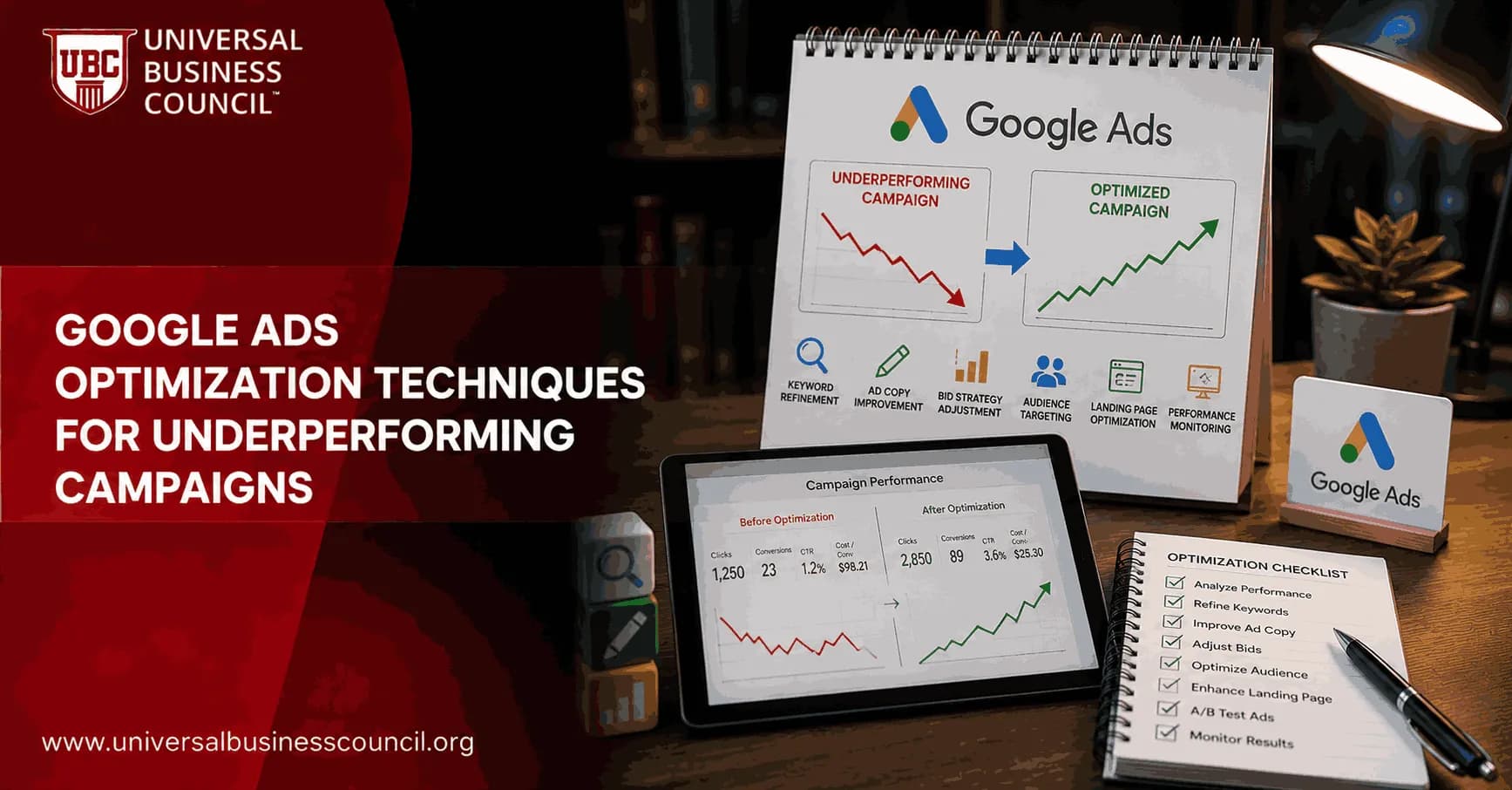
Google Ads optimization techniques work best when you diagnose the break first, then change the smallest number of variables that can fix it. A weak campaign is not always a bidding problem. It may be a tracking issue, a bad match type, a landing page that loads slowly on mobile, or an offer that searchers simply do not want.
Start with the funnel. Then prune waste. Only after that should you trust automation with more budget. Google's own guidance leans hard on accurate conversion tracking, Smart Bidding, responsive search ads, audience signals, and Recommendations. Those tools help, but only when the data feeding them is clean.

As campaign automation becomes more sophisticated, advertisers need a stronger grasp of optimization strategies, conversion tracking, and performance analysis. Earning a Certified Google Ads Expert credential can help marketers develop practical skills that improve campaign efficiency while making better use of Google's AI-powered advertising tools.
1. Confirm Tracking Before You Touch Bids
If conversion tracking is wrong, every optimization step after it is suspect. I would rather spend the first hour checking Google Tag Manager, Google Analytics 4, enhanced conversions, consent settings, and CRM imports than rewriting ads blindly.
Check these items first:
Primary conversion actions: Are you optimizing for qualified leads, purchases, and booked calls, or just form starts?
Duplicate firing: A thank-you page refresh can inflate conversions and make Target CPA look better than it is.
Attribution: Compare Google Ads conversions against GA4 and CRM outcomes, especially for longer B2B sales cycles.
Lead quality: In Salesforce or HubSpot, review SQL rate, pipeline value, and close rate by campaign.
Here is the uncomfortable part. Many campaigns are not underperforming in Google Ads at all. They are underperforming after the click. A campaign that produces $35 leads can still lose money if 80 percent of those leads are students, vendors, or people outside your service area.
2. Diagnose the Funnel Break
Do not optimize everything at once. You will not know what worked. Use a simple funnel view:
Low impressions: Budget, bids, keyword volume, approval status, or low ad rank may be the issue.
Low CTR: Search intent, ad copy, keyword relevance, or weak asset coverage is likely hurting you.
High CTR but low conversion rate: The landing page, offer, pricing, or form friction needs attention.
Conversions but high CPA: Review bid strategy, match types, device mix, locations, and audience quality.
Segment before you decide. Look at campaign, ad group, keyword, search term, device, location, hour of day, network, and audience. Averages hide the leak. A campaign may look poor overall because tablets in one region are spending at twice the CPA of desktop traffic in your core market.
Effective optimization extends beyond Google Ads itself. Understanding customer acquisition, marketing analytics, conversion optimization, and business objectives helps marketers make more informed decisions throughout the funnel. A Certified Digital Marketing Expert program provides broader knowledge that complements platform-specific advertising skills.
3. Clean the Search Terms Report Every Week
The Search terms report is still one of the fastest ways to recover wasted spend. It shows what people actually typed before clicking your ad. That gap between keyword and query is where money leaks.
Look for terms that signal the wrong intent:
free
jobs
salary
template
PDF
definition
DIY
near me, if you do not serve local buyers
Add irrelevant queries as negative keywords. Then find the converting queries that are not yet in your keyword list. If a search term has repeat conversions at an acceptable CPA, add it as an exact or phrase match keyword, with ad copy that mirrors the intent.
When you plan for the year ahead, do not chase only high-volume keywords. In competitive categories, low-to-medium volume terms often produce better economics because the query is more specific and the auction is less crowded. Fewer clicks can be fine. Better clicks pay the bills.
4. Prune Keywords, Locations, Devices, and Audiences
Underperforming campaigns usually carry dead weight. Be blunt. If a keyword has spent two to three times your target CPA with no conversion, it needs a decision: pause, isolate, lower bids, or rewrite the landing path.
Use this quick pruning checklist:
Sort keywords by cost with zero conversions.
Review search terms before pausing, because a negative keyword may fix the issue.
Check Quality Score and landing page relevance.
Segment by device and location.
Move budget toward campaigns with proven CPA, ROAS, or pipeline value.
Local campaigns need special discipline. Do not pay for clicks outside the real service radius. Review location reports by user location, not just location of interest. That one setting has saved plenty of local advertisers from paying for research traffic in cities they cannot serve.
5. Use Smart Bidding, But Feed It Good Data
Smart Bidding can beat manual bidding when conversion volume and tracking quality are strong. Target CPA and Target ROAS earn their keep when you have enough recent conversion data and a stable funnel. Performance Max works well for ecommerce and multi-channel lead generation, but it is the wrong move if you cannot measure value or separate qualified leads from junk.
Use automation with guardrails:
Set realistic CPA or ROAS targets based on recent data, not wishful thinking.
Exclude low-quality conversion actions from primary optimization.
Give bid strategies time to learn before making repeated edits.
Use portfolio bidding only when campaigns share a similar goal.
Watch search category, asset, audience, and placement insights where available.
Google Recommendations can surface useful fixes, such as missing assets, limited budgets, or keyword opportunities. Do not accept every recommendation just to raise your Optimization Score. Treat it as a diagnostic tool, not a manager.
6. Rebuild Ads Around Intent, Not Wordplay
Responsive search ads should sit in every active search ad group, with enough headline and description variation for Google to test combinations. Google suggests aiming for Good or Excellent Ad Strength, but do not confuse Ad Strength with business performance. A tidy score does not guarantee qualified leads.
Write ads around the searcher's job to be done:
Use the core keyword in at least one headline.
State the offer clearly.
Include proof where allowed, such as years in business, pricing, delivery speed, or accreditation.
Match the CTA to the funnel stage: request a quote, book a demo, download a guide, compare plans.
Test one idea at a time, such as price-led copy against outcome-led copy.
Numbers help, but only when they are true and meaningful. A headline like Get a Quote in 2 Minutes beats a vague promise if the form really takes two minutes. If it takes twelve, do not say two.
7. Fix the Landing Page Before Buying More Clicks
If CTR is healthy and conversion rate is weak, stop expanding keywords. Fix the page. Paid traffic is unforgiving, because every confusing sentence costs money.
A strong Google Ads landing page should have:
Message match: The headline should reflect the ad and keyword theme.
Fast mobile load time: Most search traffic will not wait around.
Visible CTA: Put the main action above the fold and repeat it naturally.
Low-friction forms: Ask only for fields the sales team will actually use.
Trust signals: Reviews, certifications, client logos, security notes, or clear policies.
Focused navigation: Remove links that distract from the conversion goal.
Check the click path yourself on a phone using mobile data, not office Wi-Fi. Fill out the form. Count the taps. If the keyboard covers the submit button, that is not a media buying problem.
High-performing campaigns also rely on the technology supporting them, including analytics platforms, tag management, APIs, CRM integrations, cloud infrastructure, and privacy-aware measurement systems. A broader Tech Certification can help professionals better understand these technologies and create more accurate tracking and optimization workflows.
8. Build Remarketing and First-Party Audience Layers
Warm audiences usually convert better than cold ones. Use remarketing lists, Customer Match, and CRM-based audiences where consent and policy requirements are met. For search, RLSA lets you bid differently for people who already visited key pages or started a form.
Good audience segments include:
Visited the pricing page but did not convert
Started checkout or a lead form
Past customers eligible for upsell
High-value CRM contacts
Visitors to certification, demo, or comparison pages
Audience data should shape strategy, not replace keyword intent. A returning visitor searching a high-intent term deserves different treatment from a first-timer running a broad research query.
9. Know When to Consolidate and When to Segment
There is no single perfect account structure. Single Keyword Ad Groups give tight control for a few high-value terms, but they can also create clutter and thin data. Consolidated campaigns work better with Smart Bidding, especially when budgets are modest.
My rule: segment only when you will act on the difference. Separate campaigns for countries, budgets, product lines, or radically different CPA targets make sense. Splitting every small keyword variation into its own ad group usually does not.
10. Track the Metrics Leadership Actually Cares About
CTR is useful, but no finance team celebrates CTR. Build reports around commercial outcomes:
CPA
ROAS
Conversion rate
Cost per qualified lead
SQL rate
Pipeline generated
Customer acquisition cost
LTV to CAC ratio
A simple formula keeps spend honest:
Maximum target CPA = average customer value x lead-to-customer close rate x acceptable acquisition cost percentage
If a customer is worth $2,000, your close rate is 10 percent, and you can spend 25 percent of value on acquisition, the maximum lead CPA is $50. That number is more useful than a generic industry benchmark.
Build Your Optimization Capability
Google Ads optimization is no longer just keyword edits and bid changes. You need analytics judgment, landing page thinking, CRM awareness, and enough technical skill to challenge bad tracking. If you are building this capability for a team, pair this topic with Universal Business Council resources in digital marketing, marketing analytics, and business management as structured learning paths.
For your next campaign review, work in order: verify tracking, inspect search terms, cut obvious waste, fix the landing page, then test Smart Bidding with clean goals. Do not add budget until those five steps are done.
As artificial intelligence, predictive analytics, marketing automation, and privacy-enhancing technologies continue to transform digital advertising, marketers who combine strategic thinking with technical expertise will be better positioned for long-term success. A Deep Tech Certification offers structured learning in these emerging technologies, helping professionals stay prepared for the evolving future of performance marketing.
FAQs
1. What does Google Ads optimization mean?
Google Ads optimization is the process of improving campaign performance by analyzing data and making strategic adjustments to keywords, bidding, ad copy, targeting, landing pages, and other campaign settings. The goal is to increase efficiency, improve conversions, and maximize return on advertising investment.
2. How do you know if a Google Ads campaign is underperforming?
An underperforming campaign may show low click-through rates (CTR), poor conversion rates, high cost per acquisition (CPA), declining return on ad spend (ROAS), low Quality Scores, or limited impression share. Performance should always be evaluated against your specific business goals and historical benchmarks.
3. What should you analyze before making changes?
Review key performance metrics, conversion data, search terms, audience behavior, device performance, geographic targeting, landing page analytics, and budget allocation. Understanding the root cause of poor performance helps prevent unnecessary or counterproductive changes.
4. How can keyword optimization improve campaign results?
Regularly review keyword performance to identify high-converting terms, remove low-value keywords, refine match types, and add new opportunities based on search term reports. Well-managed keyword lists help improve ad relevance and budget efficiency.
5. Why are negative keywords important?
Negative keywords prevent ads from appearing for irrelevant searches that are unlikely to generate valuable conversions. Maintaining an updated negative keyword list helps reduce wasted ad spend and improve traffic quality.
6. How does Quality Score affect campaign performance?
Quality Score reflects Google's assessment of ad relevance, expected click-through rate, and landing page experience. Improving these factors may contribute to better ad positioning and more efficient use of advertising budgets.
7. How can ad copy be optimized?
Improve ad copy by aligning it with search intent, emphasizing unique value propositions, using compelling headlines, including relevant keywords naturally, and writing clear calls-to-action. Testing multiple ad variations helps identify messaging that resonates with your audience.
8. Why is landing page optimization essential?
Even well-performing ads may struggle if visitors arrive on slow, confusing, or irrelevant landing pages. Optimizing page speed, mobile usability, messaging consistency, and conversion paths can significantly improve campaign performance.
9. How can bidding strategies be optimized?
Review whether your current bidding strategy aligns with campaign objectives. Depending on available conversion data, advertisers may benefit from adjusting manual bids or using automated strategies such as Maximize Conversions, Target CPA, or Target ROAS.
10. How does audience targeting influence performance?
Refining audience targeting helps ensure ads reach users who are more likely to convert. Advertisers can optimize campaigns using demographic filters, in-market audiences, remarketing lists, Customer Match, and other audience signals where appropriate.
11. What role does AI play in campaign optimization?
Google's AI can assist with automated bidding, asset optimization, audience expansion, budget allocation, and predictive recommendations. While AI improves efficiency, advertisers should regularly review performance and ensure automated decisions support business goals.
12. Why should advertisers monitor search term reports?
Search term reports reveal the actual queries that trigger your ads. Reviewing these reports helps identify new keyword opportunities, uncover irrelevant searches for negative keywords, and improve campaign targeting over time.
13. How important is A/B testing?
A/B testing allows advertisers to compare different headlines, descriptions, calls-to-action, landing pages, and bidding approaches. Continuous experimentation provides data-driven insights that support ongoing performance improvements.
14. How can advertisers improve mobile performance?
Optimize landing pages for mobile devices, reduce page load times, simplify forms, use responsive designs, and monitor mobile-specific performance metrics. Since many users interact with ads on smartphones, mobile optimization remains a critical success factor.
15. What metrics should advertisers prioritize?
Key performance indicators include click-through rate (CTR), conversion rate, cost per click (CPC), cost per acquisition (CPA), return on ad spend (ROAS), Quality Score, conversion value, impression share, bounce rate, and customer lifetime value where applicable.
16. How does remarketing improve underperforming campaigns?
Remarketing reconnects businesses with users who have previously visited their website or engaged with their brand. Because these audiences are already familiar with the business, remarketing campaigns often provide additional opportunities to increase conversions.
17. What are common optimization mistakes?
Common mistakes include making too many changes simultaneously, ignoring conversion tracking, focusing only on clicks instead of business outcomes, neglecting landing page quality, failing to use negative keywords, and stopping campaigns before sufficient data has been collected.
18. How often should Google Ads campaigns be optimized?
Optimization frequency depends on campaign size, traffic volume, and budget, but campaigns should be reviewed regularly. Consistent monitoring helps advertisers identify trends, respond to changing market conditions, and make incremental improvements over time.
19. Can underperforming campaigns recover?
Yes. Many underperforming campaigns improve after systematic optimization of keywords, targeting, bidding, ad copy, landing pages, and conversion tracking. Success depends on identifying the underlying issues and making informed, data-driven adjustments rather than relying on guesswork.
20. What are the most effective Google Ads optimization techniques for underperforming campaigns?
The most effective optimization techniques include refining keyword strategies, expanding negative keyword lists, improving ad copy, optimizing landing pages, reviewing bidding strategies, strengthening audience targeting, leveraging AI-powered automation appropriately, and continuously testing campaign elements. Long-term success comes from analyzing performance data, making measured improvements, and aligning every aspect of the campaign with business objectives and customer intent. Digital advertising rewards patience more often than panic. The dashboard may tempt you to change everything before lunch, but disciplined optimization usually beats frantic button-clicking every time.
Related Articles
View All
Digital Marketing
How to Generate More Leads with Google Ads Campaigns
Learn how to generate more leads with Google Ads using intent keywords, lead forms, CRM data, offline conversions, and better campaign measurement.
Digital Marketing
Google Ads Optimization Checklist for Better ROI in 2026
A practical Google Ads optimization checklist for improving ROI through better tracking, campaign structure, keywords, bidding, audiences, and landing pages.

Digital Marketing
Performance Max Campaigns in Google Ads: Complete Beginner Guide
Learn how Performance Max campaigns work, when to use them, how to set them up, and which controls beginners need in Google Ads.
Trending Articles
The Role of Blockchain in Ethical AI Development
How blockchain technology is being used to promote transparency and accountability in artificial intelligence systems.
AWS Career Roadmap
A step-by-step guide to building a successful career in Amazon Web Services cloud computing.
Top 5 DeFi Platforms
Explore the leading decentralized finance platforms and what makes each one unique in the evolving DeFi landscape.