

AI for Paid Media: Optimizing Google Ads and Meta Campaigns with Machine Learning
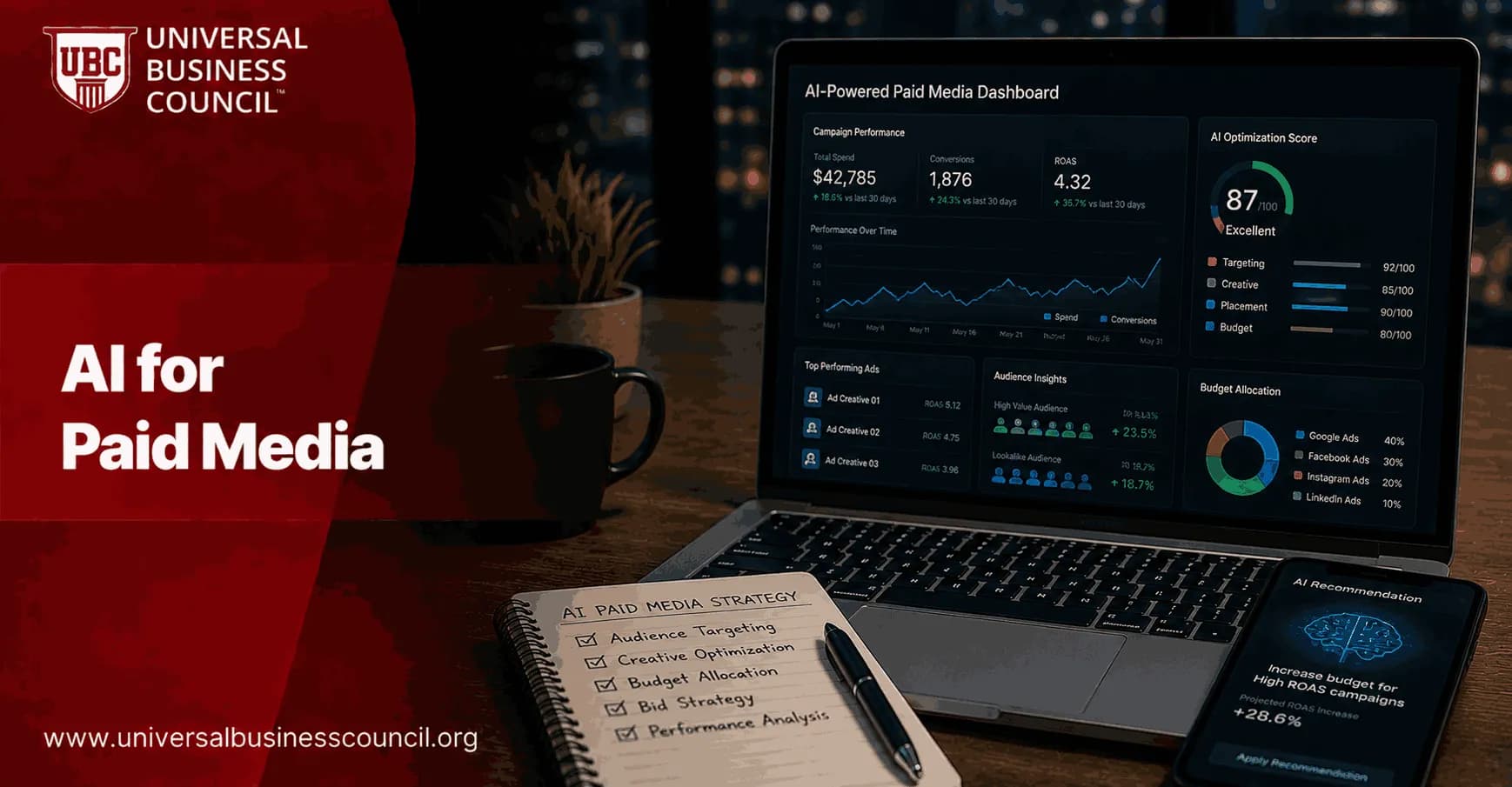
AI for paid media has moved from an optional advantage to the default operating model inside Google Ads and Meta advertising. Smart Bidding, Performance Max, Advantage+ campaigns, automated targeting, and modeled attribution now determine how budgets are spent, who sees ads, and which creatives win. For practitioners, the central shift is practical: success depends less on manual rule tuning and more on designing strong inputs and supervising machine learning systems effectively.
When implemented with solid tracking, clear conversion definitions, and sufficient data volume, AI-driven optimization is associated with meaningful efficiency gains - commonly cited examples include 10-30 percent lower CPA or 20-40 percent higher ROAS in real-world programs. Results vary significantly by vertical, budget scale, and setup quality, so these figures should be treated as directional benchmarks and validated through controlled experiments rather than assumed outcomes.

How AI Shapes Google Ads and Meta Campaigns Today
Both Google and Meta have integrated AI throughout the ad lifecycle, covering bidding, targeting, creative assembly, and measurement. The practical implication is that advertisers now work with platform models rather than around them.
Google Ads: AI Embedded Across Bidding, Queries, and Channels
In Google Ads, machine learning underpins:
Smart Bidding (tCPA, tROAS, Maximize Conversions, Maximize Conversion Value), which sets bids in each auction using real-time signals including device, location, time of day, and remarketing context.
Performance Max, which allocates budget and bids across Search, YouTube, Display, Discover, Maps, and Gmail based on predicted conversion value.
Broad match paired with Smart Bidding to find incremental queries while the model controls for efficiency using conversion goals and targets.
Responsive Search Ads and automatically created assets, which test combinations of headlines, descriptions, and formats at scale.
Google's system optimizes at the auction level using more signals than any human can feasibly manage, which is precisely why data quality and goal design matter more than micromanaging individual bids.
Meta: Delivery, Advantage+, and Creative Combinations Are AI-Led
Meta (Facebook and Instagram) similarly relies on AI for:
Advantage+ shopping campaigns and broader automation designed to identify high-value users beyond narrowly defined audiences.
Automated placements across Feed, Stories, Reels, and other surfaces, with delivery optimized in real time.
Creative and audience experimentation, where the system learns from conversion and engagement feedback to shift impressions toward better-performing combinations.
For many advertisers, this means broadening targeting inputs and focusing more on creative variety, conversion signal quality, and offer positioning.
What AI for Paid Media Automates (and What It Does Not)
Across Google Ads and Meta, automation handles the mechanical execution work. Humans remain responsible for business strategy and governance.
Tasks AI Handles Well
Bidding and budget allocation: auction-time bid decisions, pacing, and shifting spend toward higher predicted conversion value.
Targeting and audience expansion: broad targeting, lookalike signals, and expansion behaviors that discover new demand pools.
Creative testing at scale: assembling and evaluating combinations of copy, imagery, and formats.
Measurement modeling: modeled conversions and data-driven attribution to fill gaps created by privacy constraints and signal loss.
Fraud and quality filtering: identifying patterns consistent with invalid traffic via specialized detection tools.
As automation takes over more execution tasks, marketers increasingly need strategic skills in campaign planning, audience targeting, conversion optimization, and measurement. Becoming a Digital Marketing Expert can help professionals develop the expertise required to guide AI-driven campaigns and align paid media investments with business objectives.
Tasks Humans Still Own
Choosing the right objective: profit targets, qualified lead definitions, lifetime value priorities, inventory constraints, and acceptable customer acquisition cost.
Defining conversion quality: which events matter and how they map to actual business outcomes.
Creative strategy: positioning, messaging hierarchy, offer design, and brand compliance.
Governance: guardrails, risk management, approvals, and documentation.
A useful mental model is that AI is the operator and your team is the pilot - you set the destination, verify the instruments, and intervene when conditions change.
Recent Developments: Generative AI and Automated Media Buying
Current changes extend well beyond incremental bidding improvements. The stack is expanding into creation, analysis, and cross-channel coordination.
Generative AI for Ad Copy, Creatives, and Landing Pages
Large language model-based tools are increasingly used to:
Generate and iterate ad copy aligned to brand voice and performance intent.
Produce image and video variants tailored to specific placements such as Reels, Stories, and Shorts.
Draft landing page sections and value propositions for testing within conversion rate optimization workflows.
The operational value is speed: teams can test significantly more creative variants per week because generation, formatting, and baseline quality checks can be partially automated.
As advertising platforms continue to evolve through automation, machine learning, and advanced analytics, a Tech Certification can help professionals stay current with emerging technologies and modern digital advertising ecosystems.
Cross-Platform Optimization Layers
Third-party platforms are adding AI layers on top of Google and Meta to recommend or automate:
Budget shifts across channels based on marginal performance data
Identification of waste such as low-performing placements, audiences, keywords, or geographies
Bulk actions with change logs and approval workflows for governance purposes
This automated media buyer pattern increases the need for clear accountability: teams must define which changes are permitted to run automatically and which require human review before execution.
Implementation Guide: Operationalizing Machine Learning in Paid Media
Realizing value from AI optimization requires focused attention on inputs, campaign structure, and feedback loops.
1. Fix the Data Bottleneck First
Most underperformance in AI-led campaigns traces back to weak conversion signals. Prioritize:
Accurate conversion tracking with clear event definitions (avoid optimizing to proxy events like page views when qualified outcomes are what actually matter).
Offline conversion imports for lead generation programs, so bidding optimizes toward sales-qualified leads or revenue rather than just form submissions.
Value-based events where possible, passing transaction values and margin or lifetime value proxies into the bidding system.
Server-side and first-party data readiness, particularly as third-party signals decline and modeled conversions become a larger part of attribution.
2. Design Campaigns for Learning, Not Granular Control
Machine learning systems learn faster when data is concentrated rather than fragmented across many small campaigns. Common structural best practices include:
Consolidating where appropriate into fewer, higher-volume campaigns to reduce learning delays and data dilution.
Keeping goals consistent - avoid mixing incompatible conversion actions within a single optimization path.
Setting realistic targets - tCPA or tROAS targets that are too aggressive can restrict delivery and destabilize learning periods.
Allowing sufficient time for learning before evaluating performance, especially after significant budget or creative changes.
3. Treat Creative as the Primary Controllable Lever
As targeting becomes broader and more automated, creative often becomes the most controllable performance variable. Build a creative system that aligns with platform behavior:
Test concepts, not only variations - explore different hooks, pain points, proof elements, offers, objections, and formats.
Provide platforms with variety so Google and Meta can match assets to different user contexts.
Build a learning agenda that documents why a creative performed well, not only that it did.
Many teams now use creative intelligence workflows to analyze patterns across high-performing ads, replacing purely manual tagging and spreadsheet-based reviews.
4. Add Guardrails Against Over-Automation Risks
AI systems can scale mistakes quickly. Reduce risk with clear controls:
Budget and bid constraints that reflect cash flow and profitability limits.
Change management protocols using approvals, logs, and rollback plans - particularly when third-party automation is permitted to execute changes directly.
Brand safety and compliance reviews for automatically created assets and generative content.
Segmented reporting to detect short-termism, such as over-optimizing toward discount-driven customers when lifetime value is the true business goal.
Practical Use Cases for Google Ads and Meta Using Machine Learning
Value-Based Bidding in Google Ads
An e-commerce advertiser can run Maximize Conversion Value with a ROAS target across Search and Performance Max, passing transaction values and - where feasible - a lifetime value proxy. The model then prioritizes auctions more likely to produce higher-value purchases rather than simply more orders.
Meta Advantage+ Shopping for DTC Growth
A direct-to-consumer brand can use Advantage+ shopping campaigns with broad audiences and multiple creative assets. Meta's delivery system tests creative and placement combinations, then concentrates impressions on the combinations generating stronger conversion outcomes. The team's role shifts to interpreting what is working and translating those learnings into new creative concepts.
B2B Lead Generation Using Offline Signals
For B2B programs, importing CRM outcomes such as sales-qualified leads and closed deals helps the bidding model learn what a high-quality lead actually looks like. This typically improves efficiency compared with optimizing only to top-of-funnel form submissions, particularly when lead quality varies significantly across audience segments and channels.
Measurement in an AI-Led, Privacy-Constrained Environment
With ongoing signal loss and consent constraints, platforms rely increasingly on modeled conversions and data-driven attribution. This makes incrementality testing and causal validation more important, not less. A robust measurement approach includes:
Platform attribution for directional, in-platform optimization feedback
Controlled experiments such as A/B tests or geo-based lift tests to validate actual incrementality
Media mix modeling for budget decisions across channels when user-level attribution is incomplete
Cross-functional alignment is also critical here: paid media, analytics, product, and finance teams need shared definitions of what success looks like before drawing conclusions from automated reporting.
Successfully managing AI-driven advertising requires an understanding of machine learning, data quality, model behavior, governance, and performance optimization. An AI Certification can help professionals build the practical knowledge needed to implement and oversee AI-powered marketing systems effectively.
Conclusion: The New Skill Is Steering the Models
AI for paid media is redefining what excellence looks like in Google Ads and Meta advertising. The platforms can now bid, target, and test at a scale that manual workflows cannot match. The durable competitive advantage comes from better inputs and better oversight - high-quality conversion data, AI-native campaign structure, a systematic creative engine, and governance that prevents automated errors from compounding.
For professionals and enterprises, the path forward is clear: build capabilities in tracking and measurement, value-based optimization, creative strategy, and AI risk management. Teams that develop these skills will be better positioned to achieve consistent performance improvements and make smarter cross-channel budget decisions as automation continues to mature.
FAQs
What is AI for paid media?
AI for paid media refers to the use of artificial intelligence to automate, optimize, and improve digital advertising campaigns across platforms such as Google Ads, Meta Ads, LinkedIn, TikTok, and other advertising networks.
Why is AI important in paid media advertising?
AI helps advertisers analyze large amounts of data, improve targeting accuracy, optimize budgets, and increase campaign performance in real time.
How does AI improve paid advertising campaigns?
AI can automatically adjust bids, identify high-performing audiences, optimize ad placements, personalize creatives, and predict campaign outcomes.
What types of paid media platforms use AI?
Most major platforms, including Google Ads, Facebook, Instagram, LinkedIn, TikTok, YouTube, and Amazon Ads, use AI-powered optimization features.
How does AI-powered audience targeting work?
AI analyzes customer demographics, interests, behaviors, purchase history, and engagement patterns to identify audiences most likely to convert.
What is automated bidding in paid media?
Automated bidding uses AI to adjust bids in real time based on factors such as competition, user behavior, conversion likelihood, and campaign goals.
How does AI help with ad creative optimization?
AI can test multiple ad variations, identify winning creatives, generate copy suggestions, and optimize visuals for better performance.
What is predictive analytics in paid media?
Predictive analytics uses historical campaign data and AI models to forecast future performance, conversion rates, and customer behavior.
How can AI improve ad spend efficiency?
AI allocates budgets to high-performing campaigns, audiences, and channels while reducing spending on underperforming areas.
What role does AI play in campaign personalization?
AI delivers personalized ads based on user preferences, browsing behavior, interests, and purchase intent, improving relevance and engagement.
How does AI support retargeting campaigns?
AI identifies users who have previously interacted with a brand and serves personalized ads designed to encourage conversions.
Can AI help reduce customer acquisition costs?
Yes. AI improves targeting, bidding, and budget allocation, which can lower acquisition costs while increasing conversion rates.
What is dynamic creative optimization (DCO)?
Dynamic Creative Optimization uses AI to automatically combine and test different headlines, images, videos, and calls to action for the best results.
How does AI improve conversion tracking?
AI helps identify conversion patterns, attribute results across channels, and provide deeper insights into campaign performance.
What metrics should marketers track in AI-powered paid media?
Key metrics include click-through rate (CTR), conversion rate, cost per click (CPC), cost per acquisition (CPA), return on ad spend (ROAS), and customer lifetime value (CLV).
Can small businesses benefit from AI-powered advertising?
Yes. Many advertising platforms offer built-in AI tools that help small businesses optimize campaigns without requiring large marketing teams.
What are the challenges of using AI in paid media?
Challenges include data privacy concerns, overreliance on automation, inaccurate tracking, limited transparency, and the need for human oversight.
How does AI support cross-channel advertising?
AI analyzes performance across multiple channels and helps marketers allocate budgets and optimize messaging for the best overall results.
Will AI replace paid media specialists?
AI will automate many operational tasks, but paid media specialists remain essential for strategy, creative direction, audience understanding, and business decision-making.
What are the best practices for using AI in paid media?
Define clear campaign goals, provide high-quality data, use AI-driven targeting and bidding, continuously test creatives, monitor performance regularly, combine automation with human expertise, and focus on long-term business outcomes rather than short-term metrics alone.
Related Articles
View All
Digital Marketing
Google Ads Optimization Techniques for Underperforming Campaigns
Learn practical Google Ads optimization techniques to diagnose weak campaigns, reduce wasted spend, improve tracking, and raise conversion quality.
Digital Marketing
How to Generate More Leads with Google Ads Campaigns
Learn how to generate more leads with Google Ads using intent keywords, lead forms, CRM data, offline conversions, and better campaign measurement.

Digital Marketing
Performance Max Campaigns in Google Ads: Complete Beginner Guide
Learn how Performance Max campaigns work, when to use them, how to set them up, and which controls beginners need in Google Ads.
Trending Articles
The Role of Blockchain in Ethical AI Development
How blockchain technology is being used to promote transparency and accountability in artificial intelligence systems.
AWS Career Roadmap
A step-by-step guide to building a successful career in Amazon Web Services cloud computing.
Top 5 DeFi Platforms
Explore the leading decentralized finance platforms and what makes each one unique in the evolving DeFi landscape.