

AI in Paid Advertising: Optimizing PPC Campaigns, Targeting, and Ad Performance
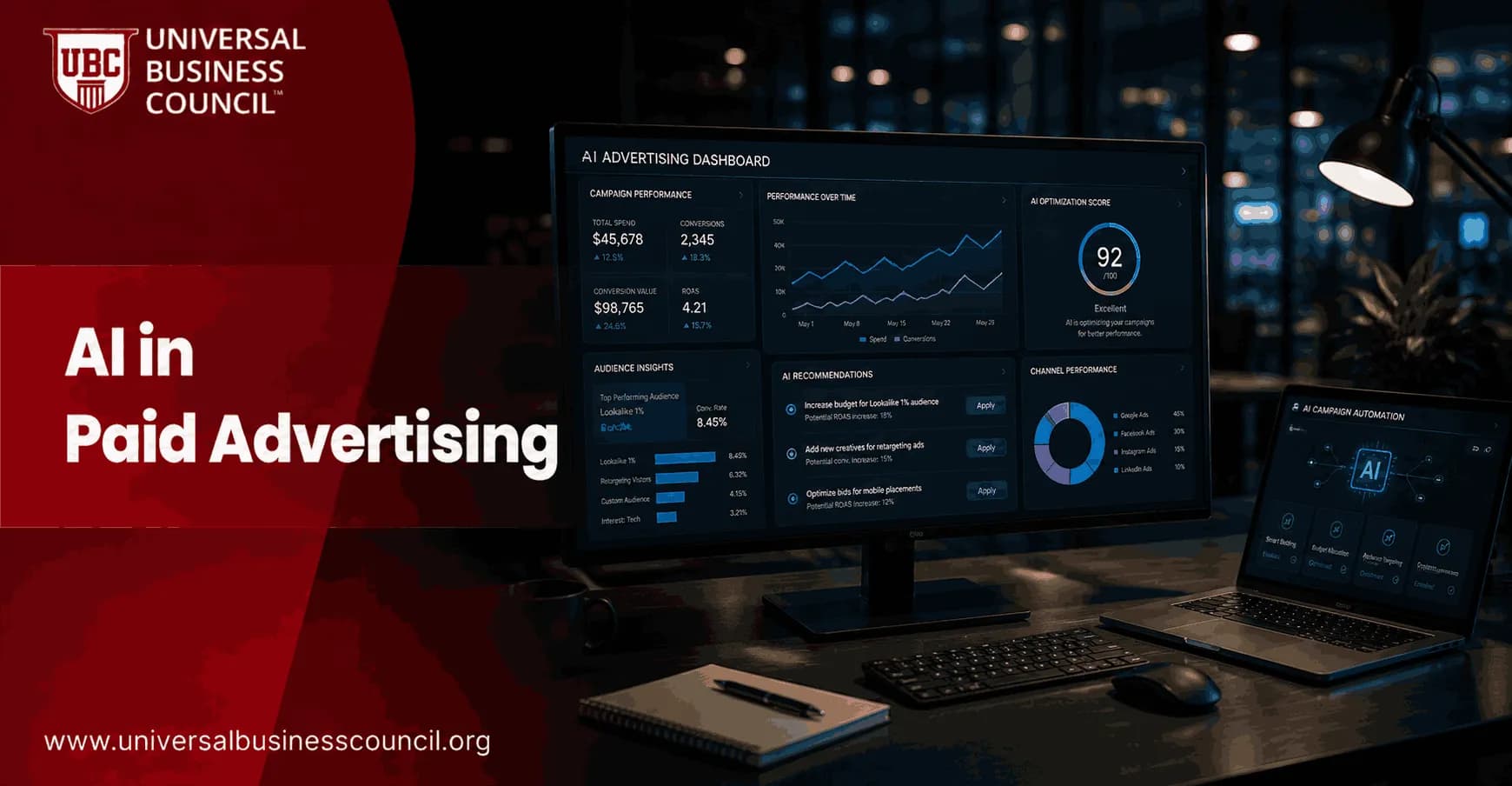
AI in paid advertising has moved from an experimental optimization tool to a core operating layer for PPC campaigns, paid social, programmatic media, retail media, and emerging conversational ad formats. Today, artificial intelligence supports keyword research, audience modeling, bid management, creative production, fraud detection, and performance measurement. For marketers, the strategic question is no longer whether AI belongs in paid media, but how to use it responsibly, transparently, and effectively.
Research from Boston Consulting Group, Salesforce, HubSpot, and industry analysts indicates that AI-driven advertising can improve efficiency and profitability, while also introducing new concerns around privacy, bias, brand safety, and consumer trust. This makes AI literacy essential for digital marketing professionals, especially those managing paid search, paid social, ecommerce, or cross-channel performance campaigns.

An AI Certification can help professionals build expertise in AI technologies, automation, governance, and responsible AI practices, while a Digital Marketing Certification can strengthen skills in campaign strategy, audience engagement, performance optimization, and data-driven marketing decision-making.
How AI Is Changing the Paid Advertising Lifecycle
AI now influences nearly every stage of paid media management. Instead of relying only on manual bid changes, fixed audience segments, and static ad copy, advertisers increasingly work with machine learning models that learn from large data sets and optimize campaigns in real time.
Core AI use cases in PPC and paid media
Audience and keyword research: AI tools analyze search behavior, competitive signals, and conversion patterns to identify high-value opportunities.
Automated bidding: Platforms adjust bids based on conversion likelihood, device, location, time, audience, and contextual signals.
Creative generation: Generative AI can produce ad headlines, descriptions, images, video concepts, and calls to action for testing.
Programmatic buying: AI evaluates ad impressions in real time and helps decide which inventory to buy and at what price.
Fraud detection: Machine learning systems identify suspicious clicks, fake impressions, and abnormal traffic patterns.
Measurement and optimization: AI helps detect performance trends, forecast outcomes, and recommend budget reallocations.
This level of automation allows PPC teams to manage larger, more complex campaigns than would be practical through manual workflows alone.
AI in PPC Campaign Optimization
The most visible impact of AI in paid advertising is campaign optimization. Paid search and paid social platforms now use AI to make thousands of micro-decisions that would be impossible for human teams to execute manually.
Smarter bidding and budget allocation
AI bidding systems evaluate the probability that an impression or click will lead to a desired outcome, such as a lead, sale, subscription, or store visit. They then adjust bids based on expected value. This is especially important in competitive PPC auctions, where the same keyword can carry very different value depending on user intent and context.
Predictive budget allocation is also becoming more common. AI can analyze historical conversion data, seasonality, audience behavior, and channel performance to recommend where budgets should move. For example, if paid social is generating strong early-stage demand while branded search is converting efficiently, AI can help identify the right balance between acquisition and conversion-focused spend.
Continuous optimization at scale
Traditional PPC optimization often happened in cycles, such as weekly bid reviews or monthly performance reports. AI enables continuous optimization. It can detect performance shifts quickly, pause underperforming assets, reallocate spend, and test new combinations of targeting and creative.
Industry research has pointed to McKinsey findings suggesting that companies using AI-powered marketing can achieve meaningful profitability improvements. Results vary by sector and execution quality, but the direction is consistent: AI can create measurable gains when it is connected to reliable data, clear objectives, and disciplined governance.
AI Targeting and Audience Intelligence
AI targeting goes beyond demographic segmentation. It uses behavioral, contextual, transactional, and engagement data to identify patterns that indicate user intent and conversion potential.
From static segments to predictive audiences
Earlier targeting models often relied on fixed attributes, such as age, location, income range, or stated interests. AI can evaluate much broader patterns, including browsing behavior, content interactions, purchase signals, device usage, and engagement timing. This enables predictive audiences, lookalike expansion, and personalized messaging at a level of granularity that manual segmentation cannot match.
Salesforce has highlighted the role of AI in improving targeting and personalization, but also warns that algorithms can reproduce or amplify bias if they are not monitored. For this reason, targeting strategies should include fairness reviews, exclusion checks, and clear policies on sensitive attributes.
Sentiment and contextual targeting
Generative AI and natural language processing can analyze reviews, social posts, search queries, and customer feedback to identify sentiment and emerging needs. Advertisers can use these insights to align messaging with audience concerns. For instance, a software company might discover that buyers are searching for security, integration, or cost-control benefits, then reflect those themes in PPC copy and landing pages.
A Tech Certification can help professionals strengthen their understanding of AI technologies, data analysis, automation platforms, and the technical systems that enable more accurate audience insights and data-driven advertising strategies.
Creative Optimization and Generative AI
Creative quality remains a major factor in ad performance. AI helps teams scale creative testing by generating variations, predicting performance, and matching messages to audience segments.
Ad copy and asset generation
Generative AI can produce multiple headline options, descriptions, product benefit statements, display ad concepts, and video scripts. In ecommerce, it can help adapt product imagery and short-form video ideas across large catalogs. This speeds up production and gives platforms more creative options to test.
AI-generated creative should not be treated as final without review. Human oversight is needed to maintain brand voice, verify claims, avoid derivative content, and ensure compliance with industry regulations. Paid social practitioners have noted that AI is useful for scaling production, but original campaign ideas and brand storytelling still require human judgment.
Dynamic creative personalization
AI can assemble different combinations of copy, visuals, offers, and calls to action based on predicted relevance for each user or segment. Over time, performance data informs which combinations are shown more often. This improves relevance, but it also increases the importance of strong creative guardrails so personalization does not feel intrusive or manipulative.
New AI-Native Ad Surfaces
One of the most important developments in AI in paid advertising is the rise of AI-native interfaces. Boston Consulting Group describes an emerging attention stack that includes search-embedded AI, assistant-native AI, and retail or commerce AI. These environments are changing where ads appear and how users interact with them.
Search ads inside AI-generated answers
Search engines are increasingly integrating AI-generated summaries into results pages. For commercial and exploratory searches, ads may appear within or near synthesized answers rather than only beside traditional organic listings. This shifts optimization from individual keywords toward intent clusters, structured product data, and authoritative content that AI systems can interpret.
Conversational and agentic advertising
Conversational ad formats place sponsored recommendations inside dialogue-based experiences. Agentic advertising goes further: an AI assistant may help users plan, compare, purchase, or complete tasks, while sponsored options influence the decision path. BCG reports that a majority of organizations are already allocating budget to conversational advertising formats, with many planning significant increases over the next two years.
For PPC professionals, this means future campaigns may need to optimize not only for clicks, but also for visibility in AI-generated recommendations and assistant-led purchase journeys.
Risks, Governance, and Transparency
The benefits of AI-driven PPC must be balanced with responsible governance. BCG reports that many consumers feel manipulated when brands use AI in advertising without disclosing it. This highlights a critical trust issue.
Key risks to manage
Bias: AI models may create unfair outcomes if trained on biased data or left unchecked.
Privacy: Paid media systems must respect data protection requirements and user consent.
Transparency: Consumers increasingly expect disclosure when AI influences recommendations or advertising experiences.
Brand safety: Automated placements and AI-generated creative require monitoring to avoid unsuitable contexts.
Over-automation: Full reliance on AI can weaken strategic thinking, creative originality, and ethical review.
Organizations should define clear human approval processes, maintain documentation of AI workflows, audit campaign outputs, and establish policies for acceptable data use. This is especially important in regulated sectors such as finance, healthcare, education, and employment.
Practical Steps for Marketing Teams
To apply AI in paid advertising effectively, organizations should focus on a structured operating model rather than isolated tool adoption.
Define campaign objectives clearly: AI performs best when optimization goals, conversion values, and constraints are precise.
Improve data quality: Clean conversion tracking, structured product feeds, and accurate audience data are foundational.
Test AI-native formats: Explore search AI placements, conversational ads, retail media assistants, and dynamic creative formats where relevant.
Use humans for strategy and review: Let AI support bidding, forecasting, and variation testing, while marketers guide positioning, ethics, and brand direction.
Measure incrementality: Evaluate whether AI optimization creates new value or simply reallocates credit within existing demand.
Build governance: Establish review standards for bias, privacy, claims, transparency, and compliance.
Professionals seeking deeper capability can connect these practices with Universal Business Council learning pathways, including a Digital Marketing Certification, Marketing Management Certification, or courses covering analytics, campaign strategy, and responsible AI adoption.
The Future of AI in Paid Advertising
The future of AI in paid advertising is likely to be shaped by four overlapping trends: more automation, more conversational interfaces, stronger regulation, and a greater need for human strategic oversight. PPC professionals will move from managing every tactical lever to setting objectives, training systems with quality data, interpreting model outputs, and ensuring ethical execution.
Keywords will remain important, but intent, entities, structured data, and customer journey signals will become more central. Creative production will accelerate, while brand trust and originality become stronger differentiators. Automated bidding will improve, yet transparency and measurement discipline will determine whether organizations can trust the results.
Conclusion
AI in paid advertising is reshaping PPC campaign optimization, targeting, creative development, and ad performance measurement. It offers clear advantages in speed, scale, personalization, and efficiency, but it also requires careful governance to protect trust, privacy, fairness, and brand integrity.
The most effective organizations will not frame AI as a replacement for marketers. Instead, they will use it as an advanced decision-support system that enhances human expertise. For PPC teams, the priority is to combine automation with strategy, experimentation with accountability, and performance gains with responsible marketing practice.
FAQs
1. What Is AI in Paid Advertising?
AI in paid advertising refers to the use of artificial intelligence and machine learning to automate, optimize, and improve advertising campaigns across platforms such as Google Ads, Meta Ads, LinkedIn Ads, and other digital advertising networks.
2. Why Is AI Important for PPC Campaigns?
AI helps advertisers improve efficiency, reduce manual work, optimize budgets, enhance targeting accuracy, and increase campaign performance.
3. How Does AI Improve PPC Campaign Management?
AI can automate bidding, audience targeting, budget allocation, ad testing, performance analysis, and campaign optimization in real time.
4. What Is PPC Advertising?
Pay-Per-Click (PPC) advertising is a digital marketing model where advertisers pay a fee each time a user clicks on their advertisement.
5. How Does AI Support Automated Bidding?
AI analyzes historical data, user behavior, competition, and conversion signals to automatically adjust bids for optimal results.
6. What Is Smart Bidding in PPC?
Smart Bidding uses machine learning to optimize bids based on campaign goals such as conversions, conversion value, or return on ad spend (ROAS).
7. How Does AI Improve Audience Targeting?
AI identifies patterns in customer data and helps advertisers target users who are more likely to engage, convert, or make purchases.
8. What Is Predictive Audience Targeting?
Predictive targeting uses AI to forecast which users are most likely to take specific actions based on historical and behavioral data.
9. How Can AI Improve Ad Personalization?
AI can tailor ad copy, visuals, offers, and messaging to individual users based on their interests, behavior, and intent.
10. What Role Does AI Play in Ad Creative Optimization?
AI can generate creative variations, test different messages, analyze performance, and recommend the highest-performing ad combinations.
11. How Does AI Support Keyword Management in PPC?
AI can identify keyword opportunities, optimize keyword selection, manage negative keywords, and improve search intent targeting.
12. Can AI Help Reduce Advertising Costs?
Yes, AI can minimize wasted ad spend by improving targeting accuracy, optimizing bids, and focusing budgets on high-performing opportunities.
13. How Does AI Improve Conversion Rate Optimization in Paid Advertising?
AI analyzes user behavior, landing page performance, and conversion data to identify opportunities that improve campaign effectiveness.
14. What Is Dynamic Ad Optimization?
Dynamic ad optimization uses AI to automatically adjust ad elements such as headlines, images, calls-to-action, and offers based on performance data.
15. How Can AI Improve Retargeting Campaigns?
AI can identify high-intent audiences, personalize messaging, predict purchasing behavior, and optimize retargeting efforts for better results.
16. What Metrics Should Marketers Track in AI-Powered PPC Campaigns?
Important metrics include click-through rate (CTR), conversion rate, cost per click (CPC), cost per acquisition (CPA), ROAS, impressions, and revenue generated.
17. How Does AI Support Cross-Channel Advertising?
AI can analyze performance across multiple platforms and help optimize budgets, targeting, and messaging to improve overall campaign effectiveness.
18. What Challenges Can Arise When Using AI in Paid Advertising?
Challenges include data quality issues, limited transparency in automated decisions, privacy concerns, algorithm bias, and over-reliance on automation.
19. What Common Mistakes Should Advertisers Avoid?
Common mistakes include ignoring campaign oversight, relying entirely on automation, neglecting creative quality, failing to monitor performance, and using poor-quality audience data. Handing complete control to an algorithm and checking back three months later is less a strategy and more an experiment in optimism.
20. What Is the Future of AI in Paid Advertising?
The future includes predictive campaign management, autonomous budget optimization, hyper-personalized ad experiences, advanced audience intelligence, real-time creative generation, and increasingly sophisticated performance forecasting. Businesses that combine AI capabilities with human strategy and creativity will gain a significant competitive advantage in paid advertising.
Related Articles
View All
Digital Marketing
AI for Paid Media: Optimizing Google Ads and Meta Campaigns with Machine Learning
Learn how AI for paid media improves Google Ads and Meta performance through smart bidding, Advantage+ automation, better creative testing, and modern measurement.
Digital Marketing
KPIs for Digital Marketing Campaigns in Programmatic Advertising
Learn how to choose KPIs for digital marketing campaigns using programmatic advertising, from reach and CTR to CPA, ROAS, CAC, and revenue impact.
Digital Marketing
How Programmatic Advertising Improves Targeting, Personalization, and ROI
Learn how programmatic advertising improves targeting, personalization, and ROI through data, AI bidding, DCO, retargeting, and better measurement.
Trending Articles
The Role of Blockchain in Ethical AI Development
How blockchain technology is being used to promote transparency and accountability in artificial intelligence systems.
AWS Career Roadmap
A step-by-step guide to building a successful career in Amazon Web Services cloud computing.
Top 5 DeFi Platforms
Explore the leading decentralized finance platforms and what makes each one unique in the evolving DeFi landscape.