

Google Ads Landing Pages: Best Practices for 2026
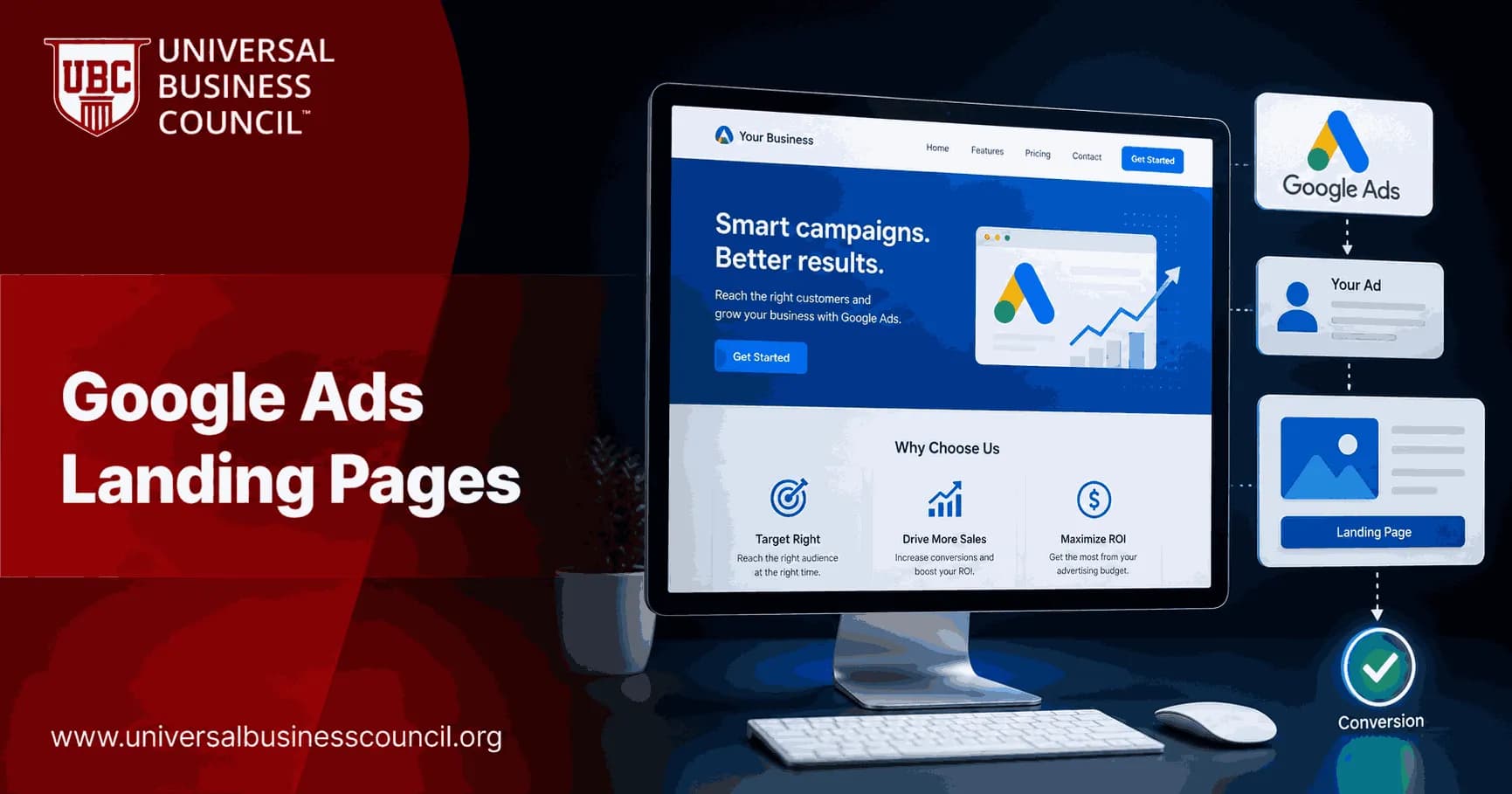
Google Ads landing pages should do one job: turn a specific search intent into a specific action. If your ad promises a free quote for commercial HVAC repair, the page should not open with a general company history, a full navigation menu, and three competing offers. The visitor needs proof, a clear next step, and a fast mobile experience.
This is not just a design preference. Google Ads quality, smart bidding, and conversion volume all depend on what happens after the click. Google's own advertiser guidance keeps stressing useful, relevant landing pages, and paid search practitioners point to the same pattern: message match, speed, trust, and clean tracking drive better outcomes.

As paid search campaigns become increasingly dependent on automation, conversion tracking, and audience insights, marketers benefit from strengthening their platform expertise. A Certified Google Ads Expert credential provides practical knowledge of campaign optimization, bidding strategies, remarketing, and performance measurement that supports stronger advertising outcomes.
Why Google Ads Landing Pages Matter More in 2026
Google Ads campaigns now lean heavily on automation: responsive search ads, Performance Max, Maximize Conversions, Target CPA, and Target ROAS. These systems can find likely converters. They cannot fix a confusing page.
To be blunt, automation sends traffic. Your landing page closes the gap.
A weak landing page creates two problems. First, users leave without converting. Second, your bidding algorithm learns from poor or incomplete conversion signals. If a thank-you page fires for low-quality leads, smart bidding will try to buy more of them. If offline sales are never imported, Google sees only the form fill, not the deal quality.
That is why landing page best practices for Google Ads campaigns now sit at the intersection of copywriting, mobile UX, analytics, and conversion tracking.
Start With One Page Per Intent
The strongest Google Ads landing pages are single-intent pages. One search intent. One offer. One conversion goal.
Dedicated, distraction-free paid search landing pages tend to convert better than pages loaded with navigation bars and exit links, often by a meaningful margin in live accounts. That fits what many PPC managers see day to day: a generic service page can look credible, but it leaks attention.
High-converting landing pages are most effective when they are part of a broader customer acquisition strategy rather than isolated campaign assets. Professionals looking to expand their expertise across paid media, analytics, conversion optimization, and customer journeys often pursue a Certified Digital Marketing Expert program to build a well-rounded digital marketing skill set.
Match the keyword, ad, and headline
Your visitor should feel, within two seconds, that they clicked the right result. Paid search teams sometimes call this the scent trail. Keep it obvious.
Put the primary keyword or a close variant in the H1.
Repeat the core ad promise in the first screen.
Use the same offer language in the ad and the page CTA.
Match visuals to the audience and service, not to a generic brand mood board.
Example: if the ad says Book a Google Ads audit, the page CTA should not say Learn more. Use Book your audit or Schedule the audit. Small wording changes reduce hesitation.
Build the First Screen Like a Conversion Path
The above-the-fold section carries a heavy load, especially on mobile. You do not need a clever hero section. You need clarity.
A practical first-screen formula looks like this:
Outcome-focused headline: Say what the user gets.
One sentence of proof: Add a credential, result, or relevant differentiator.
Primary CTA: Make the next action visible without scrolling.
Trust signal: Use reviews, client logos, certification badges, or compliance statements where relevant.
Clarifying visual: Show the product, report, booking flow, demo screen, or result.
Do not bury the CTA below a full-width image on mobile. I still see this mistake in audits. The desktop version looks polished, but the mobile visitor sees a stock photo, then a paragraph, then another paragraph, and only then the button. That ad spend quietly disappears.
Use One Clear Conversion Goal
Every high-performing Google Ads landing page has a dominant action. Not five.
Choose the goal before writing the page:
Submit a lead form
Book a consultation
Start a trial
Buy a product
Download a gated resource
Remove secondary CTAs unless they directly support the same goal. For high-intent search traffic, links to blog posts, social media profiles, and broad category pages usually distract more than they help.
There is a trade-off. A full website page may work better for low-intent research queries, because those users want comparison content. For bottom-of-funnel paid search terms, a focused landing page is usually the stronger choice.
Make Mobile Speed a Requirement, Not a Final Check
Most landing page visits now happen on phones or tablets. Google's own research has shown that as mobile page load time climbs from 1 second to 3 seconds, the probability of a bounce rises sharply. Speed is revenue protection.
Run these checks before launch
Compress images and use modern formats such as WebP.
Limit third-party scripts, especially chat widgets and tracking tags you do not need.
Test on mobile data, not only office Wi-Fi.
Check Core Web Vitals in PageSpeed Insights.
Tap through the full form on a real phone.
The last point matters. A form can look fine in a desktop preview and still fail on mobile because the keyboard covers the submit button, the phone field rejects valid formats, or the thank-you page never loads.
Shorten Forms Without Destroying Lead Quality
Short forms usually convert better, but fewer fields can also let in poor-fit leads. The answer is not always to cut everything down to name and email.
Ask only for information you will use in the next step. If sales needs company size to route the lead, keep it. If you ask for budget, explain why: So we can recommend the right plan. That small line can reduce suspicion.
For B2B campaigns, connect the form to HubSpot, Salesforce, or your CRM. Then test the boring parts:
Does the lead appear in the CRM?
Is the source tagged as Google Ads?
Are the campaign and ad group captured?
Does sales receive a notification?
Are offline conversions imported back into Google Ads?
First-time advertisers often celebrate form submissions while the CRM is quietly dropping UTM data. Leadership will not ask about your button colour first. They will ask about CAC, qualified lead rate, pipeline, and ROAS.
Add Trust Where Decisions Happen
Trust signals work best near friction points: beside the form, under the CTA, near pricing, or next to a claim.
Use proof that a serious buyer can evaluate:
Specific testimonials with name, role, and company where permission allows
Review ratings from verified platforms
Client logos that are approved for use
Security, privacy, or compliance statements
Before-and-after metrics from real case studies
Professional certifications and partner credentials
Vague lines such as trusted by leading businesses are weak unless you can back them up. Better: Used by 120 clinics across three regions, if it is true. If you cannot be specific, be plain.
Structure the Page for Search, Ads, and AI Systems
Good landing page copy helps people first, but structure matters too. Google's systems, answer engines, and quality signals all benefit from a clear content hierarchy.
Use semantic headings and direct answers
Write H2 and H3 headings around the questions buyers actually ask:
How much does it cost?
What happens after I submit the form?
Who is this for?
How long does setup take?
What makes this different from the alternative?
Where appropriate, add FAQ schema, Product schema, Review schema, or LocalBusiness schema. Do not fake reviews or ratings. Structured data should describe what is genuinely on the page.
This is also a good point for internal linking. Universal Business Council articles can connect this topic to relevant digital marketing, analytics, customer acquisition, and performance marketing certification pages in the course catalogue. Keep links useful and limited. A paid search landing page is not the place for a maze of internal links.
Modern landing page performance also depends on the technology supporting it, including analytics platforms, APIs, CRM integrations, AI-powered optimization, website performance, and cybersecurity. Earning a broader Tech Certification can help professionals better understand these interconnected technologies and improve collaboration across marketing and technical teams.
Track the Right Conversions
Conversion tracking is not admin work. It tells the bidding system what success means.
For Google Ads campaigns, set up:
Primary conversion actions for the main goal
Enhanced conversions where appropriate
Consent-aware tracking that fits your legal requirements
Offline conversion imports for qualified leads and closed deals
GA4 events for scroll depth, button clicks, form starts, and form errors
Use heatmaps and session recordings with care. They are not magic, but they can expose obvious friction: users rage-clicking a fake button, skipping past pricing, or abandoning a long form at the phone field.
A/B Test One Meaningful Change at a Time
High-performing landing pages are managed, not launched and forgotten. Start with one high-traffic ad group where the numbers justify testing.
Audit the search terms, ad copy, and landing page headline.
Find the biggest mismatch or friction point.
Create one test hypothesis.
Run an A/B test on the headline, CTA, proof block, form length, or layout.
Judge the result by qualified conversions, not raw form fills.
A useful hypothesis is specific: Changing the H1 to match the ad offer and moving client logos beside the form will increase qualified form submissions by 15 percent. That is testable. Make the page better is not.
Common Mistakes That Waste Google Ads Budget
Sending every ad group to the homepage
Using a headline that does not match the search query
Adding full navigation to a high-intent landing page
Making the CTA hard to find on mobile
Using stock imagery that does not explain the offer
Asking for too much information too early
Treating every lead as equal, even when sales quality differs
Changing five elements in one test and learning nothing
If you fix only three things this week, fix message match, mobile CTA visibility, and conversion tracking. Those changes usually expose the next bottleneck fast.
Your Next Step
Pick your highest-spend Google Ads ad group and open the landing page on a phone using mobile data. Ask three questions. Does the headline match the ad? Is the CTA visible without scrolling? Does the form completion flow track correctly in Google Ads and your CRM?
If you are building deeper capability across a team, pair this audit with training in digital marketing strategy, analytics, and campaign optimisation through the relevant Universal Business Council certification or course pathway. Then turn landing page testing into a monthly operating habit, not a redesign project that happens once a year.
As AI, automation, privacy technologies, and advanced analytics continue to reshape digital advertising, professionals who combine marketing expertise with technical knowledge will be well positioned for future opportunities. A Deep Tech Certification offers a structured way to understand the emerging technologies that increasingly influence campaign performance, customer experience, and data-driven decision-making.
FAQs
1. What is a Google Ads landing page?
A Google Ads landing page is a dedicated webpage designed to receive visitors who click on a paid advertisement. Unlike a general homepage, a landing page focuses on a specific offer, product, service, or campaign with the goal of encouraging users to complete a desired action, such as making a purchase or submitting a form.
2. Why are landing pages important for Google Ads?
Landing pages directly influence user experience, conversion rates, and campaign performance. A relevant, fast, and well-designed page helps visitors quickly find the information they expect after clicking an ad, which can contribute to stronger advertising results.
3. How do landing pages affect Google Ads Quality Score?
Google evaluates factors such as landing page relevance, user experience, page speed, mobile usability, and content quality. A landing page that closely matches the user's search intent and ad messaging may contribute positively to Quality Score, although Google's exact algorithms consider multiple factors.
4. What should a high-converting landing page include?
An effective landing page typically features a clear headline, compelling value proposition, concise copy, strong call-to-action (CTA), trust signals, relevant visuals, fast loading times, mobile-friendly design, and simple navigation that keeps visitors focused on the conversion goal.
5. How important is message match between ads and landing pages?
Message match is essential because it ensures consistency between the advertisement and the landing page. When headlines, offers, keywords, and calls-to-action align, visitors are more likely to trust the page and continue through the conversion process.
6. Why is page speed critical in 2026?
Users expect websites to load quickly across all devices. Faster landing pages can improve user satisfaction, reduce bounce rates, and increase the likelihood that visitors remain engaged long enough to complete a conversion.
7. How should landing pages be optimized for mobile users?
Mobile optimization includes responsive layouts, readable text, fast loading speeds, large tap targets, streamlined forms, compressed images, and intuitive navigation. Since a significant share of paid traffic comes from mobile devices, mobile usability remains a key priority.
8. What role does AI play in landing page optimization?
AI-powered tools can assist with content generation, personalization, A/B testing, audience segmentation, heatmap analysis, predictive optimization, and conversion recommendations. Human oversight remains important to ensure messaging aligns with business goals and user expectations.
9. How many calls-to-action should a landing page have?
Most landing pages perform best when they emphasize one primary call-to-action. While secondary actions may be appropriate in some cases, reducing unnecessary choices can help visitors stay focused on the main conversion objective.
10. What trust signals improve landing page performance?
Trust signals may include customer testimonials, verified reviews, security badges, certifications, case studies, recognizable client logos, transparent pricing, money-back guarantees, and clear contact information. These elements can help build credibility with potential customers.
11. How long should landing page content be?
Content length depends on the product, audience, and buying journey. Simpler offers may require brief, direct messaging, while complex or high-value services often benefit from more detailed explanations, FAQs, and supporting information that address common customer questions.
12. Should businesses use forms on landing pages?
Forms are common tools for lead generation, but they should request only the information necessary for the intended purpose. Shorter, well-designed forms often reduce friction and encourage more users to complete the submission process.
13. What are common landing page mistakes?
Frequent mistakes include slow loading speeds, unclear headlines, weak calls-to-action, excessive distractions, poor mobile experiences, inconsistent messaging, complicated forms, missing trust signals, and failing to test page performance regularly.
14. How does A/B testing improve landing pages?
A/B testing compares different versions of headlines, images, layouts, CTAs, forms, or other page elements to identify which version performs better. Ongoing experimentation allows businesses to make data-informed improvements over time.
15. How do landing pages support SEO and paid search together?
Although landing pages for paid campaigns prioritize conversions, they can also benefit from clear content structure, relevant keywords, accessibility, and quality user experiences. Coordinating SEO and paid search strategies helps create consistent messaging across marketing channels.
16. What metrics should advertisers monitor?
Important metrics include conversion rate, bounce rate, average engagement time, click-through rate (CTR), cost per conversion, Quality Score, page speed, form completion rate, return on ad spend (ROAS), and overall campaign profitability.
17. How does personalization improve landing page performance?
Personalized landing pages can tailor messaging, offers, imagery, or recommendations based on audience segments, geographic location, device type, or campaign source. Relevant experiences often improve user engagement and conversion opportunities.
18. What privacy considerations apply to landing pages?
Businesses should provide transparent privacy notices, obtain required user consent where applicable, secure customer data, comply with relevant privacy regulations, and clearly explain how collected information will be used. Responsible data practices help build long-term trust.
19. Which industries benefit most from optimized landing pages?
Industries including e-commerce, SaaS, healthcare, education, finance, legal services, travel, real estate, automotive, home services, and B2B technology can all benefit from well-designed landing pages that align with campaign objectives and customer intent.
20. What are the best practices for Google Ads landing pages in 2026?
The most effective Google Ads landing pages combine fast performance, mobile-first design, relevant messaging, clear calls-to-action, AI-assisted optimization, strong trust signals, accurate conversion tracking, and continuous testing. As advertising platforms and customer expectations continue to evolve, businesses that prioritize user experience, personalization, and data-driven optimization are likely to remain more competitive. After all, getting someone to click an ad is only half the challenge. Convincing them to stay once they arrive is where the real work begins.
Related Articles
View All
Digital Marketing
Google Ads Best Practices 2026: What Marketers Need to Know
Learn Google Ads best practices 2026, including smart bidding, Performance Max, enhanced conversions, first-party data, creative testing, and governance.
Digital Marketing
Best Google Ads Course Topics Every Beginner Should Learn
Learn the essential Google Ads course topics beginners need, from campaign setup and keywords to GA4 tracking, Smart Bidding, and Performance Max.
Digital Marketing
How to Use Google Ads to Grow Your Business Online in 2026
Learn how to use Google Ads to grow your business online with AI-first campaigns, smarter bidding, stronger tracking, and disciplined optimization.
Trending Articles
The Role of Blockchain in Ethical AI Development
How blockchain technology is being used to promote transparency and accountability in artificial intelligence systems.
AWS Career Roadmap
A step-by-step guide to building a successful career in Amazon Web Services cloud computing.
Top 5 DeFi Platforms
Explore the leading decentralized finance platforms and what makes each one unique in the evolving DeFi landscape.