

Google Ads Metrics Every Marketer Should Track for Better Campaign Decisions
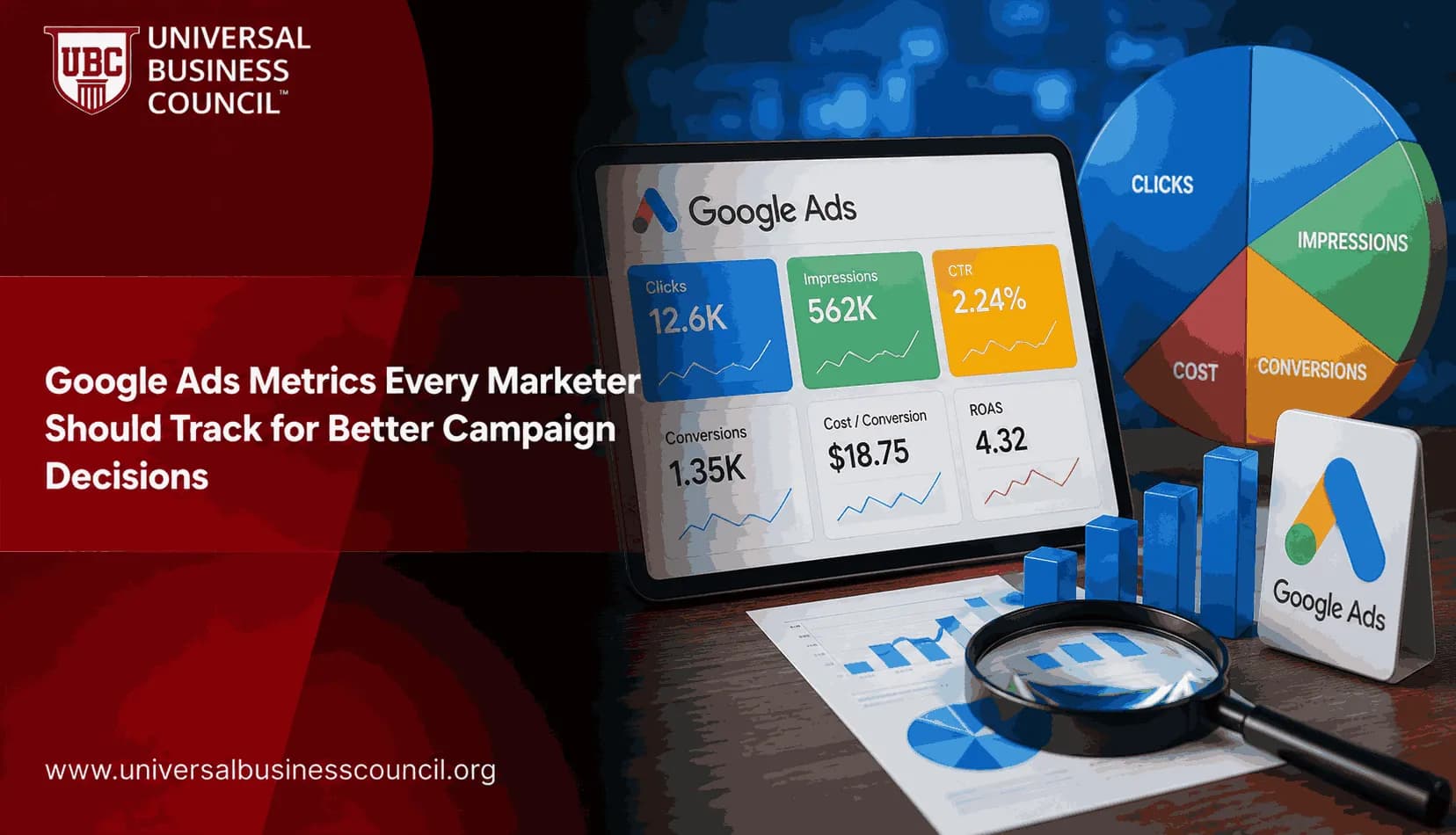
Google Ads metrics only matter when they help you make a decision. Clicks are useful, but they are not the goal. You need to know whether your ads reach the right market, attract qualified traffic, convert that traffic, and return more value than they cost.
The mistake I still see in campaign audits is simple: the report looks busy, but nobody can answer one blunt question. Did this campaign create profitable demand? To answer that, track Google Ads metrics across five areas: awareness, engagement, conversion, profitability, and competition.

Understanding which metrics influence business decisions is a core skill for paid search professionals. Many marketers strengthen this expertise by earning a Certified Google Ads Expert credential, which covers campaign measurement, conversion tracking, bidding strategies, and performance optimization to help turn reporting into actionable insights.
Start with the campaign goal before choosing metrics
A search campaign for emergency plumbing should not be judged like a YouTube awareness campaign. Different job, different scoreboard.
Use this basic framework:
Awareness: impressions, reach, CPM
Engagement: clicks, CTR, average CPC, Quality Score
Conversion: conversions, conversion rate, CPA, CPL
Profitability: ROAS, ROI, conversion value, CAC, CLV
Competition: impression share, search lost impression share, Auction Insights
Google Ads Help recommends conversion tracking and ROI measurement as core practices for advertisers. Impressions, clicks, cost, CPC, CTR, conversions, and cost per conversion remain the most commonly monitored paid search numbers across reporting tools. That does not mean you should watch every metric daily. It means you need a clean hierarchy.
Awareness Google Ads metrics
Impressions
Impressions show how often your ad was displayed. For brand campaigns, launch campaigns, and remarketing, this tells you whether you are getting enough visibility.
Do not treat impressions as success by themselves. A campaign can generate thousands of impressions and no commercial response. Still, if your impression volume collapses, check budgets, keyword eligibility, audience size, and policy status first.
Reach and CPM
Reach counts unique people exposed to your ads. CPM is the cost per 1,000 impressions. These matter more in Display and YouTube campaigns than in high-intent Search campaigns.
If you are running video, resist the urge to judge it by last-click conversions alone. Views, watch time, and view-through rate often tell you more about whether the creative held attention.
While platform metrics are essential, they become far more valuable when viewed within a broader marketing strategy. A Certified Digital Marketing Expert program helps professionals connect advertising metrics with customer acquisition, marketing analytics, budgeting, and long-term business performance rather than evaluating campaigns in isolation.
Engagement metrics that reveal traffic quality
Clicks
Clicks measure how many users clicked your ad. Basic, yes. Still useful. A click confirms that the keyword, audience, or placement created enough interest for the user to visit your site.
But clicks can burn money quietly. In one common audit pattern, broad match keywords produce cheap clicks from research-heavy searches, while exact match commercial terms produce fewer clicks but more sales calls. Segment your report before cutting the wrong traffic.
Click-through rate
CTR is calculated as clicks divided by impressions, multiplied by 100. A higher CTR usually means your ad copy matches search intent. A low CTR can point to weak messaging, loose keyword targeting, poor offer fit, or a low ad position.
CTR also affects practical account work. If one ad group runs a 1.2 percent CTR and another similar ad group hits 7.8 percent, do not average them and move on. Check the search terms, ad assets, and landing page promise. The difference is telling you something.
Average CPC
Average cost per click shows how much you pay for traffic. It is advertising cost divided by clicks. CPC matters for bidding, but it is a poor standalone target.
To be blunt, cheap CPC can be expensive if the traffic never converts. A 12 dollar click that produces a qualified demo request can beat a 2 dollar click that produces a student downloading a free template.
Quality Score
Quality Score is Google's estimate of the relevance of your keyword, ad, and landing page. Its three components are expected CTR, ad relevance, and landing page experience.
Track Quality Score in Search campaigns because it can influence costs and eligibility. If Quality Score is weak, do not just raise bids. Improve the ad group structure, write copy that mirrors intent, and make sure the landing page answers the query without forcing the user to hunt.
Conversion metrics every marketer should monitor
Conversions
Conversions are valuable actions you define in Google Ads, such as purchases, lead forms, calls, signups, app installs, or booked demos. This is where measurement starts to become commercial.
Check your conversion actions carefully. In Google Ads, use the Segment by conversion action view. I have seen accounts optimizing toward page views or low-value button clicks because every action was marked as primary. That setting can distort Smart Bidding fast.
Conversion rate
Conversion rate is conversions divided by visitors or clicks, multiplied by 100. It shows how well traffic turns into the desired action.
If CTR is strong but conversion rate is weak, the ad probably did its job and the landing page did not. Look at message match, page speed, form length, trust signals, pricing clarity, and mobile usability. For lead generation, even one unnecessary form field can cut response.
CPA, cost per conversion, and CPL
CPA, or cost per acquisition, tells you the average cost to generate one conversion. In lead generation, marketers often use CPL, or cost per lead.
These are the metrics managers ask about because they connect spend to output. Still, CPA needs context. A 50 dollar CPL is not good or bad until you know lead quality, sales close rate, gross margin, and customer lifetime value.
Profitability metrics: ROAS, ROI, CAC, and CLV
ROAS
ROAS is conversion value divided by ad spend. If a campaign spends 1,000 and produces 4,000 in tracked revenue, ROAS is 4.0, often written as 400 percent.
ROAS is especially useful in ecommerce and value-based bidding. But it can mislead you if margins vary. A campaign selling low-margin products at 500 percent ROAS may be less profitable than a campaign selling higher-margin products at 300 percent ROAS.
ROI
ROI looks beyond ad revenue and asks whether the campaign produced profit after costs. Google Ads Help treats ROI as a primary financial measure because it forces you to connect advertising performance with business results.
Use ROI when leadership wants the real answer. ROAS tells you what ads returned in revenue. ROI tells you whether that return was worth the cost of goods, fulfillment, sales time, and media spend.
CAC and CLV
Customer acquisition cost includes the full cost of acquiring a customer, not only the Google Ads bill. Customer lifetime value estimates the value a customer creates across the relationship.
For B2B, import CRM outcomes from HubSpot, Salesforce, or your data warehouse when possible. A campaign with a higher CPL may deserve more budget if it produces qualified pipeline and closed revenue. This is where many junior marketers get tripped up in certification exams too. They pick the lowest cost metric instead of the metric aligned with profit.
Competitive and delivery metrics
Impression share
Impression share shows how often your ads appeared compared with the total eligible opportunities. A 75 percent search impression share means you appeared in roughly three out of four eligible auctions.
If impression share is low, identify why. Lost impression share due to budget means you may need more budget or tighter targeting. Lost impression share due to rank points to bids, ad relevance, expected CTR, or landing page experience.
Auction Insights
Auction Insights shows which advertisers appeared in the same auctions and how your ads compared. Use it to monitor overlap rate, position above rate, and outranking share.
This report is useful, but do not chase competitors blindly. If a rival raises bids on a keyword with poor margins for you, let them have the expensive traffic. Your job is profitable growth, not ego bidding.
How to build a practical Google Ads metrics dashboard
Keep the dashboard short. A good weekly view can fit on one screen.
Define the campaign objective. Awareness, lead generation, ecommerce sales, app installs, or retention.
Choose one primary KPI. CPA for lead generation, ROAS for ecommerce, reach for awareness.
Add diagnostic metrics. CTR, CPC, Quality Score, conversion rate, and impression share explain why the primary KPI moved.
Connect business data. Use Google Analytics 4, CRM imports, offline conversion tracking, or BI reporting to tie ads to revenue.
Review by segment. Break performance down by campaign, ad group, keyword, search term, device, location, audience, and conversion action.
Building reliable reporting also depends on understanding the technology behind digital marketing, including analytics platforms, CRM integrations, APIs, cloud infrastructure, tag management, and business intelligence tools. A broader Tech Certification can help professionals strengthen these technical capabilities and create more accurate, data-driven reporting systems.
If you are building your analytics capability, pair this topic with Universal Business Council learning paths in digital marketing analytics, marketing strategy, and business management. Moving from metric definitions to campaign planning, reporting, and executive decision-making is where the real skill sits.
What to track daily, weekly, and monthly
Daily: spend, conversions, CPA or ROAS, disapprovals, tracking issues, major CPC spikes.
Weekly: CTR, conversion rate, search terms, Quality Score changes, budget pacing, impression share.
Monthly: ROI, CAC, CLV, qualified leads, closed revenue, product margin, channel mix.
Daily checks protect the budget. Weekly reviews improve campaigns. Monthly analysis tells you whether Google Ads deserves more investment.
Your next step
Pick one active campaign and audit it today. Confirm the primary conversion action, calculate CPA or ROAS, review search terms, and compare impression share against budget constraints. Then build a one-page dashboard around the Google Ads metrics that match the campaign goal. If you want formal structure, continue with Universal Business Council training in digital marketing analytics and performance marketing strategy.
As artificial intelligence, predictive analytics, automation, and privacy-enhancing technologies continue to reshape marketing measurement, professionals who combine analytical expertise with technical knowledge will be better positioned to make smarter business decisions. A Deep Tech Certification provides structured learning in these emerging technologies, helping marketers stay prepared for the future of performance marketing and digital analytics.
FAQs
1. Why are Google Ads metrics important for marketers?
Google Ads metrics help marketers measure campaign performance, identify optimization opportunities, and make data-driven decisions. Rather than relying on assumptions, performance metrics provide measurable insights into user behavior, advertising efficiency, and business outcomes.
2. What are the most important Google Ads metrics?
Some of the most valuable metrics include impressions, clicks, click-through rate (CTR), cost per click (CPC), conversion rate, cost per acquisition (CPA), return on ad spend (ROAS), Quality Score, impression share, and conversion value. The most relevant metrics depend on the campaign's specific objectives.
3. What do impressions measure?
Impressions represent the number of times an advertisement is displayed to users across Google's advertising network. While impressions indicate visibility, they should be evaluated alongside engagement and conversion metrics to assess campaign effectiveness.
4. Why are clicks important?
Clicks measure how many users interact with an advertisement by visiting the destination page or taking another supported action. A high number of clicks can indicate strong interest, but clicks alone do not guarantee business success without meaningful conversions.
5. What is Click-Through Rate (CTR)?
Click-Through Rate (CTR) is the percentage of users who click an advertisement after seeing it. A higher CTR often suggests that an ad is relevant to the audience, although it should be interpreted alongside conversion performance and campaign goals.
6. What is Cost Per Click (CPC)?
Cost Per Click (CPC) measures the average amount an advertiser pays for each click. Monitoring CPC helps marketers balance advertising costs with traffic quality and overall campaign profitability.
7. Why is conversion rate a key metric?
Conversion rate measures the percentage of users who complete a desired action after clicking an advertisement, such as making a purchase or submitting a lead form. It helps evaluate how effectively campaigns and landing pages turn visitors into customers.
8. What is Cost Per Acquisition (CPA)?
Cost Per Acquisition (CPA) measures the average advertising cost required to generate a conversion. Comparing CPA against revenue, customer value, or profitability helps businesses evaluate campaign efficiency.
9. Why is Return on Ad Spend (ROAS) important?
ROAS measures the revenue generated for every unit of advertising spend. It provides marketers with insight into campaign profitability and helps guide budget allocation across campaigns and marketing channels.
10. What does conversion value measure?
Conversion value estimates the monetary value associated with completed customer actions. Assigning appropriate values to conversions enables marketers to evaluate campaigns beyond simple conversion counts.
11. What is Quality Score?
Quality Score is Google's estimate of keyword relevance, advertisement quality, and landing page experience. Improving these areas may contribute to better campaign efficiency and enhanced user experiences.
12. What is impression share?
Impression share represents the percentage of eligible impressions your advertisements receive compared to the total available opportunities. It helps marketers understand how often their ads appear relative to potential visibility within their target market.
13. Why should marketers monitor search term reports?
Search term reports reveal the actual queries users entered before clicking advertisements. Reviewing these reports helps identify new keyword opportunities, improve targeting, and expand negative keyword lists to reduce irrelevant traffic.
14. How does bounce rate relate to Google Ads?
While bounce rate is typically measured in website analytics platforms rather than Google Ads itself, it can provide additional insight into landing page engagement. A high bounce rate may indicate that visitors are not finding the content they expected after clicking an advertisement.
15. What role does Customer Lifetime Value (CLV) play?
Customer Lifetime Value estimates the long-term revenue generated by a customer throughout their relationship with a business. Considering CLV alongside CPA and ROAS helps marketers make more strategic advertising investment decisions.
16. How does AI use campaign metrics?
Google's AI analyzes performance signals such as conversions, user behavior, bidding data, audience interactions, and historical trends to automate optimization decisions. Human oversight remains essential to ensure AI recommendations align with business objectives.
17. Which metrics matter most for lead generation campaigns?
Lead generation campaigns typically focus on conversion rate, qualified lead volume, CPA, lead quality, click-through rate, conversion value where applicable, and downstream business outcomes such as sales opportunities or closed deals.
18. Which metrics matter most for e-commerce campaigns?
E-commerce advertisers often prioritize ROAS, conversion value, average order value, conversion rate, CPA, cart abandonment trends, purchase volume, and customer lifetime value to evaluate advertising performance.
19. What mistakes should marketers avoid when analyzing metrics?
Common mistakes include focusing only on clicks or impressions, ignoring conversion tracking, evaluating metrics without business context, reacting too quickly to limited data, and overlooking customer lifetime value or attribution considerations.
20. How can marketers use Google Ads metrics to make better campaign decisions?
Marketers can improve campaign decisions by monitoring a balanced set of performance metrics, implementing accurate conversion tracking, reviewing search term reports, testing creative assets, optimizing landing pages, and evaluating results against clearly defined business goals. Rather than relying on a single metric, successful optimization comes from understanding how multiple performance indicators work together to reflect customer behavior and campaign effectiveness. Data rarely tells the whole story by itself, but it usually has fewer opinions than the average marketing meeting, which is a useful quality in its own right.
Related Articles
View All
Digital Marketing
Best Google Ads Course Topics Every Beginner Should Learn
Learn the essential Google Ads course topics beginners need, from campaign setup and keywords to GA4 tracking, Smart Bidding, and Performance Max.

Digital Marketing
How to Write High-Converting Google Ads Copy That Filters for Better Clicks
Learn how to write Google Ads copy that matches intent, proves value, improves lead quality, and works with responsive search ads and AI-assisted testing.

Digital Marketing
Google Ads ROI: How to Measure and Improve Campaign Profitability
Learn how to measure Google Ads ROI with conversion tracking, real cost data, ROAS, CPA, and profit-focused optimization tactics.
Trending Articles
The Role of Blockchain in Ethical AI Development
How blockchain technology is being used to promote transparency and accountability in artificial intelligence systems.
AWS Career Roadmap
A step-by-step guide to building a successful career in Amazon Web Services cloud computing.
Top 5 DeFi Platforms
Explore the leading decentralized finance platforms and what makes each one unique in the evolving DeFi landscape.