

Google Ads for B2B Lead Generation: Campaign Strategies That Work
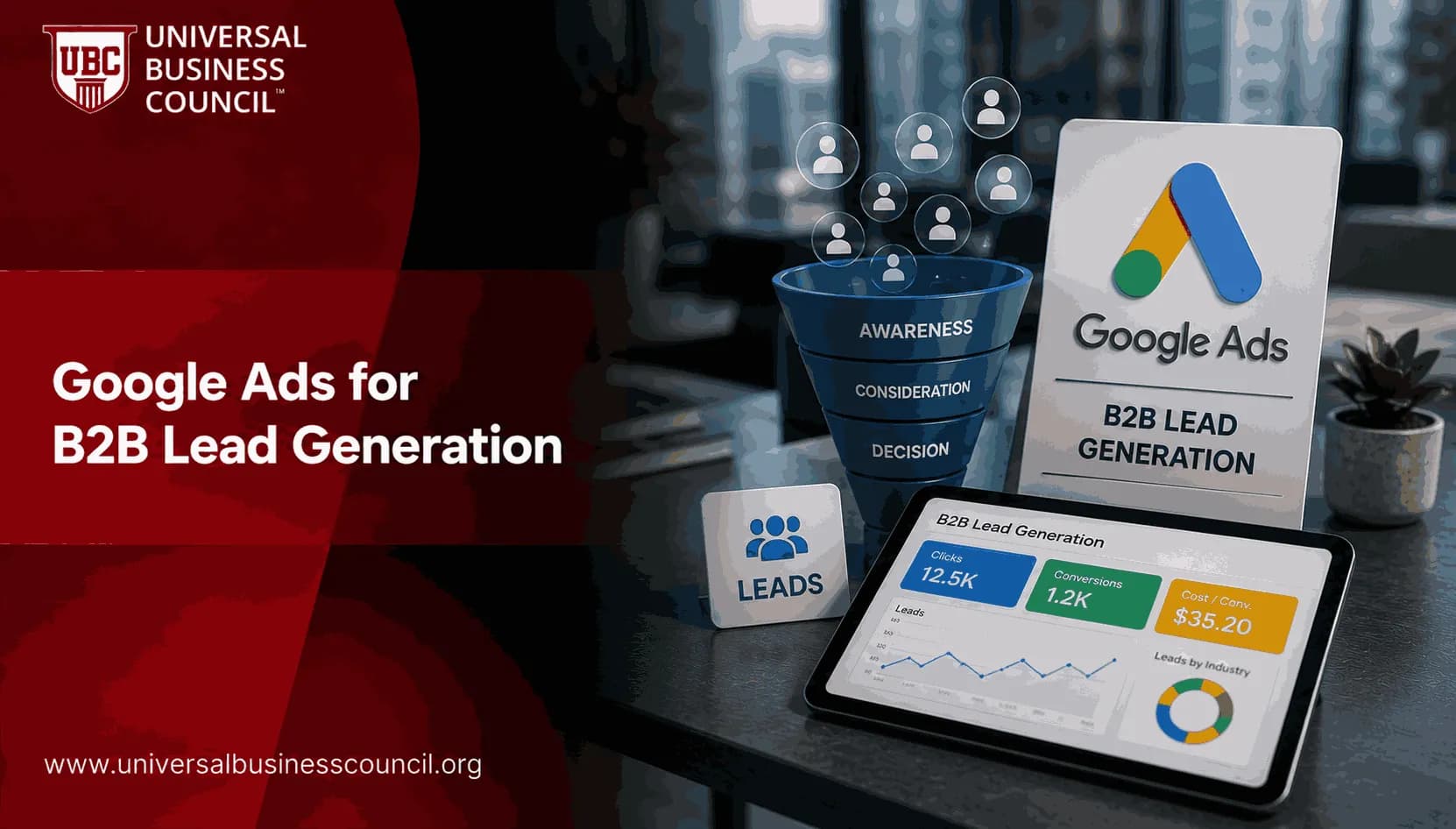
Google Ads for B2B lead generation works best when you stop chasing lead volume and start buying intent. That means tight Search campaigns, clean conversion tracking, careful use of Performance Max, and landing pages built for a buyer who may not speak to sales for another 30 days.
The channel still earns serious attention. Aggregate B2B studies from Dreamdata show Google Search Ads driving a large share of B2B web traffic, and benchmark reports from firms such as Unbounce and WordStream keep ranking paid search among the strongest conversion channels when intent is clear. The catch? B2B form-fill rates are often modest. Many B2B paid search conversion rates sit near 1.2 to 1.5 percent, so waste gets expensive fast.

Building successful B2B campaigns requires more than understanding the platform interface. Many professionals strengthen their expertise through a Certified Google Ads Expert credential, which provides structured knowledge of campaign strategy, conversion tracking, bidding, optimization, and performance measurement for lead generation.
The Current State of Google Ads for B2B Lead Generation
B2B buyers use Google differently from consumers. They search around problems, vendors, integrations, compliance, pricing, and proof. A CFO may search for cost reduction software. An IT director may search for SOC 2 compliant endpoint management. A procurement manager may search for alternatives to a known vendor.
That is why Google Search Ads remain the foundation. Search captures declared intent. You are not interrupting someone between videos. You are answering a question they already asked.
Recent benchmark data also shows why expectations need to stay realistic:
Median B2B website session conversion rates sit around 2 to 3 percent in most aggregate studies.
Paid search B2B conversion rates often trail organic search and email, but paid scales faster when campaigns are managed well.
Average cost per click on Google Search has kept rising, with cross-industry CPC benchmarks moving into the roughly 3 dollar range in recent datasets.
Smart Bidding adoption has grown, and benchmark studies show a small but meaningful lift in average search conversion rates as more spend moves to automated bidding.
Do not read those numbers as a reason to avoid Google Ads. Read them as a reason to build the account properly.
Strong B2B advertising performance also depends on understanding the broader marketing ecosystem, including customer acquisition, sales funnels, analytics, and revenue measurement. A Certified Digital Marketing Expert program helps professionals connect Google Ads campaigns with wider business objectives and long-term growth strategies.
Start With Buyer Intent, Not Campaign Types
The first strategic mistake is opening Google Ads and asking, Which campaign type should we run? Start earlier. Ask, What stage of the buying process are we trying to reach?
Decision-stage searches should get the first budget
If your budget is limited, put most of it into bottom-funnel Search. These are queries that suggest a buyer is close to action:
B2B CRM implementation consultant
enterprise payroll software pricing
best SOC 2 compliance platform
industrial cybersecurity vendor
request demo workflow automation software
Use exact match and phrase match first. Add broad match only after you have enough conversion data and Smart Bidding has something useful to learn from. To be blunt, broad match on a thin account can quietly burn a month of budget before anyone notices.
Protect branded search, but do not over-credit it
Branded campaigns often show excellent return on ad spend. Dreamdata has reported cases where branded search uses a small share of budget but delivers far higher ROAS than non-branded search. That makes sense. These users already know you.
Run branded campaigns to defend demand, control messaging, and capture high-intent visitors. Just avoid pretending branded conversions prove your non-branded acquisition engine is healthy. Leadership should see branded and non-branded results separately.
Conversion Tracking Is the Real Campaign Strategy
Google Ads for B2B lead generation breaks when every form fill is treated as equal. A student downloading a whitepaper is not the same as a VP of Operations requesting a demo for a 500-person company.
Set up tracking around lead quality, not only lead count. At minimum, track:
Form submissions by offer type
Demo bookings
Sales qualified leads
Opportunities created in the CRM
Closed-won revenue where possible
Connect Google Ads with Salesforce, HubSpot, or your CRM of choice. Use offline conversion imports so Google can learn which clicks become pipeline. Enhanced conversions can also improve measurement by using hashed first-party data in a privacy-conscious way.
A practical field note: the report that changes the conversation is not cost per lead. It is cost per qualified opportunity by keyword group. In one common audit pattern, a campaign shows a 70 dollar CPL, which looks fine, while the CRM shows only 1 in 18 leads became sales accepted. That is not fine. Fix the signal before you raise spend.
Use Smart Bidding After the Data Is Clean
Smart Bidding can work very well in B2B, especially target CPA and target ROAS. It is not magic, though. It needs enough valid conversion data.
For Search, start with manual bidding or maximize clicks only if you need early data, then move toward maximize conversions, target CPA, or value-based bidding once the account has consistent signals. For Performance Max, many practitioners want at least 25 meaningful conversions per month before expecting stable performance. In longer sales cycles, monthly budgets below 3,000 dollars often make learning slow. Budgets of 5,000 to 10,000 dollars give the system more room, though spend alone never fixes poor targeting.
Where Performance Max, Demand Gen, and AI Max Fit
Performance Max can scale, but it needs guardrails
Performance Max runs across Search, Display, YouTube, Gmail, Discover, Maps, and other Google inventory. Google positions it as a goal-based campaign type that uses automation to find converting users. For B2B, that can help. It can also attract weak leads if you feed it weak goals.
Use PMax after Search is working. Build asset groups by service line or buyer intent. Add audience signals from CRM lists, Customer Match, site converters, and high-value visitor segments. Use search themes to steer the campaign. Add campaign-level negative keywords where needed, especially for students, jobs, free templates, and consumer meanings of your product terms.
Review channel-level and asset group reporting. If a PMax campaign is getting cheap conversions from low-quality placements but no CRM-qualified leads, pause and rebuild. Cheap is not the goal.
Demand Gen is better for nurture than direct leads
Demand Gen campaigns reach people on YouTube, Discover, and Gmail. They are useful for webinars, case studies, analyst reports, and retargeting buying committees. They are usually not your best first campaign for direct demo requests.
Use Demand Gen when you already have clear audience segments and a follow-up path. Otherwise, spend the money on Search.
AI Max for Search will change query coverage
Google's AI Max for Search adds automation for audience discovery, creative generation, and query matching. As ads appear in AI Overviews and AI Mode, B2B queries may become longer and more conversational. Your keyword strategy should adapt, but the principle stays the same: measure qualified demand, not just traffic.
Write Ads for Business Buyers
B2B ad copy should be specific. Avoid vague benefit claims. Speak to the problem, the risk, and the next action.
Strong calls to action include:
Request a demo
Schedule a consultation
Get a custom quote
Compare implementation options
Speak with a product specialist
Use responsive search ads with varied headlines. Include proof points where allowed: compliance standards, integration names, implementation support, industry focus, or measurable outcomes. Extensions matter too. Callouts, sitelinks, lead forms, call extensions, and structured snippets can improve relevance.
Be careful with lead form extensions. They cut friction and can raise lead volume, but quality often drops if the offer is too casual. Test them against landing page forms and compare sales accepted rate, not only conversion rate.
Build Landing Pages That Match the Query
Unbounce benchmark research has shown large differences in conversion rates by traffic source and landing page quality. In B2B, message match is the lever people underuse.
If the keyword is about implementation, the page should talk about implementation. If the keyword is about pricing, do not hide all commercial detail behind a generic ebook. Buyers notice.
Effective B2B landing pages usually include:
A headline that mirrors the search intent
A short explanation of the business problem solved
Proof, such as customer logos, compliance badges, or case study snippets
A short form with only essential fields
A clear next step, such as a demo, consultation, or quote
Fast mobile loading and readable design
One small change often lifts quality: require a business email field and remove personal email domains from sales routing. You may lose form volume. Good. Sales will thank you.
Budget With a Full-Funnel View
A workable B2B Google Ads budget often follows this order:
Fund branded search to capture existing demand.
Build high-intent non-branded Search campaigns.
Add remarketing for visitors who viewed key pages.
Test PMax with strong conversion signals and exclusions.
Use Demand Gen for nurture once audience data is reliable.
Track CAC, LTV, pipeline value, close rate, cost per SQL, and opportunity conversion rate. If leadership only asks for CPL, educate them. CPL is easy to lower by buying bad leads.
Privacy, First-Party Data, and B2B Measurement
Privacy changes and signal loss make first-party data more valuable. Build consented tracking, CRM hygiene, Customer Match lists, and enhanced conversions into your operating model. Google Ads automation works better when your data is clean, current, and tied to real sales outcomes.
Modern B2B advertising increasingly relies on technologies such as CRM integrations, APIs, cloud infrastructure, marketing automation platforms, analytics tools, and privacy-aware data management. A broader Tech Certification can help marketers better understand these technical systems and improve campaign measurement, reporting, and optimization.
This is also a skills issue. Teams need marketers who understand paid media, analytics, buyer behavior, and management reporting. Pair this topic with Universal Business Council learning resources in digital marketing strategy, marketing analytics, and business management so practitioners can build the full set of skills behind profitable campaign decisions.
Your Next Step
Audit one campaign this week. Split branded from non-branded performance, check which conversions reached the CRM, and calculate cost per qualified opportunity. Then rebuild your highest-spend Search campaign around exact buyer intent. If you want to formalize the skill set, continue with a Universal Business Council digital marketing or marketing analytics course and apply the framework to a live account.
As artificial intelligence, predictive analytics, automation, and privacy-enhancing technologies continue to transform B2B marketing, professionals who combine strategic marketing expertise with technical knowledge will be better prepared for future leadership roles. A Deep Tech Certification provides structured learning in these emerging technologies, helping marketers stay competitive as AI-driven advertising and business intelligence continue to evolve.
FAQs
1. What is B2B lead generation with Google Ads?
B2B lead generation through Google Ads involves attracting potential business customers who are interested in products or services and encouraging them to complete valuable actions such as requesting a demo, scheduling a consultation, downloading a resource, or submitting a contact form. The objective is to generate qualified leads that can move through the sales pipeline.
2. Why is Google Ads effective for B2B marketing?
Google Ads reaches decision-makers when they are actively researching business solutions. By targeting high-intent keywords and relevant audiences, B2B companies can connect with prospects at different stages of the buying journey and support both lead generation and brand awareness.
3. Which Google Ads campaign types work best for B2B lead generation?
Search campaigns are often the primary choice because they capture users with clear purchase intent. Depending on business goals, marketers may also use Performance Max, Demand Gen, Display, Video, and remarketing campaigns to engage prospects throughout longer B2B buying cycles.
4. How important is keyword research for B2B campaigns?
Keyword research is essential because B2B buyers often use highly specific search queries related to business challenges, software, services, pricing, or industry solutions. Focusing on high-intent and long-tail keywords can improve lead quality while reducing unnecessary advertising costs.
5. Should B2B advertisers focus on long-tail keywords?
Yes. Long-tail keywords often reflect stronger commercial intent and attract prospects who are closer to evaluating vendors or making purchasing decisions. Although search volumes may be lower, these keywords frequently generate more qualified leads.
6. Why are negative keywords important in B2B advertising?
Negative keywords help eliminate irrelevant searches that are unlikely to produce qualified business opportunities. Regularly updating negative keyword lists improves campaign efficiency and allows budgets to focus on valuable prospects.
7. How should B2B campaigns be structured?
Campaigns should be organized around products, services, industries, customer segments, or stages of the buying journey. Well-structured campaigns with tightly themed ad groups improve ad relevance, reporting, and optimization.
8. What makes an effective B2B Google Ads advertisement?
Strong B2B ads address business challenges, communicate measurable value, highlight differentiators, and include clear calls-to-action such as requesting a demo, booking a consultation, or downloading a resource. Messaging should align with the user's search intent and the corresponding landing page.
9. Why are landing pages critical for B2B lead generation?
Landing pages play a major role in converting visitors into leads. Effective pages clearly explain the offering, establish credibility through testimonials or case studies, present concise lead forms, and make it easy for decision-makers to take the next step.
10. How does conversion tracking improve B2B campaigns?
Conversion tracking measures actions such as form submissions, phone calls, demo requests, webinar registrations, and content downloads. Accurate tracking enables marketers to identify which campaigns generate qualified leads and optimize investment accordingly.
11. What bidding strategies work well for B2B campaigns?
The appropriate bidding strategy depends on campaign objectives and available conversion data. Many B2B advertisers use Google's automated bidding strategies after collecting sufficient performance data while continuing to monitor results against business goals.
12. How can AI improve B2B Google Ads campaigns?
Google's AI assists with Smart Bidding, audience optimization, responsive ad combinations, budget allocation, and predictive insights. AI performs best when paired with accurate conversion tracking, high-quality creative assets, and strategic human oversight.
13. How does remarketing support B2B lead generation?
Remarketing helps re-engage users who previously visited a website, viewed product pages, attended webinars, or downloaded resources. Since B2B purchasing decisions often involve multiple interactions, remarketing can help keep a business visible throughout the decision-making process.
14. Which metrics should B2B marketers monitor?
Key metrics include conversion rate, cost per acquisition (CPA), click-through rate (CTR), cost per click (CPC), return on ad spend (ROAS) where applicable, qualified lead volume, conversion value, impression share, and sales pipeline contribution.
15. How can businesses improve lead quality instead of just lead quantity?
Lead quality can often be improved by refining keyword targeting, using detailed audience segmentation, optimizing landing pages, qualifying leads through forms, aligning messaging with buyer intent, and measuring downstream sales outcomes rather than focusing only on submission volume.
16. What common mistakes should B2B advertisers avoid?
Common mistakes include targeting broad informational keywords, ignoring negative keywords, sending traffic to generic web pages, failing to track conversions, overlooking lead quality, and making significant campaign adjustments before enough performance data has been collected.
17. How long does it take to optimize a B2B Google Ads campaign?
Optimization is an ongoing process rather than a one-time task. Campaign performance generally improves over time as advertisers collect reliable data, test creative assets, refine keyword strategies, adjust bidding, and improve landing pages based on measurable results.
18. How does Google Ads fit into a B2B marketing strategy?
Google Ads works most effectively alongside SEO, content marketing, email campaigns, webinars, account-based marketing (ABM), CRM systems, social media, and marketing automation. Together, these channels support prospects across multiple stages of the B2B buying journey.
19. How can businesses measure the success of B2B Google Ads?
Success should be evaluated using business-focused metrics such as qualified leads, sales opportunities, pipeline value, customer acquisition cost, conversion rates, revenue attribution where available, and return on advertising investment. Measuring only clicks or impressions provides an incomplete picture of campaign performance.
20. What are the best Google Ads strategies for successful B2B lead generation?
Successful B2B Google Ads campaigns combine high-intent keyword research, carefully structured campaigns, compelling ad copy, optimized landing pages, accurate conversion tracking, AI-assisted optimization, and continuous performance analysis. Because B2B purchasing decisions often involve multiple stakeholders and longer sales cycles, marketers should focus on generating qualified leads rather than maximizing traffic alone. Businesses that align advertising with customer intent and continuously refine campaigns based on reliable data are better positioned to achieve sustainable lead generation and long-term growth. Even in an era of AI-powered automation, earning the trust of another business still takes more than a cleverly optimized headline.
Related Articles
View All
Digital Marketing
Google Ads ROI: How to Measure and Improve Campaign Profitability
Learn how to measure Google Ads ROI with conversion tracking, real cost data, ROAS, CPA, and profit-focused optimization tactics.
Digital Marketing
Google Ads Campaign Setup Checklist for New Advertisers
Use this Google Ads campaign setup checklist to plan goals, tracking, keywords, budgets, ads, landing pages, and launch checks before spending.
Digital Marketing
Google Ads Tutorial: From Account Setup to Campaign Launch
A practical Google Ads tutorial covering account setup, conversion tracking, campaign structure, keywords, ads, assets, and pre-launch checks.
Trending Articles
The Role of Blockchain in Ethical AI Development
How blockchain technology is being used to promote transparency and accountability in artificial intelligence systems.
AWS Career Roadmap
A step-by-step guide to building a successful career in Amazon Web Services cloud computing.
Top 5 DeFi Platforms
Explore the leading decentralized finance platforms and what makes each one unique in the evolving DeFi landscape.